
In 2025, I missed Sunday morning worship once, which is one more time than I usually miss it in a year. Whether this is spiritual commitment, a preference for regular habits, or a symptom of neurosis is an open question. But it means that I get to see a lot of different churches in different places. Because I’ve been on sabbatical since October 31, I’ve spent a lot more Sundays as a guest than I normally do, and I’ve tried to pay attention. So here’s my year in being a church visitor.
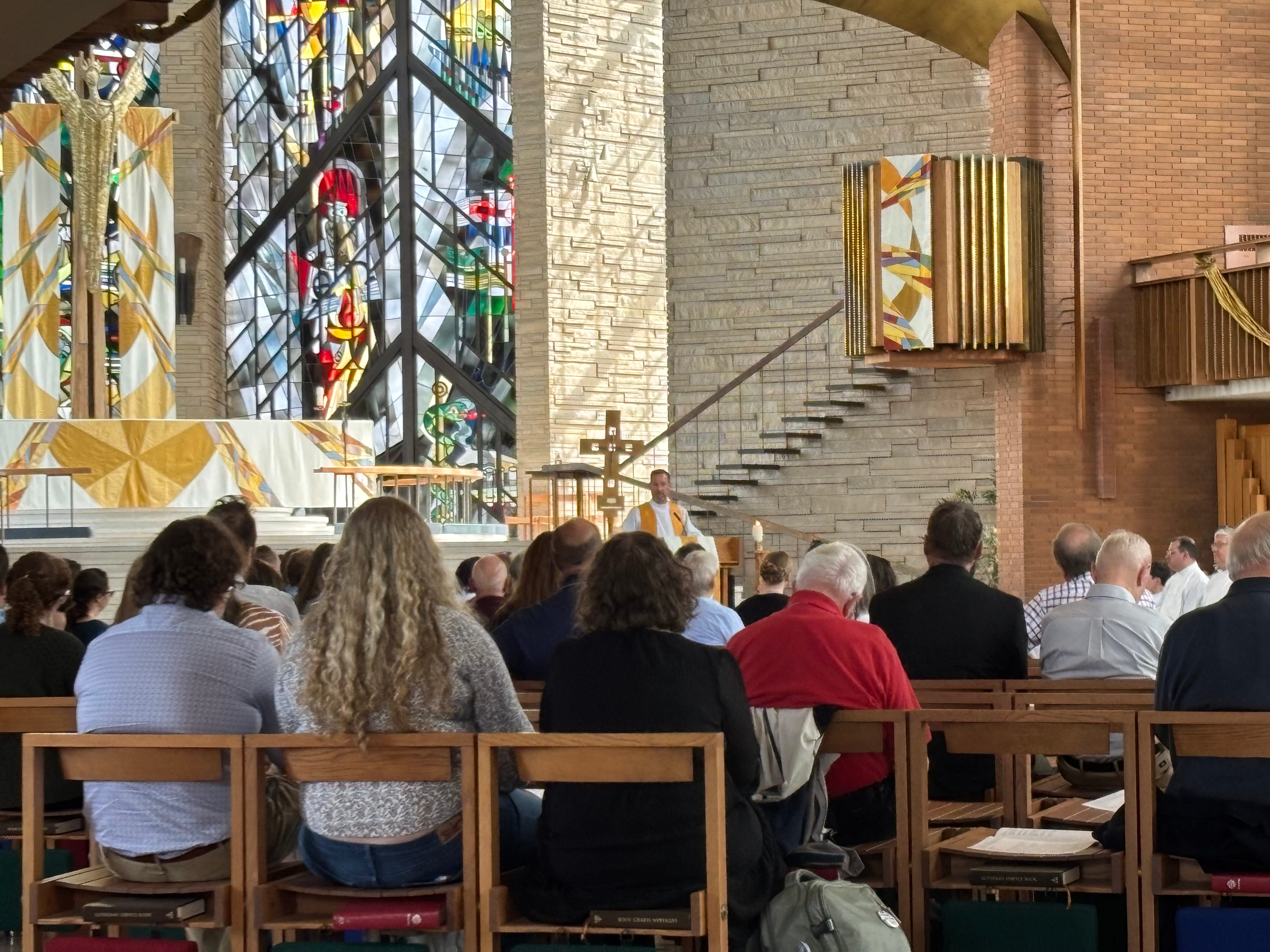
Best Congregational Singing: Chapel of the Resurrection, Valparaiso, Indiana. This is a bit of a ringer in that my experience of worship at this site was, this year and almost every other time I’ve been there, as part of the Institute of Liturgical Studies. The immense building has grown on me in the years since I called its style “Gothic fascist;” its interior adaptations all look good and work well, its organ is powerful and the space is so lively that a big piece sounds like a plane taking off. And the Institute does a good job of finding strong preachers. But the moments that pierce my heart here are the congregational hymns. Because attendees are by and large liturgical obsessives and music nerds, multi-part singing, lyrics in languages other than English, rounds, ostinato parts, and a cappella pieces are all on the menu. And because the group is momentary and non-professional, there is usually a shaggy edge to the singing which is all the more moving. I was transfixed by the singing this year. It was a wonderful thing to be in the midst of and to contribute my own little voice to. This one really stuck with me for whatever reason.
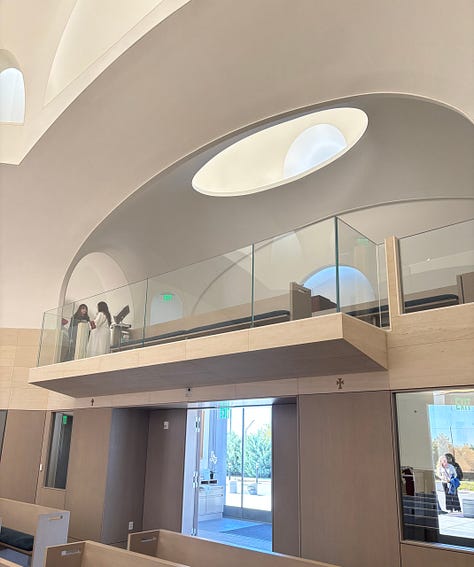
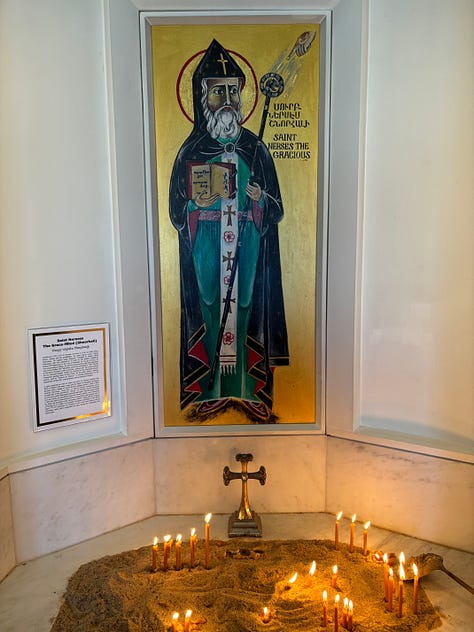
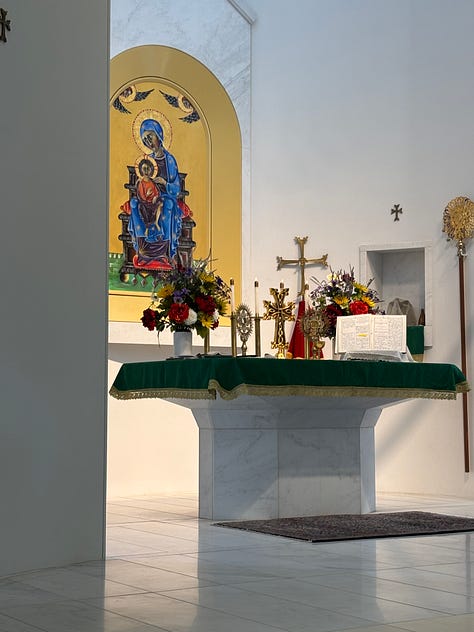
Warmest Welcome: Saint Sarkis Armenian Orthodox Church, Carrolton, Texas. There was a lot to appreciate at this church, starting with its world-renowned building. The vestments, the profound bow that starts some of the signings of the cross, the liturgical instruments that sort of rattle at different points in the service, and the choir were all new and distinctive to me. I was intrigued enough to borrow a liturgical manual. But the strongest impression I have of this community was actually the ease, warmth, and depth of the welcome they showed my son and me. A regular took us in hand from the start to make sure we never got lost in the all-Armenian liturgy. And several people made sure we knew we were welcome and even expected at the coffee hour, where the pastries were much more interesting than in the typical Anglo-Protestant church. The people were very eager to share their faith in a way that wasn’t haughty or off-putting. It made for a long morning but for someone who doesn’t always relish the thought of a lot of extra social interaction when visiting a new church, I found myself thinking back to it with persistent fondness.
Best Choir and Musicians: Episcopal Church of the Transfiguration, Dallas. I worshipped at this church three times in 2025, having found pretty much everything to be done well there. I would probably have to award them Best Vestments, though my recollections of some of the other plausible contenders are hazy. But their choir and instrumentalists are especially strong. They lead the liturgy beautifully and provide ambitious music at the offertory and communion. It all fits the day, the space, and the community, and it demonstrates skill without drawing excessive attention to itself. This is where “I Sing a Song of the Saints of God” just wrecked me.
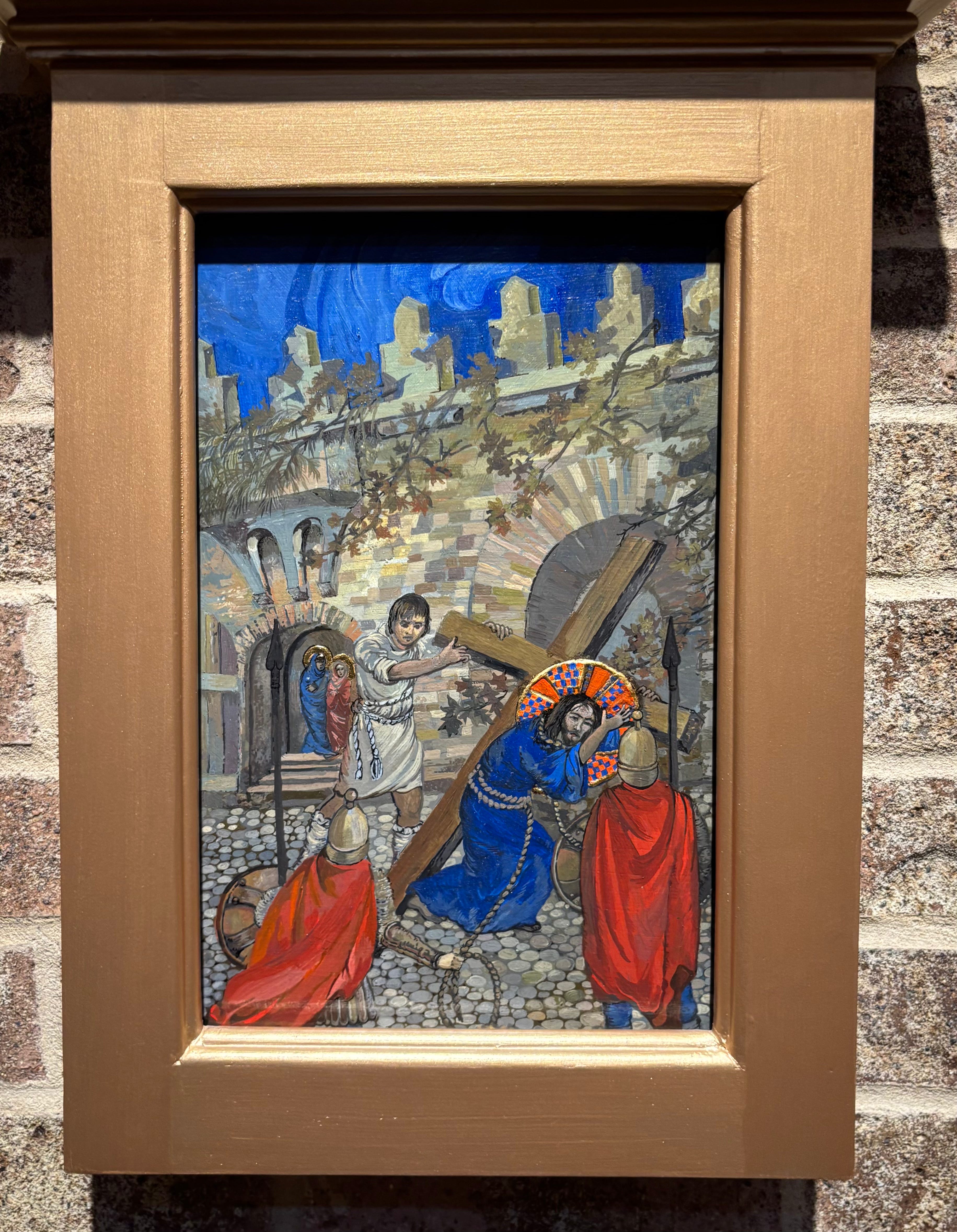
Best Altar: Basilica of Saint Clement, Rome. Tucked away a short distance from the Colosseum and in the long spiritual shadow of St. Mary Major, this 12th-century building sits atop a 4th-century basilica (discovered accidentally in the 19th century) which itself sits atop a 1st-century Roman street with a temple to Mithras. The whole site is absolutely worth a visit if you’re in Rome and have ticked off the famous must-see places. And as a place to worship, San Clemente felt genuinely old. That is to say, its space was not immediately legible to me as a reasonably knowledgeable and well-traveled worshiper. We sat in the ancient choir, so I could see an older man giving me the stink-eye through the whole Mass (I don’t know how I was offending him). When I turned around to see the pulpit behind us, I noticed that the presiding priest was quite handsome (and would be in the running for Best Vestments too) and since he was preaching in Italian, I had no particular objection to anything he was saying. But the really startling thing to me was the altar, which (as I recall) is older than the building itself, or based on a design that is older. The contrasting colors and the temple-like capital suggested both delicacy and gravity.
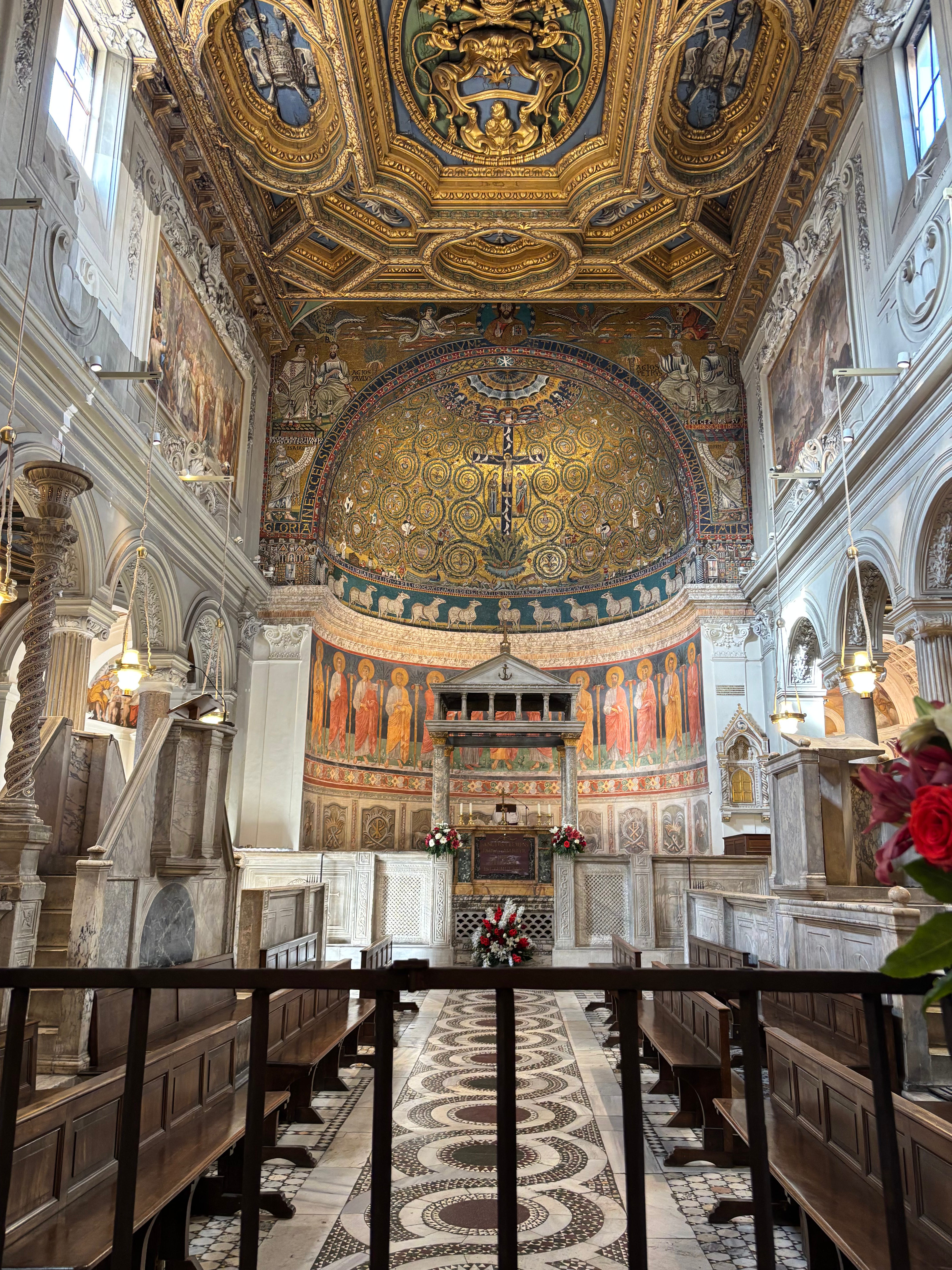
Best Crowd: Cathedral of Saint Stephen, Vienna. Not the biggest crowd, even less the liveliest, and still less the friendliest, the crowd at the 9 p.m. Mass for the first Sunday in Advent was the most moving group with which I visited. It was the last Mass of the night, so I imagined that the people were, like me, committed to their weekly obligation and also racing for the last chance to meet it.1 The Gothic building is a marvel but it needs to be segmented for liturgical use and in the November dark it runs to cold and maybe even spooky. The cantor was doing her best. The sermon was in German, so again I had no basis to object. But my fellow worshipers moved me deeply. I was among the first to sit down when the pews were opened, behind a respectfully-dressed dark-haired young man. A large Asian family sat down in front of me. A couple in my pew pinged my Yankdar—observant young woman, indifferent young man just along to humor her, it seemed—but it was clearly a very international group. Still, I hadn’t looked behind me at all, and I was not prepared for how many people came forward for communion. A lot of people were getting their Sunday attendance under the wire, and they were all sorts. I didn’t go up for Communion—I never do, I follow the rules—so I got to see everyone go through. It was like a Tom Waits song in queue form.
Best Church Kid: Parish of the Winona-Rochester Diocese, Minnesota. I’m not naming this church because I have to preface this recognition with a gripe. For the fourth Sunday of Advent at this church, I heard the worst sermon I heard all year. Not only that, but it’s in the running for the worst I’ve ever heard. The large majority of the message was Gender Law, a pure memeplex of men as warriors and leaders who are held back by a society that tells them they’re sexist if they try to lead their families to heaven, women as mothers, children as pupal-stage fathers/husbands and wives/mothers, and so forth. One hears Law where one ought to hear Gospel in all kinds of churches—liberal churches have their own ways of doing this—but this sermon distinguished itself with some exegetical monkeyshines about how Adam was a type of Joseph because Adam slept while God made Eve out of his rib and Joseph slept and had a dream about not putting Mary away, and also Jesus slept in death so in a way the whole Bible is about how women are saved by men being men and sleeping. This, however, wasn’t the worst part. That was when the priest said that he cared so much about the holiness of the congregation’s marriages because if their marriages aren’t holy, his priesthood will be less holy.2 Then the moment which a more cynical worshiper would have seen coming a mile off: “Why do you think all that scandal in Boston happened?” the priest asked. You guessed it: attacks on the family and the holiness of marriages.
On reflection, I probably ought to have stood up and walked out at that point rather than witness this spiritual abuse. There is a part of me that is at home nowhere so much as among the people of the upper middle west, where my own commitment to sensible clothing, cost-conscious haircuts, and weekly church participation feels right and normal. I hate to see the good faith of such people misused by a display utterly repugnant to the Gospel of Jesus Christ and to good morals.3 But instead I did what I tell my children to do when the preaching is bad, which is to look around. Look at the building and see if it has something to show you. Look at the people. Pray for the people if you get really bored—I did pray for these people, so ill-used by a person sent to care for them. And in this case I noticed a little kid, maybe five or six, sitting on the organ bench next to the woman playing for the Mass. Maybe he was a grandson. Anyway, he was obviously very comfortable with her. He swung his boots, he played with a fidget spinner, he fiddled with the keys. The organist played very intently, as though the sheet music might fly off and abandon her at any moment, but she was endlessly patient with the boy. For a few long minutes, they were an icon of the Holy Family to me. And to the boy’s credit, he obviously wasn’t listening.
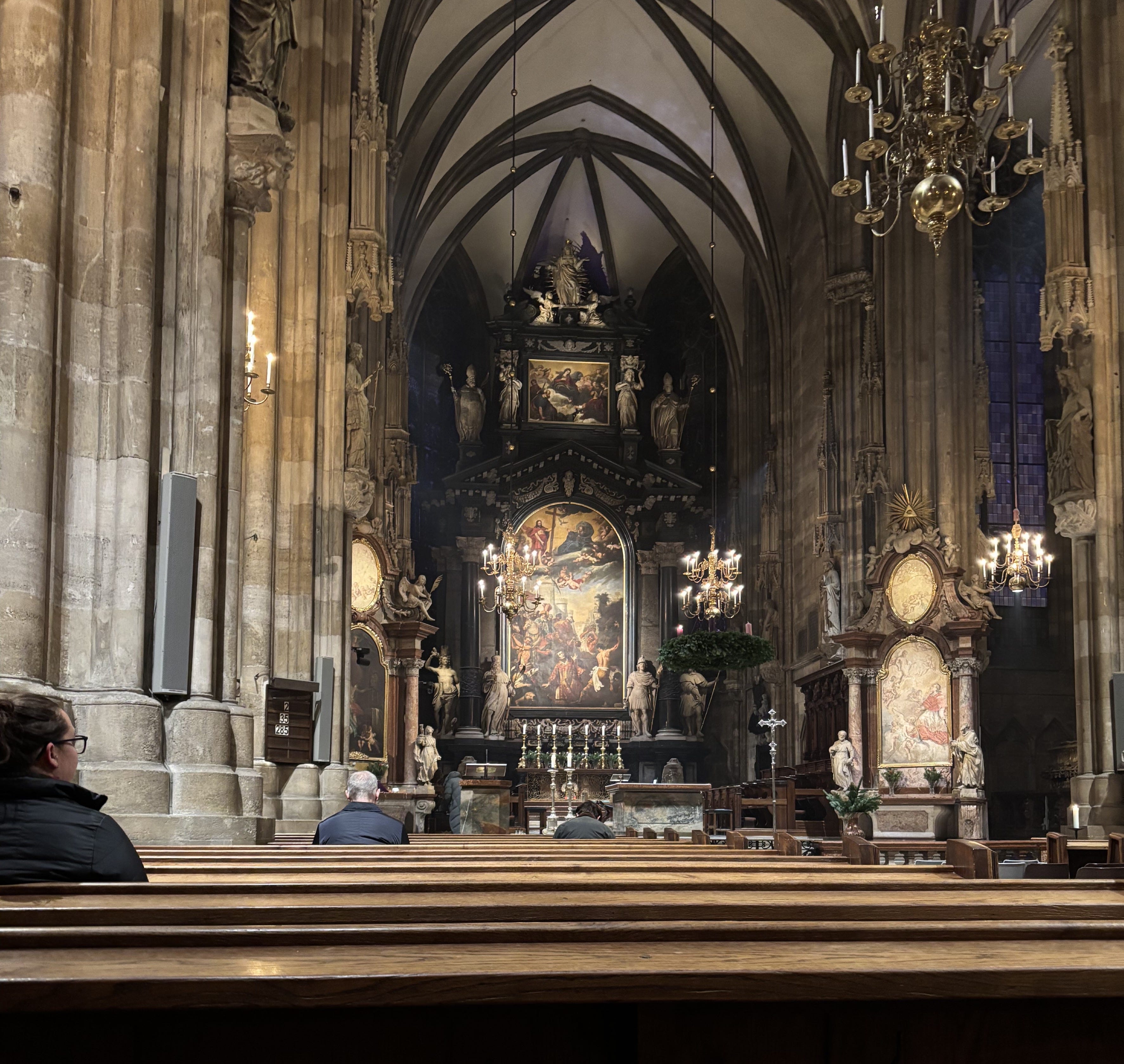
Best Sermon: Luther Memorial Church, Madison, Wisconsin. I shy away from Lutheran churches when I’m off from work. When I’m close to home, I know so many of the pastors and people that it feels a little like going to work. And when I’m away from home, I’m afraid I’ll be annoyed that a church is Doing Lutheranism Wrong and then that feels like going to work. But whenever I’m in Madison, I go to Luther Memorial. While not as staggering as some of the places I visited in 2025, it’s a contender for Best Building. The music is excellent, the liturgy is clear and well done, and for Christmas Eve it was packed and glowing with candles. But the key moment for me was on Christmas Day, when I rolled myself downhill to join the much smaller Christ Mass crowd with one of my kids. The preacher, a soft-spoken and affable pastor of a recognizably Wisconsinite Lutheran type whom I’d seen there every time over the years but had never heard preach, started with a story about a University student who came up to him in the narthex as worship was about to start and asked for his help. He asked for a sermon that would offer guidance in helping him use his gifts to make the world a better place. Since the pastor never saw the student again, he acknowledged that he’d probably not done what the young person wanted. So, he explained, he’d try again here, on Christmas day. Dedicate yourself to combatting racism, sexism, ageism, classism, ableism, and rheumatism. Give more money away. Cut back on your drinking. Do more random acts of kindness. Then—I don’t recall how he made this move and the service isn’t on their YouTube page—he started talking about Christmas and the day’s readings, which don’t talk about us and our striving and perfectibility at all but only about how God has bridged the distance between us entirely at His own initiative and cost. Whatever our denominational background, he said, we’re all Pelagians at heart. We’re as good or bad as the use we make of our gifts. But Christmas isn’t about sharing our own gifts, but about receiving God in human flesh as a gift.
It’s hard to describe how badly I needed to hear that. I know it, I preach it, I write it, but it is not the sort of proclamation that one can ever know, preach, or write oneself out of the need to hear. A period of entirely unaccustomed leisure only drives home the harder how much I and presumably anyone like me in this respect continually work to constitute my self-worth and my very selfhood by my activity, my striving, my accomplishments, my “contribution.” I received Communion and found that I could not get through the last hymn: “Veiled in flesh the Godhead see / Hail incarnate deity / Pleased as man on earth to dwell4 / Jesus, our Emmanuel…. Mild he lays his glory by / Born that we no more may die / Born to raise each child of earth / Born to give us second birth.” What a thought. My God.
The last year was not a great one for humanity. It wasn’t just the massacres, the upheavals, the cruel and pointless ending of life-saving international aid, and the ongoing retraction of democratic and law-based governance around the world. It was a bad year for the human as such, for the horizon of humanity that we might see and imagine ourselves toward before the dome of digital slop and delusion snaps tight above us. Dropping in on all these churches, I got to feel like a human among humans. Even the moments that would make me cringe as a pastor—the older people staring waspishly at a mom with a rambunctious toddler; the organist trying gamely but ineptly to lead the singing, too; an adult male altar server wearing an alb clearly cut for a child—filled me with gratitude and affection as a visitor. Here’s something we still have to do for ourselves, something that can’t be automated without ceasing to exist. I tried to thank people wherever I went for their hospitality, but inevitably I fell short, so I’ll express that gratitude here, both to everyone whose open doors I traversed and to everyone opening doors everywhere for humanity to take momentary shelter.
Phil Christman on faith and hope at the end of a bad year:
I used to think that it took a special leap of faith to believe in religious truths, that without the light of God, we naturally lived at some level of normal material self-interest, doing the things that satisfied ourselves now or that made for long-term safety for ourselves or those close to us. I thought that God had had to intervene in special ways—as God does in the major monotheistic book-religions, and their various offshoots—in order to get us to think beyond that level. As I get older, that psychology seems increasingly wrong to me. I think now that, as Lou Reed sang, it takes a “busload of faith” to get by….
Jonathan Malesic on an exhibition of the works of Jenny Saville at the Fort Worth Modern Art Museum:
Saville’s paintings feature bodies, but that doesn’t mean they make a claim about embodiment, any more than Georgia O’Keeffe’s work says what it’s like to be an orchid or Claude Monet has a thesis about the Rouen Cathedral. Bodies and faces, rather, offer Saville both a surface and visual language within which to explore representation, abstraction, and what one can do with paint. Hands, knees, fat, ears, breasts, wrinkles: these are elements of a human body. Represented in pigmented oil on canvas, they can become elements of a disturbing, elevating, or piercing work of art. But they do not say who we are.
Saville seemingly cannot resist filling a blank patch of canvas. But even as she makes thighs into landscapes and cheeks into abstract expressions, she faithfully preserves the features that painters have for centuries associated with individuality. The technical precision and expressivity of her subjects’ eyes, lips, and hands invite us to reach for a person they might reveal. But the gouges and spatters and whorls lead us away. This tension is what makes her work so captivating. Confronted with Saville’s subjects, we are primed to make judgments about character, but we can’t. The paint resists our attempts.
I skipped the second half of a concert at the Musikverein to make it, which is another story.
I can’t imagine this is actual USDA-certified Catholic theology of orders but if it is, it’s really only saved from Donatism by being implausibly stupid.
Not that it mattered much at that point but the priest hurtled through the eucharistic liturgy like an auctioneer, perhaps because he’d riffed for so long about men being men.
This line is varied in different translations but you get the gist.
No posts
Comments
Nothing yet. Say the first thing.
Sign in to join the conversation.