
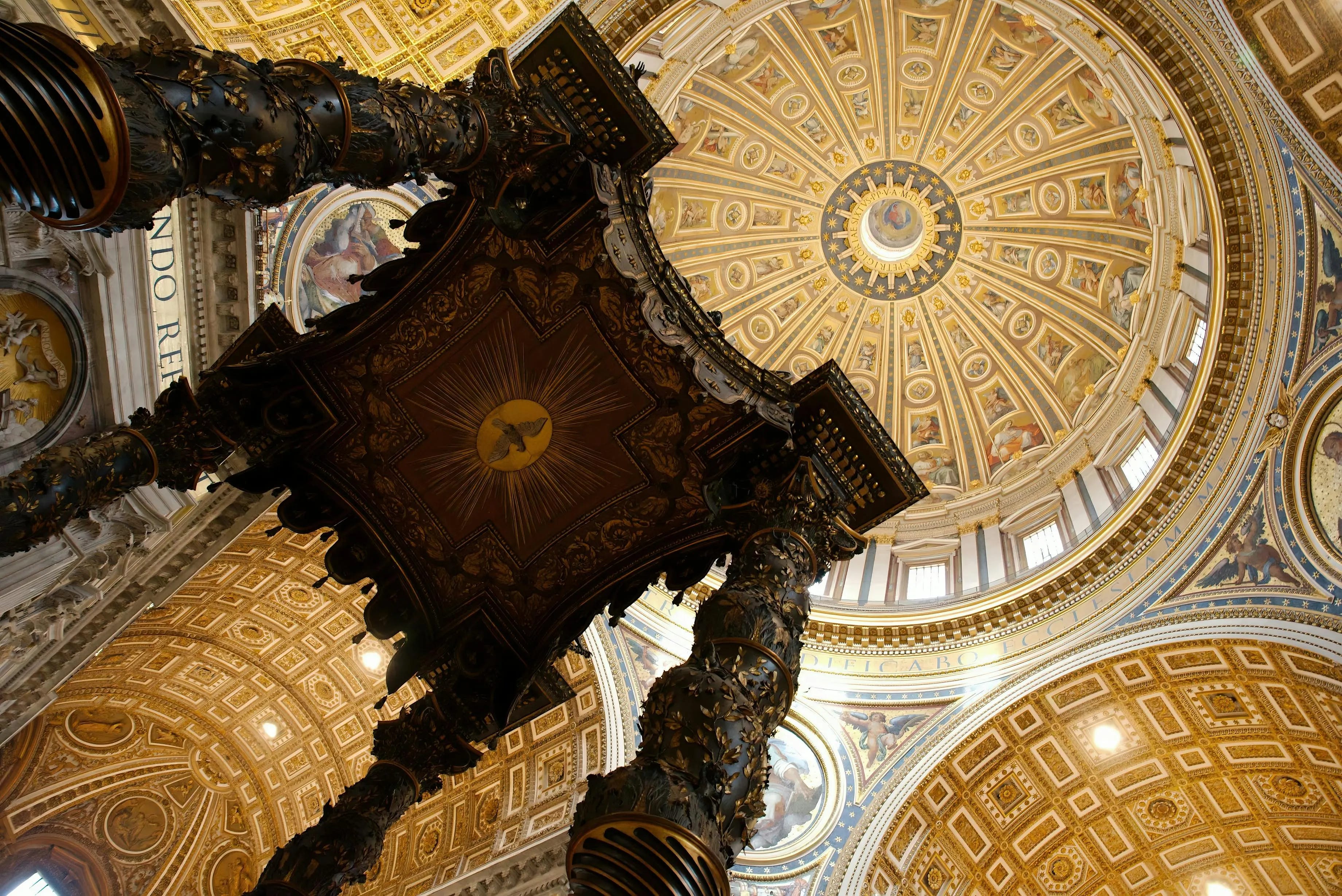
Christianity is a tricky religion because, while it does prove something, what it proves has nothing to do with the Christian creed.
If this religion proves anything, it shows overwhelmingly that life is absurd — not that God exists and will judge us after we die, not that a man who was somehow God rose from the grave in the first century, and not that the Church is especially guided by the universe’s creator.
The existence of Christianity shows decisively that life for everyone is absurd, as in comically bizarre and contrary to civilized preferences.
Christianity was originally a religion for the poor that satirized Greco-Roman aristocratic culture. Instead of emperors or the heroic demigods in that mythos, such as Heracles, Perseus, Theseus, and Odysseus, who were strong or clever enough to defeat monsters and restore order, there was Jesus, whose main victory was that he died in humility, without having used his divine powers to defeat his enemies.
For early Christians, otherworldly morality was the chief superpower, and what the underclass had in its favour was that it was on the right side of history, morally speaking. The underclass suffered on behalf of moral principles that emerged from the Axial Age’s mystical, monistic insights and social reforms. So, early Christianity was a socialist movement on behalf of the ancient world’s majority populations, the poor, sick, and oppressed.
But ironically, Christianity turned into a religion for imperialists, which is to say that empires accommodated themselves to the rise of this underclass revolt by co-opting its myths. Christianity became Christendom’s mythos or propaganda, meaning that this religion apologized for the ironic fact that a series of European empires betrayed Jesus’s absolutist, idealistic morality, and used brutal, Machiavellian tactics to conquer territory in Jesus’s name. From a Jesus-centered standpoint, the religion that spread in his name has been a dastardly perversion of his prophetic vision.
Jesus envisioned a “kingdom of God” that would be morally pure and based on atonement with the universe’s flawless maker. From the prophetic standpoint, this divine kingdom conflicted with earthly kingdoms at every turn, the latter being corrupt, run by demons, and evidence of a catastrophic fall of humankind. In the fallen world, morality has little purchase because the powerful and corrupt few rule over and enslave the more righteous many.
Christianity became a this-worldly organized religion, one of many others that operated as the mythos of an imperial ethos, a culture that promoted a worldly civilization. Jesus is supposed to have died because he prized otherworldly standards more than mundane ones, yet organized Christianity represents the triumph of worldliness at the expense of moral absolutism.
Again, the earthly powers that supposedly are in league with demons assimilated the early Jesus movement and turned that spiritual critique of imperialism into a theological rationale for demonization, war, torture, sexist or homophobic oppression, anti-intellectual conservative prejudices, totalitarian mind-control, and capitalist greed.
Nowhere is this perversion more appallingly obvious than in late-modern American Christianity. Anyone who knows even a little about Christianity knows that if Jesus returned to complete his “slave moralist” uprising of the downtrodden, the very first thing he would do is disown the loudest, “conservative” American “Christians” and send them straight to hell. Nothing about Christianity is clearer than that sobering fact. There’s no rational dispute about the grotesque hypocrisy in question.
The loudest “Christianity” in the US is the Trumpian kind, the White Evangelical variety of anti-Jesus perversion. Trumpism itself is a perversion of America’s political norms, and a pseudo-Christianity easily managed to latch on to that cultic debasement of Enlightenment ideals because Christians have been in the bastardization business for roughly two millennia.
Obviously, hucksters learned that they could keep pretending to be Christian (radical, visionary egalitarians) to provide cover for their earthly accumulation of corrupting power. In the US, they could demagogue issues and win elections by giving the beleaguered lower and working classes hope that their political representatives would reform society to benefit them for a change, rather than just further enriching the richest ten percent of the population. These desperate and prejudiced downtrodden Americans put their faith in Donald Trump since the Democrats’ urbane elitism offended them by challenging their self-image of belonging to a righteous, persecuted underclass.
Contrary to the impression we might have of Jesus from the New Testament, the poor and uneducated aren’t automatically morally pure. There are plenty of vices that afflict the unprivileged. Poverty, starvation, jealousy, and the hardscrabble life in which you must fight for scraps while the elites shun you are liable to turn you into a monster, too. There are brutes and schemers on both the top and bottom of society.
The myth or legend of Jesus is that he saw the inner purity of those who were outwardly reprehensible, such as whores, vagabonds, and oppressed Jews who longed for messianic vengeance against the empires that conquered them and mocked their religious principles. In effect, Jesus saw that everyone is spiritually valuable because of our anomalous personhood, which is to say our consciousness, autonomy, intelligence, and creativity that stand out in the animal kingdom.
That’s true enough, and Jesus’s insight can be reconstructed in more viable, secular terms. Nevertheless, while women, peasants, foreigners, and minorities surely deserve human rights, that doesn’t make those folks saintly. No one’s inherently perfect. We must be trained to treat others with respect so that our conscience emerges like an exercised muscle.
The Church was supposed to teach the world Jesus’s moral absolutism, but naturally that original mission fell by the wayside as the Roman Empire adopted this naïve religion as its official brand in the late fourth century. In effect, Rome gave Christians the Judas kiss and welcomed them to the catbird seat, to the pinnacle of earthly power. Whereas the synoptic Gospels depict Jesus declining Satan’s tempting offer of worldly power, the Church embraced Rome’s offer of it.
Thereafter, while ascetic Christian monks withdrew from the material world and its apparent godless absurdities, the Church spread a brazen, dishonest message, using Jesus as a prop to distract from the fact that “demonic” realists and hedonists continued to rule Christendom and even the Church. God’s kingdom was still nowhere to be found, and Jesus’s heavenly father was as hidden as ever.
Jews survived into the late-modern era, but their survival isn’t proof that they have a special bond with the universe’s supernatural source. Historical accidents are possible precisely because there’s no deity at the wheel. And the Church survived because of this bedrock perversity, this bait-and-switch fallacy that mocks Jesus’s absolutism to promote earthly monstrosities like the medieval popes, Crusades, witch hysterias, Inquisitions, pogroms, and Trumpian parasites.
But the absurdity that Christian history proves is overdetermined.
On top of that ironic revaluation of peasant expectations, there’s Christianity’s perversion of Jewish monotheism. Christianity is supposed to perfect and complete Judaism, a religion that itself was meant to support the downtrodden with an existential, moralistic perspective on history and human obligations. Instead, the bulk of Christianity represents the Greco-Roman assimilation of monotheism in a polytheistic rationale for aristocratic injustices.
Notice that if Christianity hadn’t perverted Jewish monism, with the deification of Jesus, the Holy Trinity, and the reverence for angels, popes, and saints, there would have been no niche for Islam to fill.
Islam’s tremendous success in conquering much of ancient Christendom, leaving us with the Muslim world in Northern Africa and most of the Middle East, testifies to Christianity’s waywardness in strict monotheistic terms. The fact that the Roman Empire was able to neutralize the moral appeal of Jewish monotheism is why Muslims could cast themselves as neo-Jews, or monotheistic radicals who preached surrender to an otherworldly God.
Let’s remind ourselves what was radical, not just about Judaism but all the Axial Age’s spiritual revolutions in the middle of the first millennium BCE. The radical prophets, gurus, and philosophers of that period envisioned abstractions that were supposed to be more real than the perceivable world and its natural imperfections.
Platonists, for instance, said that mathematics testifies to a formal reality that provides the universal standards for natural phenomena that are only flawed instantiations. Taoists said that nature is united by a spontaneous Way or flow that likewise provides everything with its proper purpose. And Jewish prophets condemned worldly idols that flatter our vain conceits and held up a deity that’s supposed to be as removed from natural norms as underclasses like Jews were from civilization’s normalized barbarities.
Again, Muslims could reclaim the purity of that uncompromising outsider perspective on nature and society only because Christians had obviously dropped the ball and tainted their Jewish inheritance with polytheistic profanities.
What’s more absurd in the Orwellian sense than a religion that claims to perfect Jewish monotheism (and by extension, the Axial Age’s mystical basis for moral and social reforms) with a manifestly polytheistic mythos? Wouldn’t you need to perfect gaslighting casuistry to pull off that fraud, the kind of gaslighting you’d also require to call yourself a Trumpian Christian?
The point is that what we learn from Christianity isn’t that God exists and miracles occur, or how to be spiritual, saintly, and existentially grounded. No, the overwhelming message of Christianity is subtextual. What we learn implicitly is that human history is absurd in the classic existential and tragic senses. Christianity’s blatant obnoxiousness proves, if anything, that there’s no God worth worshipping, and that goodness doesn’t necessarily triumph in the end because we’re only vain mammals struggling to survive in a lifeless, amoral, wild cosmos.
In that ironic respect, an atheist should feel free to think of herself as a “cultural Christian.” Even if you’re a secularist who isn’t partial to Christian art, you can regard yourself as implicitly Christian since you can accept Christianity’s esoteric message: human life is absurd, which is why Christianity was able to “succeed” in its ludicrous, backstabbing manner.
At any rate, atheists should accept that bedrock absurdity and meditate on what to do about it.
The Far Future Humanist is a reader-supported publication. To receive new posts and support my work, consider becoming a free or paid subscriber.
Comments
Nothing yet. Say the first thing.
Sign in to join the conversation.