
Show me the money! ~ Jerry maguire
I was listening to a Space on X (formerly Twitter) recently, and one of the speakers mentioned that they no longer use their resume to find jobs; they focus on sharing projects instead. By presenting potential employers with interesting projects they’ve completed, they’ve successfully landed multiple opportunities. This essentially confirmed what I’ve long suspected: people are more interested in seeing what you can actually do than what you simply say you can do. For the most part, a resume is just a list of claims.
If you’re a data analyst or data scientist trying to get a job, you’ve probably spent hours making your resume perfect. You’ve carefully listed your skills, certifications, and past jobs, hoping to catch a recruiter’s eye. But here’s the tough truth: in today’s competitive job market, resumes are everywhere. If resumes were snow, we’d be buried under an avalanche right now.
Instead of just relying on the “share resume” approach, it’s time to shift your focus to sharing projects that show your skills in action. Here’s why moving away from a resume-first mentality and leading with projects can be a game-changer for your career and how to make it work for you.
1. Resumes Claim, Projects Prove
Think about it. A resume is basically a list of claims: "Proficient in Python," "Experienced with SQL," "Built machine learning models." But claims are easy to exaggerate, and recruiters know it. Just look at LinkedIn. Most people have filled their profiles with a bunch of skills they say they have without offering much real proof. Maybe they’re just trying to speak it into existence.
Still, without something solid to back it up, your resume might just look like another overhyped pitch. And that’s how most resumes get treated by recruiters. Overly bloated pitches. Most of them end up in the trash. Even if everything on it is true, a resume usually doesn’t show how you actually use those skills or whether you can get real results.
Projects, on the other hand, are the real deal. In the famous words of Jerry Maguire, "Show me the money." Recruiters want proof (show them the money) or something that shows what you can actually do, not just what you say you can do. A GitHub repo with a solid project, like analyzing costs or customer churn with pandas, or predicting sales using a machine learning model, tells them way more than any bullet point ever could.
It’s not just:
“I know Python.” It’s “Here’s how I used Python to solve a real problem.”
When you share your projects, you’re giving hiring managers something they can look at, explore, and trust. And that cuts through all the skepticism around resume claims. Show them the money!
The Data Analyst Bootcamp Bundle (SQL + Python) 100 Hands-On Data Analysis Challenges
These are the best hands-on materials that teach how to use the important libraries in data analysis: pandas, Matplotlib, seaborn, NumPy, etc. You will also learn to write SQL queries by answering questions that data analysts face in the world, using real datasets. Get the bundle if you want real, practical learning.
2. Projects Remove the Noise of a Resume
Resumes are noisy. They’re filled with buzzwords, vague job descriptions, and sometimes details that don’t really matter. Do they really need to know about your summer job from ten years ago? All that noise can make it hard for your real skills to shine, especially in data roles where your technical ability matters more than fancy wording.
Sometimes a hiring manager or startup founder is just looking for someone who can clean data or train a model. They’re not interested in your hobbies or that workplace conflict you resolved five years ago. If you can show them, through a small project, that you’ve got the skills to clean data and train models, they’re much more likely to hire you. You’ll save them the trouble of digging through all the clutter in a traditional resume.
So instead of just DMing a resume to potential employers, send them a link to a project you’ve actually finished. Trust me, they’ll probably enjoy looking through your work a lot more than reading a bloated resume. Sharing a project cuts through the noise. A Jupyter notebook where you cleaned up a messy dataset, visualized trends with Matplotlib, and built a predictive model using scikit-learn says more than any bullet point ever could. It’s real evidence that you know how to work with data, find insights, and explain what it all means.
Instead of hoping a recruiter takes your word for it, you’re giving them something they can explore and judge for themselves. That kind of proof is hard to ignore.
3. Target Low-Hanging Fruit: Small Businesses Value Projects Over Resumes
I’m not saying you should throw out your resume completely. I’m saying be smart about how and where you use it. Resumes are often built for the “high-hanging fruit.” Yes, big companies like Google, Microsoft, or Amazon. Those places have structured hiring systems that rely on keyword-stuffed resumes to filter through tons of applicants.
And hey, I’d love to work at one of those places too. Probably just for a week or two, so I can put "ex-Amazon" or "ex-Microsoft" in my bio right after I get fired. I’ll be the proudest ex-employee they’ve ever had. But seriously, roles at those companies come with intense competition. Thousands of people apply for just one job. If you’re early in your data career, going after those roles can feel like running on a treadmill that never stops. Don’t hurt yourself.
Instead, go after the low-hanging fruit. Small businesses, startups, and solo founders often need data help but don’t have the budget or hiring process of a tech giant. These folks care more about what you can do than what your resume says. A small online store might need help analyzing their sales. A local nonprofit might want insights from their donation data. A freelancer might need a quick dashboard to wow a client. These gigs are easier to get into, and they help you build real experience.
Platforms like Twitter (well, X now) are great for connecting with these kinds of people. You can follow small businesses, reply to posts, and offer help. I’ve landed more opportunities on X than on any other platform. The key is to share your projects directly in the conversation. Drop a GitHub link or a screenshot of a dashboard you built. Unlike big companies, these folks are way more likely to reply to a tweet showing your work than a cold resume submission.
Seriously, get on X and stay active. You never know who’s looking for someone with your skills.
4. Projects Get More Attention Than Resumes
Let’s face it. Reading a resume isn’t exciting. It’s nothing like flipping through your favorite thriller. For most hiring managers, it’s just another chore. They skim through dozens or even hundreds every day. So it’s no surprise that even strong resumes sometimes end up in the trash.
But a project? That’s way more interesting. A project gets straight to the point. It addresses the pain points directly. If someone is looking for a chatbot developer, they’re more likely to choose someone who has actually built one and can show proof rather than someone who just listed “chatbot development“ as a skill. People are curious by nature. They’ll click on your Kaggle notebook or GitHub link if it looks useful or interesting.
A clean, well-documented project with clear visuals, like a Seaborn heatmap, or a result like “Improved prediction accuracy by 15%,” stands out way more than a bullet point in a resume ever could.
When you share your projects, you move ahead of people who only submitted resumes. While their applications sit unopened in someone’s inbox, your work might be getting explored, bookmarked, or even shared. It’s a great way to stand out and show real initiative. And because your project is public on places like GitHub or Kaggle, it might even get noticed by someone you weren’t expecting. That means more chances to get discovered by people looking for your exact skill set.
5. Building Projects is Easier Than You Think
You might be thinking, “I don’t have any projects to share!” The good news is that creating a project as a data analyst or scientist is more accessible than ever, even if you’re just starting out. What you need are skills and curiosity. The best way to start is to begin with guided projects to build confidence. In the books “50 Days of Data Analysis with Python: The Ultimate Challenge Book for Beginners” and “SQL Essentials for Data Analysis: A 50-Day Hands-on Challenge Book (Go From Beginner to Pro),” what I provide you are structured challenges that mimic data analysis projects. Basically, you analyze data by answering a bunch of questions that demonstrate your skills in data cleaning and preprocessing, visualizations, and analysis using popular Python libraries used by data analysts and scientists. Here is an example of a challenge from the SQL book:
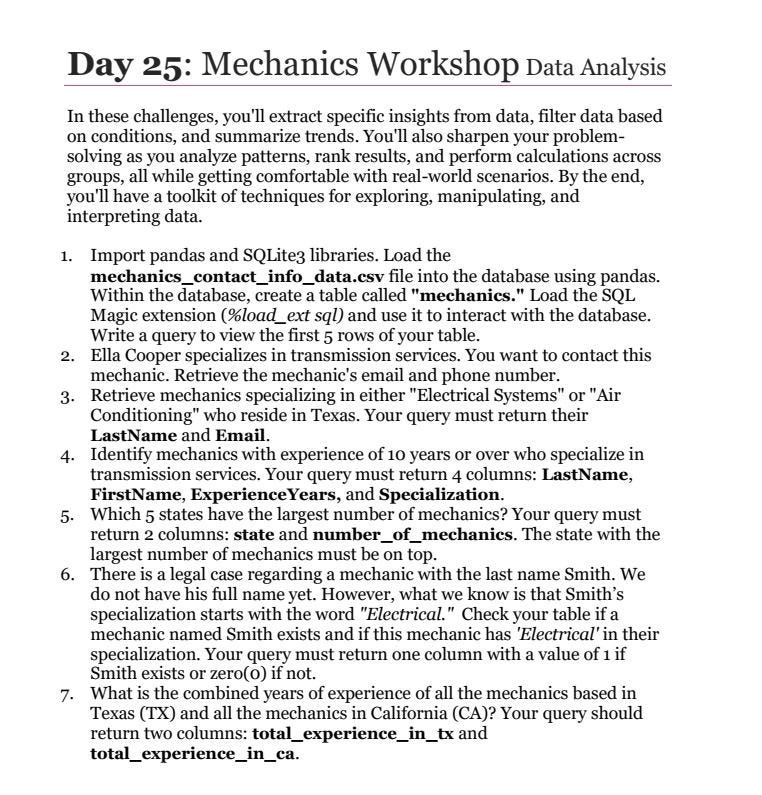
Here, these questions walk you through real-world SQL tasks such as importing CSV data into a SQLite database, querying records, filtering data based on multiple conditions, searching for specific information, performing aggregations, and using SQL logic to answer business questions. These aren’t just exercises. They closely resemble the types of requests data analysts, business analysts, and database developers receive when working with operational data.
For example, question 5 is an excellent example of data aggregation and summarization. You’re grouping mechanics by state, counting the number of mechanics in each location, and ranking the results to identify where the business has the largest workforce. This is the same type of analysis organizations use to understand regional operations, allocate resources, and make strategic decisions. Likewise, question 6 introduces conditional logic by checking whether a specific type of mechanic exists in the database, while question 7 demonstrates how SQL can produce multiple business metrics in a single query through conditional aggregation.
By solving this challenge, you’re not only strengthening your SQL querying skills, but you’re also developing your ability to retrieve meaningful information, filter and summarize data, implement business logic, and answer practical business questions. These are exactly the kinds of skills you’ll use when building real-world data projects and preparing for technical interviews or data-focused roles.
You can also try platforms like Kaggle, which offer step-by-step tutorials on analyzing different types of data. Follow along, but make sure to tweak the project (e.g., add a new visualization or try a different model) to make it your own. Don’t be scared to experiment and add more to these guided projects
Once you’re comfortable, move on to something unique. Pick a dataset that interests and analyze it. For example, you could scrape coffee shop reviews and analyze sentiment. The key is to showcase modern tools and techniques that highlight your ability to increase efficiency. Use libraries like pandas for data cleaning, scikit-learn for modeling, or Tableau for dashboards to demonstrate you’re up-to-date with industry standards. Document your process in a Jupyter notebook, explaining your steps, and share it on your GitHub.
These projects don’t need to be groundbreaking. They just need to show you can solve real problems with data. A small business owner doesn’t care if your project is “impressive” by Google’s standards; they care if you can help them understand their sales data faster or predict inventory needs more accurately. By focusing on practical, modern applications, you’re proving you can deliver value where it counts.
Wrap-Up
I get that you get the gist of it. The strategy of sharing your resume with everyone doesn’t always work. More often than not, it just buries your resume in an avalanche of others. On the other hand, projects prove your skills, removing doubt and exaggeration from the equation. They’re more engaging than resumes because they draw attention from employers who want their problems solved.
You’ve tried the resume-first approach for a while, and it hasn’t yielded the results you want. It’s time to try another approach. It’s time to try a "Show them your money" approach. It’s time to let your work speak for itself. Start small: pick a dataset, build a project, and share it with potential employers on platforms like LinkedIn and X. Engage with small businesses and individuals looking for data help. Don’t send them a PDF of your resume; send them a link to your well-documented project and watch how quickly opportunities come your way. Thanks for reading.
SQL Essentials for Data Analysis: A 50-Day Hands-on Challenge Book (Go From Beginner to Pro)
SQL interviews are not about remembering commands. They are about solving data problems. SQL Essentials for Data Analysis helps you build the problem-solving skills required to turn business questions into SQL queries through 50 days of structured, hands-on challenges. By the end, you will have practiced the same patterns that appear repeatedly in real SQL interviews: joins, aggregations, window functions, data cleaning, and analytical queries.
Python and Data Analysis Insights is a reader-supported publication. To receive new posts and support my work, consider becoming a free or paid subscriber.
Comments
Nothing yet. Say the first thing.
Sign in to join the conversation.