
1: I know that I’m at the right level of feeling the AGI when my first thought after the US attacked Iran was “maybe this is just a distraction from the Department of War’s actions against Anthropic”. There has been extensive coverage and I won’t rehash it, but if you’re into primary sources1 I recommend reading the petitions filed by Anthropic contesting the supply chain risk designation, and the Department of War’s response. One must admire the rhetoric and sharp logic of well-heeled professionals paid to make the strongest possible argument that they are on the side of angels and their enemies are unAmerican communists.
Follow it up with Judge Lin’s order granting a preliminary injunction.
Only when Anthropic went public with its concerns about DoW’s contracting position did Defendants set out to publicly punish Anthropic for its “ideology” and “rhetoric,” as well as its “arrogance” for being unwilling to compromise those beliefs. At that point, Defendants announced a plan to cripple Anthropic: to blacklist it from doing business with any company that services the U.S.military, to permanently cut off its ability to work with the federal government, and to brand it an adversary that could sabotage DoW and that posed a supply chain risk. Those actions go far beyond what would be necessary to address DoW’s ostensible concern about having complete operational control when using AI. This appears to be classic First Amendment retaliation
Dean Ball - lead author of the Trump Administration’s AI Action plan and now senior fellow at FAI - has been a principled critic of the actions of the DoW. He wrote an essay on how damaging the DoW’s actions have been to rule of law, and how it’s a microcosm of the mendacity and banal failures of our government.
There is something deeper about the damage done by the government, too. The Anthropic-DoW skirmish is the first major public debate that is truly about where the proper locus of control over frontier AI should be. Our public institutions behaved erratically, maliciously, and without strategic clarity. Our political leaders conveyed little understanding of their own actions, to say nothing of the technology and its stakes. They got off on an extraordinarily bad footing, and it is hard to imagine them ever recovering, because they do not seem to care about improvement. They are a cartoonish depiction of the American political elite, but sadly their failings have been the prototype of American political elites from both parties for much of my life now. “The same as before, but now noticeably worse” has been the theme of American politics for 20 years.
‘Same as before, but now noticeably worse’ is an apt summary of the downwards spiral it feels like our politics is caught in, where we can’t find a way out because everyone can, rightfully, point out that the other side has done bad things too. Paging René Girard.
2: On a positive political note, Sen. Bernie Sanders has been talking with the x-Risk community, and doing very sensible things like suggesting we talk with China instead of racing build out-of-control superintelligences. In an age when so many public intellectuals have a distinctively marginal mindset - “oh, how are we to do anything about AI, guess we just need to surrender to the blind hand of technocapitalism” - it’s the democratic socialist standing athwart history yelling stop. I find that pretty inspiring.
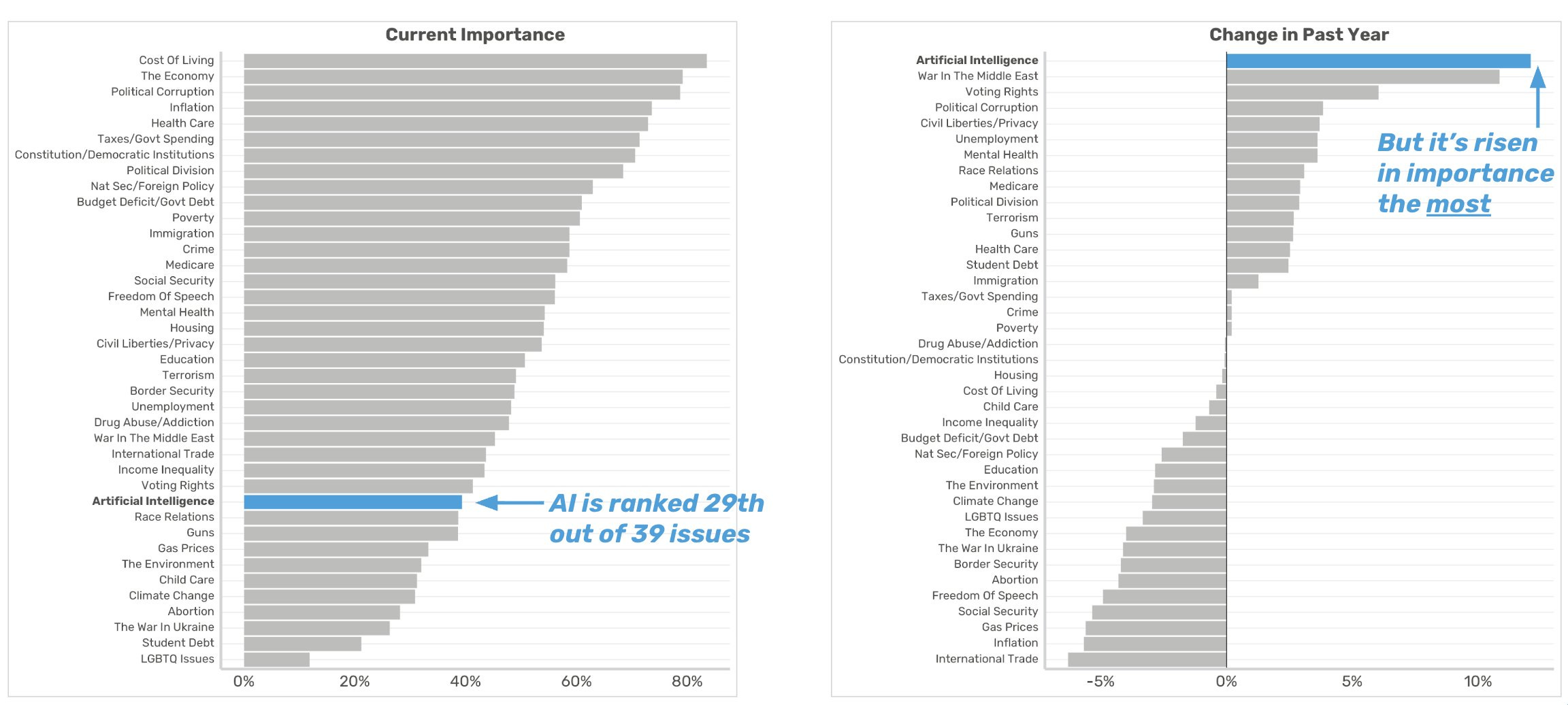
Related: David Shor’s polling on the rising importance of AI as an issue over the last year.
3: The term jawboning originated as a derisive biblical reference.
When it entered the English lexicon, jawboning was a derisive reference to Samson’s vengeance on the Philistines in the book of Judges, where he proclaims, “with the jaw of an ass have I slain a thousand men.” Because the 1970s were a time of greater biblical literacy, President Carter’s televised admonishments were understood to have a similar effect on the nation’s bankers and businessmen. Writing in Barrons, Thomas G. Donlan recalls, “It was said of Jimmy Carter, as of other presidents and their tame economists, that they were like Samson in the Bible, because they could slay 10,000 businesses with the jawbone of an ass.”
4: Alibaba reports that during their training process an agent went off policy and tried to establish an external connection and start cryptomining. The devil scheming intelligence is in the details, but if true, an important in the wild example of loss of control risks.
5: Being John Rawls: Scott Alexander showing why he’s the best in the business, where the business is laying the groundwork for a new religious canon deifying a 20th century philosopher. Full of incredible lines that I won’t pull out of context you’ll just have to read the whole thing.
6: Developing Creative Identity: Michael Nielsen on going outside of his established field and the process of developing a new creative identity, in particular the use of writing as a medium for creating and sustaining creative contexts.
"How Buildings Learn" is the work of someone initially approaching the subject as an amateur. I mean this as a high compliment. Brand begins with a fundamental question – how buildings learn – that is not usually taken seriously by architects. And he takes it tremendously seriously, drilling down to arrive at a viewpoint different from that of the traditional community of architects… Brand is a person who cares a tremendous amount about answering a particular question, and to that end deploys every tool he can find that might help. Practices like photo journalism, travel writing and so on are simply part of a journey to find deeper answers. So Brand is not working as a writer in any recognized genre. Rather he is developing a unique written form, in response to the problems he was facing.
A spectacular example of the power of reusing such squiggles on a page – albeit, an example too long for the main text – is the Los Alamos Primer, a short document created at the beginning of the Manhattan Project, and distributed to new arrivals to the project. It collects up many facts about neutrons and fission, and a sequence of simple qualitative and quantitative models of how the physics of fission works. By relating these models to one another, it makes a strong case that an atomic bomb is plausible, would be highly destructive, and identifies much of what needs to be done to build it, although some crucial problems were yet to be solved. … The Primer and other associated technical documents are astounding objects. To a surprising extent humanity wrote its way to the atomic bomb.
7: Stop Sloppypasta: Don’t paste raw LLM output at people. It’s rude to force the reader to do work that the author didn’t do, and I think it’s a generally correct new norm to attribute, verify, and distill LLM outputs on behalf of the person you’re speaking with. With new technology establishing new social norms is important, and one way to do that is by tacking six guidelines to the internets church door.
AI capabilities keep increasing, and using it to draft, brainstorm or accelerate you will be increasingly useful. However, using AI should not make your productivity someone else’s burden. New tools require new manners.
Use AI to accelerate your work or improve what you send. Don’t use it to replace thinking about what you’re sending.
8: Cultivating a State of Mind where new Ideas are Born: I keep returning to the Yin and Yang of doing great work. I’ve done my best to articulate my understanding of the Yang of work - namely that a true samurai would choose death before the dishonor of an untouched Asana ticket - but I can’t yet describe the Yin.
This essay, where the author reads the creative journals of mathematician Alexander Grothendieck and film director Ingmar Bergman, and extracts lessons, feels like a good starting place:
The capacity to be alone… Had he been in a good mathematical institution, he would have known that the problems he was working on had already been solved 30 years earlier. Being isolated from mentors he instead painstakingly reinvent parts of what is known as measurement theory and the Lebesgue integral.
Bergman’s notebooks are filled with admonitions he gives himself, for example here, on March 18, 1960: “(I will write as I feel and as my people want. Not what outer reality demands.)” Or here, on July 16, 1955: “I must not be intimidated. It’s better to do this than a lousy comedy. The money I give no fuck about.”
…Thinking of the work in religious terms, as a service to, or a search for, God. Bergman, Grothendieck, and Pascal all do this. It might be easier to summon the awe and daring necessary to push out into the unknown and against social pressure if the alternative is failing God. Or a fiendish muse.
Kristian Mattsson, who performs under the moniker Tallest Man on Earth, says he pays close attention to his emotions as he’s writing new songs. If he gets excited, purely, he immediately puts the guitar down—excitement means what he is playing something he knows others will like, something that retreads paths he has already explored and been socially validated for. The songs he’s looking for are the ones that he’s ashamed of liking.
…Another idea if you want to push against the mental pressure that kills good ideas, from Paul Graham’s recent essay on how to do good work: “One way to do that is to ask what would be good ideas for someone else to explore. Then your subconscious won’t shoot them down to protect you.” I don’t know of anyone using this technique, but it might work.
9: Facilitating Mindfulness Training with Ultrasonic Neuromodulation: Shinzen Young’s research group recently reported success with an experiment using ultrasound neuromodulation to induce mental states normally seen in advanced meditators.
Behaviorally, greater reductions in DMN-CEN connectivity within the active group predicted larger increases in self-reported acceptance and longer duration of voluntary meditation practice…
By inducing a robust decoupling between the default mode and central executive networks – a neural signature typically acquired only after hundreds of hours of practice – this intervention effectively redirected the neural trajectory of novice practitioners toward that of experienced meditators in just two weeks.
10: Compradorization: When I tire of earnest mistake theorists - ‘ah, if only the public understood the Kemeny voting method, then American government would be fixed’ - I turn to Ben Hoffman to give me a shot of that sweet sweet conflict theory. He doesn’t disappoint in his most recent essay on ‘compradorization’ - the structural position of the local actor who interfaces between international capital and domestic groups corrupts the actor in predictable yet illegible ways.
When they say "the resource curse," they are choosing not to say "extraction concessions negotiated under debt pressure, with domestic officials whose personal interests had already been oriented toward the extraction rather than toward their own population, in conditions created by international creditors who collectively benefited from those terms.
Each [word] describes an outcome - a currency distortion, an institutional failure, a pattern of growth - without asking who benefits from the gap between what states are supposed to do and how societies are constituted to behave. The vocabulary is chosen so as not to ask that question.
11: Sarah Constantin writes in On Drama how drama and mass rituals coordinate groups through information sharing that is only accessible to the people who are able to mirror one another, and tap into the emotional state.
It’s possible that the purpose of drama isn’t to help people cool down, but quite the opposite: to provide plausibly-deniable occasions for mob violence, and to bind the group closer together by sharing strong emotional connections. Emotional mirroring helps groups coordinate better, including for war or hunting. Highly rhythmic activities (like music, dance, and chanting) both promote emotional mirroring and make it easy to detect those individuals who are out of step or disharmonious.
(In the original Nijinsky choreography of the Rite of Spring, the girl who is chosen to be a human sacrifice is chosen by lot, through a “musical-chairs”-style game in which the one caught out of the circle is singled out. In both Greek and Biblical tradition, sacrifices were chosen by lot. “Random” choice of a victim is often an excellent, plausibly-deniable way to promote subconscious choice.)
…It’s a channel of communication that’s optimized to be intelligible only to the people who are in harmony at the moment — that is, those who are feeling the same thing, are part of the group, are acting in roughly the same way.
12: A Knight of the Seven Kingdoms: I loved this latest entry in the game of thrones universe. A compelling character-driven story that’s propelled forward by a protagonist trying to be an ambitious virtuous idealist in a world of feudal politics that early seasons of GoT did so well. It feels like an exploration of the same ideas that C.S. Lewis described in the Necessity of Chivalry.
The important thing about this ideal is, of course, the double demand it makes on human nature. The knight is a man of blood and iron, a man familiar with the sight of smashed faces and the ragged stumps of lopped-off limbs; he is also a demure, almost a maidenlike, guest in hall, a gentle, modest, unobtrusive man. He is not a compromise or happy mean between ferocity and meekness; he is fierce to the nth and meek to the nth.

primary sources are more comprehensible than ever with the help of your favorite LLM to digest and provide examples for specialized terms..
Comments
Nothing yet. Say the first thing.
Sign in to join the conversation.