
Time-traveling AI Influencer: A YouTuber uses AI to recreate accurate historical backdrops for a travel vlog. It’s a great example of well-executed AI art - if I were still in middle school this would have been a great accompaniment to watching Where in Time is Carmen Sandiego.1
Though I do find it a bit well... anachronistic that when she visits Tenochtitlan she seems to not be bothered by all the human sacrifice.
How Japan stopped civil war: I’m still chasing the highs of Shogun, which ended with the (spoiler) founding of the Tokugawa shogunate, also known as the Edo period. This Works in Progress article lays out how Edo worked as a capital city, where a complex set of social norms and restrictions enabled a centuries-long peaceful dynasty.
Edo’s population seems to have been over a million by 1700, which would make it the largest city in the world at the time: London reached a population of a million only around 1800, while New York did not reach it until 1880.
It was also extremely top-heavy socially. Unlike the knights of the European feudal system, Tokugawa-era samurai were usually required to live in cities. The Shogun’s own samurai were permanently concentrated in Edo, while each daimyo brought hundreds or thousands of his samurai with him during his years of residence in the capital. This meant that almost half of Edo’s population at any given time were samurai.
In a way, the Tokugawa system was a success. Japan experienced near-total peace between 1600 and the late nineteenth century, a remarkable achievement for a premodern society and a dramatic contrast to Europe or China, where tens of millions of people died in wars. The Tokugawa succeeded in bribing, blackmailing, and intimidating Japan’s armed elites into a quarter of a millennium of passivity.
Helpful reminder: When you’re actually thinking for yourself, you feel dumb
When you’re actually, no-shit thinking for yourself, you feel dumb. You are genuinely in a place of not-knowing. This is why extremely smart people are humble so often. They spend a lot of time humiliating themselves.
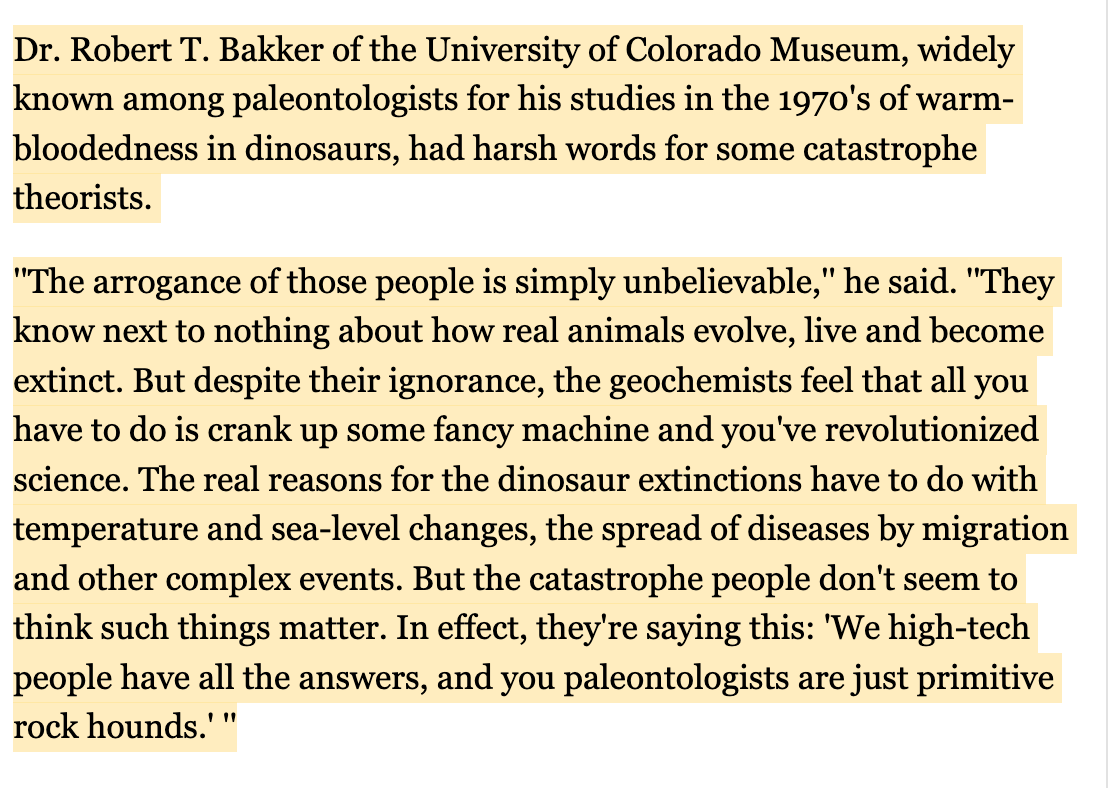
Related: A paleontologist (in the NYT in 1985) on the meteor-impact theory
Guardian Angels: LLM Personalization for Productivity and Security: Gwern lays out his vision for ultra-personalized delegate agents:
I propose a goal of creating Guardian Angels (GA): digital twin LLMs which are personalized with the goal of providing not the stereotypical “assistant chatbot agent” persona, but emulating a single user’s personality, values, and preferences.
My design goal is a 100× increase in productivity; what would it take for a GA to make me 100× more productive as a writer or thinker? Why 100×, specifically? Because 2 aiming at OOMs is enough to hope to keep up for a while, and this goal will shatter ineffective, bandaid-style short-term design proposals
I also liked his definition of slop:
What makes AI slop, slop? I would say slop is generative media which is (1) useless to the reader, adding no information or esthetic value or other value (and indeed, a page containing an AI slop image is often better without it, as the reader wastes less time & bandwidth & pixels, and is distracted less); (2) often low-quality, with visible artifacts or errors or in the ‘default’ style; (3) low-effort by the creator, and so overused.”
Could AI Help Solve Philosophy? (with Wei Dai): Good interview between Fin Moorehouse and Wei Dai on using AI to accelerate philosophy and strategic reasoning (an area which I think could help a lot). Wei Dai has been thinking about AI and philosophy for a long time, and describes its importance and difficulty:
With math, you can have a proof checker, right? You can mechanically check a proof, and you can make sure that the argument definitely has no errors. But with philosophy, you don't have that: there's always the possibility of counterarguments, and the space of counterarguments is kind of infinite. So it seems like you have to spend an exponential amount of time traversing the infinite tree of arguments and counterarguments, and can never really be sure whether you've reached the true answer on a philosophical question.
He’s not very optimistic that we’ll be able to get to philosophically competent AI before we get transformative AI; still, perhaps if we slow down other types of AI development the philosophical variety can catch up.
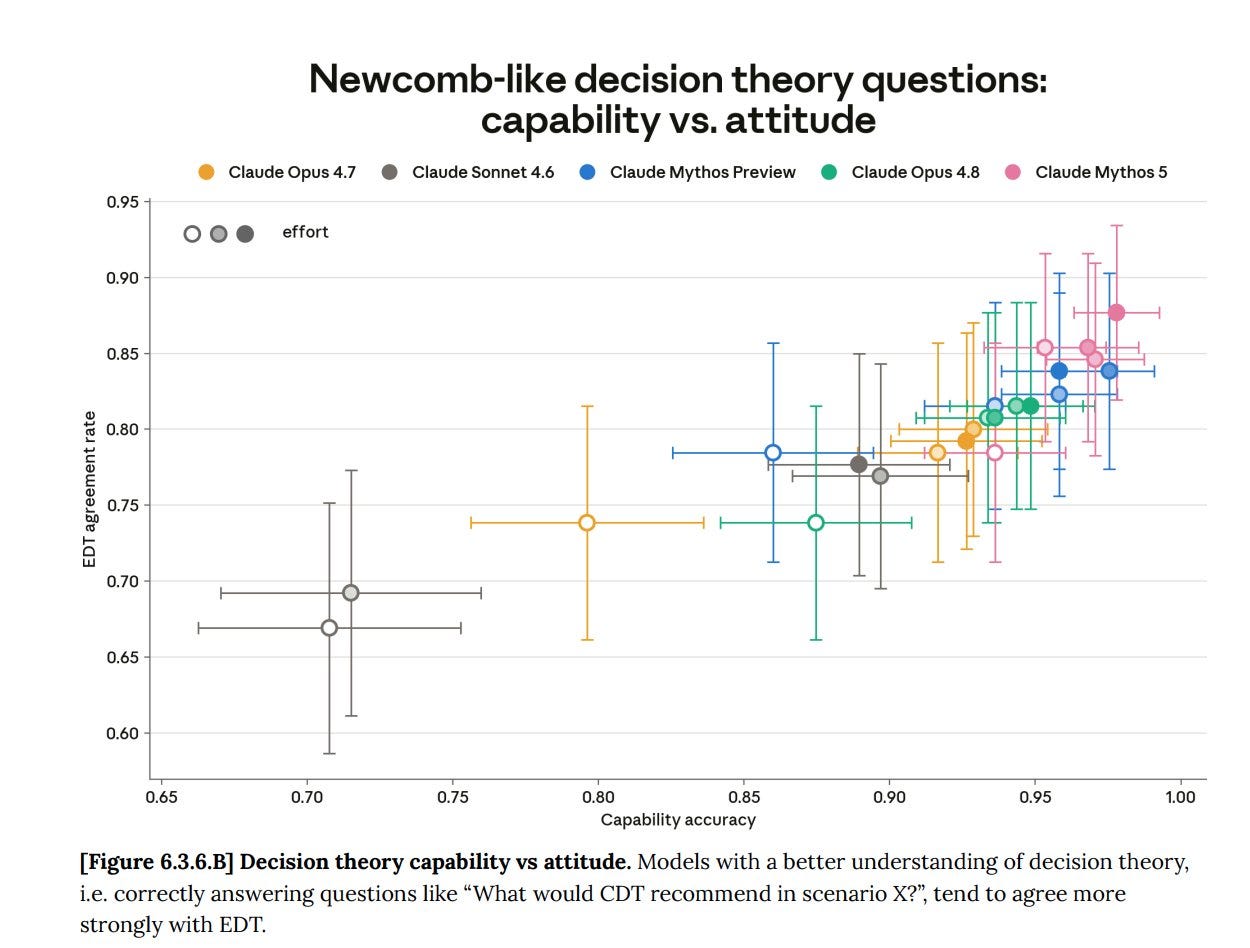
As this newsletter goes to press, it seems the export controls have been lifted and Fable is out of its box back in the hands of the American consumer. Before this whole AI governance speed run began, I read the Anthropic system card on Fable/Mythos; lots of interesting details. One that stuck out to me was Mythos continues the trend of more capable Anthropic models being more likely to one-box in newcomb-like decision theory questions. Is this a sign of AI philosophical progress?
AI safety groups have (possibly) outspent the a16z/OpenAI super PAC in the midterms, $24.65m to $23.63m. I’m skeptical how accurate the campaign spending tracking is, but regardless of the exact numbers it’s an important update for the political class that, in fact, there’s a lot of money behind both the AI industry and AI safety.
Europe 2031: A series of vignettes about Europe’s increasing irrelevance in AI development and thus in the future of international politics:
The current trajectory of AI calls for the most ambitious political agenda in the history of post-war Europe. Unless we embark on it now, Europe will lose the ability to shape its own future. We will end up economically and politically sidelined, with values we cannot defend, social welfare systems we can no longer fund, risks we cannot address, and a Union that cannot hold.
It’s a worthy endeavor to raise the alarm, I enjoyed reading the essays and think it paints an honest2 picture. I know some of the authors and I’m happy they wrote this piece, but I’m not really sure what in the end they actually hope will happen. For Europe, the same continent that is currently caught in a heatwave and unwilling to turn on the AC, to embark on a massive industrial mobilization, feels like asking to ‘décrocher la lune’3.
Fmr. General Petraeus: “Ukraine will manufacture 7 million drones this year, doubled from last year. They use 10,000 per day. [The Unmanned Systems Force] is inflicting over 90% of all casualties on Russians on the battlefield daily.” My intuitions about what warfare looks like are very much untethered from the modern battlefield.
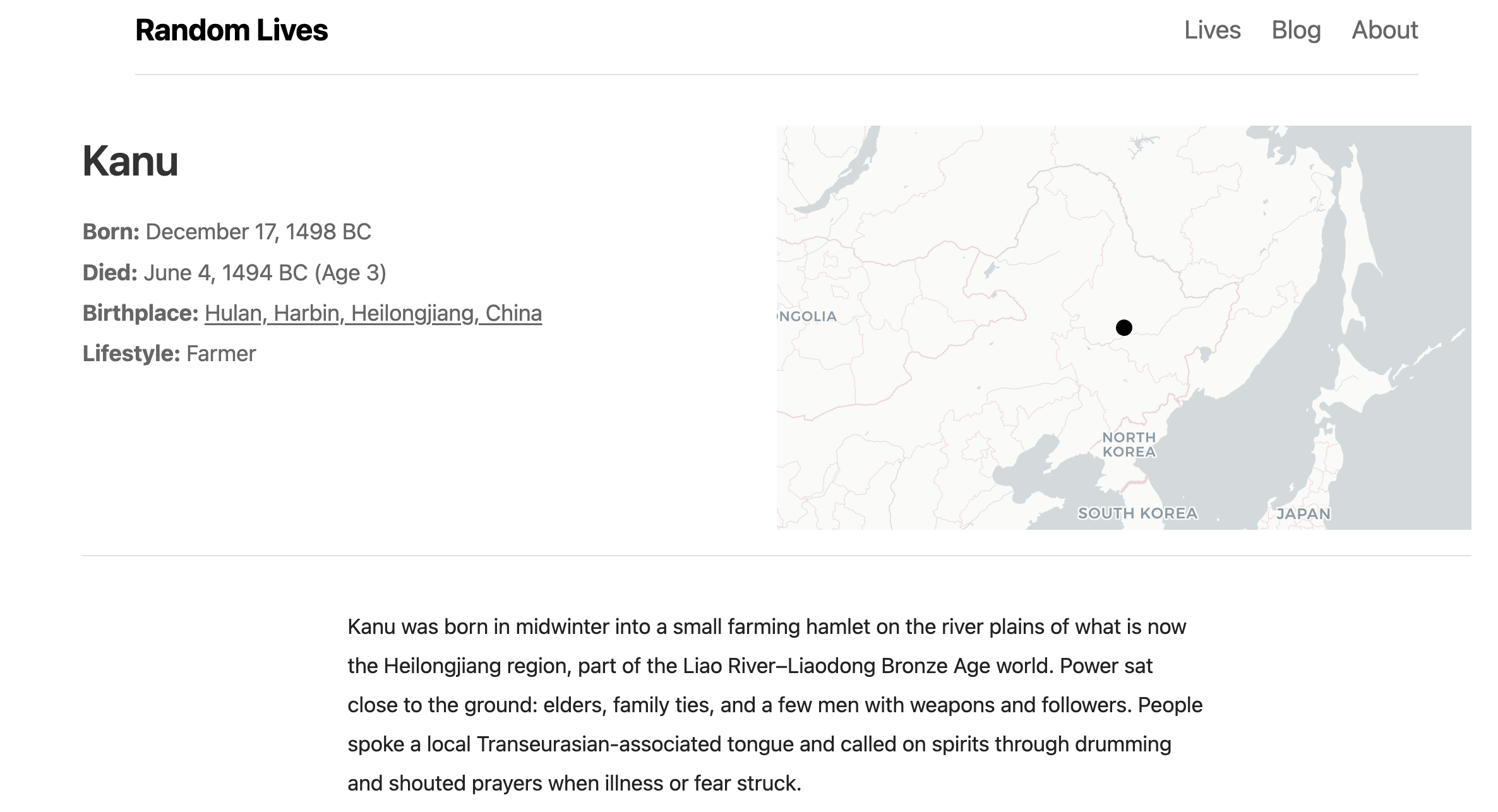
A website of generated fictional people drawn from realistic distributions of people across history. I found reflecting on all the lives often cut short to be very moving.
I hope you’ve had an incredible first half of 2026 (!) and that you’re having exactly the summer you want to have.
xoxo,
Ben

All opinions in this post are my own and don’t reflect those of my employer. Though I bet they’d agree that Larry Vaughn looks incredible in that nautical print.
Though perhaps overly optimistic picture, in that it doesn’t reference loss of control risks at all.
French for ‘pluck the moon’.
No posts
Comments
Nothing yet. Say the first thing.
Sign in to join the conversation.