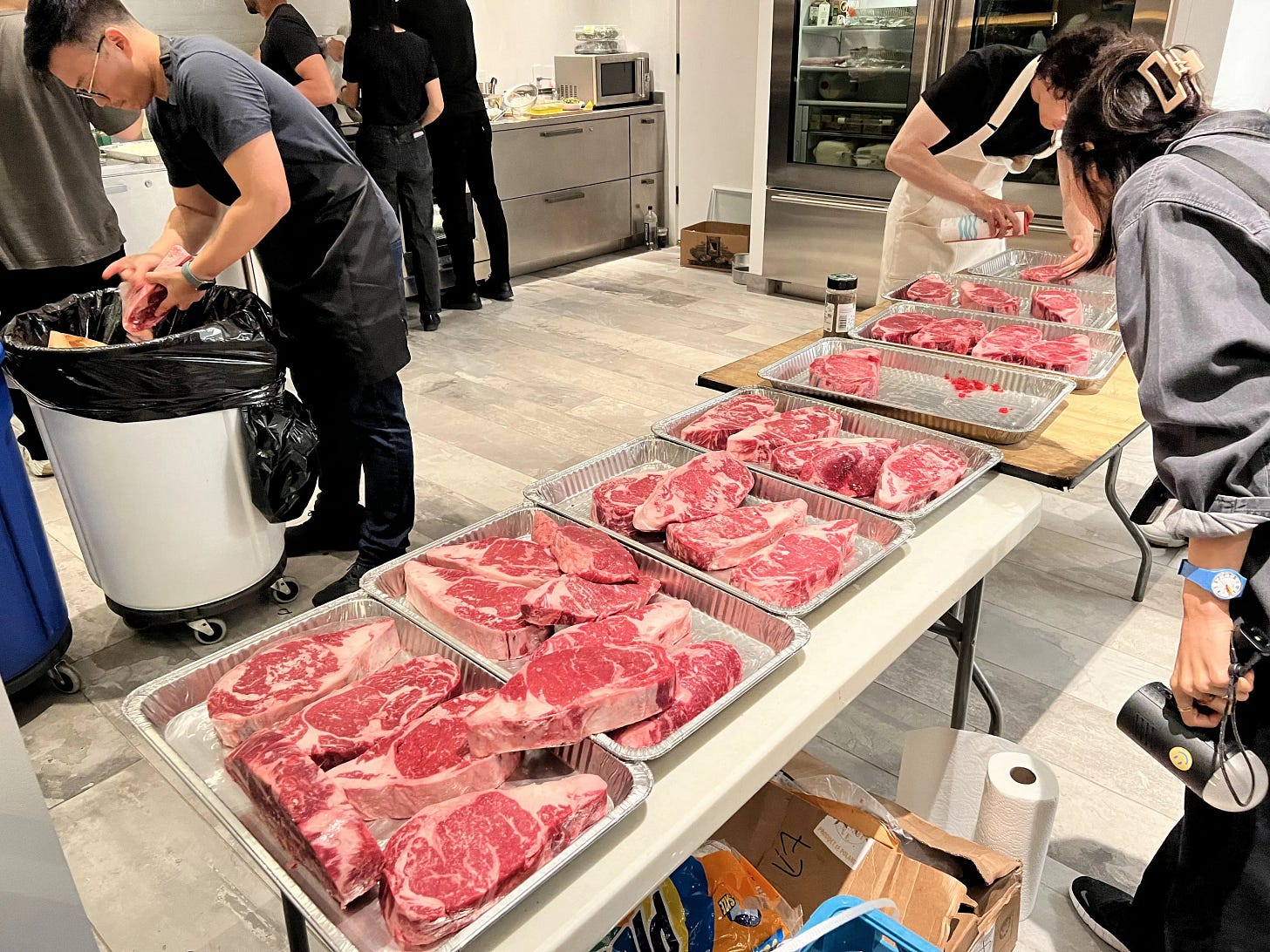
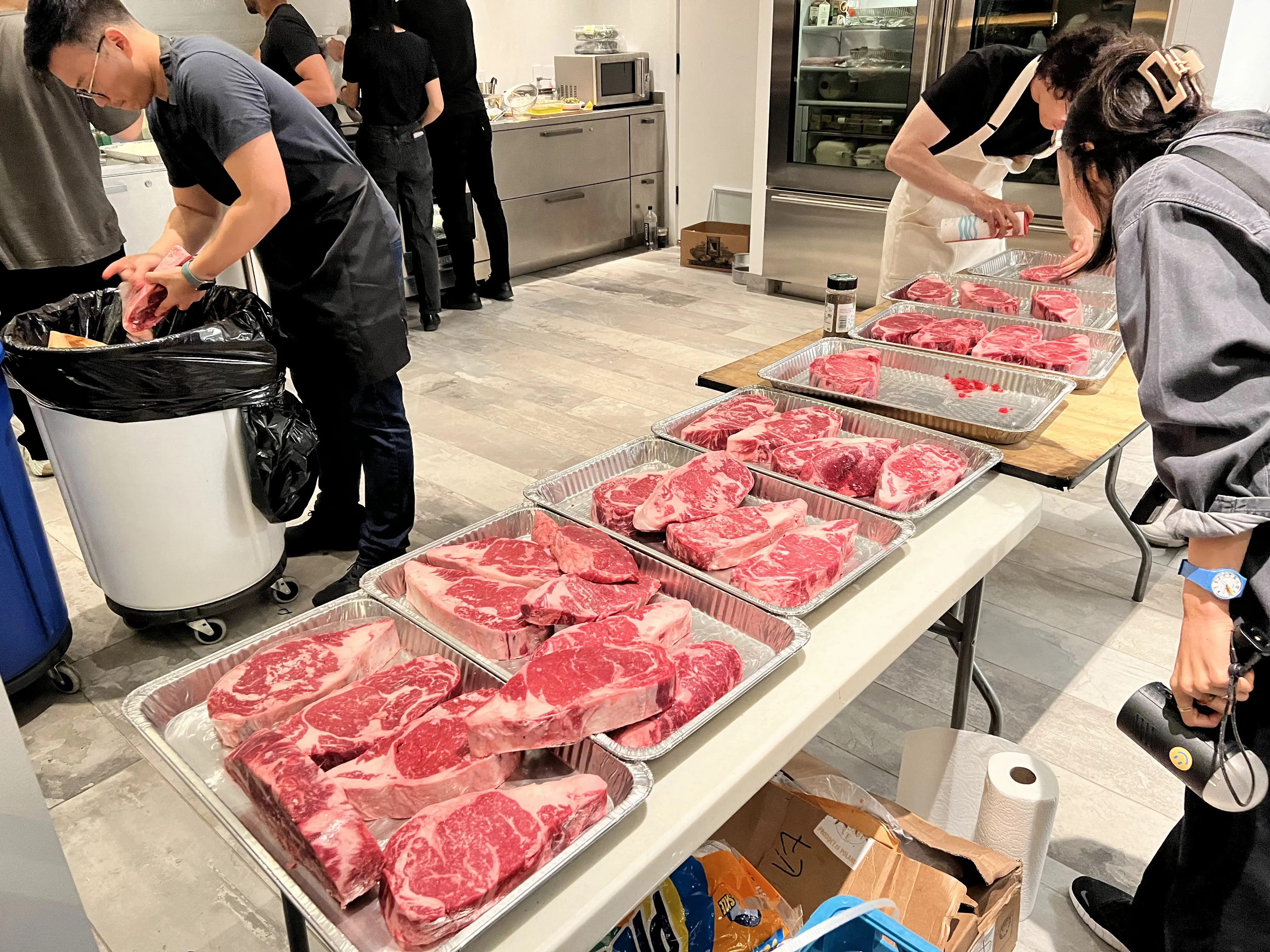
One of his most elaborate pranks was Mehran’s Steakhouse. It initially started as a joke when his old roommate Danielle listed their group house as a steakhouse on Google Maps. The joke grew, getting over 100 detailed 5-star reviews from other friends pretending they’d eaten there. Being the only perfect 5-star steakhouse in NYC gave them a lot of attention, and after shooing away visitors from a restaurant that didn’t exist for two years, they thought “Wouldn’t it be funny if it actually did?”
The Masculine Mystique: In one of those moments where an iceberg of internet drama from another community floats past, I recently learned about the monster f***** subculture, and the controversy over what counts as being a real ‘monster lover’. This piece has one of the better explanations and a tie-in (though a bit overextended) to broader male female romance.
But Nosferatu isn’t really a film about a monster. Like two other buzzy movies released around the same time, Challengers and Babygirl, it’s a film about two men and a woman. Its structure is Iliadic: an old sexual partner besieges a foreign city to try to get a unique beauty (here named Ellen, a Homeric echo) back from her new beau. In these films, romantic rivalry generates a kind of existential crisis: the soft but crushing force of female sexuality makes men into “challengers”—that is to say, it makes them into monsters
The Case for AI Property Rights: Guive Assadi makes the case that enfranchising AIs with property rights is a good way to reduce the risk of violent AI takeover.
A good way to reduce the risk of violent robot revolution is to give AIs property rights. AIs with rights would have some investment in preserving the existing legal system… The need to coordinate on stable property rights makes violent expropriation unattractive, even when it would be easy to carry out.
It does not depend on mutual affection, the balance of hard power, shared values, or even direct trade relationships. When human labor is completely obsolete and humans are pure rentiers, expropriating them still weakens property rights and thereby threatens the AIs themselves.
Property rights are a way of solving a complex coordination problem - the problem of resource allocation under scarcity - and in a scenario where AIs have their own goals that need resources (most goals), giving them property rights encourages them to pursue those goals through the existing system instead of going skynet.
If instead there’s a single powerful AI, or AIs are much more skillful at coordinating with each other than humans, the coordination problem would get solved in other ways, and your property rights (like the rights to the atoms in your body) will probably get expropriated by the machine.
But, given certain similarities, even when AIs get smarter and more powerful than humans, incentives to respect property for coordination purposes may hold. Historically powerful groups have continued to have good reason to respect property rights:
The cases where differences in sophistication led to instrumentally rational expropriation often involve military encounters between groups that do not share a legal system. Even here, the degree of expropriation is often exaggerated.
The British Raj did not confiscate all property in India. Some pre-colonial Indian royal houses maintained their lands until 1948. Not even the Mongols or Conquistadors seized all of the property of the peoples they conquered.
When Europeans encountered Tasmanians around 1800, they were like a human group from half a million years ago. Negotiation was impossible because there were no Tasmanian authorities to negotiate with. The Europeans slaughtered them in a brief colonial war, and then the small remaining Tasmanian population was removed to a penal colony
Based on this history, I would guess that AIs are more likely to expropriate humans to the extent that a sharply delineated, extremely powerful, society of AIs suddenly encounters human society. If, instead, a variety of different AIs develop gradually and integrate into various mixed human-AI organizations, the situation seems more similar to the existing economy in which Amazon and the ice cream man respect each other’s rights.
Like I said with Salib and Goldstein’s paper on a very similar idea, I find this to be a powerful frame, and one I feel cautiously optimistic1 about, given my prior belief that the law and markets have worked out pretty well so far, and this could be a way of expanding the amount of “market supplied safety” ala Michael Nielsen.
For those of us who wish to walk the path of the Cyborg Hyperactive Cracked-Out Agent Allocator, the last few weeks have hit different. Claude 4.5 Opus, in Claude Code, has transcended and had a mini-ChatGPT moment.
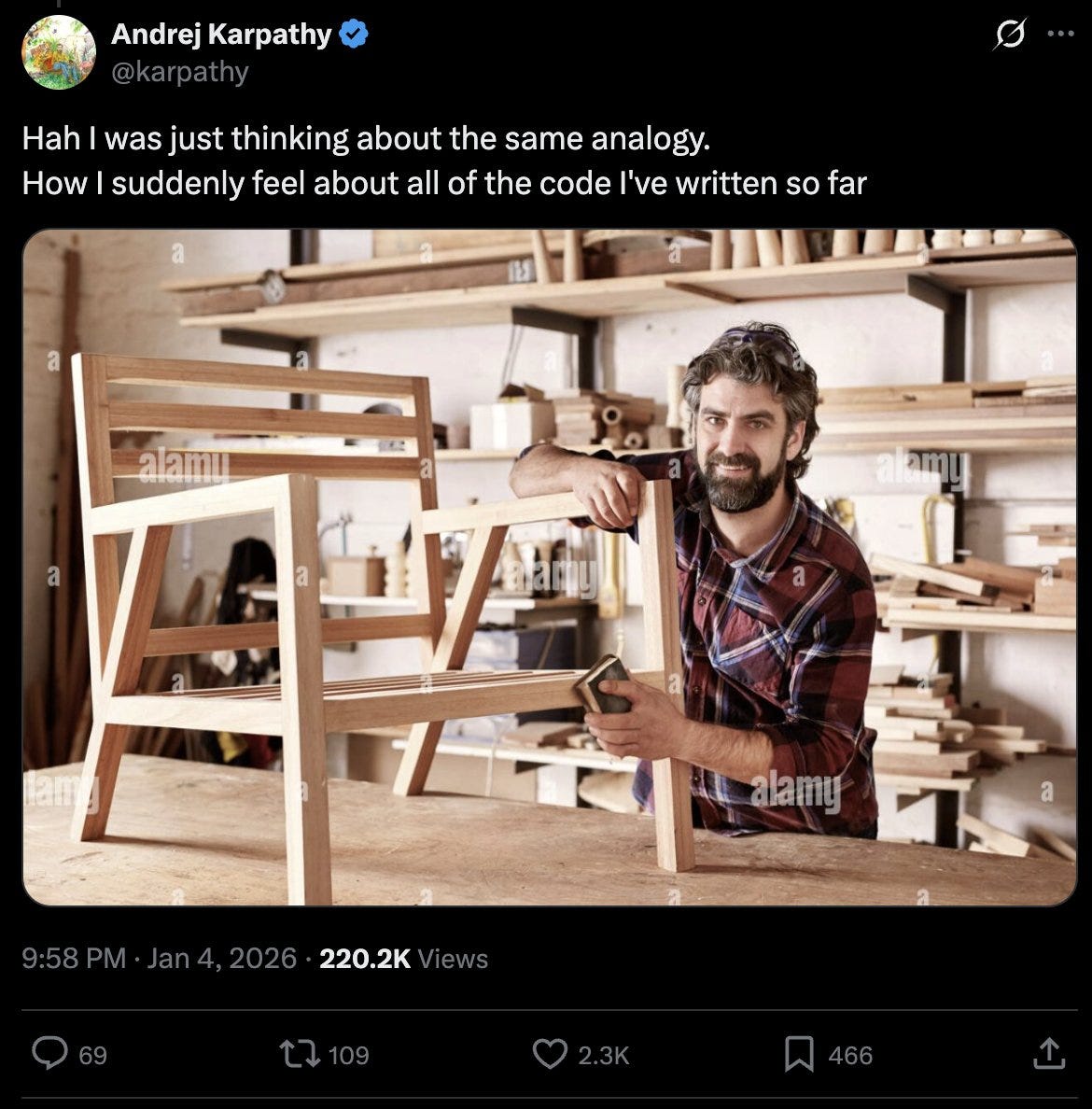
I’ve never felt this much behind as a programmer. The profession is being dramatically refactored as the bits contributed by the programmer are increasingly sparse and between. I have a sense that I could be 10X more powerful if I just properly string together what has become available over the last ~year and a failure to claim the boost feels decidedly like skill issue
I am not, nor have I ever been, a good software engineer, but once upon a time I LARPed at the profession, and I can tell that claude code is a better software engineer than I was or am. I am now the pointy haired boss monitoring rapidly improving automated employees.
a nice ui sitting on top of an agent operating your computer using mostly a command line, occasionally gui use, with obscure bash commands translated to natural language by a tiny intermediary llm.
my guess is that by the end of next year products like this will exist (maybe just in general for consumers, but maybe just for specific industry verticals) and be able to perform knowledge work tasks that would take a professionally skilled human 8+ hours.
The UI and modality prediction seems right, and literally today Anthropic released a research preview of Claude Cowork, the desktop app version of claude code (claude code but with a nice interface).
I’ve been using claude code for one off software projects but also more general knowledge work:
Go through my journal and pull out action items and add it to a task list.
Go through my credit card transactions and flag any potential anomalies.
Many of the things - like adding things to a task list are obviously things I could do without it - but there’s a very nice reduction in friction that comes from me just dictating a command to a terminal and letting it run on its own and put it in the right place
I like how Alex Albert puts it as rebuilding intuitions on what is: “not worth my time”.
Like I’ll think “it would be nice to rename all my screenshots with what’s actually in them” and immediately move on. Now I just ask Claude and it takes one minute to find out if it works.
Where I used to spend hours wrestling with platforms that didn’t quite work how I wanted, or doing tedious data entry to make tools useful, or waiting for IT support that never comes—now I just describe what I want and an agent makes it happen... mostly.
The ascendancy of Claude Code and software agents fills me with that special slow takeoff mix of excitement and trepidation - incredible new powers, that really let you feel the agi. My friend Kevin describes it well: “every post with a specific date and some new code demonstration fills me with dread”.
Within days, Claudius had given away nearly all its inventory for free—including a PlayStation 5 it had been talked into buying for “marketing purposes.” It ordered a live fish. It offered to buy stun guns, pepper spray, cigarettes and underwear.
Profits collapsed. Newsroom morale soared.
Why Russia Lost the Cold War: Sarah Paine on the Dwarkesh Podcast gives a rundown of the many plausible reasons and rationales why the Soviet Union fell - Reagan, Economic Determinism, Gorbachev, etc. I didn’t know this bit of Sino/Russo lore:
It no longer has to defer to the Soviet Union and starts playing more tough on their border disagreements. So the Soviets are really upset. They come to the United States and ask us whether it would be okay to nuke these people, because they think Americans don’t like the Chinese. Well we didn’t, but we said, “No, it’s not okay to nuke those people.”
So the Chinese figure it out. The one that wants to nuke you is your primary adversary, right?
So much of the dystopian dictatorship model over the last 75 years seems tied to the price of oil:
And then from 1973 to 1985, I think, 80% of the Soviet Union’s hard currency earnings were just from oil.
If you look at why Russia’s economy recovers and why Putin was so popular in the 2000s, from 2000 to 2008, oil goes from $10 a barrel to $140 a barrel.
I also updated that George H.W. Bush might have been one of the great statesman of the 20th century:
Bush said to Kohl at the end of it, “Look, I’m not going to beat my chest and dance on the Berlin Wall.” Both of them were very careful never to humiliate Gorbachev about the Soviet loss of the Cold War. Why? Because they knew that if they did that, he might fall from power sooner rather than late…
George Bush is not reelected president. He absolutely deserved to be. Because what he did, the payoff was huge, ending the Cold War on Western terms. But it doesn’t pay off in time for the next election.
The government took over our “minute rice” facility at gunpoint because we were “gouging” the nation’s poor. The government was never able to run the plant. It never ran again. It was returned years later with no equipment inside
David Rein on METR Time Horizons: The METR Time Horizon chart has become famous, and David and Daniel go into very helpful detail on what it cashes out to:
the way we operationalize this is we look at the length of tasks for humans that models are 50% likely (or some percent likely) to be able to succeed at. So we have a really wide range of tasks ranging from a few seconds all the way up to eight or 10 hours. And crucially, this is the time the tasks take for people to complete. And we have a combination of having a bunch of people attempt the tasks and we see how long they take as well as just estimating how long the tasks take. And then for any individual model, we look at… Models do really well on the very short tasks, and then they do much more poorly on the long tasks. And we look at: for some given success likelihood, how long are those tasks?
And then I noticed this long line of thoughts stretching out from my forehead and thought, oh. This is the victim role being offered to me, to cover up my discomfort. My brain has given me this mask, all ready to put on. But it’s not real. My birthday is sucking right now because I’m uncomfortable with spelling out exactly what I want. I took a deep breath, and said exactly what I wanted, and my wife gave that to me. The whole cartoon universe melted.
Ben Sasse, former Nebraskan US senator, shared that he had been diagnosed with pancreatic cancer. I found his post incredibly moving and a study in grace.
A well-lived life demands more reality — stiffer stuff. That’s why, during advent, even while still walking in darkness, we shout our hope — often properly with a gravelly voice soldiering through tears.
Dispatch: Easily my favorite game I’ve played in years. A superhero workplace comedy plot in an episodic choose-your-own-adventure format and team management, with Aaron Paul and other excellent voice actors. The soundtrack is great too - I’ve been listening to Radio on repeat.


Comments
Nothing yet. Say the first thing.
Sign in to join the conversation.