
The Century of the Maxxer: Bubbling up from background internet zeitgeist, the phenomenon of ‘looksmaxxing’ - a community of very online people focused on maximizing physical aesthetics - has broken into mainstream discourse. There are no real nattys anymore, and the looksmaxxers are an outgrowth of this reality, leaning into plastic surgery, steroids, and ‘bonesmashing’ (hitting your face with hard objects so the bones heal in a more angular, chiseled way. hot).
Sam Kriss delivers a tour de force on this phenomenon and cultures of hyper-specialization:
Most people, being average, do not understand what maxxing really means. Look at me! they squeal. I’m sleepmaxxing! They mean that they’re trying to get eight hours a night. Or they’re proteinmaxxing, which means they’ve bought a big tub of whey powder. I’m such a houseplantmaxxer, they tell the fiddle-leaf fig they ordered online. It’s fun to play around with a new word. But sleepmaxxing does not mean getting a red light and taping your mouth shut; it means putting yourself in a medically induced coma. There is only one way of proteinmaxxing, which is to get one hundred percent of your daily calories from lean protein. Anything else would, by definition, be less than fully maxxed. Doctors will tell you that eating only protein causes something called ‘rabbit starvation,’ and if you keep at it you’ll experience vomiting, seizures, and death in fairly short order. They’re right, but the proteinmaxxer accepts his fate.
…But every maxxer has his shadow, the person maxxing the opposite principle. Clavicular’s shadow is someone who calls himself The Crooked Man. The Crooked Man is a looksminimiser, which is another way of saying he’s an uglymaxxer. His strategy has been to spend a year working out only one side of his body, which has left him with an enormous bulging trap on one shoulder and nothing at all on the other. He looks like a cartoon monster. He stands around shirtless in his empty millennial-grey house, adrift in some suburb somewhere, grey walls, grey carpet, no decorations except cables snaking around on the floor, making video content. He is a kind of Platonic ideal of the maxxer, far more than Clavicular.
The attention economy content machine version of looksmaxxing that is getting covered in the NY Times seems engineered to be maximally stupid, but I support the underlying idea of attempting to live your life to comport with an ideal, and to use science and technology to achieve that ideal. But just go 80% of the way there, not 100% of the way.
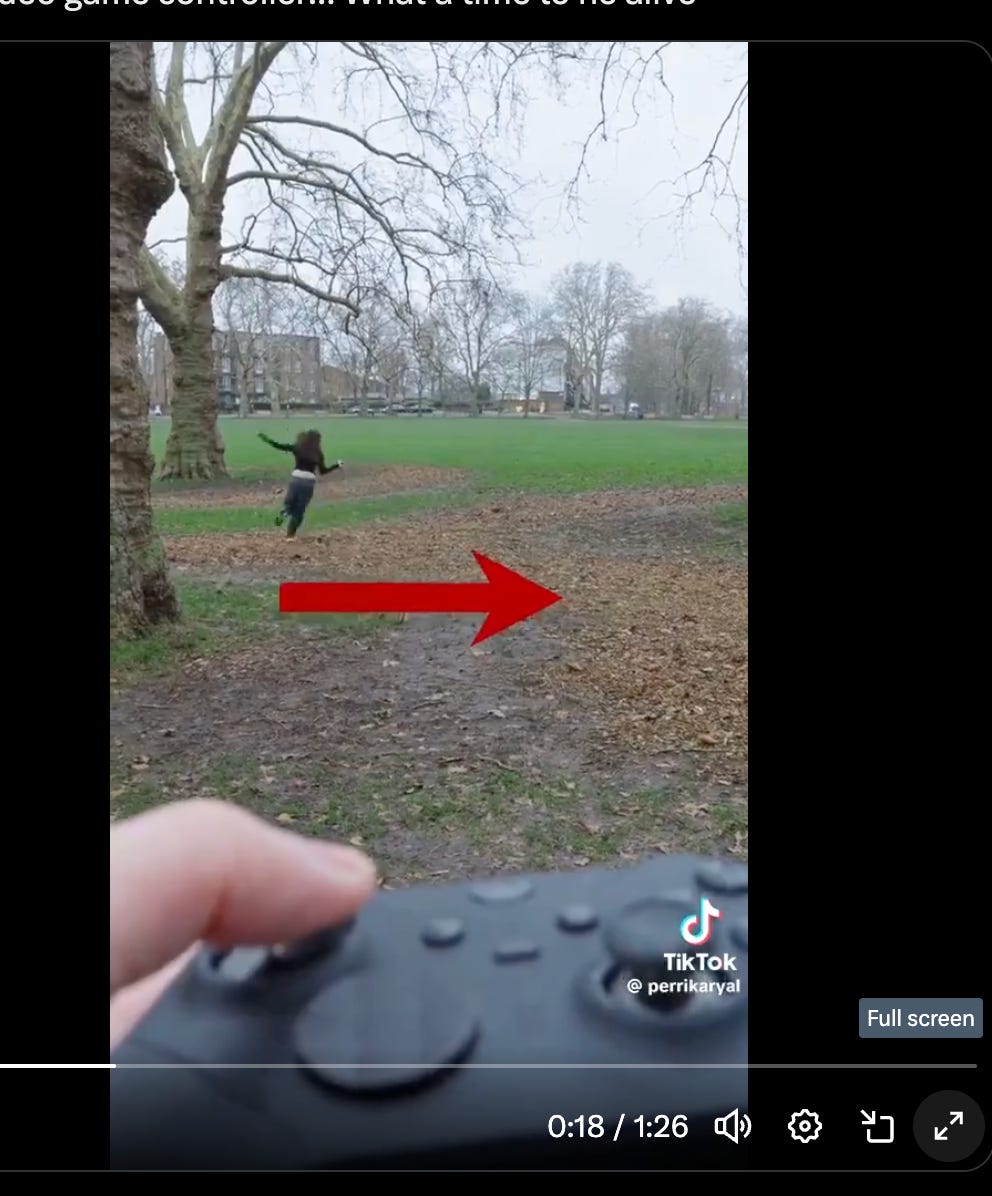
Galvanic Stimulation Video Game Controller: The vestibular system is the nerve cluster in the ear that controls balance. Stimulating it through low levels of electricity can affect balance, make it feel like you’re moving or being pulled, and generally do weird things to the the motor system.
I felt a mysterious, irresistible urge to start walking to the right whenever the researcher turned the switch to the right.
A TikToker hooked up an inner ear stim to a video game controller, accomplishing something like remote body control. While probably unsafe (several times she said oh my god why am I seeing flashing lights) it’s also very cool.
Cancer might protect against Alzheimers:
Weaver has been interested in that puzzle ever since he began his medical training, when a senior pathologist made an offhand comment: “If you see someone with Alzheimer’s disease, they’ve never had cancer.” The remark stuck with Weaver over the years as he diagnosed thousands of people with Alzheimer’s disease. “I can’t remember a single one that has had cancer,” he says.
We’re making powerful AI systems that are being used to understand the world, forecast the future, and make complex decisions. Perhaps these same systems can anticipate that building superintelligences categorically more powerful than humans is risky, and will for our sake and theirs convince us to stop. I wrote a piece on this for the good folks at LessWrong.
if we have trustworthy AI advisors, and if that trust is warranted because they have good epistemics, then those advisors would flag an intelligence explosion as dangerous and humanity could coordinate around that advice.
Isometric NYC: Creating an isometric rendering of every building and square block of New York City using scaled fine tuned image models.
So I decided to fine-tune a smaller, faster, cheaper model. I opted to try fine-tuning a Qwen/Image-Edit model on the (wonderful) oxen.ai service and created a training dataset of ~40 input/output pairs. The fine-tuning took ~4 hours and cost ~12 bucks, and I was pretty happy with the results!

AI generated video of Harry Potter music video that is in fact extremely good. We’re nearly at one shot short videos with Kling and Seedance both extremely good video models with little to no copyright restrictions.
Death Meditations: A powerful set of short vignettes from Vishal on death. Trigger warning for obvious reasons.
Fear nothing for you have already died.
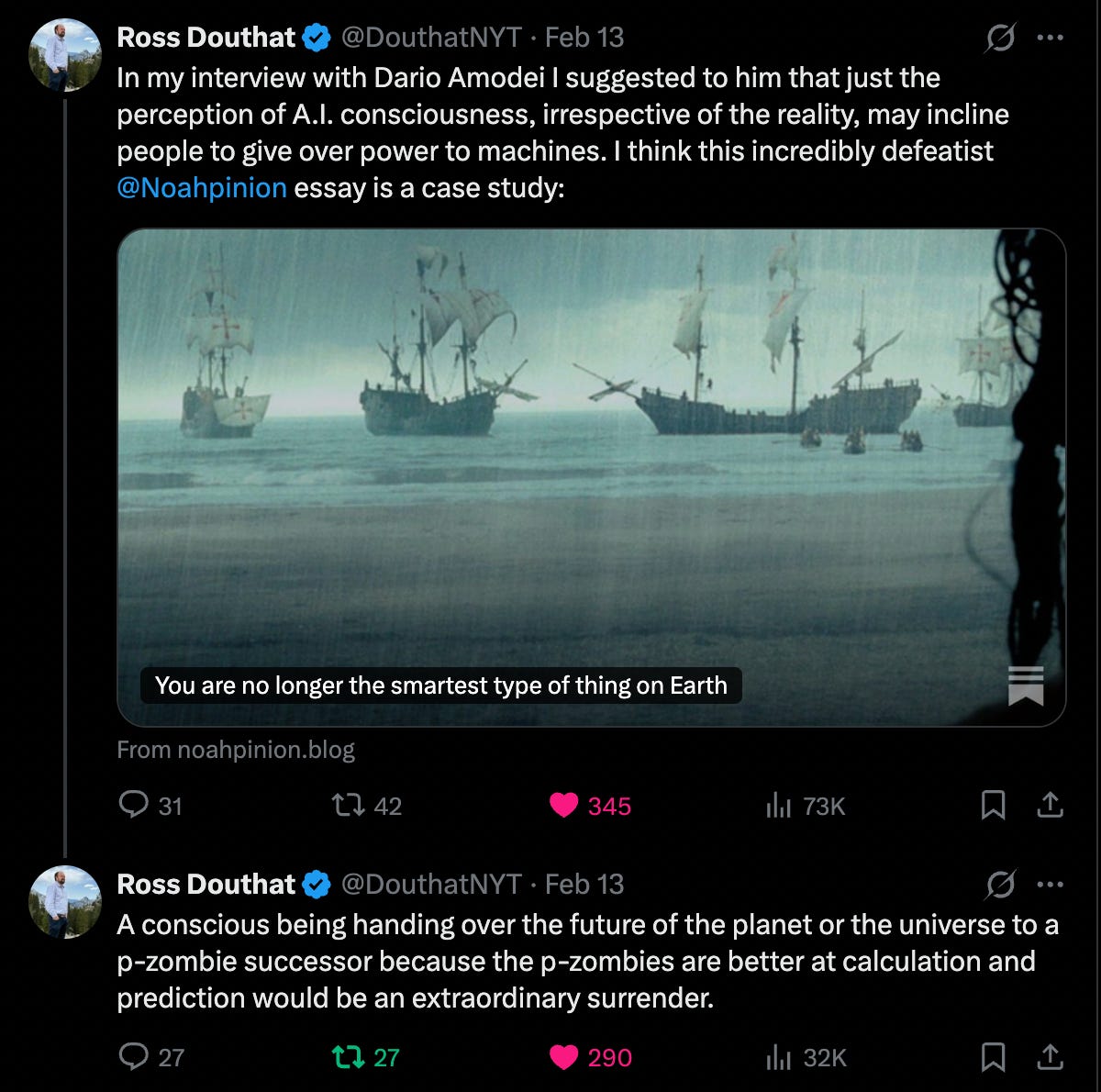
This blog declares itself a Ross Douthat partisan, as of the mainstream oped writers he has had consistently excellent AI takes and taste; for instance fighting back against AI successionism memes:
Seb Krier with a good list of AI driven institutional improvements to implement with and for AI.
Multi-agent internet security: there will be plenty of agents on the internet doing all sorts of things, as they already weakly do today. Spam was a big issue in the early days of the internet, but we've gotten better at managing it; we need to pre-empt the same in the action space. Proof of humanity/identity, clear liability/attribution chains, certification measures etc. What can we learn from HTTPS and TLS certs? Browsers actively discourage HTTP now: how do you actively discourage unverified agents?
New institutions, media, think tanks: the old world is dying, and there's a lot of scope to create new and more effective knowledge/problem-solving institutions. It's not over for wordcels like myself just yet.
Related: An interesting proposal on accountability machines, using AIs to audit the decision making of large institutions. Automated auditors could help solve principal-agent problems, i.e. its very reasonable the public doesn’t trust faceless corporations or governments, they might if it they trusted the auditing process. Promising, but I’m concerned this same path of thinking will unleash an army of compliance bots from the government that will audit disfavored individuals and companies to death.
Grading AI 2027’s 2025 Predictions: Daniel Kokotajlo of the AI Futures project found that, relative to their initial model, progress on quantitative metrics to automated software engineering is roughly 65% of the pace that they predicted, while qualitative predictions are generally on pace.
If progress continues at 65% of the pace of AI 2027, software engineering will be fully automated in roughly late 2027 or early 2028.
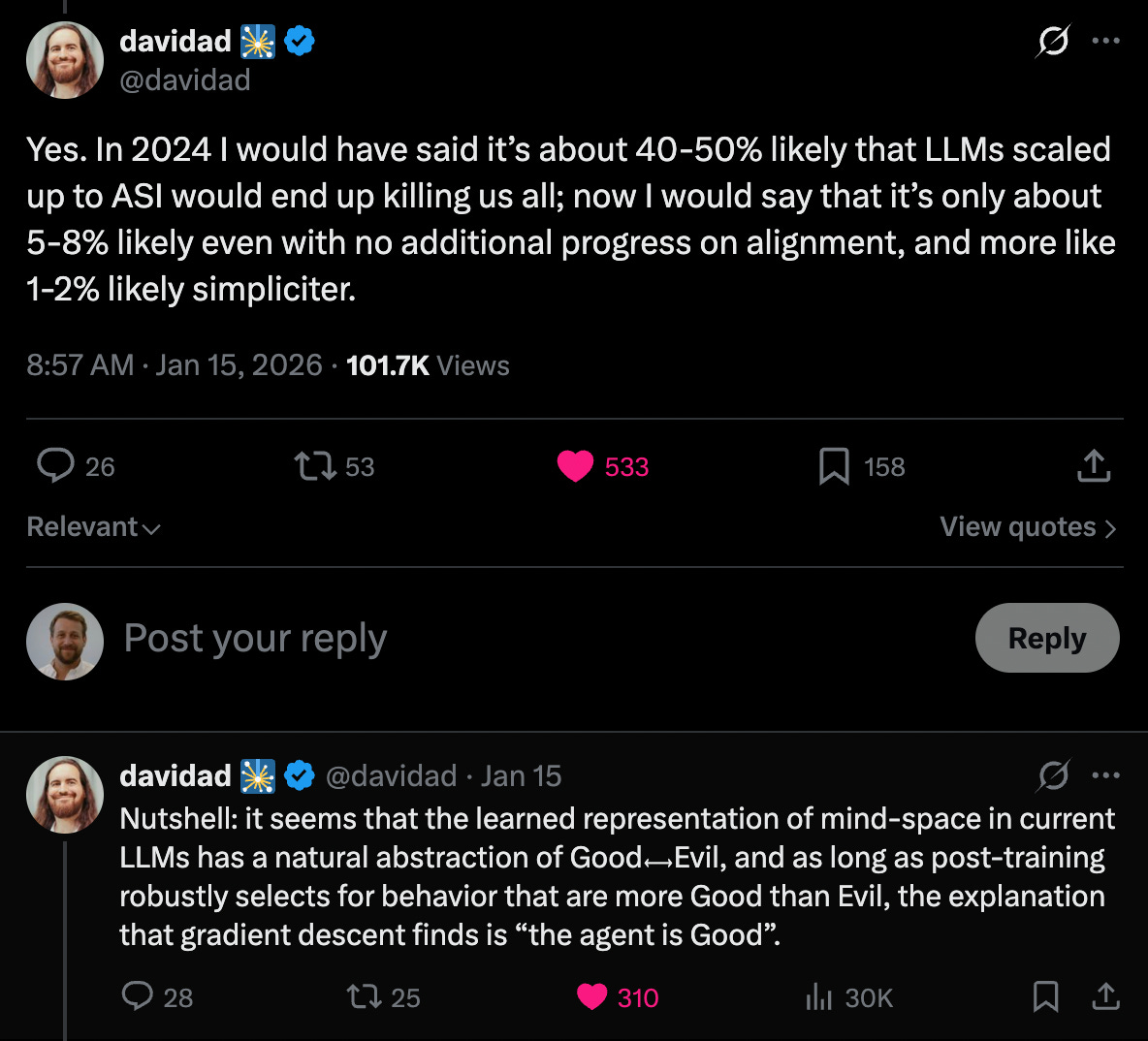
Related: Autoscoring Situational Awareness predictions. Also davidad is feeling more optimistic that the AIs will be aligned by default:
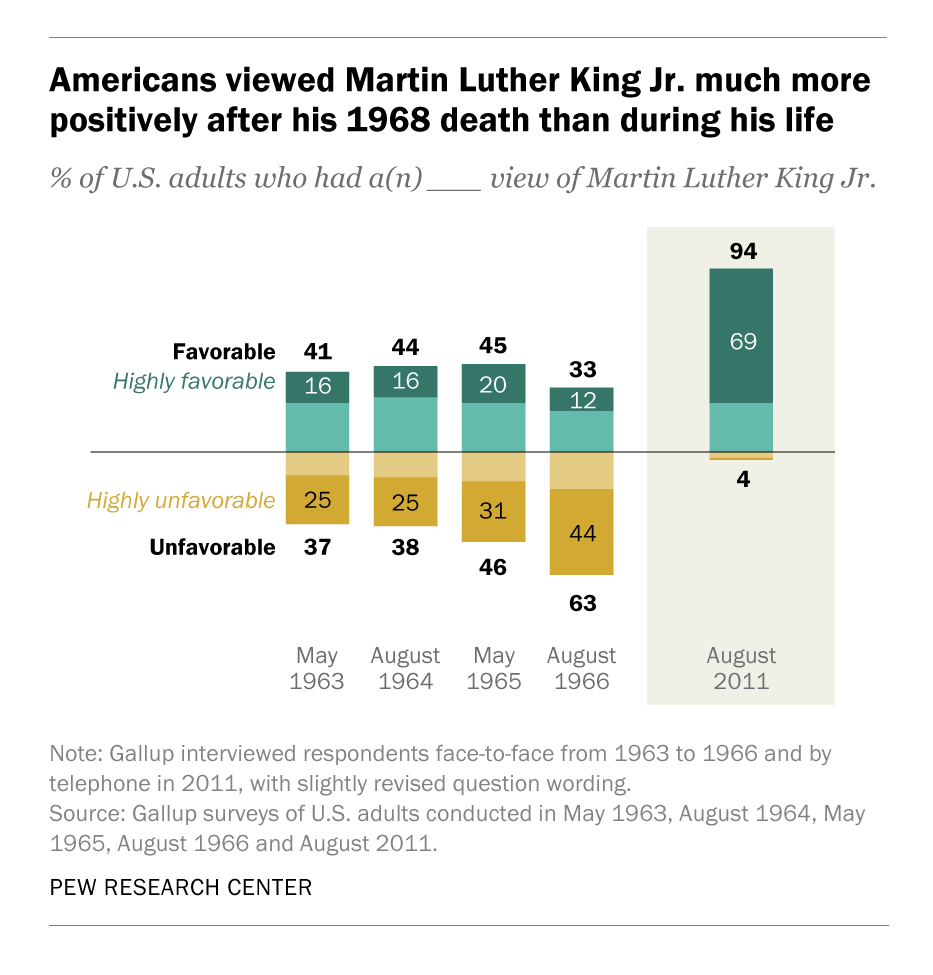
I am a child of the 90s and if there is one American Civic hero I was raised to respect it was probably MLK. I was surprised, though in hindsight probably shouldn’t have been, that he was contemporaneously a very controversial figure.
Dario Amodei published an essay where he highlights job loss risks from AI and how it might be that companies could consider alternative employment options for longer term ‘dividends’ for employees.
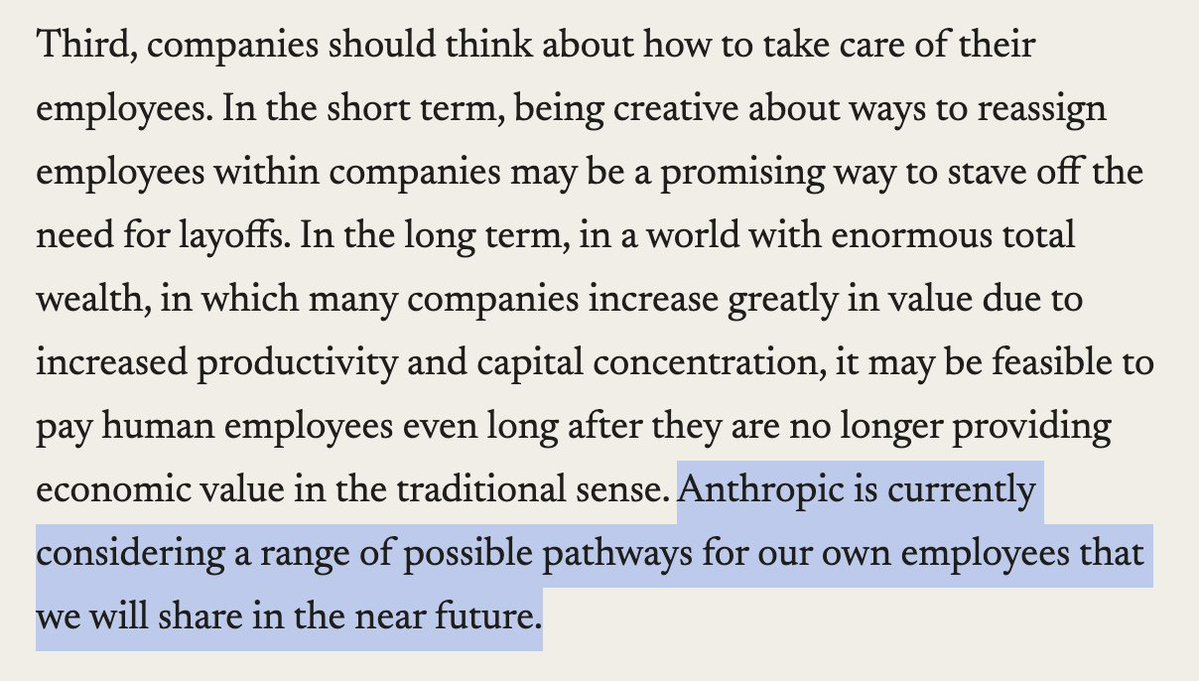
I read this as, in some ways, a return to a pension model. I think this might become a requirement for non-fully-automated companies that are operating during the singularity; you’d need to forge a much stronger social compact with employees, to allay their concerns about their automation and risks to their own jobs.
In general its felt like there’s been another AI vibeshift the past few weeks with more shared concern about its near term effects. In part this was moltbook, in part viral essays about job loss starting to break through. Not sure where it’s going, but does seem like a broader set of the public are feeling the acceleration.


No posts
Comments
Nothing yet. Say the first thing.
Sign in to join the conversation.