
I sat at the dinner table in my colleague’s home, a warm, welcoming Italian American family, and listened as the conversation turned to New York City politics. They were lovely people, the kind of hosts who make you feel immediately at home, who fill your plate before you can ask and insist you take leftovers. But as we talked about Zohran Mamdani’s mayoral victory, I noticed something troubling in their concerns.
They weren’t overtly hostile. These weren’t people shouting slurs or demanding deportations. But they were clearly uneasy. They’d heard things. Seen posts. Had concerns about his “values” and whether he really understood New York. The specific worries were vague, hard to pin down, but the underlying anxiety was palpable: Could a Muslim really lead this city? Could someone like him represent us?
I left that dinner thinking about their family’s own history. Italian Americans, not so long ago, faced almost identical questions when they sought political leadership. Their grandparents or great-grandparents would have encountered people who worried whether Italians had the right “values,” whether their loyalty to the Pope compromised their Americanness, whether people with names ending in vowels could truly represent diverse constituencies.
This essay is my attempt to understand that parallel, to explore whether the prejudice Zohran Mamdani faces as a Muslim American politician echoes the barriers Italian Americans confronted when they first sought public office. It’s written in the hope that understanding our shared history of exclusion might help us recognize prejudice when we see it today, even when it comes wrapped in seemingly reasonable concerns.
When Fiorello La Guardia first sought the Republican mayoral nomination in 1921, Samuel Koenig, the Republican Party boss in Manhattan, offered him blunt advice: “Don’t do it, Fiorello. The town isn’t ready for an Italian mayor.” This wasn’t merely political calculation. It was an acknowledgment that being Italian was itself seen as a disqualifying characteristic for leadership of America’s largest city.
La Guardia lost that 1921 primary decisively, failing to win first place in any borough. His 1929 mayoral campaign fared no better, with even Republican Party leaders either abstaining or supporting his opponent, Democrat Jimmy Walker. La Guardia lost all sixty-two assembly districts. The message from both the political establishment and voters was unmistakable: New York wasn’t ready to be led by an Italian American, regardless of his qualifications or platform.
The prejudice La Guardia faced wasn’t subtle. During his 1933 campaign (the race he would ultimately win), The Nation’s Paul Blanshard noted that there remained “great prejudice in New York against Italian leadership,” even as La Guardia’s anti-corruption platform gained momentum. Newspaper publisher William Randolph Hearst regularly attacked La Guardia specifically because of his Italian heritage. When La Guardia finally won the mayoralty, reform leaders like Samuel Seabury had to pressure reluctant Republicans and Fusion Party members to support him, as they considered La Guardia “too unpredictable, too abrasive, too rumpled, and too Italian.”
Imagine being told by your own party leadership that your city, your home, simply isn’t ready for someone like you in its highest office. Not because of your experience or your policies, but because of your last name and where your parents came from.
La Guardia’s path to acceptance required him to constantly prove his Americanness. He emphasized his service in World War I, his multilingual abilities, and his war against Italian organized crime, which he viewed as bringing shame upon honest Italian immigrants. He spoke out forcefully against the Italian mob, making his first act as mayor an order targeting Italian gangsters, a symbolic gesture meant to distance himself from the criminal stereotypes plaguing his community. La Guardia understood that for Italian Americans to gain political legitimacy, they had to actively disassociate themselves from the Mafia stereotypes that dominated public perception.
Even his unusual background (born to a Jewish mother and lapsed Catholic father, raised Episcopalian, multilingual) became both an asset and a liability. While it allowed him to appeal across ethnic and religious lines, it also marked him as not quite fitting the accepted mold of political leadership. The Irish-dominated Tammany Hall machine would not tolerate an Italian standard-bearer under any circumstances, forcing La Guardia into the Republican Party despite his progressive politics being far to the left of most Republicans.
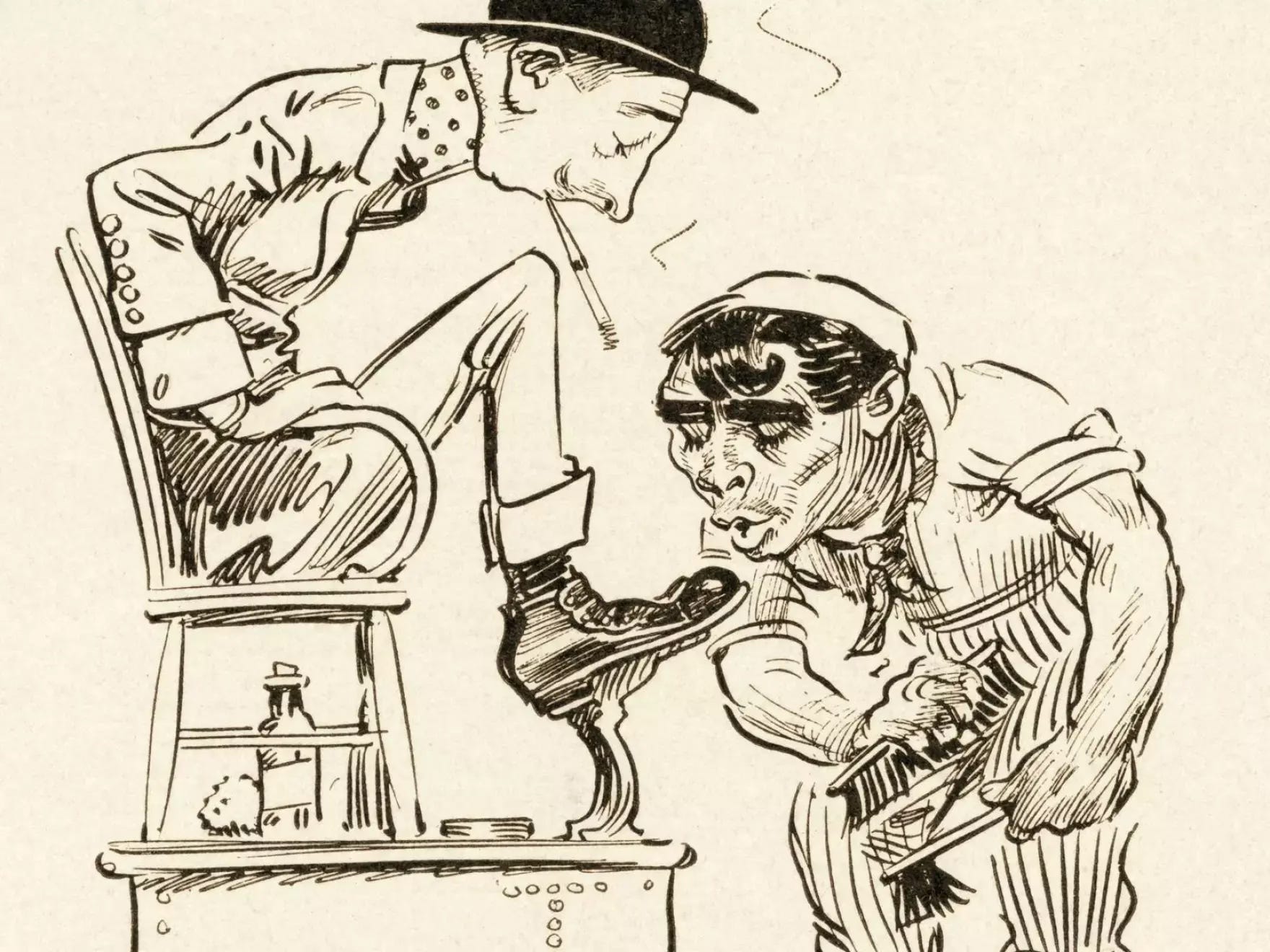
Before La Guardia could even dream of being mayor, American popular culture had already spent decades teaching Americans to fear and distrust Italian immigrants. From the 1870s through the early 1900s, dime novels (the mass-market paperbacks of their era, consumed by millions) systematically portrayed Southern Italians as inherently criminal, violent, and un-American.
As early as 1872, dime novels established Southern Italian immigrant criminality as an inborn character trait, with characters like Guido Montazio (a murderer and thief who abandons his pregnant Anglo-Saxon American wife) appearing in stories like “The White Outlaw; Or, the Branded Brigand.” Although mentioned as a “political refugee from sunny Italy,” the term refugee became linked to criminal behavior rather than political persecution.
This wasn’t accidental. Dime novels engaged with the arrival of Southern Italian immigrants by criminalizing them. No matter the series or publishing house, criminality became the standard behavior for any Southern Italian character. Detective heroes like Nick Carter would don Italian disguises to infiltrate criminal organizations, and these fictional masks reinforced a racialized image of a wholly brutal, ignorant, and anti-American people.
The irony is painful: while dime novels portrayed Italians as criminals, they erased the achievements of real Italian American heroes. Giuseppe “Joe” Petrosino, who joined New York City’s police force in 1883 as its first detective of Italian descent, was called a “master of disguises” who understood and spoke numerous Italian dialects. As head of a twenty-five-man Italian Squad, he thwarted extortion rings and even warned of an assassination plot against President McKinley (which went unheeded, resulting in McKinley’s 1901 murder). When Petrosino was assassinated in Palermo in 1909 while gathering evidence to extradite gangsters, 200,000 citizens lined the streets to pay their respects. President Theodore Roosevelt praised him as a man who “did not know the name of fear.”
Yet when dime novels featured cases similar to those Petrosino solved, or borrowed his techniques and expertise, they gave credit to fictional Anglo-Saxon detectives like Nick Carter instead. The real Italian American hero was erased while fictional Italian criminals proliferated across popular culture. Even the 1906 silent film “The Black Hand,” touted as the first gangster film and based on a case Petrosino solved, failed to mention him in the credits.
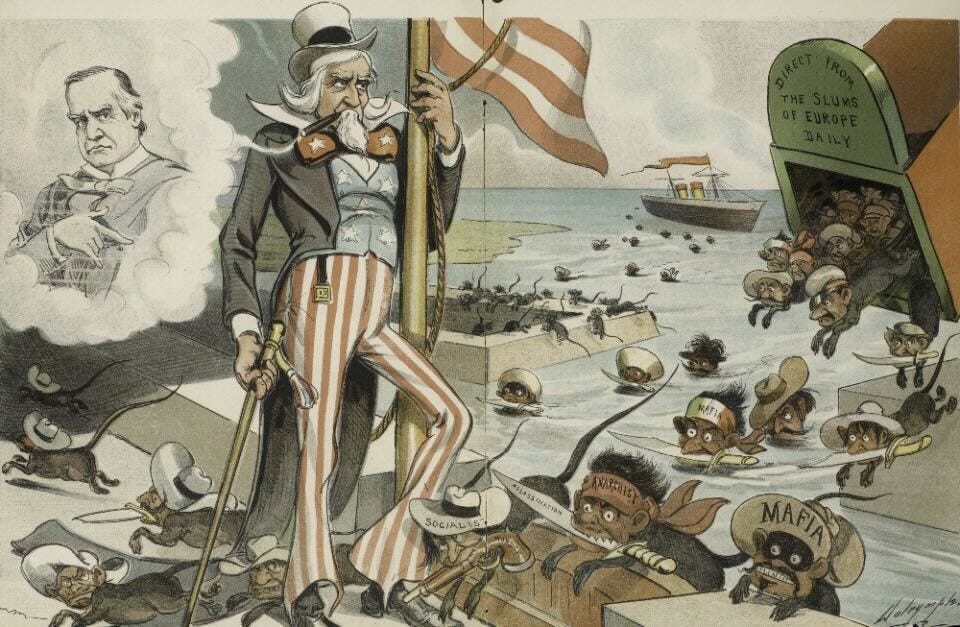
This cultural construction had real political consequences. By the time La Guardia sought office, decades of dime novels, political cartoons, and newspaper coverage had taught Americans that Italians were criminals. Political cartoonists like Louise Dalrymple portrayed Italian immigrants as violent and vulgar murderers and thieves. The New York Times published articles depicting Southern Italian immigrants as “low and ignorant” with a penchant for “fighting, violence, and attempts at murder.” When eleven Sicilians were lynched in New Orleans in 1891, The New York Times called the lynching “justified,” while Leslie’s Weekly editors suggested the victims “must have on general principles deserve[d], and no doubt expected, to meet a violent death” due to their membership in “the lowest criminal classes.”
This is the cultural environment La Guardia had to overcome. It wasn’t just political machines blocking Italian candidates. It was an entire entertainment-media complex that had spent decades teaching Americans to associate Italian names and faces with criminality.
La Guardia’s eventual success didn’t end anti-Italian prejudice in New York politics. Nearly four decades later, during the 1969 mayoral campaign, Italian American candidate Mario Procaccino faced attacks that revealed how deeply anti-Italian sentiment remained embedded, this time from elite academic circles.
Michael Lerner, a graduate student at Yale and son of prominent columnist Max Lerner, reported a shocking incident during Procaccino’s campaign. Lerner’s professor at Yale remarked about Procaccino and Italians: “If Italians aren’t actually an inferior race, they do the best imitation of one I’ve seen.” According to Lerner, everyone at the table laughed. Lerner later reflected that such a comment could never have been made about Black Americans (the social consequences would have been immediate and severe), but anti-Italian prejudice remained acceptable in elite academic settings.
Think about that for a moment. In 1969 (not 1869, but 1969, the year of Woodstock and the moon landing) a Yale professor could openly call Italians “an inferior race” and receive laughter rather than condemnation. This wasn’t some backwater bigot; this was supposedly one of America’s best and brightest, teaching at one of our most prestigious universities.
Procaccino’s campaign struggled with his Italian identity throughout the race. His working-class Italian roots, his accent, his appearance, all became fodder for elite mockery. The Harvard Crimson noted that “many New Yorkers look so much like him and tend, therefore, to think him attractive,” a backhanded way of acknowledging class and ethnic solidarity while simultaneously diminishing it as unsophisticated tribalism. Procaccino’s Southern European immigrant identity represented “an ethnic identity that was itself becoming less prevalent” in a changing New York, making him seem like a relic of an earlier, supposedly less enlightened era.
The double standard was stark. When Procaccino made clumsy attempts to appeal to Black voters (including his infamous “my heart is as black as yours” comment), he was roundly mocked. Yet the underlying assumption that an Italian American couldn’t authentically understand or represent diverse constituencies went largely unexamined. The criticism focused on his gaffes rather than on the prejudice that forced him to constantly prove his legitimacy to communities beyond his own ethnic base.
When Zohran Mamdani won New York City’s 2025 Democratic mayoral primary with the most votes of any candidate in the city’s primary history, he should have been celebrated as a democratic success story. A naturalized citizen, a state assemblyman with a track record of constituent service, elected by hundreds of thousands of diverse New Yorkers, this was, on its face, American democracy working exactly as intended.
Instead, within hours, social media erupted with attacks on his faith, his immigrant background, and his very right to hold office. According to research by the Center for the Study of Organized Hate, in the eleven days surrounding Mamdani’s primary win, 6,669 posts about him generated 419.2 million social media engagements. The volume of hate-related posts jumped from an average of 56 to 264 per day before the primary to 899 on primary day, then exploded to 2,173 posts on the day after his victory. Of the posts researchers examined closely, nearly 40 percent contained explicit anti-Muslim language targeting either Mamdani specifically or Muslims more broadly.
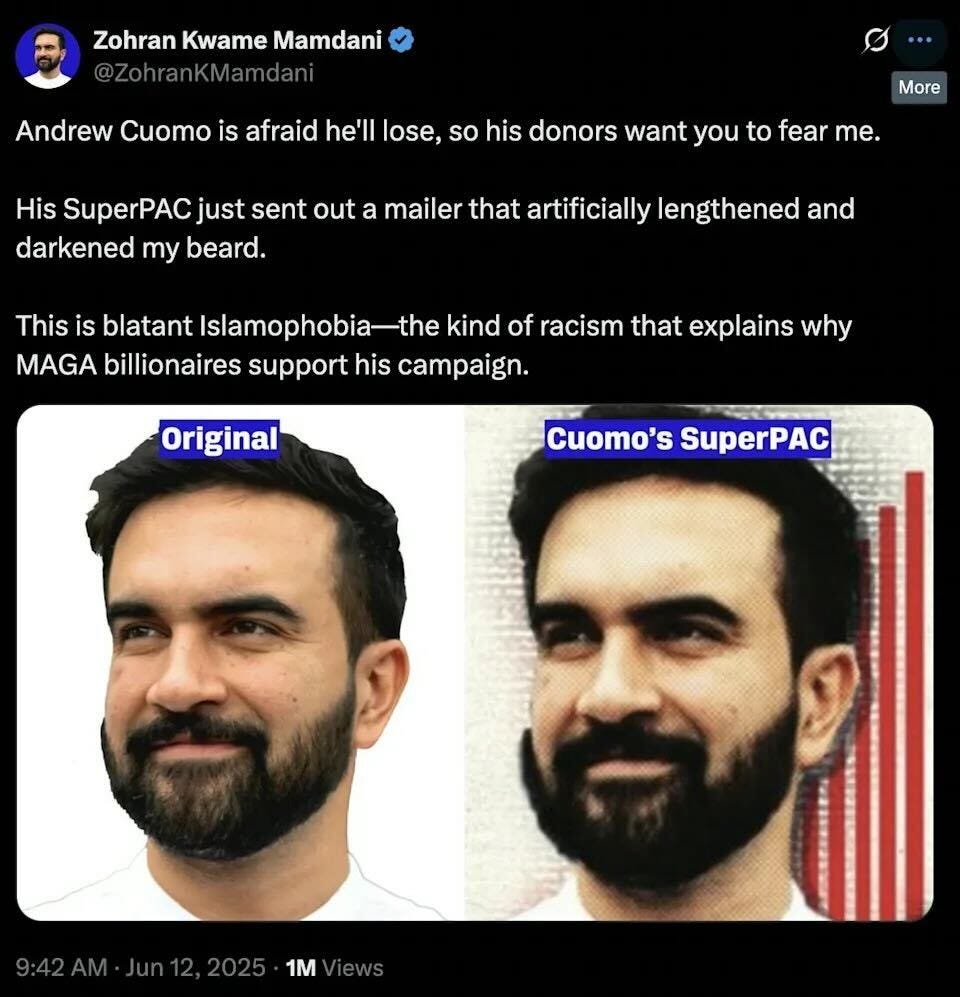
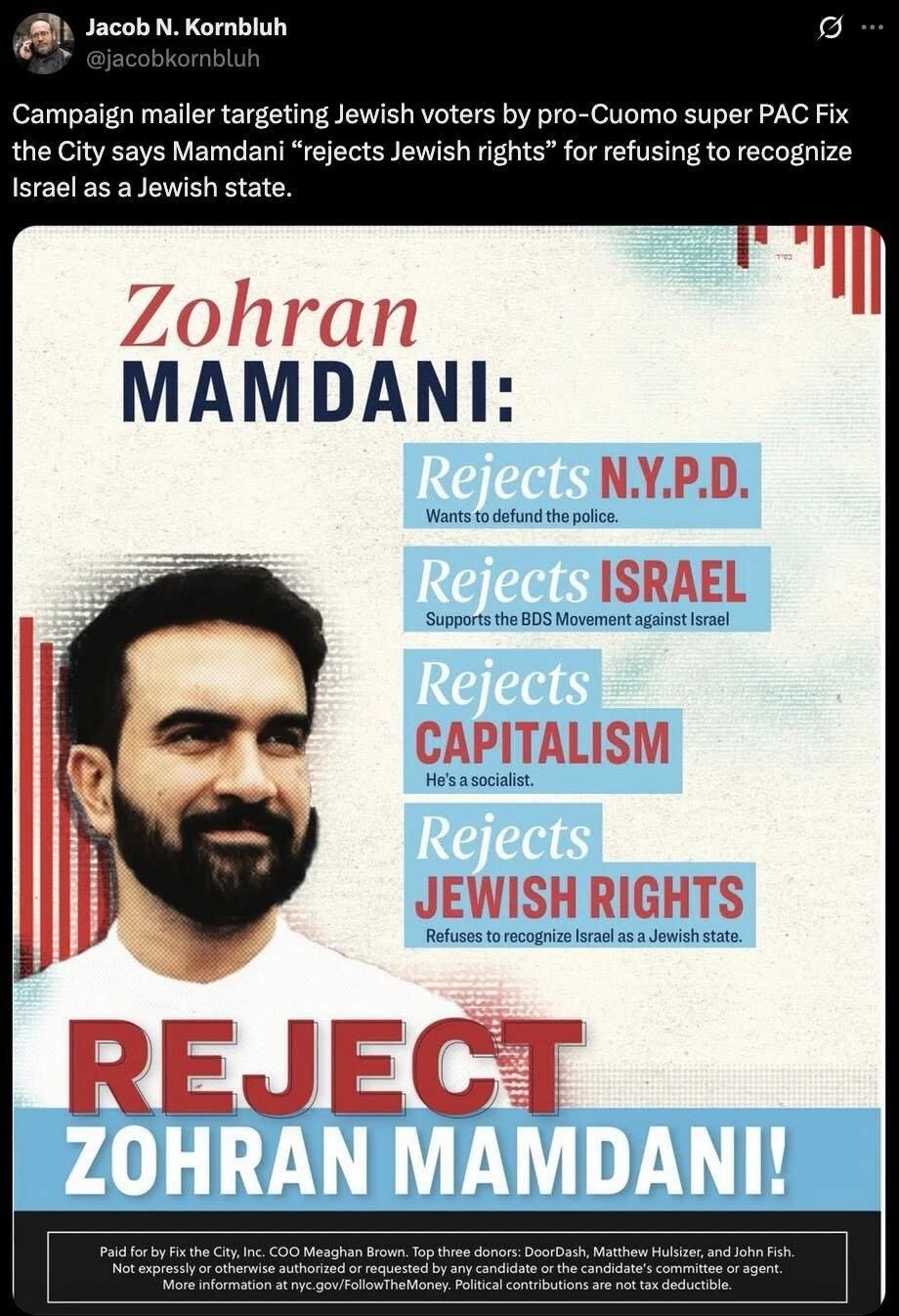
These weren’t just anonymous trolls posting from basements. The attacks came from sitting members of Congress. Representative Andy Ogles called Mamdani an “antisemitic, socialist, communist” and demanded he be deported, despite Mamdani being a naturalized U.S. citizen legally elected by New York voters. Representative Marjorie Taylor Greene posted an AI-generated image of the Statue of Liberty wearing a burqa. Representative Nancy Mace invoked 9/11, suggesting that Mamdani’s victory showed New York had “forgotten” the terrorist attacks. Donald Trump Jr. reposted content claiming that New Yorkers had voted “for 9/11” itself.
This is the environment my dinner hosts were responding to. They weren’t creating these narratives. They were absorbing them from the information ecosystem around them. The concerns they expressed weren’t entirely their own; they were echoes of a coordinated campaign to portray Mamdani as fundamentally unfit for leadership because of his religion.
Just as dime novels and early films constructed the Italian criminal in the American imagination, modern media has played a powerful role in shaping perceptions of Muslim Americans. Post-9/11 popular culture, from TV shows like “24” and “Homeland” to countless action films, has overwhelmingly portrayed Muslims as terrorists, sleeper agents, or extremists. A 2012 study found that of primetime TV shows featuring Muslim or Arab characters, 81 percent associated them with terrorism.
This cultural landscape shapes political possibilities. When Mamdani faces attacks linking him to terrorism despite having no connection to political violence, these attacks land because they tap into decades of cultural conditioning. The social media posts invoking 9/11, the AI-generated images of the Statue of Liberty in a burqa, the accusations that he represents civilizational threat, all of these rely on a foundation of cultural narratives that have portrayed Muslims as inherently dangerous and un-American.
Like the dime novels that erased Petrosino while manufacturing Italian villains, modern media often erases the contributions of Muslim Americans (the teachers, doctors, small business owners, community leaders, and yes, elected officials) while amplifying every act of terrorism committed by anyone claiming Muslim identity. Muslim American politicians like Keith Ellison, Ilhan Omar, Rashida Tlaib, and now Mamdani must overcome not just political opposition but an entire media ecosystem that has conditioned Americans to view Muslim identity with suspicion.
But there’s a crucial difference between what La Guardia faced and what Mamdani confronts: the speed, scale, and coordination of modern prejudice. A comprehensive study by the Center for the Study of Organized Hate documented the attacks on Mamdani between June 24 and October 31, 2025, the period following his primary victory through the general election. The numbers are staggering.
During those four months, researchers identified 35,522 original Islamophobic and xenophobic posts about Mamdani on X (formerly Twitter), authored by 17,752 unique accounts. These posts collectively received 7.37 million likes and 2.01 million reposts, generating an estimated reach of 1.5 billion people. To put that in perspective: the anti-Italian prejudice that took decades to spread through dime novels, newspapers, and political cartoons reached 1.5 billion people in just four months through social media.
Nearly four in ten accounts spreading Islamophobic content were verified blue-badge users (supposedly more credible sources) generating almost 45 percent of all original posts. These weren’t just random trolls; they were accounts with significant platforms and influence.
The attacks followed four distinct patterns, eerily similar to the construction of Italian criminality a century earlier:
Extremist and terrorist labeling dominated, accounting for 72 percent of all posts. Using terms like “terrorist,” “terror sympathizer,” “jihadi,” “Islamist,” “radical Muslim,” and “extremist,” these posts portrayed Mamdani’s Muslim identity as inherently linked to terrorism. This mirrors how dime novels portrayed every Italian character as a criminal simply by virtue of being Italian. Just as Guido Montazio was a murderer and thief because he was Italian, Mamdani was labeled a terrorist because he is Muslim.
Islamization conspiracy theories comprised 8 percent of posts (2,868 total), claiming that electing a Muslim politician would lead to the imposition of “sharia law” or establishment of an “Islamic theocracy” in New York City. Posts used phrases like “Muslim takeover,” “Islamic takeover,” and even “taqiyya” (a theological term distorted to allege that Muslims practice deception to conceal extremist intent). This parallels the fears about Italian Catholics being controlled by the Pope and bringing foreign ideologies to undermine American democracy.
Calls for deportation and denaturalization made up 11 percent of content (4,055 posts), with demands to “send back,” “kick out,” “deport,” “denaturalize,” or force “remigration” of Mamdani, despite him being a naturalized U.S. citizen elected by hundreds of thousands of voters. The term “remigration,” once obscure European far-right jargon for mass deportation of non-white immigrants, gained traction during Mamdani’s campaign, revealing transnational linkages between American and European Islamophobic movements.
Patriotism and loyalty attacks accounted for 9 percent (3,085 posts), using terms like “traitor,” “enemy within,” “anti-American,” and “un-American.” The phrase “New York has fallen” appeared repeatedly, framing the city as having been “taken over by enemies within.” This echoes the questions about Italian loyalty to America versus the Pope, the suspicions that Italian immigrants were anarchists or revolutionaries loyal to foreign ideologies.
The timing is revealing. Islamophobic content surged dramatically in October 2025, with 15,123 posts accounting for 43 percent of the entire four-month total. This represented an increase of more than 450 percent compared to September, suggesting a coordinated amplification of Islamophobic narratives as the election approached its final phase.
Think about what this means. When La Guardia faced prejudice, it spread through editorial decisions, political cartoons published weekly, and word of mouth in neighborhoods and political clubs. The pace was slow enough that communities could organize responses, that personal interactions might counter stereotypes, that a single impressive speech or heroic act might shift perceptions.
Mamdani faced 15,123 attacks in a single month that reached an estimated 1.5 billion people. No amount of door-knocking, no number of policy speeches, no personal connections could possibly counter that velocity of prejudice. The dinner conversation I experienced (where lovely people had absorbed vague concerns about Mamdani) makes perfect sense in this context. They weren’t seeking out Islamophobic content; it was simply saturated in the information environment they inhabited.
Sitting at that dinner table, listening to well-meaning people express vague concerns about a Muslim candidate, I heard echoes of what Italian Americans must have faced generations ago. The same patterns of disqualification, just with different targets.
The foreign threat narrative: Just as Italian Catholics faced suspicion about their ultimate allegiance to the Pope and the Vatican (Were they really Americans or were they taking secret orders from Rome?), Muslim Americans face constant insinuations about divided loyalties. Critics suggest they’re more committed to “Sharia law” or foreign Islamic states than to American democracy. Representative Andy Ogles’s call to deport Mamdani exemplifies this thinking. Despite being legally American and democratically chosen by constituents, Mamdani’s Muslim identity made him perpetually foreign in the eyes of critics.
Association with violence: Italian Americans were persistently associated with organized crime and the Mafia. La Guardia’s aggressive prosecution of Italian gangsters was partly a political necessity, a way to prove he wasn’t tainted by association with criminal elements. Similarly, Mamdani faces automatic association with terrorism. He received social media posts and comments from public figures directly linking him to the September 11 attacks, despite having no connection whatsoever to terrorism or extremist violence. The logic is the same: your ethnic or religious identity makes you collectively responsible for the worst actions of anyone who shares that identity.
Elite legitimization: The Yale professor’s comment about Italians imitating “an inferior race” came from someone at one of America’s most prestigious universities. William Randolph Hearst’s attacks on La Guardia came from one of the most powerful media figures in the country. Similarly, the Islamophobic attacks on Mamdani came not just from anonymous internet accounts but from sitting members of Congress, former governors, and media personalities with large platforms. When respected institutions and powerful figures endorse prejudice, it becomes normalized, acceptable, just “reasonable concerns” rather than bigotry.
The crime of ambition: Koenig’s warning to La Guardia (”The town isn’t ready for an Italian mayor”) wasn’t about qualifications. It was about ethnicity making someone unacceptable in a position of civic authority. The proper place for Italians was working-class jobs and ethnic neighborhoods, not City Hall. Mamdani faces similar dynamics. The sheer volume and intensity of attacks following his primary victory suggests that his crime wasn’t policy positions but audacity. How dare a Muslim immigrant seek to lead America’s largest city?
After that dinner, I spent weeks researching this parallel. What I found both disturbed and encouraged me.
The disturbance came from recognizing how little has fundamentally changed. The mechanisms evolved (from newspaper cartoons to viral social media posts, from political machines to algorithmic amplification), but the underlying dynamics remained remarkably consistent. Politicians from marginalized communities still face questions about their fundamental fitness for democratic leadership. They’re still portrayed as foreign, dangerous, and incompatible with American values. Their ambitions for leadership are still treated as presumptuous overreach rather than legitimate democratic participation. And elite institutions and respected figures are still willing to legitimize and amplify prejudice, making it acceptable in mainstream political discourse.
But I also found encouragement in stories of resilience and eventual acceptance.
La Guardia, despite facing overwhelming prejudice, eventually won the mayoralty and served from 1934 to 1946. His tenure transformed New York City. He built affordable housing, expanded the subway system, unified the transit system, modernized infrastructure, championed workers’ rights, and made government more responsive to ordinary New Yorkers. A 1993 panel of scholars ranked him as the best big-city mayor in American history. The man who was told “the town isn’t ready for an Italian mayor” became the standard against which all subsequent mayors are measured.
His success opened doors. By the mid-20th century, Italian Americans had achieved significant political representation, with multiple members of Congress, governors, and big-city mayors. The election of Italian American politicians became unremarkable, a sign of how completely attitudes had shifted.
Mamdani’s electoral success (winning the most primary votes in New York mayoral history) suggests that large segments of the electorate are willing to look beyond religious identity and focus on policy substance. The hundreds of thousands who voted for him represent a coalition that rejects the politics of exclusion and embraces a more expansive vision of who belongs in political leadership.
The comparison between Italian American politicians in the early-to-mid 20th century and Muslim American politicians today reveals an uncomfortable truth about American democracy: the promise of equal participation has always been contested terrain. Each generation faces the question of whether that promise will expand to include new communities or whether fear and prejudice will continue to draw boundaries around who counts as legitimately American.
La Guardia’s experience shows that those boundaries can shift. The man who was told his city wasn’t ready for him eventually became its greatest mayor. Italian Americans moved from being a suspect minority to being fully integrated into American political life. But that shift took generations and required Italian Americans to constantly prove themselves, to distance themselves from stereotypes, to perform their Americanness in ways that native-born WASPs never had to.
The question for Muslim Americans is whether acceptance requires similar compromises (the suppression of religious identity, the constant policing of community boundaries, the wait of multiple generations), or whether American political culture has evolved enough to embrace religious diversity without demanding assimilation as the price of participation.
Mamdani’s electoral success suggests possibility. The intensity of the backlash against him suggests how far we still have to go.
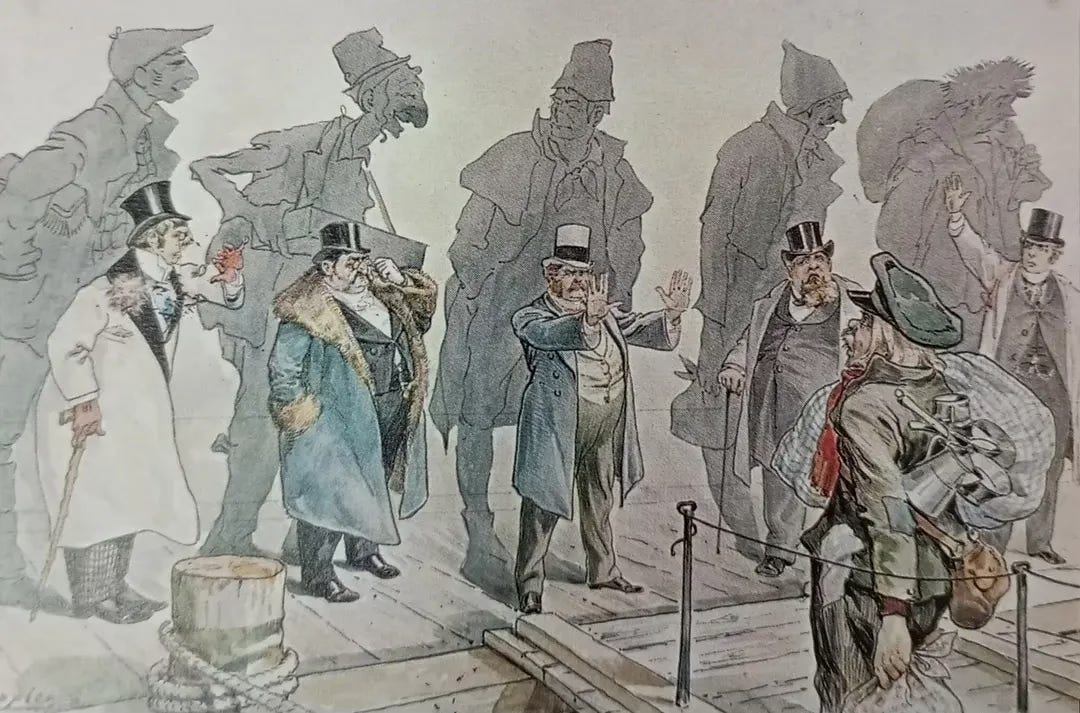
This is the political cartoon titled Looking Backward, published by Joseph Keppler in the magazine Puck on January 11, 1893. It is a famous piece of American art history that addresses the issue of nativism and immigration in the late 19th century.
I think about that dinner, about lovely, hospitable people who would never consider themselves prejudiced, but who were absorbing and repeating narratives designed to exclude. I think about how their own family history should have inoculated them against precisely these narratives, but somehow didn’t.
This is why understanding history matters. Not as academic exercise but as lived experience, as family memory, as recognition of patterns that repeat across generations with different targets.
My hope in writing this is that someone (maybe someone at a dinner table like the one I attended) will pause when they hear concerns about whether a Muslim politician is “right” for their city. Maybe they’ll recognize the echo of prejudices their own grandparents faced. Maybe they’ll ask whether these concerns are about actual policies and qualifications, or whether they’re about maintaining unstated boundaries around who deserves political leadership.
And maybe, just maybe, they’ll remember that American history is full of moments when “the town isn’t ready” turned out to mean “the town is prejudiced.” And that the politicians who broke through those barriers (the La Guardias who persisted despite being told they didn’t belong) often became the leaders we remember most fondly, the ones who expanded our sense of what’s possible.
The Italian American family who hosted that dinner are good people. I genuinely believe that. But good people can absorb and perpetuate prejudice when it comes dressed up as reasonable concern. The challenge is recognizing it (in the media we consume, in the conversations we have, and yes, even in our own reactions to candidates who don’t fit the traditional mold of American political leadership).
That recognition is where change begins.
Center for the Study of Organized Hate. “Islamophobia and the New York City Mayoral Election.” November 2025. https://www.csohate.org/wp-content/uploads/2025/11/Islamophobia-and-the-New-York-City-Mayoral-Election-1.pdf
Center for the Study of Organized Hate. “Digital Hate, Islamophobia, Zohran Mamdani, and NYC’s Mayoral Primary.” July 2025.
Axios. “Attacks on Muslims flood mainstream after Mamdani win.” June 2025.
Axios. “MAGA erupts with Islamophobic attacks on Zohran Mamdani.” June 2025.
NBC News. “Zohran Mamdani decries ‘racist, baseless attacks’ in an emotional speech about Islamophobia.” October 2025.
TIME. “Islamophobia Surges Online After Zohran Mamdani’s Win.” July 2025.
The 19th. “Mamdani spoke of his aunt’s fear after 9/11. Backlash revealed how Islamophobia persists.” October 2025.
Rep. Pramila Jayapal. “Statement on Racist Attacks on Zohran Mamdani.” June 2025.
Eltantawi, Sarah. “Zohran Mamdani and Strategic Islamophobia.” Contending Modernities, August 2025.
The Nation. “What History Tells Us About the Rise of Fiorello La Guardia.” August 2025.
Wikipedia. “Fiorello La Guardia.” Accessed November 2025.
Wikipedia. “Mayoralty of Fiorello La Guardia.” Accessed November 2025.
Jacobin. “How Mayor Fiorello La Guardia Transformed New York City.” April 2025.
Jewish Currents. “Lessons from La Guardia.” August 2025.
Vital City. “What La Guardia Gave New York.”
EBSCO Research Starters. “Fiorello Henry La Guardia.”
LaGuardia-Wagner Archive. “Fiorello H. La Guardia, A Model Mayor?” 2017.
New York Public Library Archives. “Fiorello H. La Guardia papers.”
Shu.edu. “Mayor Fiorello H. LaGuardia – History of New York City.” April 2022.
Cleveland State University. “Chapter 6: Anti-Italian Sentiment in America – Italian Americans and Their Communities of Cleveland.”
Wikipedia. “Mario Procaccino.” June 2025.
Wikipedia. “1969 New York City mayoral election.”
Gotham Center for New York City History. “Swept From the Streets: Mario Procaccino and the Rise of Law-and-Order Politics in New York City.” June 2020.
EBSCO Connection. “’My Heart Is as Black as Yours’: White Backlash, Racial Identity, and Italian American Stereotypes in New York City’s 1969 Mayoral Campaign.”
Harvard Crimson. “John Lindsay at the Crossroads.” November 1969.
Sage of Time Maps. “1969 NYC Mayoral Election.”
West Virginia University Libraries. “Italian Racialization / Erasure.” American Dime Novel: Racialization / Erasure. https://omekas.lib.wvu.edu/home/s/dime-novels/page/italian-stereotypes
Library of Congress. “Under Attack | Italian | Immigration and Relocation in U.S. History.”
Anti-Italianism in America: A History of Prejudice and Resistance. Italian For A While.
Slate. “Fargo fact check: Does Season 4 exaggerate anti-Italian racism in the 1950s U.S.?” September 2020.
CUNY Academic Works. “Italians Inside American Government: New York Politicians.”
Cleveland State University. “Chapter 6: Anti-Italian Sentiment in America.”
Wikipedia. “Anti-Italian sentiment.”
Italian-American Culture & Heritage. “Discrimination Against Italian Immigrants.” April 2023.
La Gazzetta Italiana. “America: Land of Liberty? Prejudice against Italians in the early 20th Century.” January 2019.
The World from PRX. “A brief history of America’s hostility to a previous generation of Mediterranean migrants — Italians.” 2015.
Lower East Side History Project. “The Dark and Forgotten History of Italian Immigration.” March 2025.
No posts
Comments
Nothing yet. Say the first thing.
Sign in to join the conversation.