
Reader’s note: Reminder that Rung Three is “There is one God who made all things.” Is there any way in which that idea might settle in your mind? Or is there a way in which that idea has always seemed right to you? Well, forget all that introspection, and let’s compare and contrast theological ideas instead!
I just want to roll some ideas around with you, because I’ve gotten two smart folks laying down what they regard as what they think is true about divinity/God/the infinite.
In a recent Patreon post, I shared Leo Tolstoy’s basics for what he sees as shared ideas between religions.1 It came from his essay "What Is Religion, Of What Does Its Essence Consist?"2 Here they are:
There is a God who is the origin of everything.
There is an element of this divine origin in every person.
A person can diminish or increase this "element of ... divine origin" through their way of living.
In order for a person to increase this source ("element ... of divine origin") they must suppress their passions and increase the love within themselves.
The practical means of achieving this increase of love consists in doing to others as you would wish them to do to you.
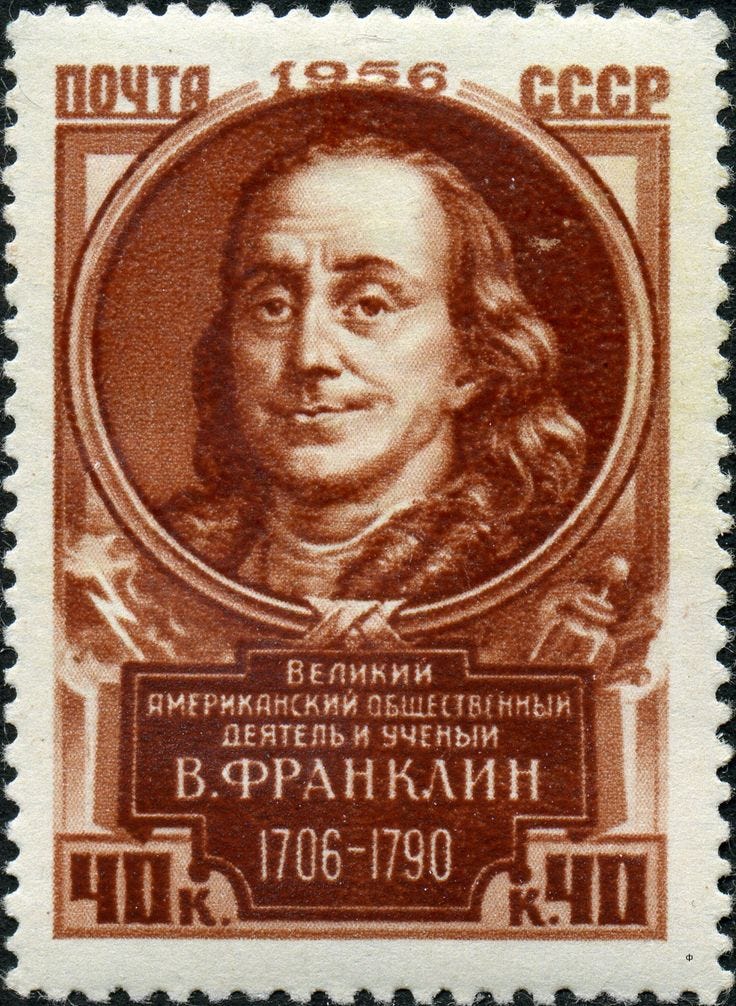
Here’s how George L. Rogers distills down Franklin’s ideas on God:
There is one God, who made all things.
He governs the world by His providence.
He ought to be worshipped by adoration, prayer and thanksgiving, but …
… the most acceptable service of God is doing good to man.
The soul is immortal.
God will certainly reward virtue and punish vice, either here or hereafter.
I bet you’re like me, and you see some overlap here. Let’s see:
Tolstoy and Franklin agree that there is a single God who made everything.
Franklin asserts that God is good and governs the world through “His providence.” Tolstoy is less concerned with the exact nature of God and God’s actions, drawing a wider circle to include many Eastern and Western religions’ concepts of deities and divinity under his umbrella.
Franklin admits he was never one for prayer, and yet he says God deserves “adoration, worship and thanksgiving.” Tolstoy’s attempts to live with the prayers and rituals of Orthodox Christianity just didn’t stick for him either; however, he doesn’t begrudge those for whom those rituals and prayers help them get closer to God. The two are begrudging fans of prayer in general, perhaps, but neither of them practitioners.
Tolstoy says there is divine spirit in people, and through their suppressing of passions or increasing their love they increase or diminish that divine spirit. Franklin says the soul is immortal. In other places, Tolstoy says there’s something of the infinite in us; we interact with the infinite as finite beings. What happens to that infinite of us when we die? Franklin doesn’t dwell, but asserts it’s forever. Tolstoy is less affirmative. We’d need to delve far, far deeper into their theological ideas to find out how important it is to their assertions about how religion guides as in our lives to find out how important it is to think, either, that human beings all have the divine spirit in them, and that the divine spirit in human beings is infinite.
Tolstoy, in what I’ve read so far, is less concerned with the punishment of vice and virtue and far more concerned with the fact that good follows good, and bad follows bad. Tolstoy feels like a bit like a fan of karma, whereas Franklin is more narrowly Christian in his view that we will reap what we sow, even after we die as finite beings.
Tolstoy says we increase our divine spirit when we lovingly follow the Golden Rule: Do to others what you want done to you. Franklin says we worship God best by doing good to others. They both agree the fundamental action of religion is doing good for others.
That last point is the crux of the issue: Theology is interesting, but for both Franklin and Tolstoy, they are not the point. Talking about God is not the point. Doing good in God’s name is. Whatever gets you to being better and doing more good, authentically, as an instrument of God’s will, is the focus.
How much did Tolstoy (1828-1910) read of Franklin (1706-1790)? A web article without sources claims Tolstoy tried Franklin’s 13-virtues daily note-taking, because Tolstoy was overwhelmed by his lascivious desires as a young man.34 I dunno, but I’m off to read a few scholarly articles to see what I can see …
You didn’t read it? It’s out from behind the Patreon patron gate, so anyone can right here.
This academic-journal article tries to work through the arguments, for and against, and the evidence, for and against, that Tolstoy knew Franklin’s work and employed the “Franklin table” in his youth.
Comments
Nothing yet. Say the first thing.
Sign in to join the conversation.