
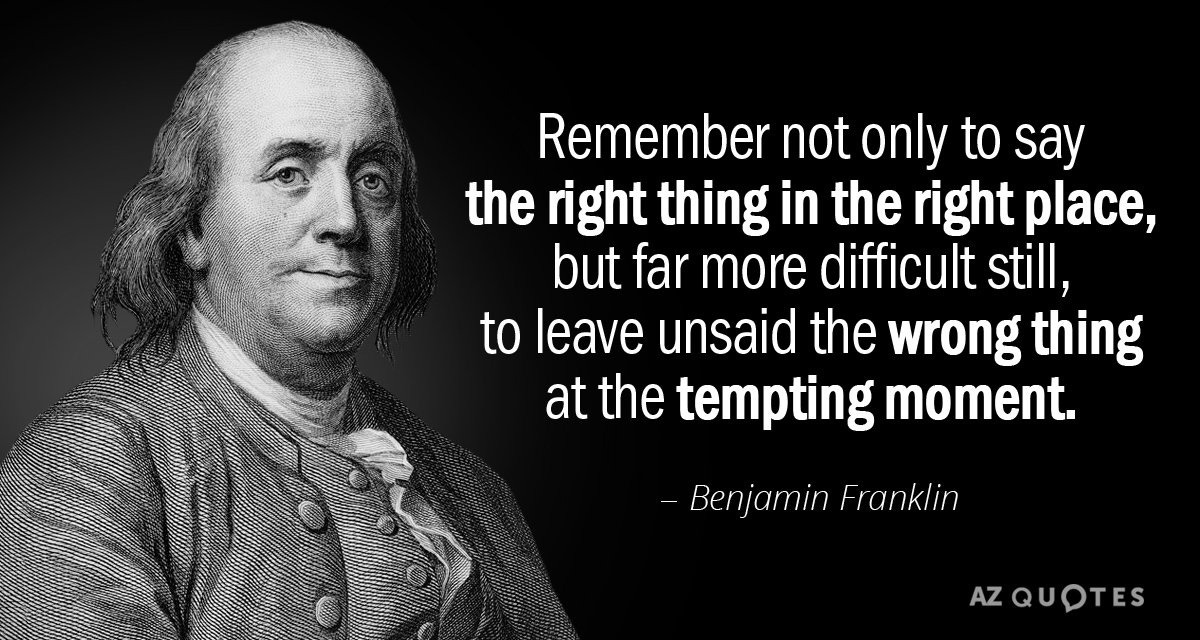
Reader’s note: Reminder that Rung Four is “Correct action follows correct opinion.” This has echoes in Buddhism (which focuses on, both Right Action and Right Speech in its precepts. It also dovetails into a book I’m reading by a Brazilian rabbi who posits that the body is the seat of law and order, and the soul imbued with the mission of disobedience and transgression: “There are two ways of honoring natural traits that hold true for all living beings, but only human beings have consciousness of this. The human difference is that we are aware not only of our body but also of our soul, of laws and acts of disobedience [me: think the core one in the Adam and Eve tale]. We can obey while disrespecting just as we can disobey while respecting.” How are you going to be able to thread that needle in the moment? Correct opinion. You need to know what’s what, and you need to know the law deep down. Now, in the first post for this chapter, Franklin shared an anecdote and wished folks, who poorly use reason, just didn’t have it a tall: common sense, natural instinct, would be better then. But, in general, if you can think things through, and think them through well, and that is very slippery and always changing … well, Franklin argues that would be better. So, let’s be better …
This small sub-chapter has a big promise in a few words: “How to think rightly.” I purposely didn’t rules and exercises in this opening chapter because I hadn’t read this sub-chapter yet. That would be putting the cart before the horse in the worst way.
Here’s opening argument:
“Accepting the possibility that we may be prone to err in our thinking and that … ”
“Unimproved reason is a blind guide to human behavior, … ”
“We are compelled to ask; ‘What can be done to assure that we do think rightly?’”
The worry of human life is captured in that short sentence: If I am a small thing who doesn’t know everything, and I can use reasoning for self-justification and rationalization, how can I know I’m doing the right thing? There are many answers. Some people say something feels right; they may be giving short shrift to all the thinking, reading, talking and experiencing that goes into that sharp intuition—but, to them (and to me, really) the gut feeling says when something should be done or not. Some people say something can be proven right through reason or argument; if you follow the logic to its conclusion, we can feel good that this is the right thing to do given these circumstances and this logic.
George L. Rogers starts off with the opening sentence above, then quotes from American patriot Patrick Henry’s “War Inevitable” speech: “ … whatever anguish of spirit it may cost, I am willing to know the whole truth.”
So, says Rogers, “Franklin realized that the only remedy to faulty reasoning was to seek out and be receptive to truth, no matter how painful it might be.”
Well, that sounds hard. “Anguish of spirit.” “No matter how painful it might be.”
The truth hurts. If we’re willing to bear that pain, to fight against “that part of our self-esteem that insists on being right, even when we are wrong,” what lessons can we draw from Franklin’s example, and is there any practical guidance for how to manage our moment-to-moment life?
“By calmly discussing rather than warmly disputing, the truth is more easily obtained.” It is fun to argue about things with heat. It is easier to do it if you’re willing to be wrong about what you were arguing a moment before. So, I’d encourage you either to stay calm and reason slowly through things, if you’re afraid of being wrong ever, or fly head-strong into possible error in order that “knowledge should increase” but you may be thought inaccurate ultimately. Be excited to defend your ideas, but be excited to be proven wrong. Don’t let that little stiff wall inside you hold off truth once you can’t argue for what you want to be true. Switch sides! Or fall into a curious, “Well, you might be right … let’s dig more … ” As Franklin writes in a letter acknowledging he was wrong about a guess in the glass conducting of electricity, “suppositions, however ingenious, are often mere mistakes.” But that’s okay: “I find a frank acknowledgment of one’s ignorance is, not only the easiest way to get rid of a difficulty, but the likeliest way to obtain information … ”
Be curious. How will you learn the truth if you don’t ask questions to know the truth? Will the truth just march out and force you to learn it? Likely not. There’s a great example of Franklin as an early storm-chaser trying to divine what in tarnation is going on with that weird air behavior (hey, dorks in vans chasing tornados, you have a historical forefather!). Franklin whips his horse up and they run after a dust devil that grows and grows. After he runs away when it gets too big, he stumbles onto his host and the rest of the party he left behind on his short adventure: “Upon my asking Colonel Tasker if such whirlwinds were common in Maryland, he answered pleasantly: ‘No, not at all common; but we got this on purpose to treat Mr. Franklin.’” Isn’t life more of a delight if you run around enchanted by the normal workings of the world? Even if we can all employ the cheat code, during our snatches of wonder, to Google why that dust devil can’t be “turned off” when a whip of our horse-buggy whip to interrupt the strange flow of cyclical air.
Franklin’s process for answering a question divined by Rogers:
Getting the facts. Are you sure you’re even asking the right question? Are all the things what you think they are? And how could you figure that out? For instance, Franklin shares an anecdote he heard about gentleman standing around giving reasons for why a device they assumed was a Chinese shoe was to be worn. This way or that way, and why would they wear it that way? A woman walked up and tried putting it on. After all, how they could argue reasons for wearing it if they weren’t sure it was a shoe at all.
Acquiring knowledge. How did he do it? A man close to my heart, he read. The difference between Franklin’s reading habits and mine is he spent the rest of his time on fruitful endeavor: “This library afforded me the means of improvement by constant study, for which I set apart an hour or two each day … Reading was the only amusement I allowed myself. I spent no time in taverns, games or frolicks of any kind … ” I feel judged.
Seeking out the opinions of others. Examples given include his Junto club, which used prompt questions to encourage members ready to show up to share things they’d learned (“Have you heard lately of any citizen’s thriving well, and by what means?” or “Have you met with any thing in the author you last read, remarkable or suitable to be commuted to the Junto?”), as well as his hesitation to write back about a paper because he couldn’t find any fault and dearly wanted to provide some assisting suggestions in some ways: “I am persuaded you think, as I do, that he who removes a prejudice or an error from our minds contributes to their beauty, as he would do that of our faces who should clear them of a wart or a wen.”1
Evaluating information. “No one is ever wholly right or wholly wrong in all the things they think and do,” writes Rogers. So, wisdom from the mouths of babes, stopped clocks being right twice a day, and fools having right opinions. Judge the opinion not the opinion-haver. (I agree with my politicians, so they’re right! A conspiracy theorist and a government expert? The expert has to be right!). And, hypocrisy, so what? Rogers quotes Franklin quoting probably someone else who wrote it: “Altho’ thy teacher act not as he preaches, / Yet ne’ertheless, if good, do what he teaches … Thus like the whetstone, many men are wont / To sharpen others while themselves are blunt.” There’s a back-and-forth between Franklin and a judge on the legitimacy of the king conscripting just merchants and sailors to do his work (versus, say, a general draft). Franklin says it’s unfair to conscript one industry like that and not others, and he ends with a knock against the length of the judge’s paper: “This author could not well have made his argument shorter. It required a long discourse to throw dust in eyes of common sense, confound all our ideas of right and wrong, make black seem white, and the worse appear the better opinion.” Jeez, Franklin—mee-YOW.
Using moral algebra. Franklin loves charts. If you love charts, you’ll love his “pro” and “con” list.2 You’re familiar with the pros and cons. He takes a few days, putting them on one side or the other of a tough decision. Then he sits down to take stock: “When I have thus got them all together in one View, I endeavour to estimate their respective Weights; and where I find two, one on each side, that seem equal, I strike them both out: If I find a Reason pro equal to some two Reasons con, I strike out the three. If I judge some two Reasons con equal to some three Reasons pro, I strike out the five; and thus proceeding I find at length where the Ballance lies; and if after a Day or two of farther Consideration nothing new that is of Importance occurs on either side, I come to a Determination accordingly. And tho’ the Weight of Reasons cannot be taken with the Precision of Algebraic Quantities, yet when each is thus considered separately and comparatively, and the whole lies before me, I think I can judge better, and am less likely to take a rash Step; and in fact I have found great Advantage from this kind of Equation, in what may be called Moral or Prudential Algebra.” If you’re a reason/logic nerd, maybe this subjectively mathematical play on decision-making might be fun. I’ll try to keep it in mind.
What can you draw from the examples and edicts?
Do you have a difficult decision to use with Franklin’s moral algebra? Can you take a beat and wonder whether you’re dismissing someone you disagree with or agreeing with someone you like on some truth just because of who they are? Do you reach out to others for solid, varying and expert advice when trying to learn things? Do you read enough—widely enough? And before asking a question, do you ask yourself whether you already know the crucial facts about another truth before you start?
This advice, in this chapter, like faith in God from Rung Three, is a world’s work of self-reflection and action. Taking all the advice from this chapter to heart and trying to put it into use would mean asking everything about the world and being open to being wrong about all of it. That’s a tall order we humans, with habits, routines and values, can have a hard time living with and sitting in all the time.
But, maybe, today … or this week … take one sliver to heart of Franklin’s ideas on discovering correct opinion to lead to your correction action?
Good luck, friends …
Read a lengthier treatment here with the full letter excerpt.
No posts
Comments
Nothing yet. Say the first thing.
Sign in to join the conversation.