
Last weekend I was in Florida for my good friend Laser’s wedding (which was awesome) and was honored to give a brief 1-2 min toast between dessert and dance time. This type of thing makes me more nervous than giving a 90 min talk in front of thousands people. I kept it real, got some laughs, and was told it was very me. Big relief!
There’s a trope about product managers being “mini CEOs”. It never sat well with me. I recently had some wifi issues at home and have been toying with the idea that PMs might be more like CEO amplifiers than mini-CEOs.
Here’s what I mean: imagine a mesh wifi network in your house. You’ve got a main router generating the signal. Then you’ve got mesh routers placed around the house that pick up that signal and amplify it.
The CEO is the router. They set the vision, the strategy, the priorities. They generate the signal.
The PM is a mesh router. Their job is to tune into that signal and make sure every decision in their corner of the product is consistent with it. PMs amplify the CEO.
CEOs don’t want their PMs to be mini-CEOs, but they do want PMs who make decisions the way the CEO would if they were sitting in their seat (assuming they were looking at the same information and had the same “on the ground” context).
Does this make any sense? Keep me honest.
Last week I learned that LinkedIn required their top R&D leaders do 15 hours of vibe-coding homework before an offsite. Not optional - mandatory. These are people with decades of experience in technology. Some of the best tech execs in the industry.
And many of them came back and said the same thing: "I was hearing about it. I was learning about it. I was even talking about it. But I had never actually done it."
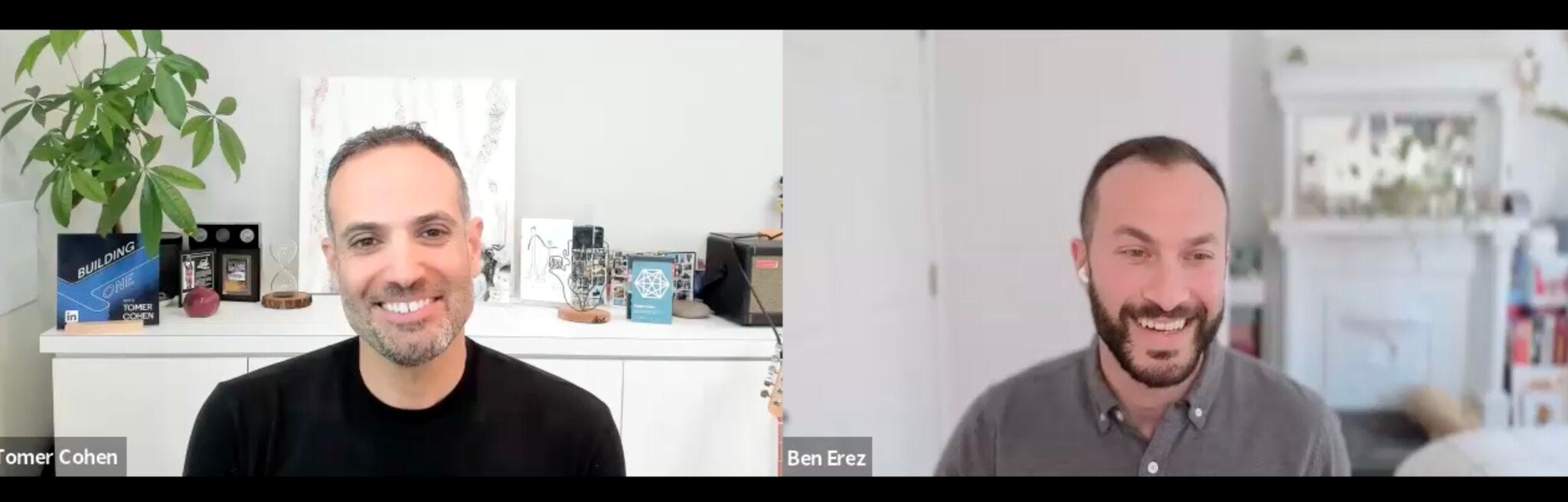
Tomer Cohen (former Chief Product Officer at LinkedIn who recently left after 14 years with the company) shared this story during a fireside chat I hosted with him - recording below.
This story stuck with me more than anything else we discussed bc this is the gap I keep seeing everywhere. Not a knowledge gap - but more of an "agency gap". People know AI is important. They read about it. They have opinions about it. They can hold a great conversation about it at dinner. But so many haven't sat down and built something with it. And until you do, you don't really understand it. You're operating on perception, not experience.
Tomer put it simply: AI literacy is not the same as AI agency.
The leaders who came out of that offsite didn't just learn a new skill. They changed how they thought about what was possible. And that shifted how they led their teams. And if some of the most senior technology leaders at LinkedIn needed a forced deadline to close that gap, the rest of us probably aren't immune either.
You might not need need 15 hours. Start with 2. Pick a real problem you have. Not a toy project. Something you actually care about solving. Then sit down with the tools and take a stab at building it. Building is how you close the literacy<>agency gap.
Marc and I recently shipped our sixth Insider Loops PM interview guide, this time unpacking Google’s loop. This one felt different bc there really isn’t just one track - there are different paths.
After spending a few weeks talking to Google PMs across different orgs and candidates actively going through the loop, we realized that Google's PM interviews are going through so much change, that there's variance even within Google insiders about the current interview process. Here’s some of what we found:
Standalone behavioral questions like "tell me about your biggest weakness" have mostly been phased out across Google.
They still evaluate Googleyness and leadership, but it comes through how you handle product and execution questions now, not through dedicated behavioral rounds.
Estimation is evolving in parts of the org too, moving from standalone Fermi problems to analytical thinking embedded in product context.
The technical/system-design round for PMs got replaced in mid-2024 with an execution and cross-functional round.
No more algorithm questions, but they still expect technical fluency throughout.
Our Google guide covers the full process across orgs (excluding Waymo and DeepMind which are their own thing), including what's changing and what's being evaluated in each of the interview loop variants.
My first few attempts at running a podcast died in the first 10 episodes.
When Marc and I started the Supra Insider podcast, we knew the survival rates were super low. I think 90% of podcasts do not make it past three episodes. And of the 10% that survive past three episodes, roughly 90% of those die before episode 20.
So when we recently shipped episode 100, it felt really special. Mainly because of the relationship with Marc, our process, and culture that allowed us to publish every week for two years. It's all been very intentional.
To celebrate, we recorded a short but special 100th episode reflecting on what we've learned and how we're thinking about the future of the pod. We call these episodes without a guest "one-on-one-isodes" and they're some of our favorites.
At the end of the episode we riffed on podcast longevity, contrasting two podcasts we believe have staying power: Acquired and TBPN. These two couldn't be more different from one another.
Acquired has been running for 10 years. They publish a single four-hour episode every few months. The content is so thoroughly researched that episodes from years ago are still worth listening to today. Their catalog compounds.
TBPN has been running for about a year. They go live for three hours every single day, five days a week. The content is day-of relevant. Yesterday's episode is already stale. There is zero catalog value.
Two completely different approaches, both working really well. So what do they actually have in common? A few patterns I noticed:
Two co-hosts who love talking to each other
An obsession with getting better over time
A commitment to making the show feel authentic and true to who they are
Designing the show to fit their life instead of forcing their life to fit the show
Refusing to let outside pressure turn the show into something it isn't
Supra Insider looks nothing like those shows. We're a weekly conversational podcast about PM careers, product leadership, and the tech industry. We're not four-hour deep dives. We're not a daily live show.
But when I look at Acquired and TBPN, some of it feels like looking in a mirror. Marc and I talk every day. We make changes to the show constantly. We protect the recording slots like they're sacred. And we've never once optimized for anything other than "does this feel right for us."
That's what got us to 100. And I think it's what will get us to 1000 🚀
We also recently published a couple episodes with awesome guests 👇
So many people tinkering with AI tools right now are committing the cardinal sin of "solution in search of a problem".
I've asked friends buying Mac minis and setting up OpenClaw what problem these solved and get "I'm just exploring" or "nothing yet".
This is no different than building solutions in search of a problem. Just instead of building a product, it's building a toolkit or setup.
As product people, we know that solutions in search of a problem are bad places to spend time. But when the FOMO is strong enough, even experienced product people get sucked in.
Don't get me wrong, I love tinkering. But I forced myself to do what I'd tell any PM to do: I started with a problem.
I identified one specific, annoying, repeatable podcast workflow that required AI. After every podcast episode, our teammate uploads the transcript to Google Drive. Then, I would:
pull it into Claude
brainstorm episode titles
brainstorm ideas for how I'd write about the episode on LI
draft the post for the idea I like best
This felt like a good candidate for a workflow to automate with an agentic system.
I looked at options and landed on Zo, which is essentially a personal computer in the cloud with AI built into it. What caught my attention about Zo was that it could connect to Google Drive, run scheduled tasks on its own, build reusable skills, and text or email me. Everything the OpenClaw crowd was raving about, but easy and secure.
I wired up the exact workflow I was already doing by hand and have it run every day without me touching it.
🤖 My Zo agent has a scheduled task to check Google Drive daily for a new transcript.
🤖 When it detects one, it pulls it in, generates a folder with title ideas and post concepts, and emails me when it's done.
🤖 If there's no new transcript, it still emails me with a "no update" update.
🤖 I built custom skills inside Zo for title generation and post ideation, and a separate voice transformer skill trained on my past writing so the output actually sounds like me.
This one workflow solved a problem I could name clearly before I ever opened the product. The people getting real leverage from this wave of AI tools aren't the ones with the most impressive setups. They're the ones who start with a clear problem and work backwards to the tool.
Same principle PMs have always known, just applied to tooling instead of product development. Marc & I got into all of this with Ben Guo (co-founder & CEO of Zo Computer), in episode 101. If you're feeling pressure to tinker with AI but aren't sure how it can actually improve your life, I think you'll love this conversation.
Anyone can build products now but almost no one can get anyone to care. That's the trap of the AI age. Building has become the easy part. Standing out is hard. And the only way to do it is with a unique and memorable point of view. You gotta be opinionated!
We just published our first ever in-person episode of Supra Insider with Elan Miller, my friend of 20ish years, where we hit this whole topic head on.
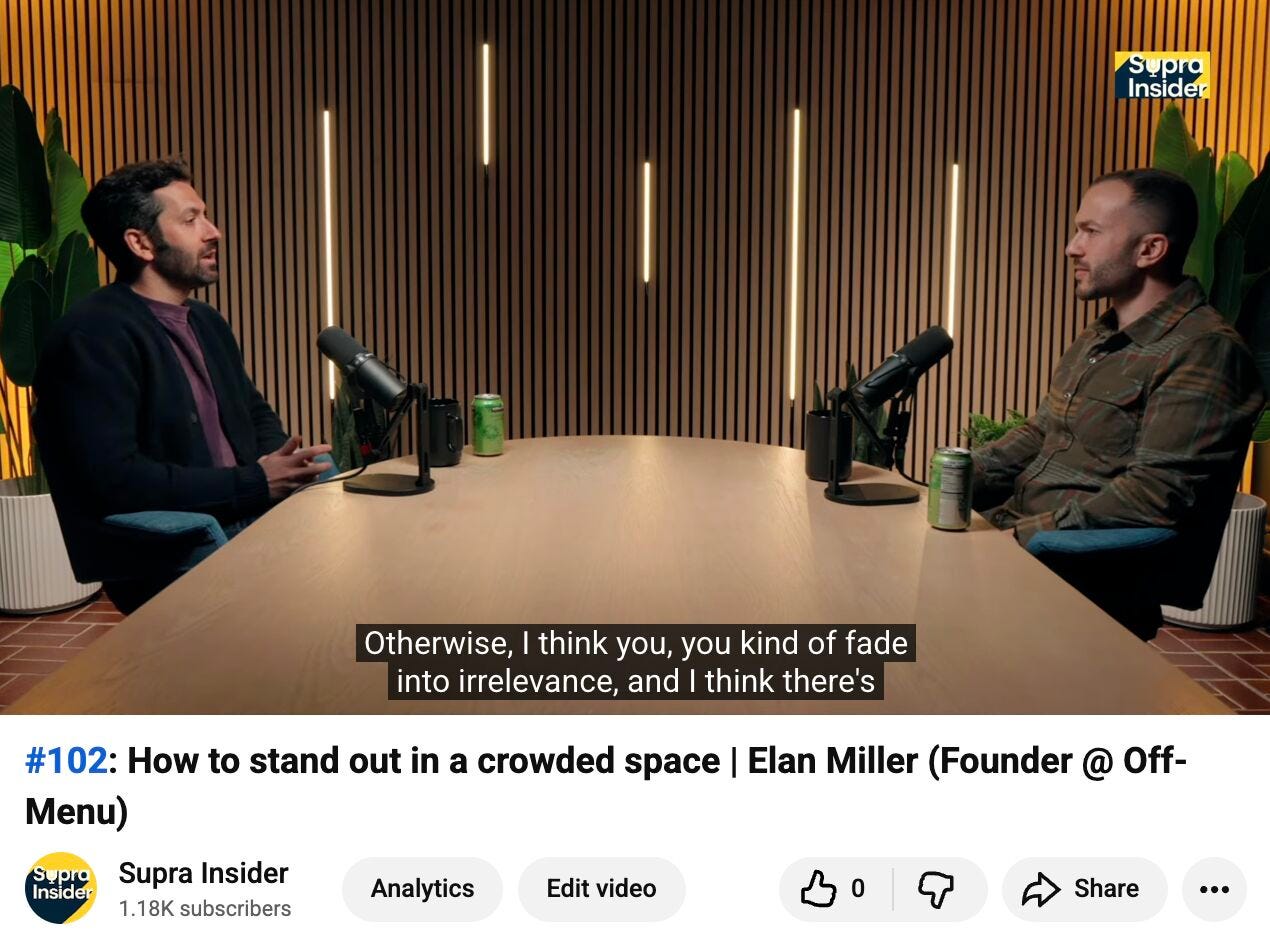
Here's what stuck with me from my convo with Elan:
Personal branding matters more than ever. When anyone can build anything, the differentiator isn't the product - it's who's behind it and what they stand for.
Tasteful positioning wins. Look at Claude and Anthropic. No ads. No slop. They built a brand that screams "we have standards." And it works - great positioning attracts your people AND repels the rest.
Brands that stand for something repel people and that's the point. If everyone likes you, you're probably not saying anything worth hearing. The best brands are magnets for their people and turn off everyone else.
Your brand story is a recruiting weapon. In the talent war, the companies with clear points of view win. People don't just join companies - they join movements.
The episode goes deeper on all of this. Talking with Elan is always a masterclass in thinking clearly about brand, identity, value, and messaging. You're going to love it.
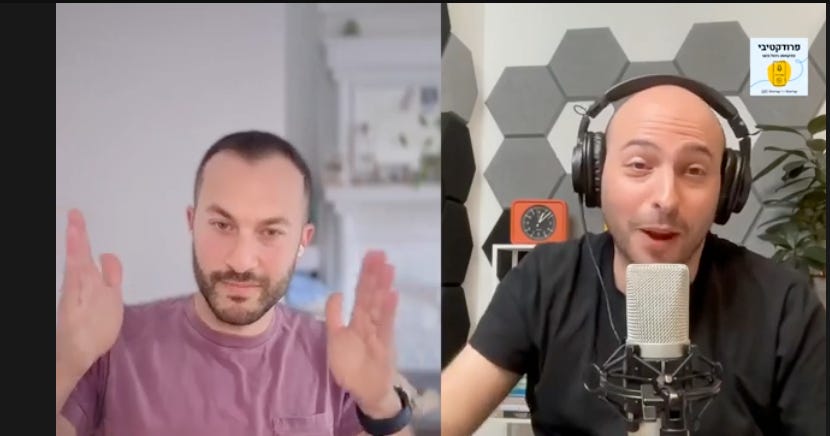
I joined Ran Erez on his product management podcast, Productivy. People wonder whether Ran Erez and I are related. It’s flattering because he’s a more gifted PM and podcast host than I am.
In the conversation, we explored the PM lessons that can be learned from the process that led to my AI practice copilot. Ran’s conversations with PMs are to-the-point in typical Israeli “תאכלס” culture, but were always in Hebrew... which made them inaccessible to 99% of the PM world.
So we did this one in English to broaden the appeal. Hopefully a good tradeoff!
If you’re thinking about how to package your expertise or if you’re a product builder looking to hear a new perspective on building products that are possible with AI (but not necessarily AI products), I think you’ll enjoy this conversation.
P.S. while Ran and I are not related, we learned that both of our grandfathers changed their last name to Erez. We suspect they chose it because Erez is the Hebrew word for Cedar tree, which symbolizes “strength, longevity, and nobility in Jewish tradition”. It’s nice to have a name that makes you want to deserve it 💪
You can check out the full episode on YouTube here.
While everyone’s doing layoffs, OpenAI is reportedly planning to double headcount to 8,000 people. That means a lot of PM hiring.
We launched our Insider Loops guide for OpenAI's PM interviews in February and it's already our best seller (Stripe and DoorDash following shortly behind).
I'm sure the OAI loop will evolve quite a bit in the coming months and we have dozens of candidates feeding us regular insights from the interviews, which we bring into our guides in breakneck speed. Nobody updates guides faster than us.
Stripe product leader Stephanie J Neill posted that Stripe is opening applications for their “Product Manager: New Grad Accelerator” program. This isn’t a traditional PM role. They’re looking for early-career engineers, designers, and data analysts who are highly autonomous and deeply immersed in AI-native workflows.
If you spend your time tinkering in Claude Code or Cursor and refining your own skills.md files, this is for you.
You’ll be paired with a host team for 12 months to take acute user problems from discovery to deployment. Learn, ship, repeat.
If you care deeply about quality, thrive in ambiguity, and want to help us define the next archetype of product building, come join us.
📍 SF, Seattle, or NYC (In-person)
⏳ Apply by April 24, 2026
🔗 Link to apply: https://lnkd.in/e8_zp5QY
Lastly, Lenny Rachitsky just dropped his latest “state of the product job market” report, which I’m excited to dive into 👇
David Senra’s interview podcast has been excellent. I loved his interviews with Jason Fried, Tobi Lutke, and Michael Ovitz.
Halfway through Bonehunters (book 6 of the Malazan series). I blame Laser for hooking me. Yes, the same Laser from the wedding. How many Lasers do you think I know?
Carole and I watched Sinners the other night. Was… different. Entertaining but definitely not best actor performance IMO.
I can’t wait to watch Project Hail Mary - I loved the book.
I’m hosting an in-person morning fireside chat in NYC on April 2nd with Rishin Banker, VP Product at Maven, about the blurring lines between PM/eng/design. Request invite here (30 seat cap). Excited to experiment with IRL events.
At the end of May, Marc and I are heading to Toronto for a live recording of the Supra Insider podcast in front of an audience of a couple hundred people (part of the Toronto Product Conference, which is generously hosting us). It’ll be my first time in Toronto and our first time recording live in front of an audience. Can’t wait.
🕵️♂️ Insider Loops. Company-specific PM interview guides for OpenAI, Google, Stripe, DoorDash, Uber, and Figma (more coming soon). Rigorously researched and continuously updated with Marc Baselga.
📚 My self-paced PM Interview Bootcamp: Product Sense & Analytical Thinking. Selected by Lenny Rachitsky as a top product course on Maven (rated 4.9/5.0).
🤖 My AI Practice Copilot for PM Interviews. Unlimited practice reps with calibrated feedback on Product Sense & Analytical Thinking questions. It’s like having a calibrated interview coach available 24/7. Over the past year, my Copilot has helped dozens of PMs land roles at Meta, Google, OpenAI, Stripe, DoorDash, Uber, Datadog, Monday.com, and more. Testimonials on the site.
🧠 My Product Sense Interview Template. Free Google sheet template for practicing product sense questions. Make a copy and get as many reps as you’d like with my frameworks. Updated regularly and fully compatible with my AI Copilot. My guest post on Lenny’s Newsletter: The definitive guide to mastering product sense interviews.
📊 My Analytical Thinking Interview Template. Free Google sheet template for practicing analytical thinking questions. Make a copy and get as many reps as you’d like with my frameworks. Updated regularly and fully compatible with my AI Copilot. My guest post on Lenny’s Newsletter: The definitive guide to mastering analytical thinking interviews.
🤝 Interested in coaching? I offer 1:1 coaching and a premium coach-matching service. Learn more on my site.
No posts
Comments
Nothing yet. Say the first thing.
Sign in to join the conversation.