
Writing this from my living room while the snow continues piling up outside and the blizzard is in full swing. Everything in NYC is basically closed because of the 20+ inches of snow. George is loving the powder (esp eating it - which is basically him chugging water in solid form). Gaia is enjoying an extra day of weekend-only TV time while Carole & I are staying afloat.

I’m more excited about work than ever, while simultaneously having less hours to work than ever. My life this year so far is basically down to family, work, health/gym, and sleep. I’m doing a lot and it feels full.
Yet, I perpetually feel behind.
I don’t know exactly what I’m behind on, but I’m sure there’s something.
Here are a few that my various inboxes are baiting me about:
If I’m not automating my whole life with AI, I’m a laggard.
If I’m not buying a Mac Mini to configure OpenClaw, I’m a dinosaur.
If I’m still doing anything the old way, I’m a boomer.
If I’m not spending hundreds of dollars per month on tokens, I’m under-leveraged.
etc etc etc
Every minute not spent tinkering with AI is making me fall behind… right?
Come on. What a depressing way of thinking!
In a world where tools are proliferating faster than the population of South Williamsburg, it seems to me that the ability to embrace the uncomfortable FOMO of not playing with every single thing is a superpower.
What if the best thing I can do is less, not more?
In her awesome post today, how to be an idea factory, my friend Hilary Gridley wrote about how AI might be able to help us do less. And now I feel behind because I’m not using AI to learn how to do less.
You get the idea.
This will only continue, too. Things won’t slow down anytime soon.
My thinking will keep developing but for now, here’s the story I tell myself:
AI tools are a new category of tools. Tools will get better, faster, and cheaper. This will accelerate at a pace none of us can imagine.
The most important thing isn’t using every tool. It’s being insanely focused. Picking the right areas to spend my time, defining the top problems to solve, scoping the right solutions to these problems, and executing intentional experiments to test solutions in the market.
All the while, I need to be incorporating my learnings from experiments into how I think about the next wave of work.
This means I can’t plan too far ahead. I need to stay nimble and as long as I’m excited about what I’m working on for the next 1-2 weeks, that’s the best way to spend my time.
Worrying about falling behind isn’t productive - shipping and learning is the way.
If a new tool comes along that clicks for me, I’ll try it out. But I won’t invest 30 hours to tinkering with a tool that may or may not help me hit my goals.
That’s a conscious tradeoff: I’m fine with being in the first 1% to adopt new tech instead of the first 0.1%. And I’m happy to ignore a lot of tools as long as I adopt the ones that are truly going to make a difference for me.
Being an early adopter is not in itself the goal.
The goal is staying focused and executing intentionally and consistently.
Tools that helps me hit my goals will get my fullest attention as I go.
Here are some of the things I shipped since my last post in late January: our OpenAI guide is live, four new episodes of the podcast are live, and recordings from two lightning lessons I hosted are available. Details below.
Since launching Insider Loops last September, the most common request Marc & I have received for new guides is OpenAI.
So we got to work over the last couple months and had a bunch of off-the-record convos with insiders, as well as a handful of PMs who recently went through the OpenAI loop. The result is our first guide for a major AI lab’s PM interview process.
OpenAI is raising at a $850B valuation and our Insider Loops guide breaking down their PM interview process is now live.
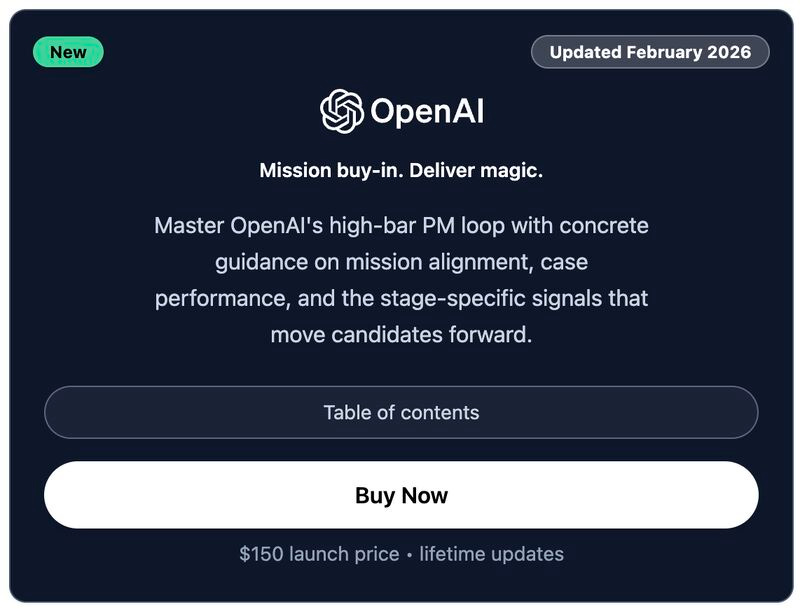
We launched the OpenAI guide at a lower introductory price of $150 because we had fewer insiders and debriefs to draw from compared with our more mature guides.
That said, we're still highly confident in the guide's accuracy and usefulness today: it captures the core filters, stage-by-stage expectations, and preparation strategy that matter most for OpenAI.
As we add more proprietary interview intelligence in the coming weeks, we'll continue enriching the guide and increase the price accordingly. Since buyers get lifetime access to guide updates, we want to let people lock in the early bird price.
Based on early feedback, we’re confident bringing the price up to $200 within the next week.
P.S. more guides are in the works and our existing guides for Stripe, DoorDash, Figma, and Uber are getting better every month based on real-time insights from PMs
I hosted a 90 minute solo session on Feb 10th, packaging up the advice I find myself repeating to people who ask me about fractional work and solopreneurship (full recording here). I’m honestly really proud of how it came out.
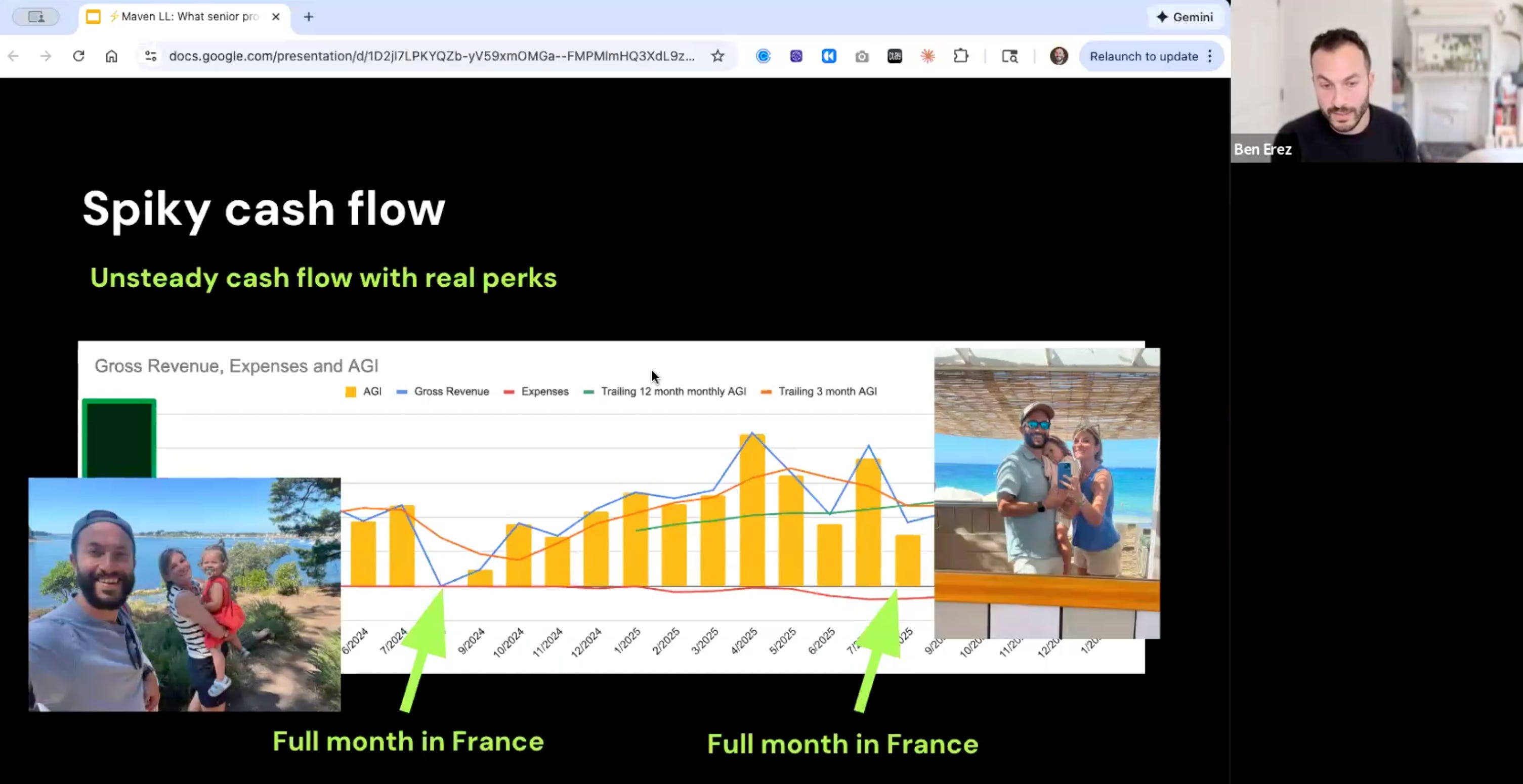
Some of the big buckets I covered in the session:
What fractional work actually is (and isn’t)
Why the right starting point is your constraints
How narrow positioning helps drive business
Why most sustainable fractional setups combine multiple types of work instead of relying on one role or one client
The difference between perceived risk and actual risk with this path
The importance of being intentional with designing your portfolio career
I hosted a session with Tal Raviv and Aman Khan on Feb 3rd where I shared a new framework I’ve been developing for designing PM interviews to evaluate AI fluency. We had ~2.5k signups and hundreds joined live. Full recording here.
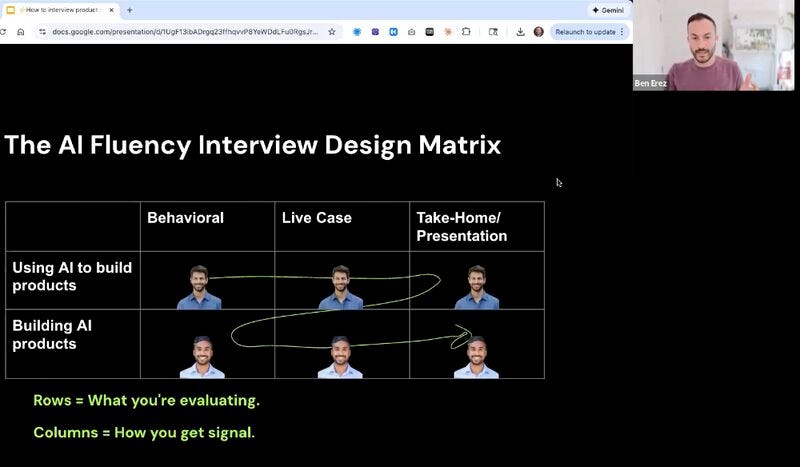
Some of the key ideas we covered:
Interview design requires tradeoffs. There is no perfect loop. Every interview should have a clear job to do, and if two interviews do the same job, one should probably be cut.
Using AI ≠ building AI. Using AI tools to ship faster builds intuition, but it’s not the same as having shipped AI features to production. Teams need to be explicit about which one they actually care about.
Behavioral, live cases, and take-homes surface different signals. The same competency can be evaluated in multiple ways, but you should be intentional about where you want depth.
Live cases are especially revealing for AI fluency. Watching how someone actually works with AI in real time often reveals more than how they describe it after the fact.
Judgment matters more than tool choice. Fancy prompts or tools don’t matter if the candidate can’t explain when to use AI, when not to, and how it actually changed outcomes.
Candidate experience is a product decision. Timeboxing take-homes, giving sufficient context, and being explicit about expectations directly affect signal quality and who opts out of your process.
A talent leader recently pinged me they’re hiring a product recruiter. I asked around for referrals and was truly surprised what I heard back.
Multiple versions of: “Tell them good luck. it’s impossible right now”. And that’s from recruiting leaders I trust!
My reaction: “wait wait wait... what?”
I’ve been operating under the assumption that there are tons of strong recruiters available because so many companies slashed their recruiting teams. So when someone asked me if I knew a great product recruiter, my instinct was, “there must be a ton of them - one sec...”.
And apparently - nope! There’s a surprisingly intense squeeze for top recruiters. They’re almost impossible to hire. Had no idea.
So I asked, “why is this happening?”
Not because companies aren’t hiring.
Not because the recruiter role isn’t important.
It’s because the top end of that market is extremely constrained.
So I asked “why is that the case?” and heard two factors back:
The last cycle of tech didn’t actually produce that many truly great recruiters.
The ones who are great tend to have extreme agency. They’re either in the best job already, or they’ve gone independent and built their own platform.
Basically, the best recruiting talent is either operating at the top 1% of companies or working for themselves.
Hmm.
We keep saying it’s a buyer’s market for talent. And overall, that might be true. But when you zoom in on specific high-leverage IC roles, the market may still be structurally tight.
The truly strong ones don’t float around for long. They choose environments. Or they create them.
Which forces a tougher question for hiring managers: if you can’t hire the top 1%… are you building a system that can grow someone into that tier?
And is recruiting unique constrained? Or is the top 5% of IC talent simply concentrated than we want to admit across the board?
Joe Rogan Experience #2443 - Filippo Biondi. Filippo led the team that discovered the mega structures beneath the great pyramids on the Giza plateau using ground penetrating radar. Those of you who follow my newsletter know I’m fascinated with ancient civilizations (post and another post) so this was an absolutely delightful episode for me.
Make Something Heavy “We’re creating more than ever, but it weighs nothing.” This is like an anti-slop manifesto that deeply motivates me. I aim to make heavy things.
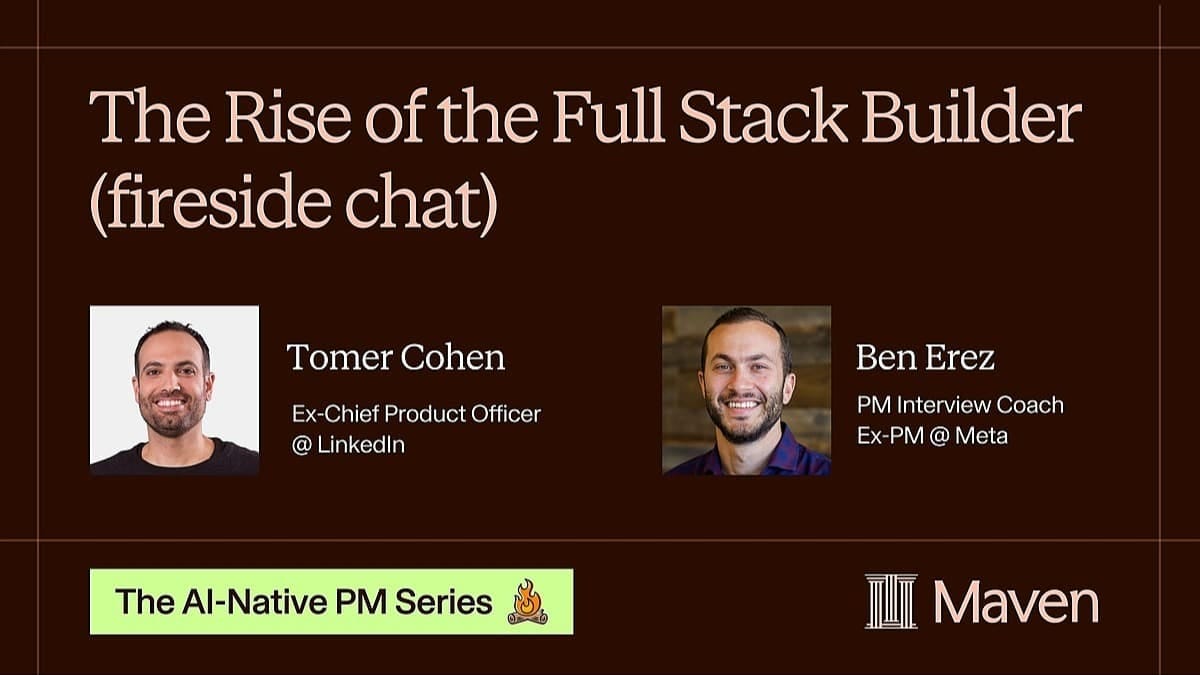
I’m excited to be hosting a fireside chat on Wednesday March 18th with Tomer Cohen, who recently left his role as LinkedIn’s Chief Product Officer after 14 years with the company.
The topic is about the rise of the full-stack builder. You can sign up here to join the live event (you’ll get the recording emailed to you after if you can’t make it).
My goal is to always create more value for the community by sharing free content than I can ever capture with my paid offerings (e.g. I have no plans to monetize this Substack). But if any of the below looks interesting to you, I invite you to take a look:
🕵️♂️ Insider Loops. Company-specific PM interview guides for OpenAI, Stripe, DoorDash, Uber, and Figma (more coming soon). Rigorously researched and continuously updated by me and Marc Baselga.
🎥 Self-paced course: Product Sense & Analytical Thinking Bootcamp for Meta-Style PM Interviews. Selected by Lenny Rachitsky as a top product course for Lenny’s List.
🤖 AI Practice Copilot for Meta-Style PM Interviews. Unlimited practice reps with calibrated feedback on Product Sense & Analytical Thinking questions. It’s like having a calibrated interview coach available 24/7. Over the past year, my Copilot has helped dozens of PMs land roles at Meta, Google, OpenAI, Stripe, DoorDash, Uber, Datadog, Monday.com, and more. Testimonials on the site.
🧠 Product Sense Interview Template. Free Google sheet template for practicing product sense questions. Make a copy and get as many reps as you’d like with my frameworks. Updated regularly and fully compatible with my AI Copilot. My guest post on Lenny’s Newsletter: The definitive guide to mastering product sense interviews.
📊 Analytical Thinking Interview Template. Free Google sheet template for practicing analytical thinking questions. Make a copy and get as many reps as you’d like with my frameworks. Updated regularly and fully compatible with my AI Copilot. My guest post on Lenny’s Newsletter: The definitive guide to mastering analytical thinking interviews.
🤝 Ben’s premium coach-matching service. White glove service in which I match PM candidates with calibrated interviewers from their target companies. Fully confidential and quick to start.
No posts
Comments
Nothing yet. Say the first thing.
Sign in to join the conversation.