
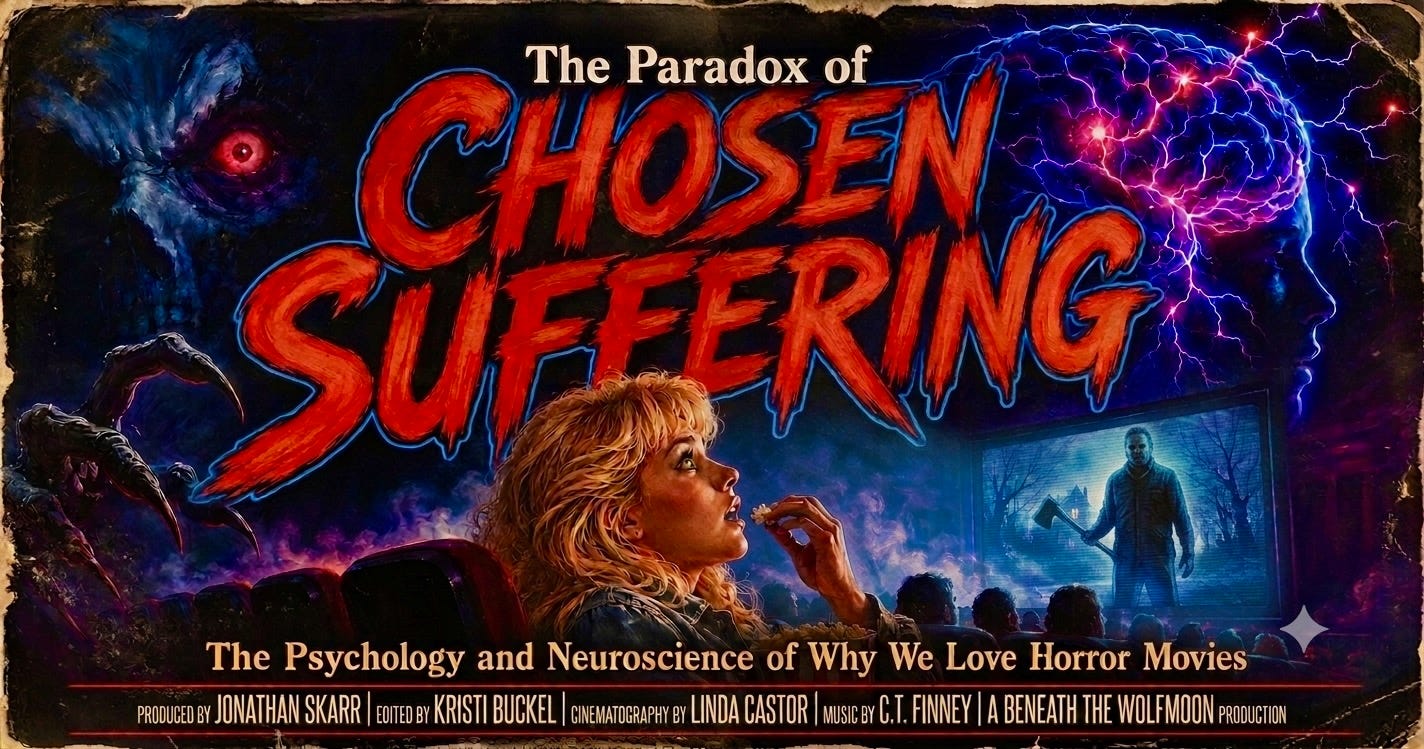
Think about the absurdity of eating a ghost pepper. You sit down at a table and put something in your mouth that your body registers as a chemical burn. Your eyes water. Your skin flushes. Your nervous system begs you to stop. Then you take a breath and go back for another bite.
On paper, engaging in pain-inducing activities for pleasure makes no sense. Yet suffering is clearly on the menu of human recreation: sour candy, rigorous exercise, BDSM. Psychologists call this phenomenon “chosen suffering,” and it is not a glitch. It is one of the most sophisticated hacks our biology has produced.
And nowhere is the paradox more apparent than in horror entertainment. Horror fans like me pay hard-earned money to sit in dark theaters and watch people get hunted by monsters (human or supernatural, pick your poison). We stay up past midnight with a novel about a serial killer that has us double-checking the locks on our doors. Whatever the format of the terrifying story, something specific is happening in your brain during those moments.
Comfort: Too Much of a Good Thing
To understand why anyone pays to be terrified, let’s start with a more basic question: does pure comfort truly satisfy us? Psychologist Paul Bloom examines this topic in his book The Sweet Spot (Bloom, 2021), arguing that human beings do not thrive in pure, consequence-free comfort. That sounds counterintuitive, right? We think we want comfort and pleasure unending. But put someone in a perfectly cushy, temperature-controlled room with every need instantly met, and they do not stay fulfilled for long. They get miserably bored. Without friction, there is no traction.
We need effort to establish value. There is a term for this: eudaimonia. It is a deeper, purpose-driven form of happiness, as opposed to fleeting hedonic pleasure like eating candy (Ryan & Deci, 2001). We assign greater value to those experiences that cost us something.
Horror entertainment is that concept in practice. A scary story charges an emotional toll on us before it pays out. You spend ninety minutes, or two hundred pages, in dread, and “surviving” the horrific events delivers a dopamine bath because your body believes you’ve earned it. The pleasure isn’t free. That’s exactly why it works.
But earning implies risk, and watching a horror film from a couch is not dangerous. So what exactly is going on with your body and brain during these experiences?
Benign Masochism: The Safe Threat
This is where Paul Rozin’s theory of benign masochism comes in (Rozin et al., 2013). The name sounds like an oxymoron, but the actual psychological mechanism is elegant.
When you watch a horror film, your body mounts a naturally occurring fight-or-flight response. Your heart rate rises. Pupils dilate. Cortisol and adrenaline flood your system. Your biology believes you are in actual danger, and your body goes berserk. At the same time, however, a protective frame in your brain knows the experience is only a simulation (Apter, 1992). It’s like riding a roller coaster. Your stomach drops, your nervous system screams that you are falling, yet your conscious mind notes the reinforced steel bar across your lap, keeping you safe. You are literally manufacturing a crisis and tricking your own survival instincts for a thrill.
The most interesting part is that the reward comes from what researchers call the “contrast effect.” The euphoria does not come from the fear itself. Fear is the setup, the gateway. The pleasure comes from the surge of dopamine and endorphins that hits the moment you realize you are safe. Dolf Zillmann showed that the arousal left over from terror does not vanish when relief arrives. It spills into the relief and intensifies it (Zillmann, 1996). You subject your neurology to a simulated crisis so you can experience the triumph of surviving it.
Escape from the Self
There is also a therapeutic function at work, and in the modern world this may be the most important component of why we enjoy horror entertainment.
Our day-to-day mental lives are dominated by what psychologists call the default mode network (DMN) (Buckner et al., 2008), the brain circuitry responsible for worry and rumination. It is the anxious voice in your head at 2 a.m. while you stare at the ceiling worrying about next week’s presentation, replaying an awkward conversation from 13 years ago, or thinking of the perfect response to an argument that is long over. The DMN is the engine of low-grade anxiety, and it rarely stops. Gripping, terrifying narratives, however, can temporarily shut the DMN down.
When your brain believes a predator is near, the intensity forces total awareness of the present moment. You cannot worry about your inbox while a monster stalks across the screen. Chosen suffering becomes a brutal but effective moment of respite. Think of it as forced mindfulness through terror.
The Great Divide: Horror Fans and Non-fans
If all of this is beneficial, a fair question follows: why can one person watch a brutal slasher and sleep soundly while their partner needs the lights on after a mildly creepy trailer?
The dividing line comes down to real biological and psychological differences in sensation seeking. Marvin Zuckerman’s work (Zuckerman, 1994) shows that fans of intense media (e.g., horror movies, heavy metal music) tend to have a higher baseline tolerance for stimulation. Their engines idle lower, and it takes more to rev them up. A terrifying film brings them to optimal arousal. Non-fans have a lower threshold, so the same stimulus pushes them past excitement and into actual distress.
We horror fans can also compartmentalize the experience due to the elasticity of our mental protective frame. We see a gruesome scene and think about the cinematic craft: effects, set design, plot progression; our protective frame holds. Non-fans often cannot keep that distance. Some feel too much empathy for the victim on screen. Others may have lived through something similarly traumatic, too close to what they are watching. Either way, their protective frame collapses. The movie stops feeling like a movie and starts feeling real.
None of this means horror fans lack empathy. Research suggests the opposite (Clasen, 2017). Our empathy is intact; we do care about the characters. What differs is where we draw the line. We can feel for the victim without drowning in the feeling. Our protective frame holds, and part of what maintains that frame is the knowledge that we can get off the ride anytime we want.
Disgust sensitivity draws the line between horror fans and non-fans even more sharply. Disgust is one of our oldest primal defenses, designed to keep us away from contamination and threats (Rozin & Fallon, 1987). Horror fans either have lower disgust sensitivity or have trained themselves to find transgressive beauty in viscerally stirring imagery. Non-fans see cinematic gore and experience an unpleasant somatic rejection. They do not just feel fear; they feel an instinctual urge to flee contamination, hardwired in their biology, and it drains rather than energizes them.
The Purpose of Fear
These differences mean fans and non-fans are not just reacting differently. They are using media to do opposite jobs. The horror fan uses terrifying media as an anxiety release valve. Modern stress is abstract and intangible: deadlines, finances, endless emails, the mortgage. It is exactly the fuel the default mode network runs on. The scary movie fixes that. It gives anxiety a face, and a runtime. The monster appears, the threat escalates, the conflict resolves. The credits roll. Our bodies complete the cycle and release the tension.
The non-fan uses media for restoration. Their system is already saturated with stimulation. They do not want more; they want safety, predictability, and cognitive rest. The screen becomes a warm blanket, not a pressure valve.
The irony is that both are pursuing the same goal. The person watching a slasher film and the person rewatching a cozy romcom for the twentieth time are both trying to relax. They simply take opposite paths to get there.
A Question Worth Sitting With
So dear reader, we have traced the path from ghost peppers to dopamine, from protective frames to disgust sensitivity.
But a question lingers…
During the COVID-19 pandemic, researchers found that horror fans and the morbidly curious showed greater psychological resilience, likely because they had spent years vicariously experiencing catastrophe through entertainment (Scrivner et al., 2021). They had essentially inoculated themselves against the terrors of reality. So what happens if we strip that away? If we seek only comfort, only positivity, only safe narratives, do we lose a vital mental training ground? Do our protective frames weaken from disuse?
What happens when real adversity arrives without cognitive rehearsal? It’s something to consider the next time you are hovering over the play button on a brutal slasher film.
To all my fellow horror fans: know that you are not malfunctioning for enjoying the simulated fear, gore, tension, and panic. Your brain knows exactly what it is doing.

References
Apter, M. J. (1992). The dangerous edge: The psychology of excitement. Free Press.
Bloom, P. (2021). The sweet spot: The pleasures of suffering and the search for meaning. Ecco.
Buckner, R. L., Andrews-Hanna, J. R., & Schacter, D. L. (2008). The brain’s default network: Anatomy, function, and relevance to disease. Annals of the New York Academy of Sciences, 1124(1), 1-38.
Clasen, M. (2017). Why horror seduces. Oxford University Press.
Rozin, P., & Fallon, A. E. (1987). A perspective on disgust. Psychological Review, 94(1), 23-41.
Rozin, P., Guillot, L., Fincher, K., Rozin, A., & Tsukayama, E. (2013). Glad to be sad, and other examples of benign masochism. Judgment and Decision Making, 8(4), 439-447.
Ryan, R. M., & Deci, E. L. (2001). On happiness and human potentials: A review of research on hedonic and eudaimonic well-being. Annual Review of Psychology, 52, 141-166.
Scrivner, C., Johnson, J. A., Kjeldgaard-Christiansen, J., & Clasen, M. (2021). Pandemic practice: Horror fans and morbidly curious individuals are more psychologically resilient during the COVID-19 pandemic. Personality and Individual Differences, 168, 110397.
Zillmann, D. (1996). The psychology of suspense in dramatic exposition. In P. Vorderer, H. J. Wulff, & M. Friedrichsen (Eds.), Suspense: Conceptualizations, theoretical analyses, and empirical explorations (pp. 199-231). Lawrence Erlbaum Associates.
Zuckerman, M. (1994). Behavioral expressions and biosocial bases of sensation seeking. Cambridge University Press.
No posts
Comments
Nothing yet. Say the first thing.
Sign in to join the conversation.