
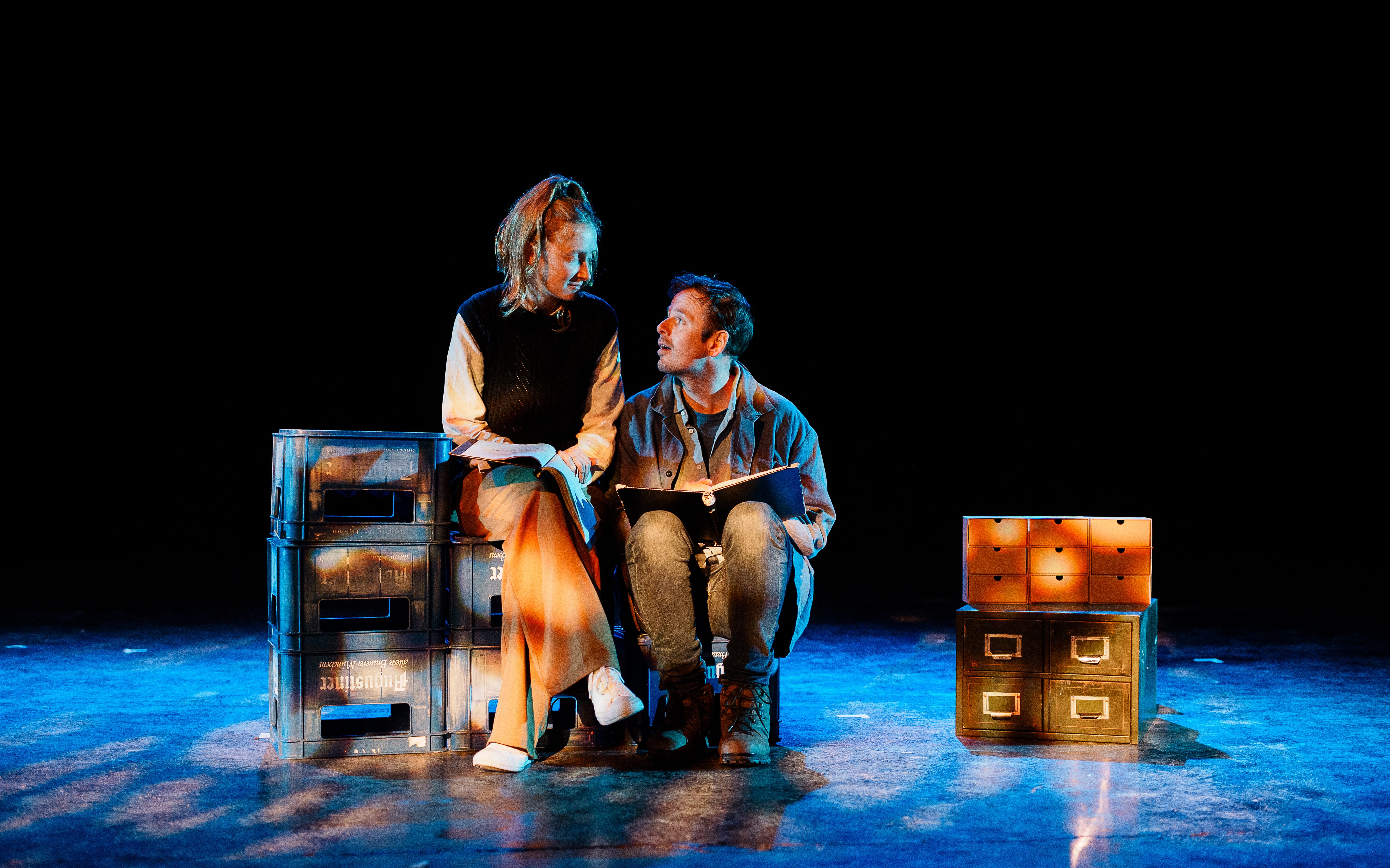
In late 2025, Hannah Mulder wrote and directed a new theatre piece with thrutopian goals. It was called Unstoppable...a beginner’s guide to making an (im)possibly glorious future and toured venues as a work-in-progress across Devon and London. This is what it was about:
‘Ethan and Stella have been best friends ever since the post-it note incident at work. Now Ethan’s got a new job halfway across the world and Stella has a burning question that can’t wait. One that might change everything, forever.
Unstoppable is a funny, inventive new play about the kind of future we want and how we can shape it. A love story between friends has consequences that resound across multiple possible futures, from seed libraries to concrete-smashing parties, real democracy to treetop saunas. Exploring tipping points, in human lives and the earth’s living systems, the play takes inspiration from climate and systems science, revealing how we all have the power to build radical hope in a time of crisis.’
Bending The Arc co-editor, Laura, was lucky enough to see a performance at Soho Theatre, London, in December. Here, Laura interviews Hannah about the process of creating Unstoppable, the challenges and joys of thrutopian theatremaking.
Laura: Hello Hannah, thank you so much for giving your time to Bending The Arc! To start with, can you tell us where you first came across the term ‘thrutopia’? What does it mean to you?
Hannah: I found out about Manda Scott’s ‘Thrutopia Masterclass’ through Rob Hopkins, who is a neighbour and friend and was teaching on it. As soon as I looked it up I knew I wanted to do the course – it was articulating so much of what I wanted to explore in my work. For me, the idea of thrutopian storytelling is neither telling utopias, where everything has magically been solved in a way that is detached from the possible, nor dystopias which dwell in the worst-case scenario, but instead telling a through-line narrative of where we want to get to and how we could actually get there. I had seen a lot of work in theatre and other story art forms that focused on dystopian warnings, which was an understandable and perhaps necessary first response in comprehending the gravity of the crisis that we’re in, but now we need a new wave of stories. We need to get excited about what we could co-create out of this unravelling, rather than being terrified of the worst consequences, which is hard to wake up for in the morning with a sense of warm thrill.
Laura: Beautifully put. That’s very much how I think of thrutopian stories. The editorial team at Bending The Arc all did Manda Scott’s course too – that’s how we got to know each other and came to work together. Some of us are fiction writers, some of us are poets, some are both! I’m really interested in how the idea of thrutopia manifests differently in different types of creative work.
Hannah: I love theatre for the shared experience of it – being in a space with other people and live performers. I love the feeling you get at the end of seeing a theatre piece of having been through something with your fellow audience members. With this show, I always have a vision of people washing their hands afterwards in the bathroom, making eye contact with each other in the mirror with a sense of “we can do this” and perhaps that is a unique thing that can happen with live performance. That’s how I’d like people to feel after seeing Unstoppable!
Laura: There was a Q&A discussion after the performance I watched and the audience definitely felt energised by the piece – there was a real feeling of possibility in the air. I loved the fact that the show included real-world actions.
Hannah: Thanks. I’m really glad that’s how people felt afterwards and that is definitely the intention. After the various performances I had quite a few people tell me about practical actions they had taken in the following days, like joining the Green Party or buying a bike. A significant part of the creative process for the show involved community development work, and one participant told me that she had given up her car as a result of being part of it. That was quite amazing.
But for me it’s also important to acknowledge that actions aren’t always visible – sometimes they involve opting out, or slowing down, choosing differently and I’m especially interested in how we shift our internal stories - how can work like this change the stories we tell ourselves about what it means to be human on a living planet.
Laura: That is such an important point. I always think thrutopian work is as much about changing the stories that underpin society – the myths that we assume to be true – as it is about specific practical actions. The writer Ursula K Le Guin famously pointed out that the Divine Right of Kings was thought by many to be an inescapable truth until that story was changed. Other stories have been changed in the past – the idea that women are inferior, that enslaving people is acceptable, that homosexuality is a crime and so on. And there are so many stories that still need changing about how we live in this world.
Hannah: Absolutely! The other inspiration behind the show was the idea of tipping points – both the terrifying ones impacting our earth systems but also Positive Social Tipping Points which are being looked at by people like Tim Lenton at the Global Systems Institute in Exeter.
How we tip into new stories and underpinning myths is perhaps what interests me most of all. In the language of Positive Social Tipping Points science, the elements that build towards a system crossing a tipping point are called ‘enabling conditions’. These are all the actions, resistance, processes, shifts etc that build momentum, so that eventually all it takes is one final action or moment and the system tips into the new state in a way which is unstoppable (hence the title of the play!). The examples you mention, like the Divine Right of Kings, were all ways of ranking one type of person or being above another. Perhaps such changes – ending the Divine Right of Kings, the enfranchisement of women and so on – perhaps those changes were enabling conditions towards a bigger shift, which more fundamentally dismantles the whole system and mindset which allows capitalism to exist. I wonder if there’s a wider, deeper tipping point which is still in process, and we are close!
Laura: That’s fascinating. In his book Sand Talk, Tyson Yunkaporta says the most destructive idea in existence is the thought ‘I am greater than you, you are less than me’. So many of the interconnected problems we face stem from inequality – both social inequality between people, and also inequality in the way we treat the world and the other living creatures in it. I do hope change is in process.
Hannah: Yes, the polycrises – whether that’s climate and nature or mental health or social polarisation or loneliness etc – are all symptoms of the same underlying systems which are fundamentally story structures of what we tell ourselves about who we are. I think story is key to unlocking how we shift into a life-sustaining, thriving and joyful way of being in this world – not just story through art, but through every moment. And art is a powerful way to inspire all those other stories.
Laura: Agreed! Changing stories in art is how we start to shift the fundamental myths that underpin how society functions. That’s one of the driving forces behind Bending The Arc.
Hannah: Yes! When I was reading about Positive Tipping Points, I was struck by how very few of the people involved in significant social shifts, like the abolition of slavery or women’s suffrage, lived to see the outcome they were striving for. We have to make the work and tell the stories without always knowing what impact they’ll have in the longer term. We can’t predict our effect on complex systems, so it has to be about intention rather than outcome. Which is a big shift in thinking – deep time rather than short term.
Laura: I find that idea both challenging and also heartening. It’s sometimes called ‘cathedral thinking’, isn’t it? Imagine those medieval builders starting work on a vast building they knew would never be completed in their lifetimes…
One of the ways you explored tipping points in Unstoppable was through interactive audience games. Can you tell us how this came about?
Hannah: I collaborated on these with my husband, Robin de Carteret, who runs something called Systems Games, teaching complexity science and systems thinking through games and interactive, embodied exercises. I’ve always been really inspired by his work and it was a conversation about the lens of tipping points that got us excited about the idea of making a show together in the first place.
It was a challenge for the actor who led the games, because in order to communicate complexity the games are by nature unpredictable, so we had to map all the potential ways they could go and script for that. But I find the games such a powerful way to communicate the ideas.
Laura: I agree. I found the experience revelatory. There was one game, where everyone had to secretly choose two people in the audience to watch. If one of them stood up, we stood up and sat down again. If both of them stood up, we stood and stayed standing. I was hesitant, thinking ‘when am I meant to stand up?’ and then I realised ‘oh! Anyone can stand up – we just need people to be brave enough to be one of the first!’ And of course, that’s what happened, we all started being brave and standing up and eventually the whole audience was standing – like a wave of positive action.
Can you tell us about the other elements of Unstoppable?
Hannah: There are a few strands. One is a contemporary story thread about two friends deciding whether to have a baby together. These scenes are where I give space to those knotty dilemmas about how we act today with the future in mind, how we care or try to ignore or cope with feelings of hypocrisy and guilt and privilege, all that messy stuff!
Laura: I thought the characters were very sympathetic. I recognised the feeling of disappointment when the world doesn’t appear to change despite all your gruelling activism! And equally, I felt empathy for the character who was juggling ill parents and money worries and hoping to get pregnant, and who just didn’t have the capacity to care about the plight of people thousands of miles away.
I also loved the scenes showing different versions of alternative futures being played out. Can you tell us a bit about these?
Hannah: We tend to think in a binary way – like we will either win or lose at climate – but I wanted to give a sense that there are many possible futures that could grow out of now. So I explored four different futures in which the same moment – a first flirtatious meeting between two young people - takes place, on the same piece of ground.
One is a regenerative and thriving future; another is based on an AMOC[1] collapse with severe drought and a gated community. A third future had very little life surviving in that place – which felt bleak but important to include – and the last one was a kind of surprise, a ‘what if’ world of wild, night-time, live music, with a treetop funfair and polyamorous communities! The value system behind each encounter is different according to the future they’re in. So the flirting revolves around contraband water in one scene; in another, his ultimate pick-up line is that he has a tandem bike!
Laura: Alongside these scenes were monologues from a single future, in which we heard people telling us about positive changes that had happened. It was wonderfully thrutopian and I found it very moving to be thanked for doing things that had made a difference.
Hannah: Thank you! This was the final strand of monologues, from a series of interconnected characters thanking us for things we are doing now that have made their thriving, life-sustaining world possible. I wanted to do two things with this – one to give a sense of what their world is like in tangible, joyful, specific ways, and then secondly to track back to something particular that a person or group of people might be involved with now, which could lead to that shift in the future. I tried to choose things that anyone can do, to give the audience a strong sense of possibility.
Laura: It worked! My favourite line from the play is: “You are standing on the edge of multiple positive tipping points.” Do you have a favourite line or scene?
Hannah: Yes, I love this line too and it seemed to really strike people, especially as it follows one of the games. It’s so hard to pick because what I love is all the different markers along the path of a story or show, where we might feel the grief together and then in the next moment, sniff some sense of wild possibility. I’ll have to rely on audiences to tell me!
Laura: Thank you so much Hannah. It’s been a pleasure talking to you.
Hannah: Thank you and likewise!
Hannah Mulder is a writer, director and founder of MakeShift. Her work spans theatre-making and participatory practice, engaging imagination, story and collective creativity to help shift the narratives which underpin the crises of our time, including the climate and ecological emergencies. She also works as a climate consultant, supporting creative processes, artists and organisations, focussing especially on narrative shift. Current projects include Unstoppable and Unstampable, and The Secret Gardens at The Egg, Theatre Royal Bath, as climate consultant.
Hannah was previously Co-Artistic Director of the award-winning company The Wrong Crowd, making work for cross-generational audiences, which toured nationally and internationally. She is currently an Associate Artist at Exeter Northcott and lives in Devon.
Many thanks to support from Arts Council England and to co-producer Fern Culture, partners at Exeter Northcott, Sterts Arts and Environmental Centre, Libraries Unlimited and to Robin de Carteret at Systems Games.
[1] AMOC is the Atlantic Meridional Overturning Circulation, a system of ocean currents driven by differences in temperature and salt content, that carry warm water from the tropics northwards into the North Atlantic. See the Met Office factsheet & information page
We’ve kicked off week two of this edition by sharing Bending The Arc’s first encounter with thrutopian theatre; tomorrow we’ll shift gears into poetry with three poems from Katrina Naomi and Sarah Mnatzaganian.
Comments
Nothing yet. Say the first thing.
Sign in to join the conversation.