
By the third year, nobody called it a disaster anymore.
They called it The Rising.
It came the way it always did now. The river rose politely at first, a familiar creep over the banks, then with less patience, pushing into lanes and gardens and ground floors as if reminding the village who had always owned the place. The old men still said it never used to do this, and the maps agreed with them, but the water did not.
Ruth woke at 4:11 a.m., the moment when sleep breaks without explanation.
Her phone buzzed a second later.
Redbridge gauge critical. Rising fast.
She sat up and swung her legs out of bed without swearing. Swearing wasted breath. She pulled on yesterday’s jeans, a jumper, and her boots, already by the door. Outside, the rain had that relentless, merciless sound that meant business.
Ruth kept the folder on the kitchen shelf, between the flour tin and the torch that never quite worked when you needed it.
FLOOD PLAN – UPDATED, the spine said, in her handwriting. She updated it every autumn, after the first heavy rains, when memory was fresh and optimism was still faintly possible.
She had not set out to become the sort of person who ran a flood response. She was a librarian by training, which meant she liked systems, lists, and the satisfaction of knowing where things belonged. It turned out those skills translated alarmingly well to emergency planning.
She opened the folder on the kitchen table and flicked to the laminated map.
The village lay marked in familiar colours: blue for floodplain, orange for possible, red for don’t argue with this. Small stars marked people that needed help.
Mrs Calderon, ground floor flat, mobility issues.
Tom and Ash, newborn, anxiety but capable.
Arthur Bell, refuses to leave, a cat called Nelson.
The Kapoors, dialysis equipment, needs power.
Ruth did not think of them as vulnerable. She thought of them as known.
She sent the first message.
THE RISING. ACTIVATE PLAN. CHECK YOUR NAMES.
The replies came in almost immediately. On it. Heading out. Hall open.
Someone added: EA says they’re stretched thin. Delays expected.
Ruth closed her eyes for half a second.
Last year, in the next valley over, two people had died waiting. The Rising came faster than anyone expected and the emergency services arrived too late. No one had done anything wrong, exactly. There had simply been too much water and not enough time.
After that, they had stopped waiting.
The Community Flood Action Group formed without fuss, in a WhatsApp thread that grew longer and more serious by the hour. It began with shared memories about who had waited too long, who had nearly drowned, and whose calls for help had gone unanswered. They mapped the village properly, not as it appeared on paper but as it behaved in water. They divided keys, shared phone numbers, argued about generators and kettles. They decided that emergency services would be support, not salvation.
When the river rose again, they would already be moving – rising to meet it.
Ruth grabbed the high-vis jacket from the hook by the door and stepped into the rain. Her neighbour Sam was already outside, hauling sandbags from the communal shed with the resigned competence of a man who had once been afraid and now treated floods like recurring paperwork.
“Morning,” he said.
“River’s up,” Ruth replied.
Sam nodded. “Of course it is.”
They hauled sandbags toward the bridge together. The water was already licking at the path, dark and purposeful.
By five, the plan was fully in motion.
The teams moved in pairs. One checked doors while the other ferried supplies. Another made tea at the hall, because it turned out people were braver when they were warm and holding a mug.
Ruth walked with Elena, who knew the village like a body she had lived in her whole life. Elena knocked firmly on Arthur Bell’s door.
“No,” Arthur said from inside, as expected.
“It’s Elena,” she called. “With Ruth.”
“No,” Arthur repeated. “I’m not leaving.”
Elena looked at Ruth, who nodded.
“Arthur,” Elena said, patiently. “Where’s Nelson?”
There was a pause.
“In the airing cupboard,” Arthur said, suspicious.
“Elena will get Nelson,” Ruth said calmly. “You can shout at us later.”
The door opened.
They moved Arthur upstairs to Mrs Kapoor’s spare room, the cat Nelson tucked under his arm like a grievance. Mrs Kapoor pressed tea into his hands and told him firmly he would sleep, because she was not having a sleepless man making decisions in her house.
By six, the lower road was gone. By seven, the power flickered and failed.
The Kapoors’ generator kicked in as planned. Sam texted Ruth a thumbs-up emoji that felt wildly insufficient and entirely perfect.
At Tom and Ash’s house, the water was already at the doorstep. Ash stood there barefoot, white-faced, clutching the baby to her chest.
“We didn’t think it would be this fast,” she said.
“No one ever does,” Ruth replied gently. “You’ve done nothing wrong.”
The baby was bundled in a blanket too thin for January. Elena swore softly and shrugged out of her coat, wrapping it around the small, warm weight without asking.
They moved quickly. Ash slipped once on the steps and Ruth caught her, heart hammering. The water surged against Ruth’s boots, cold and insistent, testing her balance and for a second she understood how people were taken.
By the time they reached the hall, the baby was asleep, pink-cheeked and breathing steadily.
The hall filled with the quiet noise of competence: chairs scraping, mugs clinking, names being checked off lists. Children slept in coats and adults sat with their shoulders hunched, staring at nothing.
Ruth pinned the updated flood map to the wall.
By eight, the emergency services arrived tired, soaked, grateful and overwhelmed.
“We’re covering three valleys,” one of them said, scanning the room. “We’ll help where we can.”
Ruth nodded. “We know.”
The Rising peaked just before noon.
It sat there, occupying space and testing resolve. The rain did not stop. It simply continued, as if this were now the normal arrangement.
A rumour moved through the hall that a man had been taken by the water upstream. Unconfirmed. Always unconfirmed, until it wasn’t.
Ruth forced herself to keep moving.
She checked the doors. She counted heads. She marked the high-water line on the hall’s outer wall with a pencil, a small, precise line.
Near the back of the room, Ash sat with the baby tucked against her chest, Elena’s coat wrapped around them both. The child stirred and let out a small, indignant sound.
Ruth crouched beside them. “How’s she doing?”
Ash smiled, a flicker of something fierce and bright. “Warm,” she said. “She hates the noise.”
“She’s right to,” Ruth said.
The baby yawned, enormous and solemn, and then settled again.
Something loosened in Ruth’s chest.
At three, the rain eased.
At five, the water began to retreat slowly and grudgingly, as if offended it could not rise further.
They did not cheer. Mud coated everything like a second skin. People fetched brooms, someone made soup from whatever was left in the freezer and someone else found candles.
By evening, the hall smelled of damp wool and disinfectant and relief.
Ruth sat on the steps outside, boots soaked through, legs aching in that deep, satisfying way that meant she had been useful. Elena joined her, lighting a cigarette she would regret later.
“Well,” Elena said. “That was lively.”
“Gauge was late,” Ruth replied automatically.
Elena nodded. “We’ll adjust.”
That night, Ruth updated the folder.
She added a note about the Redbridge culvert by the mill. She added two more stars for two more people who would need help next time, who were now known. She wrote CHECK BABY SUPPLIES in the margin and underlined it twice.
She did not write about climate change. It was assumed. Like gravity. This was the world they lived in now.
The next morning, the village smelled of earth and silt and the faint, stubborn promise of things that had survived.
Arthur Bell stood in his doorway, surveying the mud, Nelson by his feet.
“That,” he said, “was unpleasant.”
“Yes,” Ruth agreed.
“But,” Arthur added grudgingly, “efficient.”
Ruth smiled.
They would not stop the river. That was not the work.
The work was knowing who needed help before they asked. The work was memory made practical. Names written down. Doors knocked on in time.
Before she went home, Ruth looked at the faint pencil line on the hall wall and left it there.
Not as a warning.
As proof.
The water would rise again. Everyone knows that now.
But so would they.
Carrie Starbuck is a UK-based writer and conservation professional working at the intersection of farming and nature recovery. Her writing explores who gets to care for land, speak for it, and belong to it, shaped by her experience moving through rural Britain as a queer woman.
“I’m drawn to Thrutopia because it dares to imagine futures shaped by care, repair, and the stubborn, collective work of hope.” ~ Carrie Starbuck
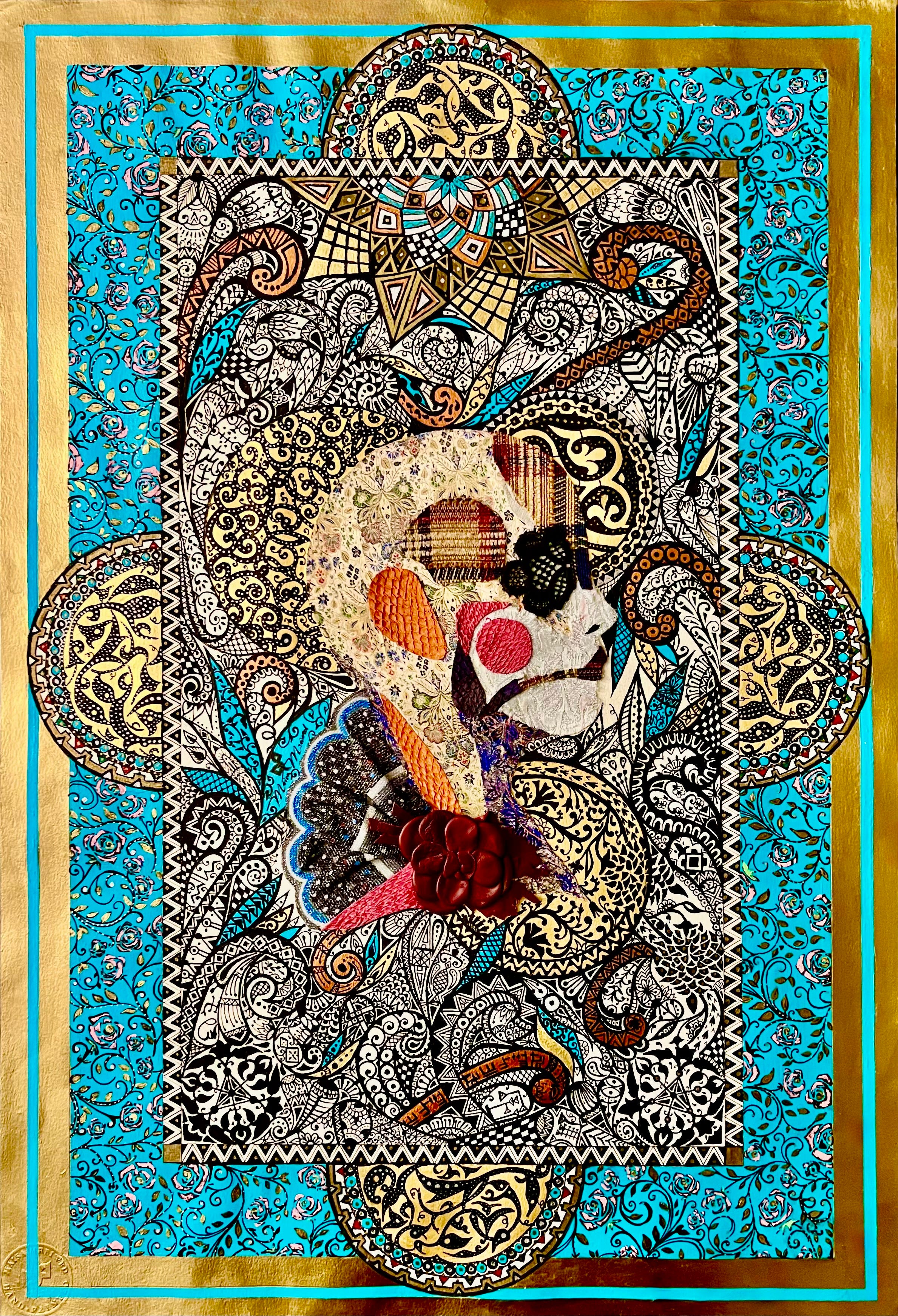
Maisa Mreiwed is a Syrian-Canadian multidisciplinary artist. Her practice explores historical and contemporary themes through intricate visual languages of signs and symbols. She views art as a powerful narrative tool that fosters meaningful connections between people, place, and environment. She has exhibited nationally and internationally. Her public art includes murals with the London Arts Council and Joy, a permanent installation at the South London Community Centre. In 2022, Maisa received the Arts Integrated Research Award from Lakehead University for work addressing climate change and environmental action. Her recent publications and artworks appear in leading arts-based research and social change publications.
“As an artist, I’m always aware of how crucial it is to use my work to raise awareness about climate change, and thrutopia’s commitment to reimagining regenerative and inclusive futures resonates strongly with my practice. As a Syrian Canadian artist, educator, and designer, my work explores survival, interconnection, and unity within our shared ecosystems. Through intricate geometric patterns, layered symbolism, and stories embodied by diverse living beings, I invite viewers to reflect on our responsibility to safeguard our oceans, skies, lands, and one another.”
~ Maisa Mreiwed
Edition 3 of Bending The Arc launched yesterday with three earthy poems! Today we’ve shared an inspiring flood story from Carrie Starbuck; tomorrow the watery theme continues in a memoir extract about salmon…
Comments
Nothing yet. Say the first thing.
Sign in to join the conversation.