
I am neither a prophet nor the son of a prophet, and I’m certainly not an expert in foreign policy. To be 100 percent honest, I didn’t even stay at a Holiday Inn Express last night, nor any time in recent months.
As a result, I will refrain from opining today on Operation Epic Fury, other than to pray for a swift, just, and peaceful outcome that brings regional stability and an end to the evil Iranian regime, at the least cost possible to our nation.
Setting the Stage
Instead, let’s reflect on a historical moment at the precipice of a far more costly and consequential American conflict. It’s the third time I’ve published an article on this platform reflecting on the 165th anniversary of a significant speech delivered by Abraham Lincoln (most recently his impromptu remarks on the Declaration at Independence Hall).
This edition highlights Lincoln’s last public pronouncement delivered before officially becoming our nation’s 16th president. The inaugural address delivered on March 4, 1861, came at a moment of immense tension and uncertainty. Seven states had seceded from the Union and threatened a federal military installation in Charleston Harbor, South Carolina.
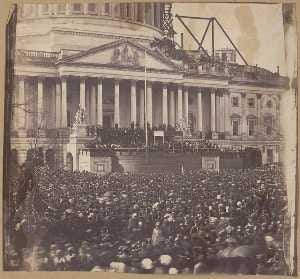
A deepening disunion and the ominous threat of civil war hung like a pall over the celebration of the nation’s first Republican Party chief executive. An unfinished remodel of the Capitol building formed a sort of fitting backdrop to a nation in its own state of disrepair.
The Wrong of Slavery: Continuing a Theme
About the substance of the speech itself, my first observation is that Lincoln could not neglect the cause of the conflict. None of his 15 predecessors had made anything approaching the clear moral declaration he delivered about the inhumane institution of human bondage, a lingering dark blot:
One section of our country believes slavery is right, and ought to be extended, while the other believes it is wrong, and ought not to be extended. This is the only substantial dispute.
But no bystander in Washington, D.C., that day had any reason to be surprised by his plain talk about slavery. The point is driven home in the scene painted by Harold Holzer in his 2008 tome Lincoln President-Elect.
After all, only a year earlier, the ascendant Illinois politician had made a very similar, if more elaborate and forceful, case in the conclusion of his Cooper Union Address:
If slavery is right, all words, acts, laws, and constitutions against it, are themselves wrong, and should be silenced, and swept away. If it is right, we cannot justly object to its nationality—its universality; if it is wrong, they cannot justly insist upon its extension—its enlargement. All they ask, we could readily grant, if we thought slavery right; all we ask, they could as readily grant, if they thought it wrong. Their thinking it right, and our thinking it wrong, is the precise fact upon which depends the whole controversy….
The Case for a Perpetual Union
The threat of disunion was the dominant theme of the inaugural, however. Lincoln’s opening line stressed the word United in the address to his “Fellow citizens of the United States.” He placed a great deal of weight on the idea of Union, which he uttered 20 times in the 3,600-word speech.
In a furnace of fuming passions, he crisply enunciated and laid out his case for a perpetual Union:
Perpetuity is implied, if not expressed, in the fundamental law of all national governments. It is safe to assert that no government proper, ever had a provision in its organic law for its own termination….
Again, if the United States be not a government proper, but an association of States in the nature of contract merely, can it, as a contract, be peaceably unmade, by less than all the parties who made it? One party to a contract may violate it -- break it, so to speak; but does it not require all to lawfully rescind it?…
It follows from these views that no State, upon its own mere motion, can lawfully get out of the Union, -- that resolves and ordinances to that effect are legally void, and that acts of violence, within any State or States, against the authority of the United States, are insurrectionary or revolutionary, according to circumstances.
Constitutional Fidelity in Crisis: A Simple But Immense Burden
Yet undergirding Lincoln’s entire argument was a careful and repeated assertion, both implied and explicitly stated, that he fully intended to uphold the Constitution (used more than 30 times in the inaugural address) — with a mandate to preserve the Union and a prohibition on interfering with slavery in the states where it already existed. How many modern Presidents can you imagine giving even such credence to our nation’s Founding document, flawed as it was?
“I therefore consider that in view of the Constitution and the laws, the Union is unbroken; and to the extent of my ability I shall take care, as the Constitution itself expressly enjoins upon me, that the laws of the Union be faithfully executed in all the States,” Lincoln said, describing it as a “simple duty” he was obligated to undertake.
Simple, yes, but also immense and burdensome. Three weeks earlier, departing the train station at his hometown of Springfield, he had compared the burden facing him unfavorably to the father of the Republic: “I now leave, not knowing when, or whether ever, I may return, with a task before me greater than that which rested upon Washington.”
One of the initial elements of that task was to deliver a confident and precise message to the nation, one that avoided the twin ditches of aggressive hostility and complaisant concession.
A Precise and Precious Draft
Lincoln began crafting the inaugural address shortly after securing the victorious election in November 1860, administering numerous revisions in the weeks and months ahead. All as the country started to fall apart, with one Southern state after another breaking away from the Union, and legitimate hostile threats to his life before he could ever reach the Capitol and swear the oath of office.
So precious was the carefully constructed copy of Lincoln’s inaugural address that he secured it in a worn black carpet bag and entrusted it to his eldest son Robert to watch over on the train journey to the nation’s capital. That arrangement didn’t last long. The first night, Robert casually left the bag with an Indianapolis hotel clerk to go out on the town with companions.
Ted Widmer, in his riveting Lincoln on the Verge, retells the comic scene of the president-elect leaping over the hotel desk and rummaging through multiple black bags until finally finding the precious draft of his speech intact. Widmer quotes Ward Hill Lamon observing that he had never seen his good friend “so much annoyed, so much perplexed, and for the time so angry.”
Lingering with “The Better Angels of Our Nature”
With input from his soon-to-be-Secretary of State William Seward and others, Lincoln made further edits and refinements to the speech, particularly to its impassioned closing plea to the Southern states:
In your hands, my dissatisfied fellow countrymen, and not in mine, is the momentous issue of civil war. The government will not assail you. You can have no conflict without being yourselves the aggressors. You have no oath registered in Heaven to destroy the government, while I shall have the most solemn one to “preserve, protect, and defend it.”
I am loath to close. We are not enemies, but friends. We must not be enemies. Though passion may have strained, it must not break our bonds of affection. The mystic chords of memory, stretching from every battle-field, and patriot grave, to every living heart and hearth-stone, all over this broad land, will yet swell the chorus of the Union, when again touched, as surely they will be, by the better angels of our nature.
In its own way, the “better angels of our nature” represents a final homage to the incoming President’s Constitutional duties. It reflects the Framers’ view of the duality of human nature and their purposeful creation of Constitutional structures that elevated reason in the governance of the policy while putting the brakes on passion.
I don’t know if might even vaguely evoke perhaps the most well-known of arguments from the Federalist Papers, in which James Madison asserted that “if angels were to govern men, neither external nor internal controls would be necessary.” More is there to be unpacked another time.
Still, the picturesque plea echoes down the decades to our own divisive time — though, if we are to be honest and humble students of history, one that thankfully does not rival the dark days of 1861.
A Personal Postscript: An Unexpected Relation
A few days ago, I dove into my used copy of Walter Isaacson’s Benjamin Franklin: An American Life. Barely a dozen pages into the book, I spotted the name and description of Franklin’s maternal grandfather, Peter Folger. It sounded too familiar. I had to dig into my dusty genealogy software to find that — well, yes, I guess the famous Founding Father is my first cousin, nine times removed.
Not just my namesake. As delightful as the discovery was, I ought to leave it there. After all, this article isn’t all about the Benjamins.
No posts
Comments
Nothing yet. Say the first thing.
Sign in to join the conversation.