
Graduate students are often asked a deceptively simple question: “What’s next?” Usually, people mean academia, industry, or government. But those broad labels tell you very little about what you’ll actually do every day or which path is most likely to help you reach your career goals.
The mistake I made early in graduate school was assuming “industry” was a single career destination. In reality, it’s an ecosystem of organizations with very different cultures, hiring expectations, and career paths. Once I understood how those pieces fit together, job postings suddenly made much more sense.
Most of us naturally describe careers using these broad categories because they’re familiar. In reality, each sector contains a wide range of organizations and specialized roles for toxicologists.
Take industry for example. For the purposes of this article, industry is defined as any organization involved in the development and/or manufacture of a product. This includes (but is not limited to) healthcare, consumer goods, energy, and chemical manufacturing. Each organization offers different responsibilities, career trajectories, and opportunities for growth.
In this article, we’ll focus on the healthcare industry. Specifically, I’ll discuss how different organizations fit together, what toxicologists do within each, and why understanding the ecosystem can make your job search much more strategic.
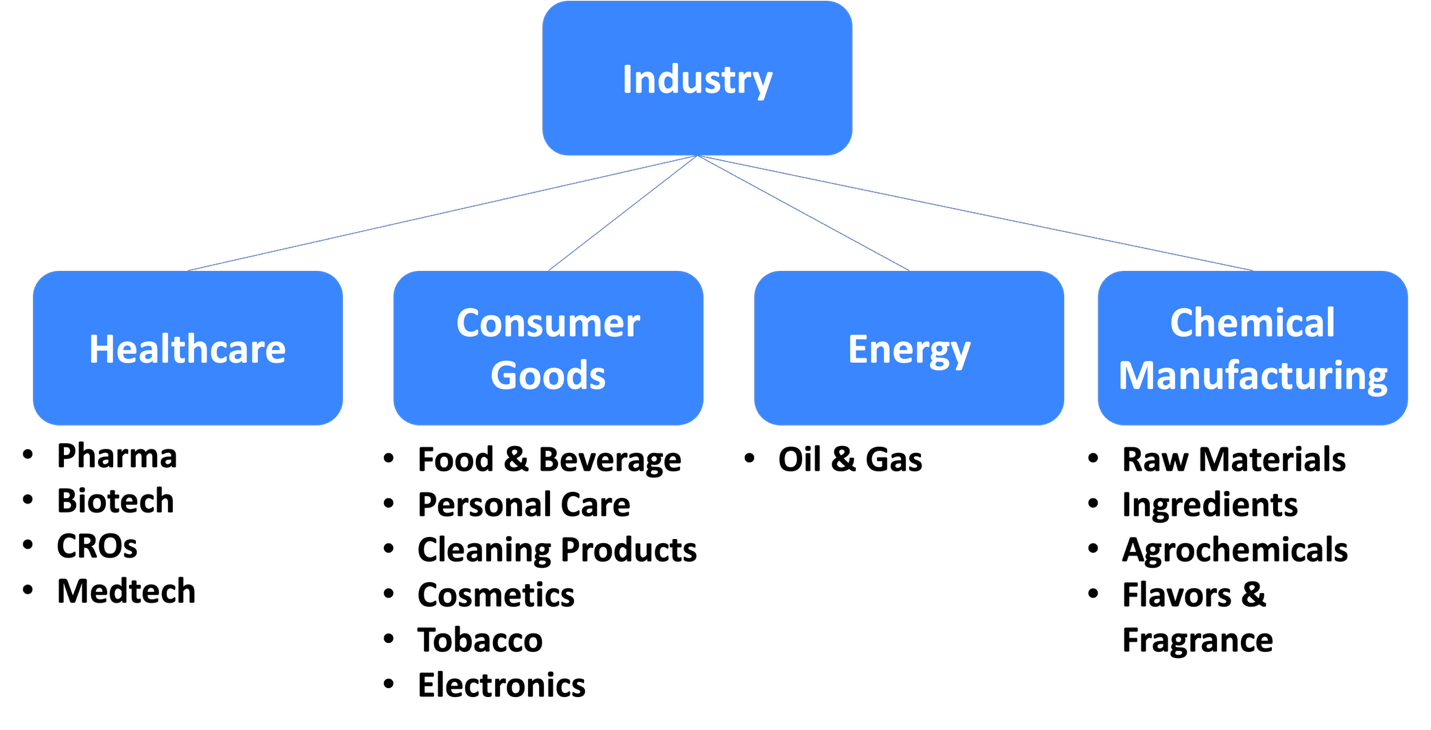
Toxicologists work across a connected network of organizations that move products from early research and development to real-world use.
When I was a graduate student, I referred to “pharma” and “biotech” interchangeably, but later learned that each serves different purposes within the drug development ecosystem. I also learned that understanding those differences revealed far more entry points into industry than I’d realized. Rather than thinking of industry as one destination, think of it as a network of organizations with different missions, cultures, and hiring needs. Although these organizations often collaborate on the same products, they hire toxicologists for different reasons and value different experiences. Here’s a high-level overview:
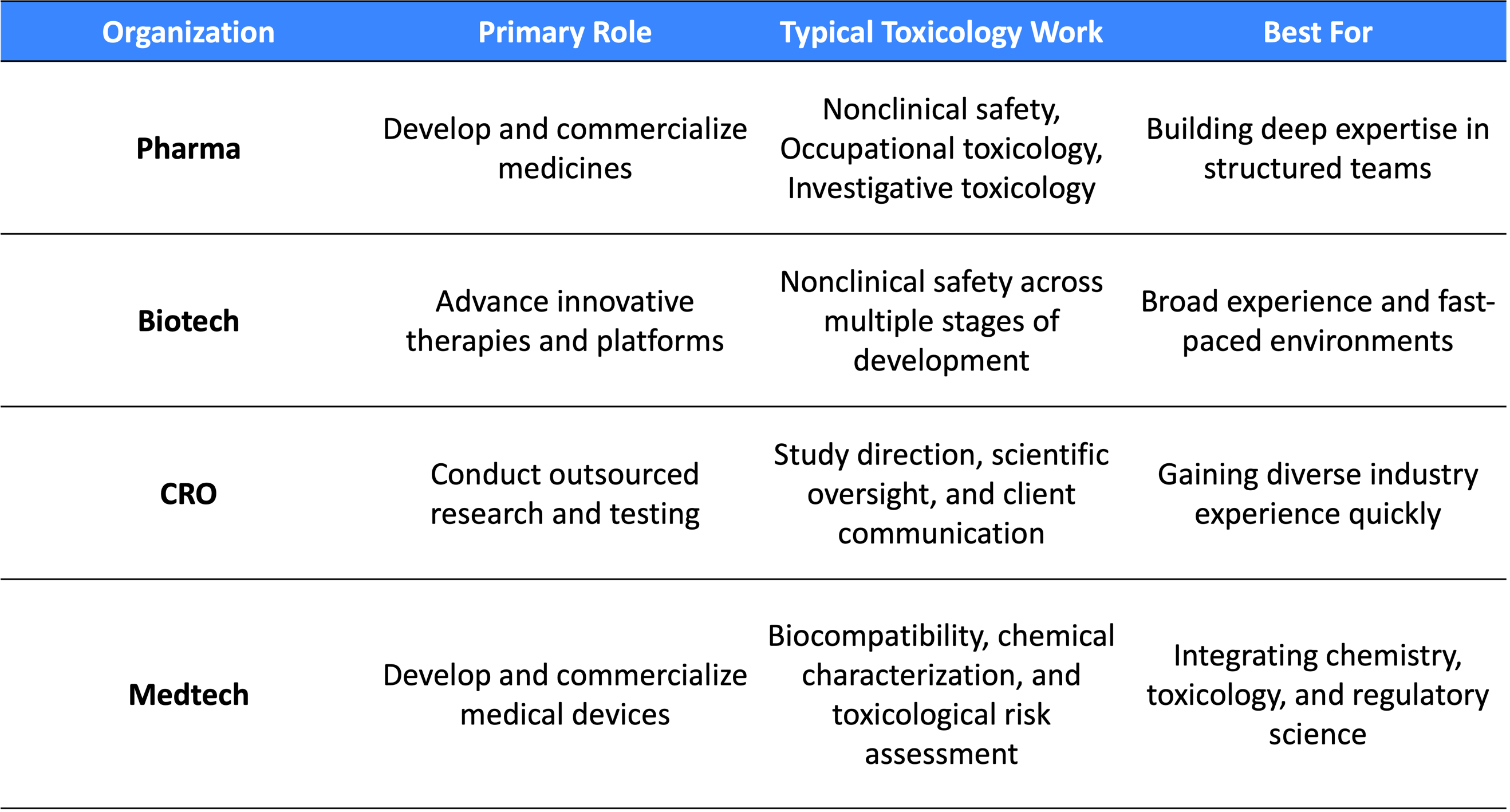
The rest of this article explores each organization in more detail and explains how they fit into the broader healthcare ecosystem.
What They Do
Traditionally, pharmaceutical companies have developed and produced medicines exclusively via chemical synthesis and without the use of living organisms. Today, many pharma companies are combined biotechnology and pharma organizations (e.g., Roche, Novartis, and Pfizer). Large pharmaceutical companies frequently acquire smaller biotech companies with promising drug candidates or technologies.
What Their Toxicologists Do
Pharma toxicologists work with internal teams to develop safety assessment strategies for candidate molecules, identify specific biological causes behind adverse drug reactions, and conduct risk assessments to ensure safe limits for unintended patient or worker exposure.
Good Fit If…
You thrive in structured organizations.
You enjoy collaborating across disciplines.
You want to build deep subject-matter expertise.
Challenges
Breaking into large pharmaceutical companies can be highly competitive.
Opportunities to broaden your experience may depend on business priorities rather than your individual interests.
Common Entry Routes
Industry internship
Industry or academic postdoc focused on relevant indication or technology
CRO experience
Entry-level toxicologist
What They Do
The traditional definition of biotech is an organization that uses living organisms or biological systems to develop products and technologies. As follows, biotech companies often focus on a single technology platform, disease area, or therapeutic approach. Not all biotech companies are focused on healthcare, however. Some specialize in agriculture and environmental management solutions like genetically modified organisms (GMOs). Some biotech companies refer to themselves as “biopharma” to indicate that they’re focused on developing pharmaceutical products.
What Their Toxicologists Do
The biotech environment is fast-paced and lean. Biotech toxicology teams are typically small—sometimes with only one toxicologist for the entire organization. Smaller teams often mean broader responsibilities. As a result, biotech employers frequently look for candidates who can contribute with minimal supervision, making prior industry experience especially valuable. Breaking directly into biotech isn’t impossible, though many professionals first build experience at a CRO or larger pharmaceutical company before making the transition.
Good Fit If…
You thrive in fast-paced, dynamic environments.
You enjoy taking ownership and contributing to key decisions.
You want broad exposure across multiple stages of drug development.
Challenges
Resources may be more limited than at larger pharmaceutical companies.
Company priorities can shift quickly as programs evolve.
Job stability may depend on funding and pipeline success.
Common Entry Routes
Industry internship
Industry or academic postdoc focused on relevant indication or technology
CRO experience
Pharma or biotech experience
Entry-level toxicologist
Contract Research Organizations (CROs)
What They Do
In the past, big pharma companies conducted many of their nonclinical safety and investigative toxicology studies inhouse. Nowadays, it’s very common for both pharma and biotech companies to outsource studies to CROs. CROs operate on a service model that centers on execution- and deadline-driven projects across multiple clients. CROs range from mid-size regional organizations to large, global service providers.
What Their Toxicologists Do
CRO toxicologists typically serve as study directors and act as the single point of control responsible for each study. Their responsibilities include overseeing overall scientific conduct, regulatory compliance, and study data reporting.
Good Fit If…
You enjoy managing multiple projects simultaneously.
You like study design, data interpretation, and scientific problem-solving.
You want broad exposure to different molecules, sponsors, and therapeutic areas
Challenges
Heavy workloads and overlapping timelines are common.
Regulatory compliance carries significant responsibility.
Opportunities to follow a molecule through development may be limited.
Common Entry Routes
Academic postdoc
Entry-level study director
Career Myth
Myth: You need to start at a large pharmaceutical company for a successful career in the healthcare sector.
Reality: Many successful toxicologists begin their careers at CROs, consulting firms, or smaller biotech companies before moving into large pharmaceutical organizations. Some even choose to specialize in a different sector—choose your own career adventure.
Medical Technology (Medtech)
What They Do
Medical technology, or medtech, focuses on the development of medical devices used to diagnose or treat disease such as surgical instruments, diagnostic tools, medication delivery systems, and implants. Like pharmaceuticals, medical devices are subject to regulatory oversight to ensure safety and effectiveness. Unlike pharmaceuticals, medical devices operate based on a physical function or through a combination of physical and chemical functions.
What Their Toxicologists Do
Medtech toxicologists evaluate the biological safety of medical devices by integrating chemistry, toxicology, and regulatory science to support biocompatibility assessments under ISO 10993.
Good Fit If…
You enjoy integrating chemistry, toxicology, and regulatory science to solve complex safety questions.
You like using nonanimal evidence to support risk assessments whenever appropriate.
You want your work to directly influence patient safety and regulatory decisions.
Challenges
Keeping pace with evolving global regulations and standards requires continual learning.
Building expertise in ISO 10993 and toxicological risk assessment takes time and specialized experience.
Common Entry Routes
Industry or academic postdoc focused on biomaterials or tissue-device interactions
CRO experience
Entry-level toxicologist
Industry postdocs (and student internships) are often touted as a way to gain industry experience while still in the trainee phase of your career.
What They Offer
Industry postdocs and internships provide an opportunity to experience industry science firsthand while building experience that’s attractive to future employers.
What They Don’t Guarantee
Completing an industry postdoc doesn’t automatically lead to a full-time position. Toxicology internships and industry postdocs can also be rare. Hiring decisions for any role ultimately depend on business needs and the skill sets that organizations are currently seeking.
How to Make Yourself Competitive
No need to panic if you don’t have industry or postdoc experience. More important than simply having “industry experience” is demonstrating that your skills align with an organization’s current hiring priorities. For example, many organizations are investing in New Approach Methodologies (NAMs) and actively recruiting scientists with experience in organoids, advanced cell models, and computational toxicology. If your research aligns with these priorities, make those skills impossible to miss on your resume and highlight them in interviews.
If your background doesn’t include emerging or in demand areas, consider building those skills through collaborative projects, targeted coursework, an academic or industry postdoc, or independent learning. You don’t necessarily need another training position but you do need to demonstrate that you can contribute to where the field is heading. Many toxicologists who go on to work at pharma or biotech companies, for instance, have previous experience working as a study director at a CRO.
Current Hiring Trends
Experience with NAMs, advanced in vitro models, computational toxicology, and risk assessment continues to become increasingly valuable across multiple sectors.
There isn’t one “correct” entry point into industry. Many toxicologists build successful careers by moving between sectors as they gain experience.
Try This 👉 Map Your Target Career
Pick three healthcare companies you’re interested in.
For each one, answer:
1. Is it pharma, biotech, or a CRO?
2. What toxicology roles exist there?
3. Which skills appear most often in their job postings?
4. Which organization seems like the best fit for your interests and why?
You’ll quickly start seeing hiring patterns.
The best career decisions start with understanding the landscape before choosing a destination. Once you know how the ecosystem works, you can build experiences that move you toward the roles that genuinely fit your interests.
Which part of the ecosystem are you most interested in exploring?
What would you like me to cover next in this series?
Subscribe for free to get weekly curated toxicology roles plus practical career insights to help you navigate the field with intention.
© 2026 Lauren Walker. All rights reserved. No reproduction without permission.
Disclaimer: This content is for informational purposes only and reflects personal opinions, not professional or legal advice
No posts
Comments
Nothing yet. Say the first thing.
Sign in to join the conversation.