
The past few weeks’ discussions about the interview process reminded me of an older article I wrote about how to decipher job descriptions and frame your professional experience on your resume. At both the application and interview stages, you have an opportunity to shape your professional story and show why you are the strongest candidate for a particular role.
During an interview, that means presenting your expertise through the lens of how it can help solve the hiring team’s current challenges. The same principle applies at the application stage when tailoring your resume. Your goal at this stage is to make the relevance of your experience immediately clear to the recruiter and hiring manager.
Just as your job talk doesn’t need to include every data point you’ve ever collected, your resume shouldn’t be a laundry list of every project you’ve completed. A strong resume highlights the skills, experiences, and accomplishments that demonstrate how you can solve an employer’s problems and gives them a reason to invite you to the next conversation.
In light of these reflections, I thought it was worth revisiting this piece through the lens of translating your experience directly to the role. Ultimately, your resume should help answer the recruiter’s main question: “Why should we interview this person for this role?”
As you read, consider the questions behind that decision:
What can this applicant actually do?
At what level of proficiency can they do it?
Have they previously solved problems like ours?
Can they be effective in our environment? (Are they a culture match?)
Does their experience make sense for this role and why?
A small newsletter update—
Going forward, I'm moving the career advice pieces to a less frequent schedule while continuing to publish the toxicology job roundup every week. I want the advice pieces to be thoughtful and genuinely useful rather than creating something new simply to meet a weekly cadence. As the job market moves quickly, the weekly roundup will continue to be your regular dose of what's out there every Thursday.
Sending the same resume to every employer makes it difficult to demonstrate why you’re a strong fit for a specific role. In many organizations, the first person reviewing your resume isn’t a subject matter expert. They’re a recruiter or HR professional screening for key qualifications. Sometimes an internal referral will expedite your resume to the hiring manager, but that’s not always a guarantee. Your resume should quickly show that you both meet the role’s requirements and can contribute to the team’s future goals.
The purpose of your resume isn’t to convince an employer that you’re an impressive candidate. It’s to show them that you’re relevant. Crafting a compelling resume is only possible if you can identify which skills and experiences are most suitable for a given role. There are two ways to do this: 1) connect with the hiring team to inquire about the opening and 2) critically evaluate the job description.
Both strategies will help you understand the role’s purpose, the team’s biggest challenges, and the qualities they’re looking for in a competitive candidate. While it is ideal to pursue both avenues to gain a more complete picture, it is not always possible to connect with hiring team before the interview process. You will be able, however, to critically evaluate a job description.
The goal isn’t to convince an employer you’re impressive.
It’s to show them that you’re relevant.
Critically evaluating a job description is a skill in itself. Job descriptions are more than a list of requirements—they give clues about team priorities and challenges. With practice, you can learn to use a job description to understand the hiring manager’s needs, translate your experience into a compelling resume, and clearly demonstrate an ideal fit for a role.
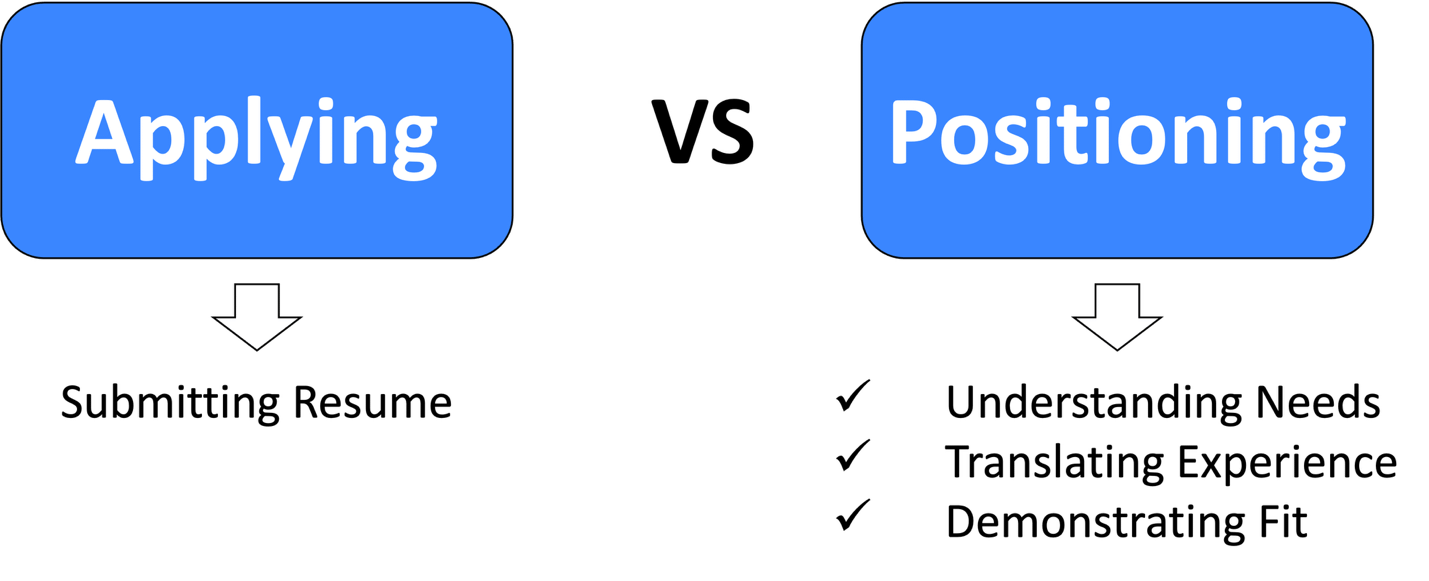
To see how this works in practice, let’s examine a hypothetical job description modeled after a role posted last week.
Translational Safety Scientist, Toxicology
We are currently seeking a highly motivated Scientist to join our Translational Safety group, an area within the Investigative Toxicology department.
Our team is committed to providing project teams with toxicological mechanistic insights and integrating data to understand the correlations between in vitro and in vivo ADME properties. We are looking for an individual to support development and application of advanced in vitro tumor models, such as patient-derived organoids, tumoroids, 3D bioprinted tissues, and immune cell co-culture systems to support the characterization of next generation solid tumor therapies.
The candidate will work at the interface of immuno-oncology, translational PK/PD, and innovative New Approach Methodologies (NAMs).
Responsibilities include designing and conducting laboratory experiments, generating mechanistic insights, and integrating findings across multiple platforms to understand drug exposure, biological response, and potential safety liabilities.
This role requires hands-on experience with complex cell culture systems and the ability to collaborate with multidisciplinary teams in a matrixed environment.
In addition to experimental work, the candidate is expected to analyze and interpret data, prepare technical reports, contribute to scientific publications, and communicate findings through presentations to both internal stakeholders and external scientific audiences.
This job description is looking for someone who can use human-relevant tumor models to generate mechanistic evidence. The ideal candidate will produce work that informs both drug safety and drug efficacy while helping teams translate laboratory findings into predictions about clinical outcomes.
This is evidenced by the phrases highlighted above in blue.
Now, let’s examine the required qualifications for this role:
Required Qualifications
Required Minimum Education: PhD degree in a relevant life science discipline, with a preference for candidates with postdoctoral experience.
Required Years of Related Experience: 0–2 years post PhDTechnical Expertise
Hands-on experience with advanced in vitro model systems, including organoids, tumoroids, 3D tissue models, and immune cell co-culture platforms.
Strong understanding of tumor biology, immunology, and translational research approaches.
Experience developing, optimizing, and troubleshooting complex cell-based assays.
Methodological Skills
Proficiency with common cellular and molecular biology techniques.
Experience designing studies that investigate drug disposition, biological activity, and safety-related endpoints.
Ability to independently execute experiments and interpret biological data.
Innovation Skills
Ability to generate mechanistic insights from experimental data and translate findings into actionable recommendations.
Strong critical thinking and problem-solving skills with a demonstrated interest in addressing complex scientific questions.
Project Management and Interpersonal Skills
Ability to manage multiple research activities simultaneously while maintaining project timelines and deliverables.
Strong written and verbal communication skills.
Experience collaborating effectively with multidisciplinary teams and external scientific partners.
Preferred Qualifications
Experience in drug discovery, translational safety, pharmacology, or related pharmaceutical research environments.
Familiarity with pharmacokinetics/pharmacodynamics (PK/PD) principles.
Experience with R, data analysis workflows, or in silico modeling approaches.
Track record of scientific presentations, technical reports, or peer-reviewed publications.
This position is designed for an early-career scientist who has recently completed a PhD and is interested in applying advanced laboratory models to support drug discovery, translational safety, and cancer research.
The hiring team has a specific vision of their ideal candidate that fills the following categories: Education, Technical Expertise, Methodological and Innovation Skills, and Project Management and Interpersonal Skills.
Let’s break down this analysis further keeping the different categories in mind:
Education
PhD is listed as the minimum requirement. This means that they are most likely only going to review applicants with a PhD. In addition, candidates need to have a PhD in a relevant life science discipline such as:
Toxicology
Cell Biology
Immunology
Oncology
Pharmacology
Biomedical Sciences
Biotechnology
While not required, some relevant postdoctoral experience may be viewed favorably since it’s specifically highlighted in the job description.
Pro Tip: Some hiring managers prefer candidates with postdoctoral research experience as it can demonstrate professional maturity and the ability to work independently.
Technical Expertise
The core responsibility of this role is centered on advanced in vitro models that support decision-making in drug development. Thus, the strongest candidates will demonstrate hands-on experience developing and maintaining at least of the listed advanced in vitro models:
Organoids
Tumoroids
3D bioprinted tissues
Immune cell co-culture systems
Methodological and Innovation Skills
As this is a lab-based role, strong candidates will also show hands-on experience with common cellular and molecular biology techniques, including but not limited to:
Microscopy-based analyses
Cell isolation and separation
Transcriptomics and gene expression profiling
General cell culture and experimental troubleshooting
Beyond technical execution, this job description emphasizes the ability to design experiments that answer complex biological questions. This ability should be highlighted in any resume submitted for this role.
Project Management and Interpersonal Skills
While thesis research is often a solo endeavor, professional scientists frequently work in matrixed teams.
In these environments, the success of the team depends on each member’s ability to deliver work on time and work effectively with other teammates.
Strong project management, communication, and teamwork skills are essential to be successful as a professional scientist.
Job descriptions are more than requirements lists—they’re clues about a team’s priorities and challenges.
In summary, this job description is looking for recently graduated PhDs who are:
Scientifically curious problem-solvers
Comfortable testing novel hypotheses
Interested in developing new methodologies
Motivated to investigate complex biological mechanisms
At its core, this position is seeking a scientist with expertise in advanced cell-based models who can combine strong laboratory skills, mechanistic thinking, and collaborative research abilities to support the development of next-generation cancer therapies.
So, how would you position yourself competitively for this job?
If you’re a newly minted PhD you likely have an CV that skews academic not industry-ready.
The key here is to take your existing experience and translate it for what the job description explicitly states without simply copy-pasting the posting into a word document. It’s important to keep in mind the skills and expertise that are specifically called out in the description, as they hint at what makes a strong candidate.
The table below lists examples of how academic experience can be used to qualify yourself as an industry candidate.
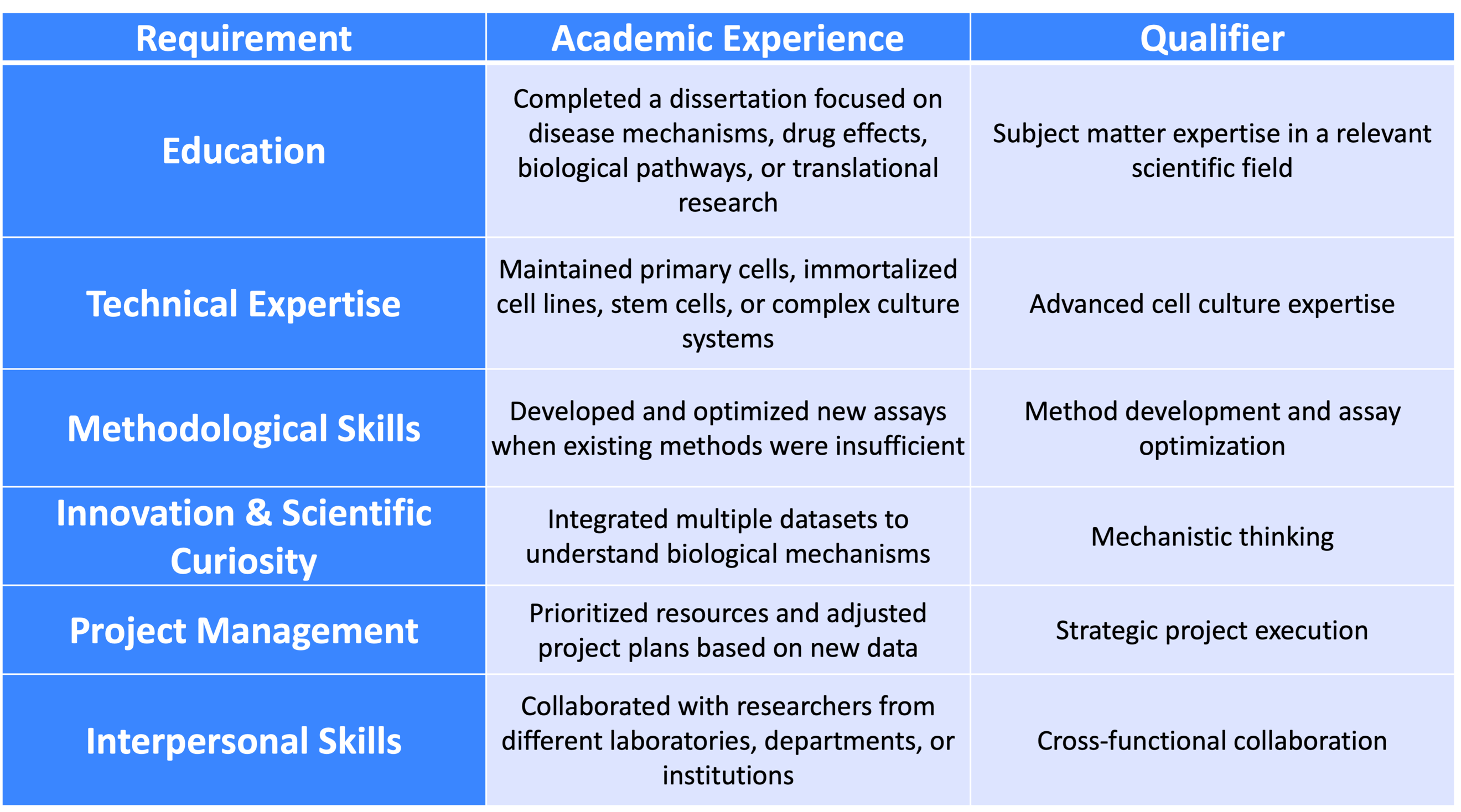
The table above isn’t an exhaustive list of examples, but can be used as a starting point for how to think about and translate your own experiences for job applications.
Once you identify the experiences that qualify you for a role, you can further translate them from your academic CV into an industry resume like so:
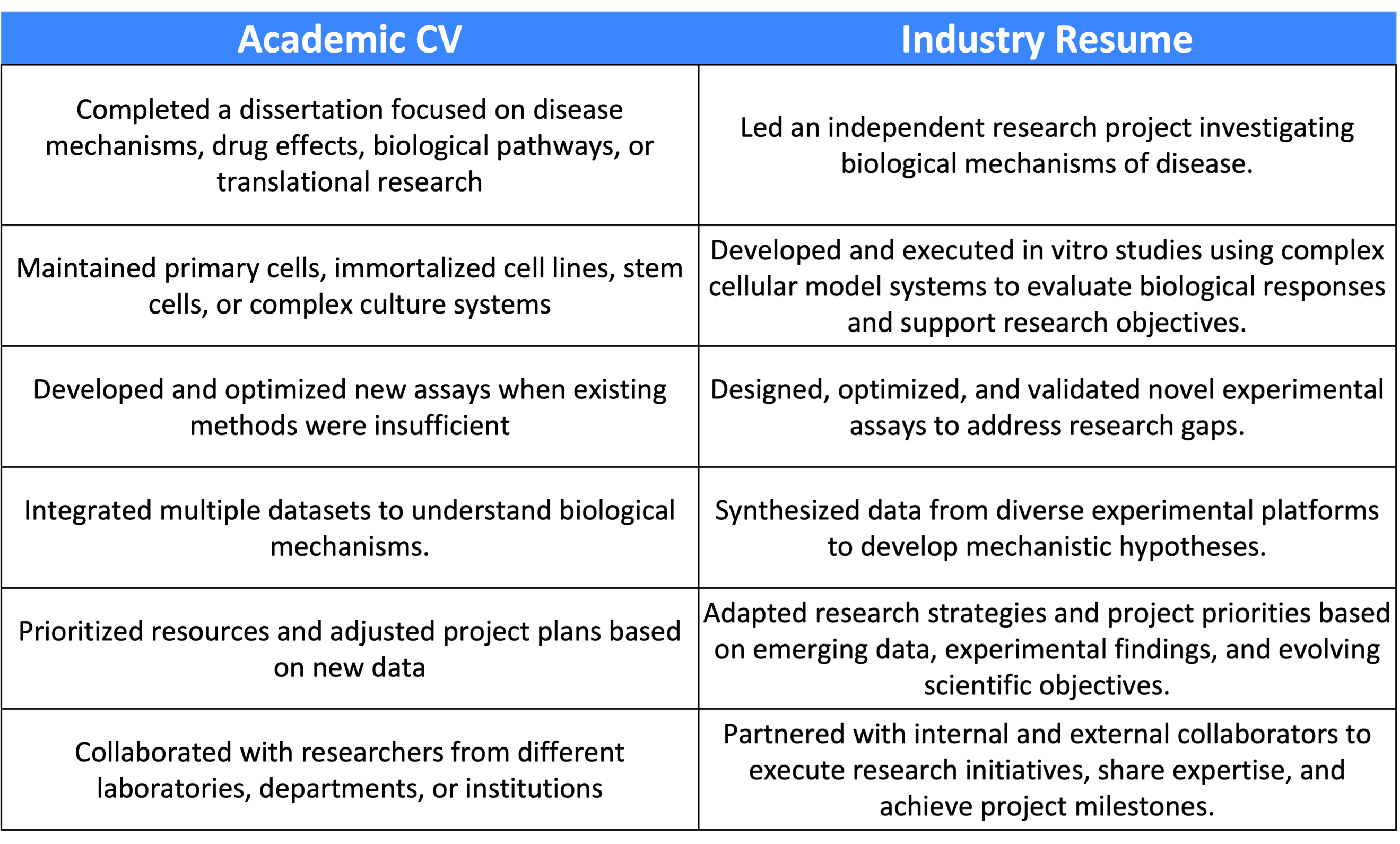
Positioning isn’t about changing your experience, but communicating it strategically. The strongest candidates understand what employers need and make those connections obvious. Before submitting your next application, spend some time understanding the role you’re trying to fill first.
Find a role that interests you and answer these questions:
Which technical skills are mentioned multiple times?
Which soft skills are emphasized?
What problem is this role likely solving?
Which of your experiences demonstrate those skills?
How could you describe those experiences using language that resonates with the employer?
Look for patterns. Recurring themes reveal which skills you should emphasize on your resume, LinkedIn profile, and during interviews.
This works equally well for students exploring careers and professionals pursuing their next role.
Job searching isn’t simply a numbers game. Every job description contains clues about what success looks like in that role. The difference between applying and positioning is intentionality. Learning how to identify and respond to job description clues can make your experience far more competitive.
The more clearly you connect your background to an employer’s needs, the stronger your chances of standing out.
Thanks for reading From Bench to Beyond!
Subscribe for free to get weekly curated toxicology roles plus practical career insights to help you navigate the field with intention.
© 2026 Lauren Walker. All rights reserved. No reproduction without permission.
Disclaimer: This content is for informational purposes only and reflects personal opinions, not professional or legal advice.
No posts
Comments
Nothing yet. Say the first thing.
Sign in to join the conversation.