
Have you ever noticed how, in Ireland, we attach a lot of meaning to community, and pride ourselves on being quite community minded? Well, what you might not know (at least I didn’t) is that this is largely to do with how, in the 20th century, the Irish state consciously used an ideology of communalism to develop a coherent sense of national identity.
The below essay is a deep-dive into that whole story. Into how and why it chose communalism, the inspiration it took from a system of communal land ownership and farming once common in the West of Ireland, and to how this (sadly) remained an ideal and an ideology the state more often used to justify their lack of support on issues of poverty and social welfare. And it’s also the story of what women did about that, and the effects this ideology had on them.
This is a long piece, representing hundreds of hours of research and thought. It will likely be truncated by your email provider so I recommend reading it online or through the Substack App.
Making thoughtful, well-researched knowledge freely accessible is something I’m truly passionate about—I have no plans to put my writing behind paywalls. If you find value in my work and want to help sustain it, you can support it by buying me a coffee or becoming a monthly supporter through the link below. But if that is not available to you, don’t worry, I’m just glad you’re here :)
In a study titled “An analysis of Cultural Perspectives in Ireland,”1 the author noted, with some surprise, that Irish people seemed to have a definite ‘collectivist’ attitude. More than “63%” of the people they surveyed felt that “One’s responsibility for family members should go beyond one’s parents and children,” while 60% agreed that “Every person has a responsibility for all others in his or her workgroup or unit.”
Collectivist cultures are all about ‘we’ rather than ‘I,’ with each individual understood and known not for who they are, in and of themselves, but for who they are in relation to others (your family, parish, sports team, community, town, region, home-place). The breadcrumbs of this cultural outlook are littered everywhere in Irish society, most especially in greetings like “And who are your people?,” or “Where are you from?” When I meet another Irish person for the first time there is an immediate and notable attempt to try to place me, not by how I introduce myself to them, but by where I’m from, who my family are and my accent. Who you are in a collectivist culture is rarely just about your personality or your own actions, who you are is enveloped by, and considered through, who you are in relation to others. This inherent relationality and its accompanying emphasis on interdependence gives way to an untold, unwritten yet sacrosanct expectation to uphold and honour one’s responsibilities to others. As that much quoted and much beloved saying as Gaelige puts it, “Ar scáth a chéile a mhaireann na daoine” (We live in each other’s shadows)—we all depend on and are responsible to each other.
Ireland’s “dominant social ideology,” writes sociology professor Liam O’Dowd, is “communalism”2 (i.e. the emphasising of community over society). I was immediately struck by the word ideology—I had never thought of it that way. Never considered the community-mindedness we, in Ireland, so often pride ourselves on and rave about as more of an orienting belief system than a de facto state. In essence, what O’Dowd was trying to say was that ‘communalism’ was one of the central tenets Ireland chose to define itself—how it chose to see itself—not necessarily a reality it has lived up to. It was a ‘story’ it chose to ‘story’ itself with, and I would like to share something with you now of how and why ‘communalism’ was selected as the ‘dominant social ideology’ of Ireland, and the very real impact this has had on Irish life, most especially the lives of women.
William Irwin Thompson,3 esteemed American cultural historian and critic, social philosopher, and poet, writes in the preface of his book The Imagination of an Insurrection: Dublin, Easter 1916:
“Because I came to this history with literary eyes, I could not help seeing history in the terms and shapes of imaginative experience.”
Similar to Declan Kiberd, Irwin saw how Ireland used story (myth, poetry, drama, literature), and imagination to differentiate itself from Britain—to invent and define what made Ireland, Ireland. But, between the 1880s and 1920s, when such imaginative and nation-building efforts were at their peak, what exactly constituted Ireland and defined Irishness was a bit of a pick ’n’ mix of ideas. Generally speaking, being Irish meant one or several of the following—anti-urban, anti-capitalist, anti-imperialist, Catholic (anti-Protestant, cough cough) and anti-modern. But, above all, being Irish meant being not English: if England was modern, urban, capitalist, industrial, imperialist, and Protestant then for ‘Ireland to be Ireland’ it had to be the opposite to all of those things.
However, a simple sentiment of anti-Englishness was not a strong enough ideology on which to build a national identity. What Ireland needed was a common vocabulary or, better still, a pre-existing common vocubularly under whose banner these various facets of Irish identity could be gathered and given meaning. Here, Irwin with his ‘literary eyes’ identifies the banner, or the central organising ideology, as communalism.
To make ‘Ireland, Ireland,’ he asserts, society was exchanged for community. Communalism would be the singular, unifying story the creators of the modern Irish nation could use to invent, differentiate, define and form Ireland. To be Irish, they said, was to be ‘communal’—it was to be governed by the traditional, relationship-based social ties and kinship systems found in pre-industrial communities, not the impersonal, bureaucratic and economic motivators of that great horror ‘the modern society’ (which, of course, England and everything English, typified). In short, the founders of the Irish state, as Liam O’Dowd explained, made “communalism” Ireland’s “dominant social ideology.”
In exchanging society for community Ireland was making a statement. It was throwing off the yoke of empire and returning to what was, it believed, it’s true and original form: an agrarian, self-sufficient society organised around small rural, close-knit communities founded on family, faith and mutual aid. For the ’True Gael’ had never been an urban-dweller—this was something imposed upon him by a series of invaders, The Vikings, The Normans, The English—his natural state was that of the Túath or the Clochán. Ireland’s future, in this way, was to be constructed upon a reimagining and a revoking of the past (before colonisation).
However, those (re)writing the story of Ireland were not pulling this vision of society out of the ether. They went West for inspiration and arrived at the bright red door of its white-washed cottages, the “cosy homesteads” of De Valera’s bucolic idyll. But they didn’t go inside. Instead, they observed the communal system this figurative cottage was embedded in—the Rundale system of communal land tenure—and selected it as the cultural soil from which it would dig, and idealise, the truest form of Irish communalism.
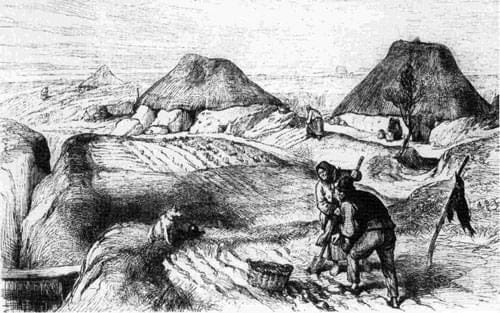
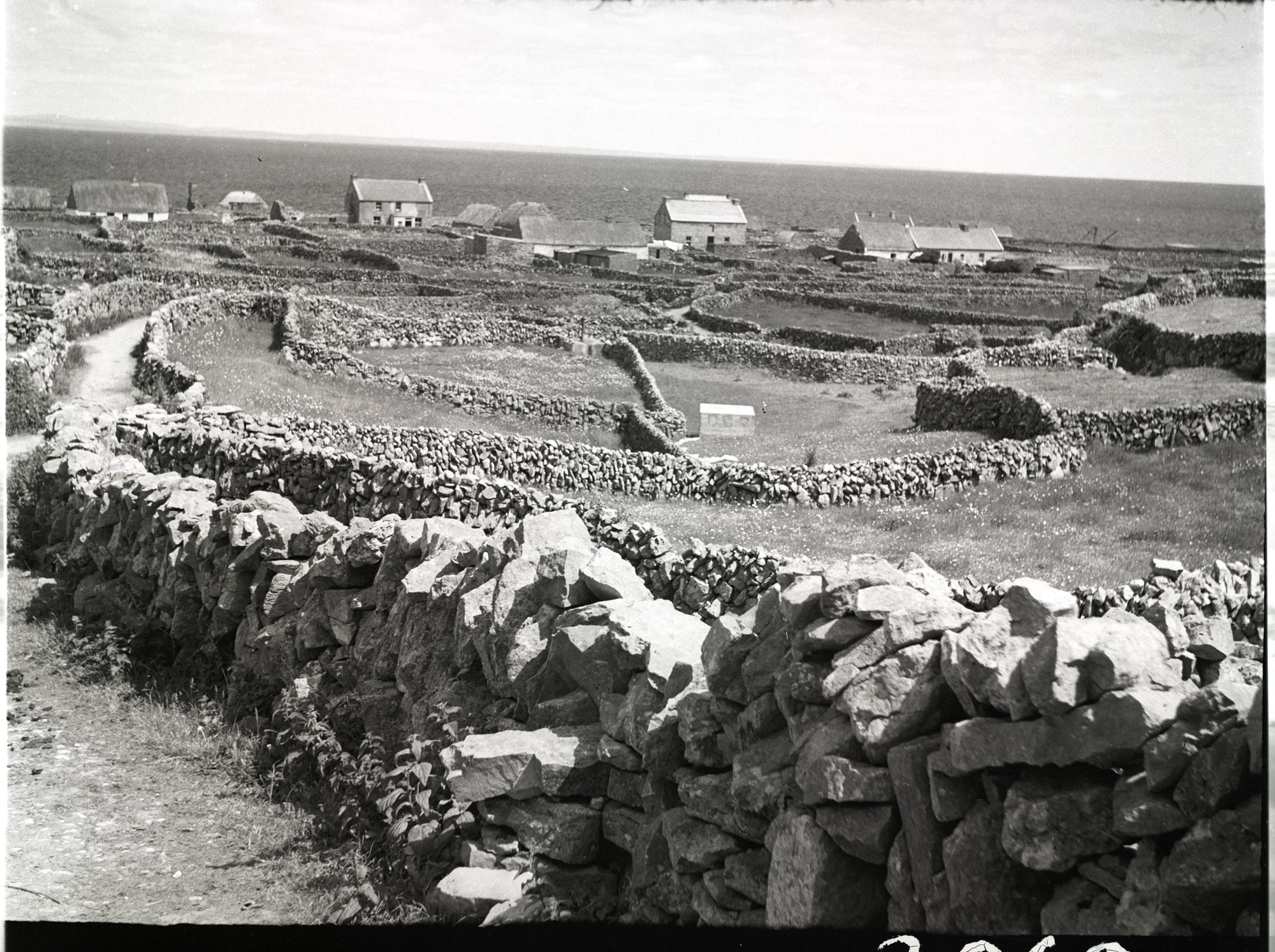
I’m not really sure where to begin, or how best to describe the intricately interwoven agricultural, cultural and social components which make up a unique mode of living once commonly found in the West of Ireland in the 19th century and ambiguously known as Rundale. But, figuratively speaking, if we were to find ourselves on a hill looking down upon one of the Rundale settlements which were estimated to occupy 2,000,000 acres of land on the eve of the Famine in 1845,4 the first thing we might remark upon would be the, not particularly sturdy looking houses which, from a distance, would look as though they were grouped practically on top of one other. We’d probably say, “Looks to be a village down there,” except there is no shop, or pub, or church. Instead, this is a clochán, a word borrowed from Scottish-Gaelic clachan to describe a clustered settlement of houses. If we’re locals, we’d know this clochán for the name of the people who live there, for most were bound together not just by the joint leasing of the land they lived upon, and collectively farmed, but by kinship and the sharing of common ancestors.
Next to, or surrounding, the clochán was the in-field where families cultivated their crops and laid out the lazy-beds of potatoes. The ridges and furrows this method of farming required are still a visible feature in the Irish landscape today, the clochán next to them now a tumbled heap of stone we call ‘Famine villages.’ But in looking down upon these fields, we might wonder “Where are the fences?”
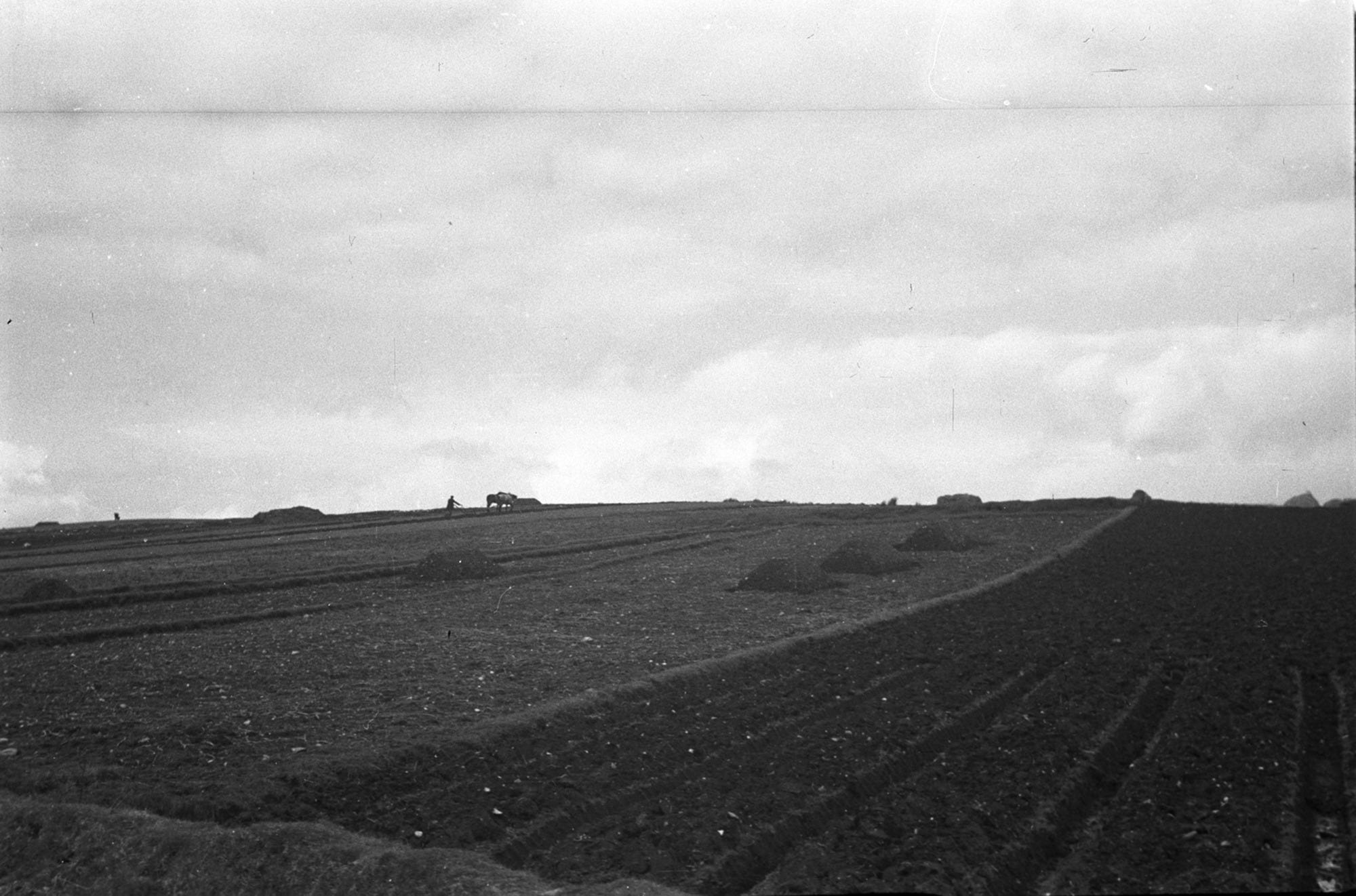
Instead of the system of enclosed farming we know today, with its hedges, ditches, stone walls and electric fencing, Rundale utilised an open-field system. Whose land was whose was determined, not by physical barriers, but by mutual understanding. As Tom Yager puts it in his exploration of the remnants of a Rundale system on the Mullet peninsula in Co. Mayo, “The passing stranger would not have known where one family’s holding ended and the other began.”5 Although each household was assigned their own strip of land to cultivate within the in-field, there was no sense of individual ownership because—to both account for the quality of the land or the need to subdivide the land further between growing families—these strips of land were redistributed every few years. In some areas this was done by a sort of lot-casting, or lottery system, but in most cases, it was overseen by the local headman, or ‘king.’ As Yager explains:
“The headman or king…. cast the lots for the triennial land scramble and, no doubt after considerable consultation, set the ‘bin’ every year, i.e. the number of animals that could be put on the common pasture. This was an important decision, because overgrazing would deplete the land. It was the headman’s role to see that the rent was collected. He also organised any communal work that needed to be done, such as building fences or reclaiming a new piece of land.”6
Beyond the cultivated in-field, Rundale systems also had what was known as the out-field. This was ‘over-flow’ land in a way: extra land that could be used to grow crops should need arise and/or grazing land for livestock when the in-field was under crop. Women and older children would be dispatched to set up temporary camps in the out-field, often in remote hill-land, where they would spend the summer living in small camps or groups to tend to the animals. So common was this practice of transhumance (or ‘Booley-ing)—the seasonal movement of livestock and people—it is etched into the landscape in the numerous townlands or places in Ireland still referred to as Booley, or Buaile in Irish. Yet, regardless of how the land was sub-divided or managed, the emphasis was not on efficiency or productive husbandry but on mutual support and the longevity of the whole community.
In addition to contributing their share of the rent, all members of the community were expected to contribute to their share of effort to get the ‘big jobs’ done. Things that required people to work together, like ploughing, bringing in turf, gathering seaweed, and reclamation work needed to expand cultivatable areas, were done communally. Important resources, like turf, and seaweed and dung for fertiliser, were also collectively managed to ensure that each member of the community had an appropriate share were, critically, an individual’s ‘right to resources’ depended on whether they had done their share of the work. Not contributing to the community, in other words, carried an individual penalty. In this way, a Rundale system was entirely predicated on a social system and cultural ethos of cooperation, mutual dependence and communality. As geographer James Anderson explains, Rundale:
“Was based more on communal than on individual enterprise, originally in kinship groups, later on partnership farms. Co-operation and equity were among the guiding principles”7
It is precisely this communal mind-set and mentality which fascinated and enthralled so many. As sociologist Eoin Flaherty writes, “The notion of an agricultural system based not on competition but on reciprocity and cooperation offers much to capture the imagination.”8 Not just a method of farming perfectly suited to ensuring a community’s survival on poor land and in harsh places, it was also a way of life—a social system based on shared rhythms and relationships where both the boundaries between people, and between people and place, were as faint as the boundaries between the fields themselves. And it is precisely this ethos of cooperation, community, mutual support, collective governance, and the inextricable bonds between people, place, nature and society which the Irish nationalist movement was keen to exemplify as Ireland’s ’native mentality.’9
Since E. Estyn Evans, the Queen’s University Belfast scholar first stumbled across two remote Rundale communities in the North-West of Donegal in the 1930s and, not long after, proposed that the open in-field, out-field farming practice he encountered were “archaeological fossils” of pre-Celtic agriculture and the system of shared land-use comparable to “the old ‘Celtic’ practice of equal division of lands of different qualities among male heirs,”10 debate has raged among scholars as to the antiquity and origin of the Rundale system. Many discount his vision of the cultural continuance of a native farming practice surviving from the Iron Age into the 20th century in remote parts of Ireland, and instead consider it an example of an adaptation to the ecological parameters of the land people had to survive on. Highlighting how the Rundale system (apart from some accounts in South Kilkenny and the Glens of Antrim) is overwhelmingly represented in the poor, mountainous, boggy regions of the West of Ireland, professor of Irish history Kevin Whelan sees the open-field system and characteristic allocation of strips (as opposed to fields) of land to cultivate as “an ingenious adaptation to an environment where fertile patches of glacial drift were frequently embedded in desolate expanses of bog or mountain.”11
However, when Ireland was beginning to imagine and story itself into materiality, such scholarly debates were in a not-yet-realised future. Rather, 19th and early 20th century Irish nationalists would have been much more likely to share the musings of one English writer who, in 1870, viewed the Rundale system, still in existence at the time, as a remnant of Gaelic, pre-colonised Ireland:
“What traces did Brehon Law…. leave in the habits and sentiments of the people, and can any of those traces be observed in the present day? Of the custom of Tanistry we hear no more; but the custom of gavelkind long survived, reappearing, under English law, in the form of tenancy common down the early part of this century; and it may still be traced in the love of holding property in families, in the tendency to subdivide the land, and in an unfavourable shape, in Rundale, where the tenement is made up of a number of scattered patches of each particular quality of the land.”
While the author, Frederik Weymouth Gibbs, and his contemporaries viewed such continuance of a communal mindset as part of the problem with Ireland—what made it so difficult to govern, so uncivilised, backward, and unreceptive to the ideals of economic improvement and private ownership—Irish nationalists viewed it as the basis of cultural reclamation. It was it’s very pre-colonial ‘backwardness’ which made it so appealing to those of the formative movements of modern Ireland. But in selecting it as the defining, centralising feature of a new national identity, those who used it to story Ireland into material reality unwittingly changed the shape of it. They took a cultural mentality wholly and intrinsically rooted in, and determined by, a way of life based on a relationality of people and place (the ties and interactions between nature and society which defined the Rundale system), uprooted it and transformed it into an untethered, intangible, civic orthodoxy.
Following the War of Independence and the separation of the 26-county Irish state from Britain in 1922, this civic orthodoxy manifested in the championing of collectivism over individualism, and tradition over modernity. De Valera, in an almost direct echo of descriptions of the cultural mentality found in Rundale communites, framed “the capacity for mutual tolerance, co-operation, [and] obedience to authority” as “the ideals that shape everyday [Irish] life,” while dismissing “individualism and self-interest” as “a broken reed” and glorifying “the unity which exists between the individual and the society of which he or she is a part.”12 And it was this very sentiment which successive governments (including De Valera’s Fianna Fáil party and their predecessors Cumann na nGaedheal), from the 1920s to the 1950s and a bit beyond, used to justify a series of economic policies based on protectionism, self-sufficiency and the family farm as the primary economic unit of the state. As social historian Clair Wills puts it:
“The 30-acre farm was meant to be the crucible of independent Ireland’s rural economy, an area of land supposedly large enough for farmers to be able to make an admittedly frugal, but honest and mostly self-sufficient living. Whether that was ever possible is doubtful.”13
Prof. Liam O’Dowd—who surprised me by naming communalism as a “social ideology” rather than the de facto workings of everyday Irish life—has an interesting and insightful take on why this ideology proved so useful to various Irish governments in the decades following independence: it helped to address the nascent state’s marginal position within global capitalism.
On the one hand it could be harnessed to engender solidarity and build on the patchy networks of native capitalist development at the time, and on the other, it could offer a buffer against economic pressures or, as O’Dowd puts it, protect “against the depredations of a system geared for profit rather than to human needs.” One political commentator, the Cork solicitor John J. Horgan, writing in November 1930 evoked the interwoven ideals of agriculture and community to claim that Ireland had survived the Great Depression of the 1920s better than most because of the counteracting effect such forces had against capitalism:
“Despite the general slump in agricultural prices, conditions in the Free State are relatively more normal than in most other European countries. This is probably due to the fact…. that the Free State is predominantly agricultural and pastoral, and so the reactions of the almost world-wide economic depression are slow to take effect here. There has not, in fact, been any serious increase in unemployment, and, as there is no dole, there is no inducement to become unemployed by artificial means. The world crisis has only touched us at two points so far, namely in its effect on the Ford factory at Cork, which manufactures for the world market and has been virtually closed down since early summer owing to a lack of demand for its products, and, secondly, by the marked decrease in emigration. This last phenomenon is due to the increasing reluctance of the people themselves to venture into the uncharted arena of American unemployment, and to the tightening of the regulations by the American consular officials, who are now refusing visas to would-be emigrants who cannot prove that they possess reasonable means with which to support themselves for some time after their arrival.”14
The picture Horgan is presenting here, and the story he is choosing to tell, perfectly incapsulates the dominant ideologies informing a general attitude to the economy, society, and welfare at the time. That Ireland was a rural, self-sufficient country whose community-mindedness protected it from the vagaries of the laissez-faire capitalist economics which were ravaging the world, and that the work ethic of the Irish people was enhanced by the lack of any social insurance or welfare provision by the state. So good, indeed, were things—he says—people were choosing not to emigrate into the ruined capitalist cesspits of moral and economic depravity of Depression era US (or Britain).
Except, of course, this was wishful thinking and fantasy. In reality things were, as my Mum would put it, “dire” across the country.
Poverty, unemployment and rising rates of emigration were rife in post-independence Ireland. The poverty in rural communities was so high as to be considered exceptional among Western countries of the time. Nowhere in the country was this worse than in the rural regions of the West of Ireland where some have described the conditions as a forgotten-famine. Rather than Gaelic utopia, real-life within the white-washed cottage the Irish state had drawn on to symbolise national identity was nothing short of desperate. In January 1924, the medical officer for Clifden described how:
“Bad weather, unemployment, and actual poverty are causing great suffering among the poorer families, and many cases of actual want of food and clothing have come under my notice … I have no hesitation in stating that at no time in my experience has poverty and unemployment been greater.”15
A casual wander through newspaper clippings, Dáil debates, correspondence between state officials, bishops, priests, nuns, doctors, teachers and ordinary people of this time simmer with accounts of abject poverty and daily human suffering—stories of people on the edge of hunger, others dying from it, outbreaks of typhoid, typhus and the ever present tuberculosis taking more, the constant exodus of the young people, and the sense of helplessness in the face of a collapsing fishing industry and the reality that, “There was a grave over-dependency on the land, many of the holdings were too small to be economic, and when the crop failed the people were little removed from destitution.”16 And yet, as I wandered through lived accounts of the times my grandparents were born into, what struck me as altogether more shocking than the rates of poverty and newspaper reports of yet another person believed to have died from hunger,17 was the general attitude of the government of the time to it—apathy and distance.
Rather than seeking to alleviate suffering or offer welfare supports to the most vulnerable members of society, successive Irish governments repeatedly reinforced the narrative that the state should not intervene on such matters. While other European countries were developing the ethos which would later form the concept of the Welfare State, Ireland was reversing on some of the welfare supports that had been introduced under the British system, cutting pension payments and dramatically reducing public spending.
And it is here, in this context and time-space that I think of my Granny, of the constant vigilance she maintained throughout her life as to the welfare of her neighbours (and which I, from my position of 1990s and 2000s comfort and privilege found a bit ‘too much’), and her mantra that “one arm should always be shorter than the other” when you head out the door (because you should always have something with you to give to another). And in thinking of her, in honour of her and because of her, I would argue that there is another reason, one overlooked by Prof. O’Dowd above, as to why the ideology of communality was so favoured and proved so useful to numerous politicians—it offered a welfare system of a kind which the state was either unwilling or unable to provide. One almost entirely enabled by the silent, unrecognised, yet taken-for-granted, efforts of women upholding their ‘civil duty.’
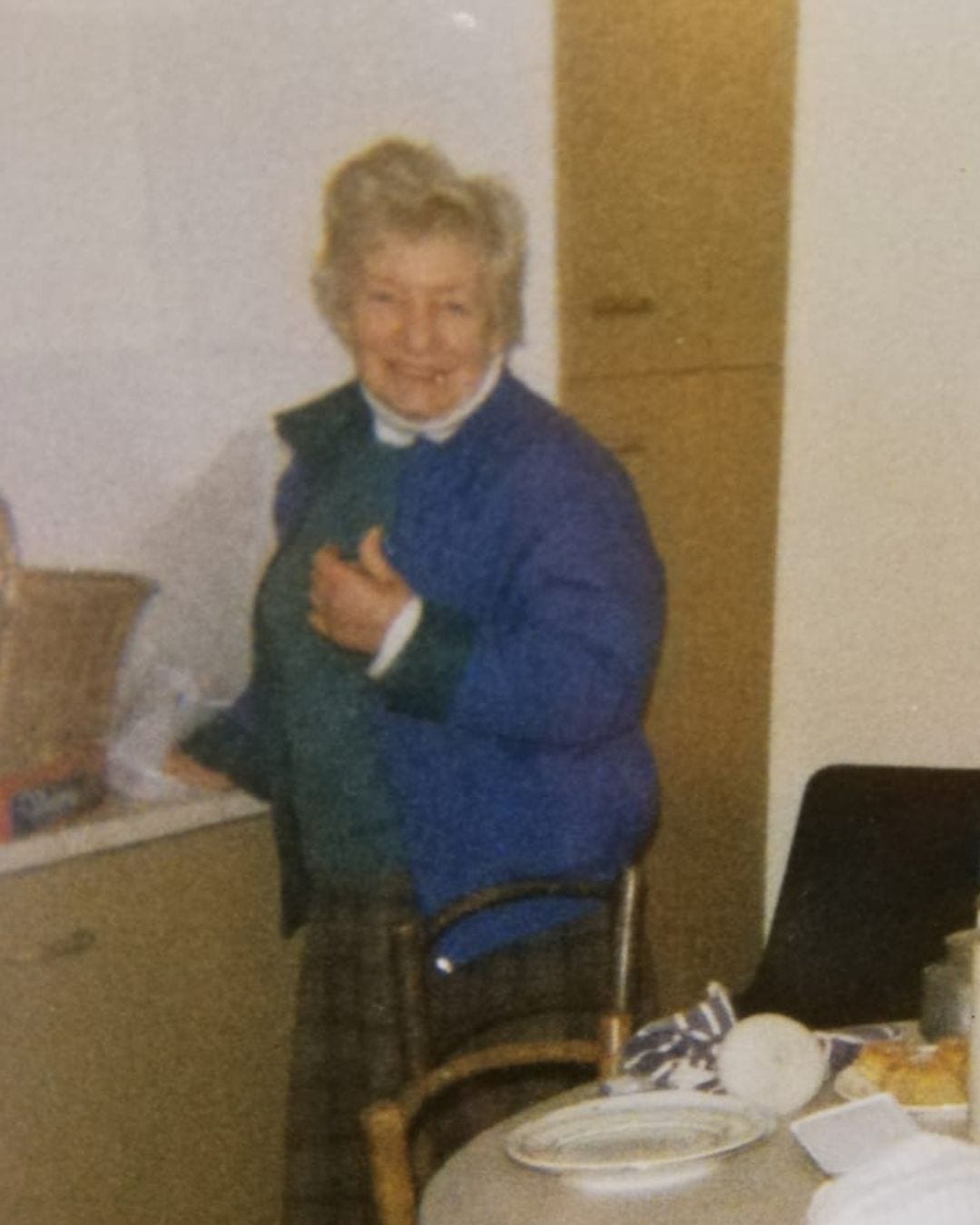
Women are at the absolute centre of community life in Ireland—they are its heart, they pump and power it. And when I allow my mind to wander into the feeling of it, my chest swells with the warmth and energy of it. An energy that is generous and kind but not soft—it’s tough, and gritty, and unrelenting because it’s the energy emitted by the veritable force-to be-reckoned-with powerhouses of women who run the plethora of community and voluntary organisations across Ireland which keep the whole place going.
The general apathy the Irish state demonstrated in its formative years towards getting involved in ‘community matters’ or providing funding for welfare and social services is largely another outcome of the influence of the Catholic Church. Catholic social teaching believed state intervention made people lazy and dependent.18 When, in 1925, the Cumann na nGaedheal government eventually sent some aid to the poverty-stricken, famine-facing communities of ‘True Gaelic Ireland’ in the West, it was in the form of fuel grants, reduced price seed potatoes and oats, road-building relief work schemes (doesn’t that sound familiar!?), and school meals for children in most need. When they proposed to give out free seed to enable the planting of the next year’s harvest, local clergy heavily opposed it on the basis that it “counteracted the self-help ethos they were trying to promote in their parishes.”19
The priest in Roundstone, Fr. White, wrote a letter exclaiming, “It was that kind of thing that had ruined the Connemara man…. the people here are so demoralised that a man with £1,000 in [the] bank will come looking for relief as well and with more cheek than the man that is starving.”20 Instead, it was agreed that the bishops of each diocese would handle the administration of relief and aid. It was a concern and a decision wholly rooted in Catholic social ideology which taught that the state had no right to intervene on social issues or citizen welfare—this was a matter to be handled locally, through family solidarity and community networks (in their most formal form, voluntary organisations and charities) which the Church, of course, heavily controlled.
While this example from Connemara is just one snapshot in time, it represents the approach taken by countless Irish governments for decades. Even today, Ireland is noted as having an unusual proclivity towards voluntary over statutory services for the provision of social services,21 with the hours provided by volunteers estimated to be worth €1 billion.22 According to the 2022 Census, 14% of people in the Republic of Ireland volunteer (but no sub-set of individuals in Ireland volunteers more than those who identify as Black and Black-Irish, where the volunteering rate increases to 27%), while in Northern Ireland, findings from the continuous household survey for 2023/24 found that nearly half (47%) of those surveyed volunteered in some capacity.23 In the Republic men outnumber women, while there is little difference between numbers of men and women volunteering in the North (except for informal volunteering, like dropping in on a neighbour, doing someone’s shopping, or helping someone which more women than men did). However, the difference between the sexes gets really interesting when you break it down into types and forms of volunteering. While the majority of male volunteering is carried out in sporting organisations, when it comes to volunteering in the community or getting involved with social organisations and charities, women far outrank men (in both the Republic and Northern Ireland).
Community is the realm of women in Ireland. It’s where women truly shine in the fullness of their strength as initiators, doers, organisers and orchestrators. As one woman I interviewed said of the women in her home-city in Derry, “it’s always” the women who are found driving “community associations.”
While the 26-county, post-independence Irish state was busy ‘footering about,’ as my Granny would say, somewhere between outright apathy and paying cursory lip-service to the variety of issues impacting the wellbeing of the nation’s populace, women in Ireland were coming together to do something about it. Through organisations like the Irish Housewives’ Association (IHA) and the Irish Countrywomen’s Association (ICA) they, throughout the twentieth century, campaigned to have the needs and issues afflicting their communities seen and addressed. The IHA successfully lobbied the government into rationing food more fairly during the second world war, raised awareness of issues of public health, poor maternity care, education and family law, and, along with the Irish Women Workers’ Union, campaigned to improve the conditions of women working in domestic service. They were also instrumental in establishing the Commission on the Status of Women 1970—the first ever report to examine what life was really like for women in Ireland. For the ICA, improving the lives and living conditions of those living in rural communities was their central concern. They successfully campaigned, despite opposition from the Irish Farmers Association (who many a members’ husband was a part of) to get piped water into every rural home in Ireland and increase access to and use of electricity. They also fought successfully to get a proper advisory service for women on farms when the existing agricultural advisory board offered their services only to men.
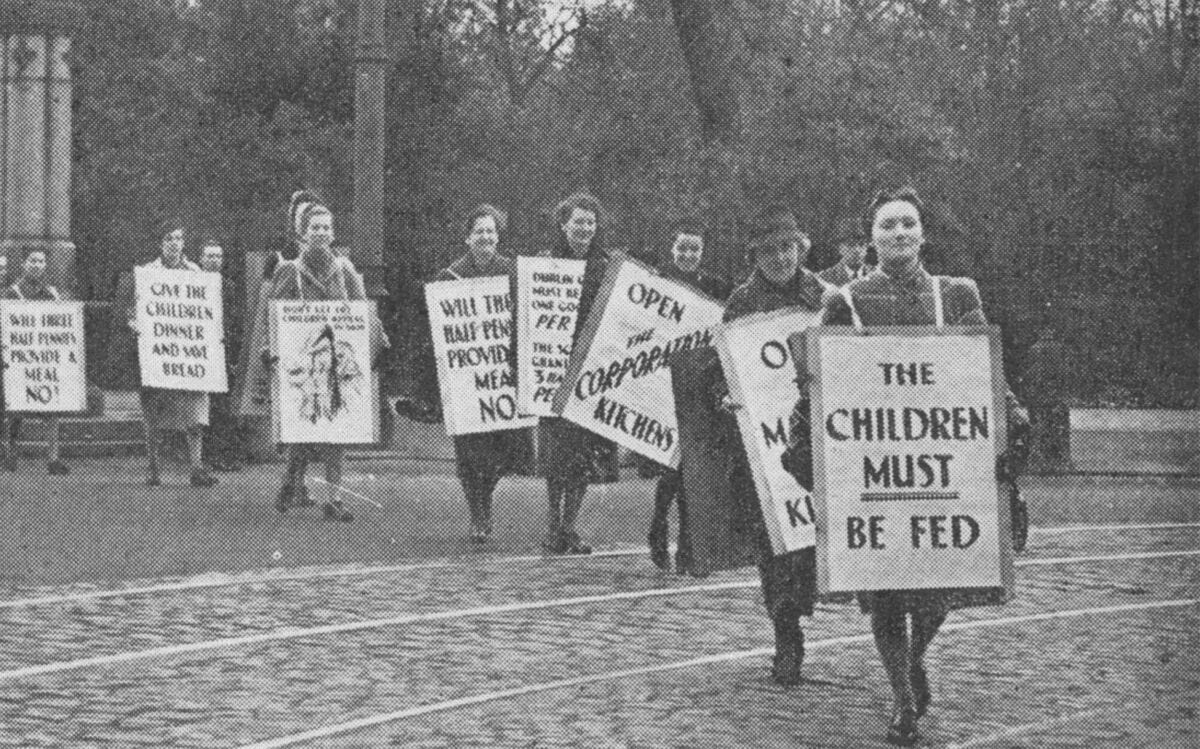
Women, through organisations such as these and the countless other local community groups and informal support networks they set up, ensured that the state didn’t get off so lightly when it came to the needs of the populace. They ensured that the ‘local’ remained political, working tirelessly to ensure that the needs of their communities could not be so easily overlooked by ‘them up in Dublin,’ and when they were, that something was done about it even if they had to do it themselves (which was more often the case).
Writing of the doings and achievements of such groups, or of women of my Granny’s sort (of which I imagine you have quite a few of your own) doesn’t do near enough justice for why their efforts and organising deserve, in my opinion, to be remembered as legendary, because these women were doing all this when they, officially speaking, couldn’t.
Until well into the 1970s (and beyond) women, across Ireland, were defined according to very strict ideals of womanhood and expected to conform to them. They were, for all intents and purposes, socially and legislatively barred from the public and political sphere of society. It is easy to look upon this era of women’s history as being entirely bleak, with women passive and servile, trapped by the confines of a patriarchal, religious and conservative society whose ideals the majority had subsumed. But women, most especially when it came to issues impacting their families and community, did not disappear from the public sphere or stop exerting influence on it—instead they found ways to subvert the system and play it at its own game.
Names like The Irish Houswives’ Association or The Irish Countrywomen’s Asssociation might sound twee or conservative to our ears but they were a genius veneer, a cloak of acceptable and conventional womanhood behind which women could continue to influence, shape and be active in public and political life. In such a form they were, as Professor of Law Carol Coulter writes, “virtually unassailable by the patriarchal institutions which otherwise excluded women from public life. They offered women an avenue through which to fight for a better life for themselves and their children and a voice in the development of public policy.”24
There is something about ‘women’ and ‘community’ which I feel rouses or stirs a deep sense of pride within us. It is as though—knowing as we do the many achievements, hard-won fights, and things that wouldn’t have got done without them—the ‘community-minded women’ of ancestral memory and local lore have come to symbolise, or perhaps provide a material representation for, the very ‘thing’ which we believe makes women of Ireland, women-of-Ireland. That remarkable essence of power, that energy, force and tenacity, and how it all seems to come together, and shine at its fullest and most formidable, when women are working collectively for a common cause—a ‘common form of life.’
As I’ve explored in previous essays here on Substack, women in Ireland were made symbols of the nation and Irish national identity. They were given the role of culture-bearers,25 as is common in post-colonial nations, tasked with embodying and reproducing the cultural identity of the nation and transmitting it to their children and other women. In this way, women come to internalise, and thus perform, the ideals the nation adopted as its identifiers and differentiators.
If ‘communalism’ was what made Ireland ‘Ireland’ and differentiated it from Britain then it follows that women, as the nation’s culture bearers, had to embody, perform and transmit this very ideal. There is a part of me that does not want to interpret the depth of the generosity, all the ‘minding’ of the neighbours, the community organising and campaigning of generations of women of Ireland in this way, but I think it holds that both realities can co-exist: that what women do out of the goodness of their hearts and from a place of mutual and deep reciprocity has also been shaped and, perhaps, amplified by how it has been prescribed as women’s role by Irish society. That the (in)famous “Housewife of the Year Competition,” which ran from 1965 to 1995, judged competitors on their ‘civic spirit,’ alongside categories such as meal preparation, is rather telling in this regard. If being community-minded was the story Ireland chose to tell about itself to realise the nation and national identity, then it was to women to whom the responsibility for the material creation of this reality most strongly fell.
But sometime in the 1950s and 60s, Ireland slowly began to change the story of communality.
Two things happened. First, in response to a stagnating economy and some of the worst rates of emigration the country had yet recorded, many commentators, particularly among a new wave of politicians, began to highlight how Ireland’s exalting of communality, tied as it was to the ideals of a rural, agrarian, family economy and the eschewing of modernism, industrialism and urbanism, was to blame. Second, Ireland “rediscovered poverty”26 as data on the levels of people living on or below the bread-line was gathered and published for the first time, awakening the country into just how ‘dire’ things were for many and revealing the inadequacies of the state’s long-standing policy to frame such things as largely a ‘community’ and ‘local’ matter. In other words, the ideology of communality, which had served so well as a singular principle onto which the many facets of Irish identity could be tacked, had failed to produce, in material terms, the Ireland it symbolised. Thus, Ireland needed a new story and a new ideology.
However, so central was communality, by this point, to Irish people’s sense of self it could not simply be discarded. Rather, it provided a powerful civic orthodoxy through which new ideologies could be introduced as long as they were framed as ‘in the interests of the community.’ The story of communality was shifted from one that was rooted in the rural Ireland of bygone eras, with its Rundale system and mutually supporting, egalitarian kin-groups, to one that was rooted it in the state and capitalism. The image symbolising it would no longer be the white-washed West of Ireland cottage, with its family farm enterprise, but the new IDA industrial estate built on the edge of town where community interest meant economic growth. A new era was beginning in Ireland, one which continued to claim that ‘community’ was what defined the Irish people and made them so different to the rest of the Anglophone world, but which embraced modernity and economic growth because it was ‘for the good of the community’ and for ‘the good of all.’27
However, in shifting the story and “advancing an alternative communalist ideology” as Prof. Liam O’Dowd puts it, Ireland opened the doors to capitalism and neoliberalism and the changes this has had on society. While communalism continues to be our dominant ideology it is largely symbolic; neo-liberalism is, in truth the dominant organising force of our daily lives and how we now think of ourselves and our place within society. No longer do we think in terms of ‘duty’ to others, we think in terms of ‘duty’ to ourselves. To our boundaries, our priorities, our needs.
But not quite. Not quite.
As I have witnessed in so many of the women I interviewed for this project, many women of Ireland (and many men too) continue to feel a huge sense of duty to their wider families and communities. That older ideology, which women as culture-bearers were prescribed to embody, continues to inform and shape their lives. But gone is the through-line from the Rundale system and its communal mentality, to the likes of my Granny heading out the door with ‘one arm shorter than the other.’ Instead, women continue to be expected to perform the ideals of communality Ireland prides itself on, while existing within a social world vastly different from the one this ideology was pulled from—they no longer occupy a similar cultural soil to the past, with its wider networks of support, kinship and mutual aid. The impact of neoliberalism and capitalism on community life in Ireland is that it has exacerbated the demands and burdens placed on women, while simultaneously isolating them from the prior support system or intergenerational network they once had access to, to share the load or seek support.
In “Women in Ireland: Voices of Change,” a book written in the 1980s and based on the first-hand accounts of women, Jenny Beale captures the experiences of women who lived through this time of great social change, as Ireland’s largely agricultural economy and its associated high-levels of communality and collectivism gave way to capitalism and the adoption of neo-liberal economic policies. The interviewed women rather astutely chart the effects of the adoption of Ireland’s ‘alternative communalist ideology’ on everyday life in how the goal “shifted away from neighbourhood cooperation towards individual achievement.” But even though this wider social ideal changed, the original story—the one which prescribed that women should occupy the role of primary caretakers, performing the emotional and physical ‘labours’ necessary to uphold, maintain and reproduce community and family— continued to apply. Consequently, women found themselves increasingly isolated from a wider network of community support yet still expected to uphold such ‘labours’ which, for previous generations, had been a shared responsibility (albeit, across a local network of women). One woman, Maura, captures this as she compares her own life to that of her mothers”
“There was a great closeness, there was no television on the road and they had a great support system, helping each other with their babies. We’ve been living where we do for two years and we hardly know the people round us. It isn’t like the place where I grew up where we were running into people’s houses all the time and the doors were always open. We are much more closed off”.28
If we are truly living according to the ideals of communality then why are women, as one woman said to me, so “bloody knackered”? Why are women confessing the burden of responsibility they carry for keeping their families and communities going? Why have so many of the women I have spoken to over the years used phrases like “co-dependent” to describe a familial relationship which, within the tight kinship bonds of a Rundale system or interdependent, functioning community wouldn’t have caused anyone to bat an eye-lid? Something has gone awry. Something about this story we tell ourselves of Ireland being this outlier on the edge of the Anglophone, modern Western world were community and communality still hold sway just isn’t adding up. And the cracks are showing among those who have been most strongly expected to materialise this ideal—the women. They have been over-burdened with the responsibility of it all, and many confess a growing resentment, a desire to push back against and place boundaries between themselves and these older ideals of ‘communality’ because, in truth, they are often a one-woman collective seeking to serve the needs of an entire family or community eco-system, and they are exhausted.
I, personally, have always valued and delighted in how a general community-mindedness is part of Ireland’s sense of self, something which many people pride themselves on and which leads them to create, build, and support so many wonderful things. But I also highly value my individualism, my “boundaries” and the opportunities to prioritise my own needs and desires. In some ways, I think the Ireland of the last hundred years or so is an interesting lesson in what happens when particular ideals and ideologies are pushed or prioritised—to what happens when you go too far one way, or value the ideal more than the lived reality of the people having to live up to it. But in a time when so many people are increasingly seeking out ways to consider community from different perspectives, I feel there is also rich soil to be found in this history. What do you think?
Making thoughtful, well-researched knowledge freely accessible is something I’m truly passionate about—I have no plans to put my writing behind paywalls. If you find value in my work and want to help sustain it, you can support me by buying me a coffee or becoming a monthly supporter through the link below
Thanks for reading The Women of Ireland Project! Subscribe for free to receive new posts and support my work.
Laffiteau, C. (2009). An Analysis of Cultural Perspectives in Ireland.
O’Dowd, L. (1987). Town and Country in Irish Ideology. The Canadian Journal of Irish Studies, 13(2), 43–53. https://doi.org/10.2307/25512708
Thompson, W.I. The Imagination of an Insurrection: Dublin, Easter 1916. New York: OUP, 1967.
Slater, E., & Flaherty, E. (2009). The Ecological Dynamics of the Rundale Agrarian Commune. NIRSA Working Paper Series, 51. https://mural.maynoothuniversity.ie/id/eprint/1548/1/WP_Ecological_Dynamics.pdf citing Freeman (1965)
Pg. 155 in Yager, T. (2002). What was Rundale and Where Did It Come From? Béaloideas, 70, 153–186. https://doi.org/10.2307/20520797
Ibid, p. 159
Anderson, J. (1995). Rundale, rural economy and agrarian revolution, in Donegal History and Society, (eds.) Nolan, W., Roynane, L., & Dunlevy, M.
Pg. 3 in Flaherty, E. (2015). Rundale and 19th Century Irish Settlement: System, Space, and Genealogy. Irish Geography, 48(2), Article 2. https://doi.org/10.55650/igj.2015.623
Flaherty, E. (2015). Rundale and 19th Century Irish Settlement: System, Space, and Genealogy. Irish Geography, 48(2), Article 2. https://doi.org/10.55650/igj.2015.623
E. E. Evans, ‘Some Survivals of the Irish Openfield System’, Geography 24 (1939), 24-36.
Pg. 77 in Mac Cárthaigh, C. and Whelan, K., eds., 1999. New Survey of Clare Island. Royal Irish Academy.
De Valera, Eamon. Speeches and Statements 1917-73, edited by Maurice Moyhihan, Gill and Macmillan, 1980 cited in Kim, S. (2022). The Blackwater Lightship: Modernity and the Idealism of Family Bond in the Era of the Celtic Tiger. James Joyce Journal, 28(2), 139–165. https://doi.org/10.46258/jjj.2022.28-2.139
Clair. Missing Persons, Or My Grandmother’s Secrets (p. 37)). Kindle Edition.
Alexander May, ‘The Round Table, 1910-66’ (D.Phil. Thesis, Oxford, 1995), Appendix F, List of Contributors, pp. 485-509
Newell, Una. The West Must Wait : County Galway and the Irish Free State, 1922-32, Manchester University Press, 2015.
Ibid.
Ian Miller offers some heart-breaking examples in this article: https://www.rte.ie/brainstorm/2022/0714/1308735-ireland-cost-of-living-crisis-1920s-1930s/
Holohan, C. (2016). Conceptualizing and responding to poverty in the Republic of Ireland in the 1960s: A case study of Dublin. Social History, 41(1), 34–53. https://doi.org/10.1080/03071022.2015.1108711
Pg. 79 in Newell, Una. The West Must Wait : County Galway and the Irish Free State, 1922-32, Manchester University Press, 2015.
Pg. 79 in Newell, Una. The West Must Wait : County Galway and the Irish Free State, 1922-32, Manchester University Press, 2015
Holohan, C. (2016). Conceptualizing and responding to poverty in the Republic of Ireland in the 1960s: A case study of Dublin. Social History, 41(1), 34–53. https://doi.org/10.1080/03071022.2015.1108711
Charities Regulator Authority. (2023). Report on the Social and Economic Impact of Registered Charities in Ireland (p. 40). https://www.charitiesregulator.ie/media/4767/scoeco.pdf
Analytics Division. (2024). Experience of volunteering by adults in Northern Ireland (Continuous Household Survey 2023/24). Official Statistics. https://datavis.nisra.gov.uk/communities/experience-of-volunteering-by-adults-in-northern-ireland-202324.html
Pg. 33-34 in Coulter, C. (1993). The Hidden Tradition: Feminism Women and Nationalism in Ireland (Reprint edition). Cork University Press.
Winter, B. (2016). Women as Cultural Markers/Bearers. In _The Wiley Blackwell Encyclopedia of Gender and Sexuality Studies_ (pp. 1–5). John Wiley & Sons, Ltd.
Holohan, C. (2016). Conceptualizing and responding to poverty in the Republic of Ireland in the 1960s: A case study of Dublin. Social History, 41(1), 34–53. https://doi.org/10.1080/03071022.2015.1108711
O’Dowd, L. (1987). Town and Country in Irish Ideology. The Canadian Journal of Irish Studies, 13(2), 43–53. https://doi.org/10.2307/25512708
Maura, a woman interviewed in the 1980s by Jenny Beale, pg. 45 in “Women in Ireland: Voices of Change”
Comments
Nothing yet. Say the first thing.
Sign in to join the conversation.