
We’re constantly consuming other people. Their voices. Their appearance. Their seven second videos I don’t mean to be negative, I just mean to say that it’s a lot, and that usually when you feel disconnected from yourself it’s because you’re so full of other people.
That’s the curse of being energy-sensitive. And guess what? Every creative and spiritual person I’ve ever met is energy sensitive.
That includes you, darling.
How many times have you woken up and swallowed a hundred voices before breakfast? Opinions, aesthetics, silly little videos. Seemingly harmless. But deep down you know as well as I do that it eats at your creativity.
So of course you can’t hear yourself think.
Of course you’re stuck in the loop of bookmarking other people’s ideas instead of making your own.
Of course you’ve gotten so good at documenting your life for everyone else.
It’s just crowded in that beautiful head of yours.
Thing is, creatives need spaciousness. We need to wrestle with boredom until our third eyes flutter open for a moment at a time. We need silence so that we can hear God.
I’m writing this because I need it too. I just got back from three weeks in three countries visiting my family and my fiancé’s, and you can bet that in my free time I was scrolling more than I was creating.
So let me tell you how I kicked the habit.
Before you roll your eyes and think I've tried that — hear me out. Not all journaling is equal.
I’ve been journaling since I was seven years old and I need you to understand what I mean when I say journaling. I’m not talking about perfect handwriting, or bumper-sticker inspiration. No. journaling isn’t another productivity system or a surface-level self-help hack.
Journaling is a portal into observing your self-concept and your unconscious. And everything you most need to know about yourself is down there, waiting.
Let me give you the clinical part before I give you the magic.
When you put a feeling into words, your conscious mind does something we can literally measure.
It’s called affect labeling. The moment you name what you’re feeling on the page, the amygdala — your inner smoke alarm — settles down, and the thinking part of your brain comes back online. Naming the thing on paper takes the charge out of it.
That’s the science. But here’s what it feels like:
As your hand keeps moving slowly across the page, the pace lets the deeper stuff slip past your conscious protective mechanisms, and you begin to reveal the deeper aspects of the psyche.Your subconscious stops performing and starts confessing.
I’ll give you a vulnerable example.
I’m in my Tarot era. I’ve been studying it obsessively in all my free time, because on a scientific level I believe in the morphogenetic field’s ability to deliver the exact guidance we need, and on a spiritual level, I believe our angels and guides are always available for advice.
I pulled the nine of swords first. Of course I did.
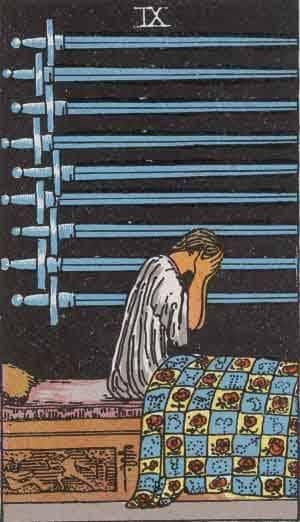
The Nine of Swords is the card of being tortured by every terrible unconscious thought you can think of. The suffering it shows is real, but it's entirely internal. Yup. That’s how I was feeling on that late-luteal-overwhelmed-by-work day. Like my contracted mind could only latch onto negatives no matter how much I meditated.
Every good tarot reader knows that every card asks us to take a specific action. This one asks you to reflect:
What specific fear does your mind return to most reliably when you sit down to create?
Damn. Okay universe, call me out.
So I did what it asked. I wrote down every fear, every contraction, every invisible dragon. And once they were on the page, I could finally see the light at the end of the tunnel. I knew what I needed.
Quiet. Space. Room to create.
I took it. And from that action, this article was born.
You can lie to your therapist. I would know, I am one, and my clients are talented.
But you cannot lie to your own handwriting for more than about three pages. The hand is slower than the mask.
And baby, the truth is the only thing that gives you the sweet release you’re actually craving.
Not all journaling is created equal. But don't worry, I've spent two decades mastering writing prompts and teaching identity work, so here's the exact process to come home to yourself when you're feeling creatively uninspired, or lost in general.
1. Bring awareness to what’s underneath.
You know that famous Carl Jung line? “Until you make the unconscious conscious, it will direct your life and you will call it fate.”
Yeah. That one.
We journal to get intimately familiar with our own little underworld. Pro tip: find external inspiration for your prompts. The Tarot. My 7-Day Higher Self Challenge. Whatever it takes to ask yourself the questions that make the unconscious conscious. 2. Reflect and redirect the story you’re telling.
Most of us have no idea what story we’re telling ourselves. It’s usually one you absorbed from someone else, or an old wounded victim story trying to protect you. No shade. None of us are exempt from this.
Catch the limiting story, then ask: if I were the author of my own hero story, what would I choose to believe? How would I move differently, right now?
3. Come back to who you actually are, and act as her.
This is where you return to essence. You take action as your highest self. As the truest version of you.
Memory is fickle, and it’s rarely kind to us with its distortions.
I’ve been through enough identity crises — and survived enough of them — to know one thing for certain: The meaning you assign to a thing shapes you more than the thing did.
This is the part of the work I love the absolute most. You get to be the author of your own mythology.
So when you journal, understand what you’re actually doing. You’re taking dictation from your unconscious, and then deciding, consciously, which lines make it into the book.
Evolve or repeat, my love. You hold the pen that decides the storyline.
When you vent to someone you love you’re usually looking to be seen. But retelling the story and venting and looping is often exactly the thing keeping you stuck.
The vicious cycle goes: feeling → story you (unconsciously) create→ rumination → intensified feeling.
When you write, it’s just you and you. You become the one receiving your own complaints. And once the charge flows out of you and onto the page, you start drifting toward solutions on your own.
It’s almost like you’re the author writing the story of your life.
And if that were true… wouldn’t you write yourself a hero?
You are not your thoughts. You are the one who chooses which thoughts to act on.
I type fast. I think faster. That’s exactly the problem.
Handwriting is slow enough that your body catches up with your mind, and something else finally gets a chance to speak. The pace drops you into a trance-like presence, which is why journaling is my favorite form of meditation, and why I get my clearest downloads when I’m holding a pen instead of my phone.
Thank god for the practices that still let us slow down.
I’ve had entries come through that I don’t fully remember writing. I read them back and think, I did not write that alone. Or I catch the truth just sitting there on the page and go; Damn. I can’t believe I wrote that.
Call it your higher self. Your angels, your guides, the morphogenetic field, the universe conspiring in your favor to help you grow. Whatever superior force you believe in will do.
And look, writing doesn’t have to be your act of creation.
Whatever medium you choose to reflect & express, there’s only one question that matters:.
Whatever act of creation you choose, there’s only one question that truly matters: does it put you back in participation with your own life? If yes, that’s your answer. Follow it.
To create is to make contact. With the world. With the people you were sent here to find. With the parts of yourself that only come forward when you’re quiet enough to notice them nudging you.
And then you move. Because a nudge you don’t act on becomes a knock, and a knock you ignore becomes a rude awakening.
Ask me how I know, I dare you.
You need a blank page and about seven minutes and a playlist without lyrics that gets you in the mood.
My one rule: pick up the pen (or start typing) and don't stop. Don't edit. Even if what comes out is "I don't know what the fuck to write and I lost my train of thought and I don't feel like doing this."
Eventually the real words start flowing through your fingertips and onto the page.
Uncover what’s underneath. Reclaim the story. Return to yourself.
You already know yourself better than you think. She’s just been waiting for you to take action on living from a more empowered story.
So if you needed to read this, set aside some solo time to write today.
Put your name at the top of the page like you’re summoning someone.
Because you are. Your higher self.
—B
No posts
Comments
Nothing yet. Say the first thing.
Sign in to join the conversation.