
In the final days of 2025, we at Being and Becoming are reflecting on the past year of cafés, classes, workshops, and newsletters, and the countless interactions we’ve had with the members of this community.
We feel immensely grateful to all of you. For spending your Tuesday evenings at a pub talking about promises, AI and authenticity, and music. For contributing in our online WhatsApp group and continuing conversations offline. For coming to our educational programming pilot this summer and participating in the classes and skills workshops. For reading our newsletter and subscribing. For every time you purchased a ticket to support our work. For spreading the word about our events. And for showing up as yourselves in our spaces. Thank you for being part of this community of people who like to think deeply about life’s big and small and medium-sized questions.
We plan to do it all again and more next year (more on that soon). We hope you have a wonderful holiday season, and we can’t wait to see you again in the new year!
By Adrian Ma
“The past is never dead. It is not even past,” William Faulkner famously wrote in Requiem for a Nun. Few things demonstrate the seeming eternal aliveness of the past—and the tragic irreversibility of time—more powerfully than regret, than the spectre of the roads not travelled, the words not spoken, the love not pursued, the joys not indulged in, the talent not cultivated, the hurt inflicted. To some, regret is a normal and inevitable consequence of our human nature and condition, of our capacity to grow, evolve, and reflect, and the unfortunate nonexistence of time machines. To others, it is a feeling of dubious value and rationality—one that stems, perhaps, from an inability to recognize that the past is indeed past, or to appreciate how our past mistakes have made us who we are.
So what, exactly, is regret, and what does its value—if any—consist in? Last Tuesday, we explored both facets of this question at our (regrettably) final Curiosity Café of the year, moderated by Tony D’Amato Stortz and our very own Sophia Whicher. But first:
Curiosity Café Recap: Regret
Community Survey
“A Reflection on Regret” by Tony D’Amato Stortz
Upcoming Events
Our Annual Public Philosophy Social in January! (January 31st, 2026)
By Adrian Ma
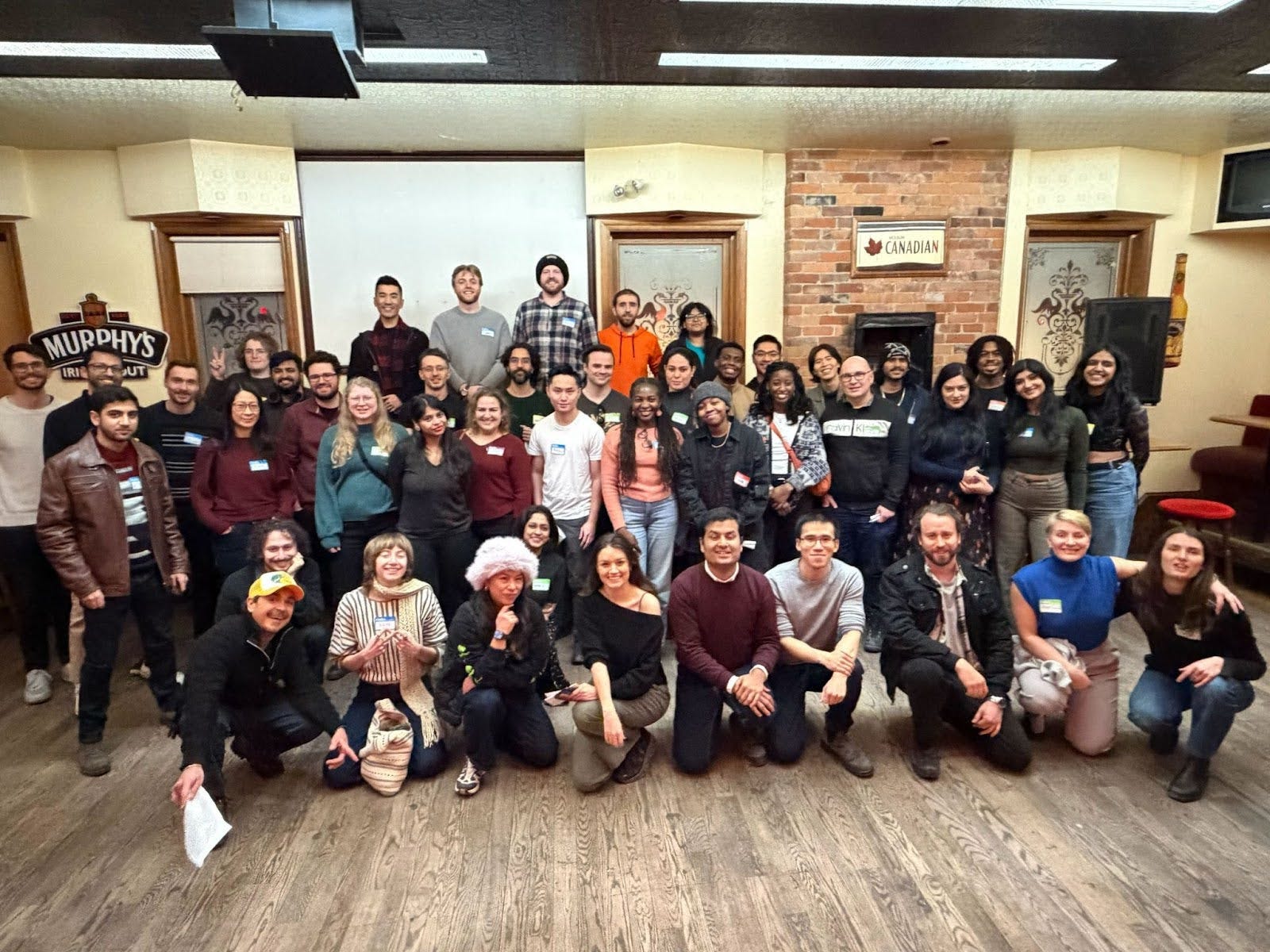
Our latest Curiosity Café, moderated by Tony D’Amato Stortz and Sophia Whicher, began with the question: “What is regret?” As usual, we turned to personal experience as a starting point, asking:
Share something, if anything, that you regret.
What does that regret feel like?
What primary emotion(s) does it involve?
What are some notable commonalities in your group? What are some notable differences?
After reflecting on our past encounters with regret, and the features they do or do not share, we proceeded to explore what regret itself is and involves, asking:
Do you think that all of the following count as instances of genuine regret?
“I regret that I did that…”
“I send my regrets…”
“I regret to inform you…”
What is the difference between regret and remorse?
What is the relationship between regret and free will?
Does regret imply that it was possible for you to do otherwise in the moment you were acting?
Do we regret decisions or outcomes?
Here’s a small sample of the ideas you shared in the first half of our discussion:
Regret is characterized by a sense of missed opportunity.
Regret is associated with a range of emotions, including fear, shame, humiliation, cringe, sadness, and loss.
I tend to regret decisions I was conflicted about rather than decisions of which I was thoroughly convinced, because my ambivalence suggests I could have chosen better had I made use of the capacities and information already available to me—for example, if I had engaged in further reflection or exercised a greater degree of self-control or restraint. Such decisions are different from, and more blameworthy than, those I made when I could not have reasonably been expected to know better.
There is no free will. Regret is an expression of our resistance to this fact, accompanied by a sense of melancholy, guilt, or shame. We must learn to accept, and surrender to, the uncomfortable reality that the actions we regret could not have been avoided, because they were necessitated by forces beyond our control.
Regret might, in fact, underscore the existence of free will, because it points to the existence of options one could have chosen, but didn’t.
Statements along the lines of, “I regret to inform you…” seem bizarre when interpreted as genuine expressions of regret, because they suggest that one’s regret is pre-emptive—that it concerns something one is about to do (and could therefore avoid), rather than something one has already done.
Statements like this do count as genuine expressions of regret, because they can be understood as conveying a wish that things could be otherwise, a feature shared by characteristic examples of regret. A doctor who says, “I regret to inform you that your father has passed away,” can be understood as saying, “I wish I didn’t have to make you feel this way,” or, “I wish I could avoid causing you the pain this news will inevitably bring.”
To say, “I regret to inform you…” is also to acknowledge one’s responsibility for the negative feelings, such as disappointment or heartbreak, that one’s statement will lead to. This points to another defining characteristic of regret: the sense that one is responsible for an unpleasant outcome.
Remorse is a form of regret, but the two are not identical. Remorse concerns actions of mine that have harmed other people; it has a moral and interpersonal dimension that regret in itself does not require. I can regret not ordering a cheesecake, but it would be strange to feel remorse for doing so.
Remorse is a subset of regret, and regret, of hindsight. These concepts are nested inside each other like a series of Russian dolls.
Regret is directed at internal consequences for us, remorse at external consequences for others.
When reflecting on our regrets, we like to believe that, had we known then what we know now, we would have chosen better. But the comfort we find in this certainty is illusory. Hindsight is never 20/20, and there is no guarantee that our decision would be any wiser even if we were given a second chance with the benefit of our present knowledge. We cling to our trust in hindsight because it is frightening to admit the extent of our ignorance.
What is the relationship between regret and acceptance? Is it coherent to regret something despite having accepted it?
Yes! The very feeling of regret implies a lack of, or at least incomplete, acceptance.
No; we can accept a past decision but still live with the pain of having lost something or someone we value because of that decision.
Having explored what counts and doesn’t count as regret, we shifted our focus after the break to the question: Is regret valuable? We asked:
What do you do when you feel regret?
Do apologies always imply that the apologizer feels regret?
If someone said sorry to you, but that they did not regret what they did, would you feel right accepting the apology?
Does regret shape your life? If so, how?
Does regret shape your decision-making?
Can regret lead to moral growth or change in another way?
Regret skeptics will often argue that without making the mistakes they made in the past, they wouldn’t be who they are today, and since they are happy with who they are today, it doesn’t make sense to regret anything they did to get them to where (and who) they are now.
Can regret and the belief that you are living your best life exist at the same time?
What do you assume about someone when they tell you they have regrets?
Is there something about regret that is necessary for living a good life? Why or why not?
Here’s what a few of you had to say:
Regret is a learning opportunity, an invitation to reflect on what we wish we hadn’t done and how we can do better going forward. But it can also be a vortex that draws us in, leading us to obsess over, wallow in, our past mistakes, instead of learning from and building upon them.
Regret often feels more like punishment than like any edifying experience. It does not entail any sort of moral or spiritual growth—only suffering.
Regret is important because it sheds light on one’s values. What I regret, and how deeply I feel regret, throw into relief the things I find important, the kind of person I want to be, the kind of life I want to live or have lived.
On the question of apologies without regret:
I can sincerely apologize for actions I don’t regret. For example, I might offend someone by expressing a belief I genuinely hold but with which they vehemently disagree. I may not regret saying what I said—I might stand by it, in fact—but I can still apologize for the pain I caused my interlocutor, and validate rather than dismiss their upset feelings.
Sometimes, apologies are made just to avoid consequences, or as a form of damage control. Such apologies are mere means to an end and do not entail the feeling of regret.
Apologies without regret can be interpreted in two ways. They can be taken to mean, “I’m sorry for what I did, but I wouldn’t do anything different.” This is respectable. But they can also be translated as: “I’m sorry for what I did, but I don’t feel bad about it”—which would be downright infuriating, and possibly incoherent.
When someone apologizes to me, I care only about what they will do, not how they feel. Apologies accompanied by regret are meaningful only insofar as they translate into action.
The notion of a “moral remainder” from moral philosophy can explain how we can sincerely apologize without feeling regret, if we understand regret as expressing a wish to reverse a past decision. Imagine I miss my best friend’s wedding to drive my mother to the hospital. Driving my mother was clearly the morally superior decision, yet I would still, and understandably, feel some guilt over missing the wedding, and feel a residual obligation to apologize to my friend. Generally stated, I can make a decision that I recognize to be the morally best option on balance, while still being subject to moral pressure generated by the obligation I didn’t perform. This moral remainder can form the basis for a genuine apology, even as I maintain that the decision for which I am apologizing was the right one.
Regret is illogical. People make decisions they feel are right at the time, based on the information, beliefs, values, and capacities they have. We cannot reasonably fault our past selves for making the decisions they sincerely believed were best.
But is it true that we always make the best and most informed decisions with what we have? I can think of countless times I made decisions that I knew—even at the time—to be unwise, like when I downed another three pints of beer while knowing I was just a teaspoon away from a hangover. Aren’t such decisions at least reasonable candidates for regret?
As painful as it is, regret might serve for some as a kind of coping mechanism for the irreversibility of time, by focusing our attention on the paths we didn’t take and inviting us to inhabit those alternate realities.
What is the relationship between regret and conscience? Is it possible that we cling to regret as a way to soothe our conscience—as though feeling bad about our past actions can somehow make up for them?
I am skeptical about the existence or character of regret skeptics. No one makes the right decision all the time, so everyone’s history should contain decisions worthy of regret. Having no regrets whatsoever signals arrogance, dishonesty, or an unwillingness to introspect, and closes one off to the positive things regret can yield, such as moral growth and a sense of accountability.
But aren’t accountability and moral development possible without the feeling of regret? Some people sincerely swear they have no regrets, or at least find regret unproductive, while being paragons of moral integrity.
Our café concluded with a poll: do you more often regret actions, or inactions? A slight majority of you raised your hands for the latter. Whether you were part of that majority or not, however, all of you are bound to regret not taking our community survey below, reading Tony’s thoughtful contribution on regret, or purchasing a ticket to our upcoming social in January. Do all of that now. Thanks for reading.
For those who’ve attended our Curiosity Cafés, please consider taking our brief community survey. We are conducting this survey to gather feedback on our events, and it should only take a few minutes to complete. Your responses are completely anonymous and will be invaluable in helping us improve our offerings. Thank you in advance!
By Tony D’Amato Stortz
“… it is clear that we must trust what is difficult; everything alive trusts in it…. We know little, but that we must trust in what is difficult is a certainty that will never abandon us; it is good to be solitary, for solitude is difficult; that something is difficult must be one more reason for us to do it.“
- Rainer Maria Rilke, Letters to a Young Poet
To me, the most interesting questions in philosophy are the ones about hidden forces that define our lives, but we rarely stop and examine carefully.
These hidden forces are like gravity. We can’t see them or touch them, but they pull us back over and over to the places where there is heaviness inside of us. Despite not being able to see them, we can feel their presence.
It was a desire to explore one of these hidden forces that led to last week’s regret café.
Whether we feel we live with “no regrets,” or whether regret is an active force that shapes our lives every day, for many of us, regret (or the overcoming of regret) is a force that made us who we are today. So what is the value of regret?
I would argue that our struggle with regret—like our struggle with gravity—is an essential part of a life well-lived.
Gravity is a force we spend our lives fighting against. Every time we stumble, and often when we struggle to get out of bed, we are under the spell of gravity. That said, gravity is also the force that allows us to be strong. When we lift weights, climb mountains or carry the one we love, we are doing it in opposition to gravity. Gravity is what makes effort meaningful. Gravity is the thing we push against, in order to grow strong.
I would argue the same thing is true of regret. While regret is uncomfortable, and can be a powerful thing we struggle against, it is also the force that we grow strong against. When we choose poorly and are haunted by that choice, we’re given the opportunity to grow wiser—informed by regret. When we decide quickly and act on it, we are given the opportunity to be brave in the face of regret. When we come to peace with the person we are (and let go of the many people we will never be), we are given the opportunity to be brave in the face of regret.
So here’s to regrets—and the many bad decisions that made us who we are!
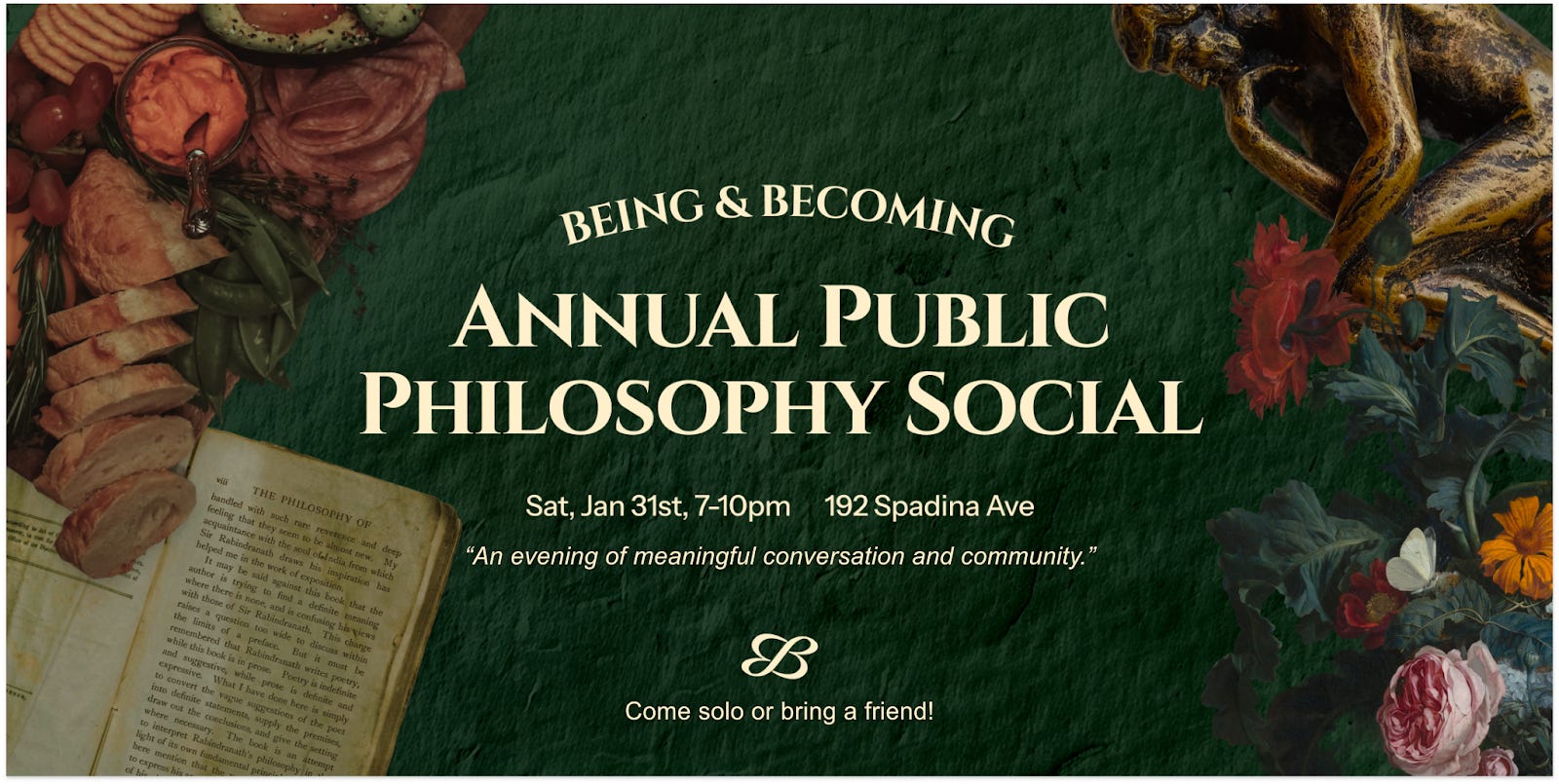
You’re invited to our Annual Public Philosophy Social! Every year we host an event to celebrate public philosophy. This year we’re back at one of our favourite venues for an evening of meaningful conversations and community. There will be just enough facilitation to help you find others who share your curiosity about the same questions, along with refreshments (small bites and non-alcoholic beverages), and a cash bar.
🗓️Date: Saturday, January 31st (7–10pm)
📍Location: Centre for Social Innovation (192 Spadina Ave)
🎟️Tickets: Early Bird - $28 (ends Dec 31st) | Regular - $35
Whether you’ve attended our events before or are joining us for the first time, we’re excited to welcome you. Spread the word to others who might be interested and we hope you can join us!
This event is supported in part through the Toronto Event Generator.
I saw myself sitting in the crotch of this fig-tree, starving to death, just because I couldn't make up my mind which of the figs I would choose. I wanted each and every one of them, but choosing one meant losing all the rest, and, as I sat there, unable to decide, the figs began to wrinkle and go black, and, one by one, they plopped to the ground at my feet.
- Sylvia Plath
Our mission is to present a diversity of perspectives and views. The views and opinions expressed in this newsletter are solely those of the individual authors and do not necessarily reflect the views or opinions of Being and Becoming. Being and Becoming disclaims any responsibility for the content and opinions presented in the newsletter, as they are the exclusive responsibility of the respective authors. If you disagree with any of those presented herein, and you feel so inclined, we recommend reaching out to the original author and asking them how they came to hold that opinion. It’s a great conversation starter.
Comments
Nothing yet. Say the first thing.
Sign in to join the conversation.