
In 1971, psychologist Philip Zimbardo divided twenty-four ordinary college students into two groups: prisoners and guards. The Stanford Prison Experiment was supposed to last two weeks. It was shut down after six days.
Within hours, the guards had begun abusing their power. Within days, the prisoners had broken down psychologically. Nobody had told them how to behave. Nobody had scripted the cruelty. The roles simply took over — because when you give one person power over another, something ancient and dangerous awakens. The experiment didn’t reveal what happens when bad people get power; it revealed what power does to ordinary people.
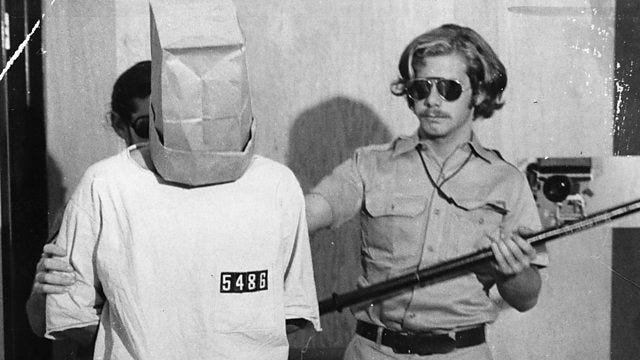
You don’t need to be a sadist to become one; you just need to be told you are the guard. The roles didn’t reflect who these people were — they created who they became. The same way my date created a role for me. I met him at a philosophy meetup. The room is always the same: polished academics, Harvard fellows, neurologists, engineers, the kind of people who have built their entire identities around the word “evidence.” That evening, the topic of discussion was consciousness. I talked about panpsychism, the philosophical theory that consciousness is not produced by the brain but is a fundamental property of the universe, present in all matter at every scale, like a river. It’s not something we generate but something we participate in.
The Kabbalistic tradition calls it a field of awareness that contains all existence, like an ocean contains its waves. We are not the source of consciousness; we are inside of it. They patiently explained why I was wrong. Consciousness is biological, measurable, and located in the prefrontal cortex. The conversation moved on without me.
One man didn’t move on; he stayed at the end of the evening, quiet, in his late forties, the kind of person who asks follow-up questions rather than waiting for his turn to speak. He didn’t dismiss what I said; he found it interesting, and we agreed to meet for a drink.
The first hour was easy; we talked about consciousness, materialism, and whether the universe has an inside. He disagreed with me, but he did so with curiosity and validation that made me want to talk more; I was enjoying myself.
Then he said something that changed the room's temperature: "You have this quality; I noticed it when you were talking. You don't apologize for what you think or who you are. You hold your identity as your own. Like it's not up for negotiation. I find that," he smiled, tilted his head slightly, "I find that genuinely compelling, not just intellectually." I let that sit. He turned his glass slowly on the table. "Identity is such a loaded thing, not just emotionally. I think we don't talk honestly about how charged it is. Politically. Historically. Even," he paused, "erotically. The things people carry in their bodies, who they are, and how they carry themselves in the world.
"I'm part of this group,” he said quietly, as if testing the water before speaking. It's kind of hard to describe without it sounding like something it isn't. He laughed a little, uncomfortable. “Some people call it kink, but that word flattens it; what we actually do is work with identity. The real weight of it, who people are, where they come from, and what that means in a room with other people.” He stopped. Started again. I put down my glass. “Tell me more,” I said, and I meant it; I was curious.
“Well,” he said, “it’s mostly people you’d see at your neighborhood protest or on the university lawn — activists, intellectuals, lots of socialists, woke, LGBTQ+, and lots of curious people who want to explore our ideas. Most of them are your go-to Cambridge people.” He smiled. “But what makes us special is that we think about sex differently, and it’s not just a preference; it’s more like a philosophy.” He was searching for the right words. “The basic idea is that identity and desire aren’t separate. Who you are in the world — politically, historically, gender-wise, status, all of it — sits within the power structure — and that comes into the bedroom.”
“We are a very accepting, tolerant community; all identities are welcome, erotically. We submit, and then we dominate through it, reliving cathartic moments and situations, not necessarily as a political act, but as a space where our most authentic, honest selves can exist. We don't pretend anything away. Race, nationality, status, ethnicity. All of that comes into the room with you. So we give appropriate space to be; we allow ourselves to fully become who we are, with resistance play, race play, colonial play, whatever your identity script is; we play it. Explicitly. Because that's where the charge is. That's what makes it real." He paused. "And then you said Israeli, and I thought, okay. That's interesting. That's a very particular place on the map.”
“So,” I said, “what role do I play as an Israeli? Where would you place me?” I wasn't quite ready for what came next.
Comments
Nothing yet. Say the first thing.
Sign in to join the conversation.