
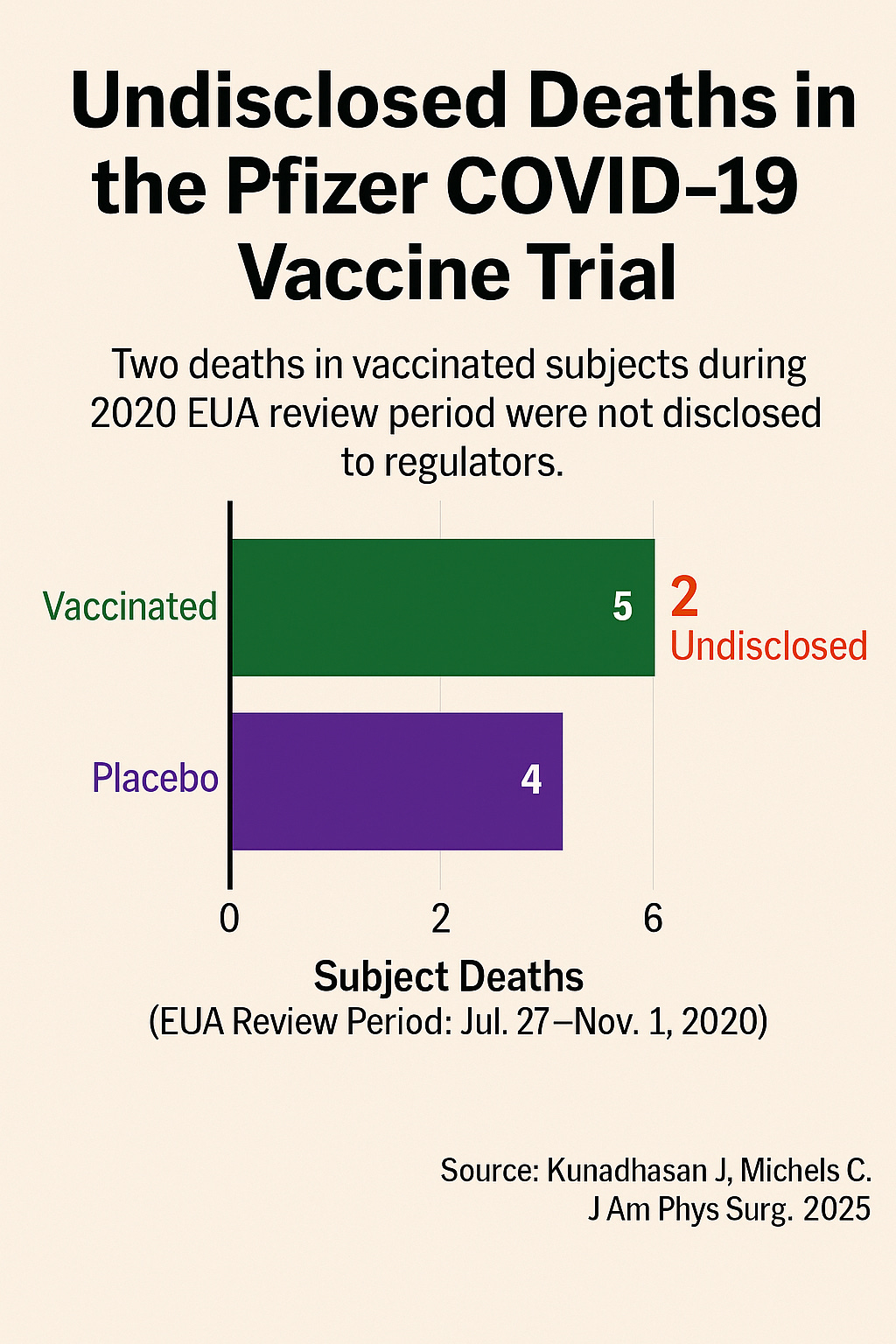
A new peer-reviewed paper in the Journal of American Physicians and Surgeons examines the Pfizer/BioNTech COVID-19 mRNA vaccine trial and documents two subject deaths in the vaccinated arm that were not disclosed to U.S. regulators during the 2020 Emergency Use Authorization (EUA) review. The study, authored by former WarRoom/DailyClout Pfizer Documents Project researchers, Dr. Jeyanthi Kunadhasan and Dr. Corinne Michels, is publicly available here.
The authors base their analysis entirely on Pfizer’s own internal case report forms, six-month death narratives, and adverse-event documentation released under court order. Their work focuses strictly on timelines, data accuracy, reporting completeness, and what information the FDA’s advisory committee did—or did not—receive before making its recommendation.
This investigation was made possible by the WarRoom/DailyClout research team, which examined the 450,000+ pages of Pfizer trial documents after a federal judge ordered their release. Dr. Kunadhasan and Dr. Michels’ earlier work on the WarRoom/DailyClout project, identifying subject IDs, reconstructing reporting timelines, and analyzing trial discrepancies, forms the backbone of the new peer-reviewed analysis.
The study identifies two clinical trial participants—both in the vaccinated arm—whose deaths occurred within the official reporting window (Jul. 27–Nov. 14, 2020) but were not disclosed to the FDA’s Vaccine and Related Biological Products Advisory Committee (VRBPAC) during the EUA evaluation:
Subject 11141050 (Kansas, age 63): Died Oct. 19, 2020, 41 days after Dose 2. Autopsy listed “sudden cardiac death.”
Subject 11201050 (Georgia, age 58): Died in her sleep on Nov. 7, 2020. No autopsy performed; cause listed as “cardiac arrest.”
Both deaths were later documented in Pfizer’s six-month narrative report. But they were absent from Pfizer’s presentation to VRBPAC and from the major trial publications that regulators were relying on.
Family members notified clinical trial sites on the day each subject died, yet the official entry of the deaths into Pfizer’s system was significantly delayed. These delays contributed directly to Pfizer’s omissions in the dataset shown to regulators in December 2020 when the company was seeking EUA for its vaccine.
When VRBPAC met on Dec. 10, 2020, it had only 20 days to review the thousands of pages submitted with Pfizer’s EUA application. At that meeting, members were told that six total deaths had occurred during the first 20 weeks of the trial: two in the vaccinated group and four in the placebo group.
The peer-reviewed study shows that the correct number, based on Pfizer’s own documentation, was actually 11 deaths during that window: six vaccinated, five placebo.
The committee also did not request updated death information for the period between the data cutoff (Nov. 14, 2020) and the meeting date (Dec. 10, 2020). Had it done so, it would have learned that 17 subjects had died by the time the EUA was evaluated: eight vaccinated, nine placebo.
These differences stem mainly from recording delays in Pfizer’s system, overwhelmingly concentrated in the vaccinated arm and primarily before the EUA approval date.
By the end of the six-month interim period (July 27, 2020–March 13, 2021), the trial documentation listed:
21 deaths in the vaccinated arm
17 deaths in the placebo arm
Within the vaccinated group, 10 deaths were classified as sudden or unexpected—subjects found deceased at home, collapsing without warning, or not waking from sleep. Only two of these cases received autopsies, and just one autopsy result appears in the publicly released documentation.
In several cases, investigators concluded that the deaths had “no reasonable possibility” of being related to the study drug—even when autopsy results were still pending or never obtained.
The placebo group showed five sudden deaths, with the remainder distributed among causes such as stroke, pneumonia, overdose, cancer, diabetes, or multi-organ dysfunction. COVID-19 was recorded as a secondary cause of death in five placebo subjects and one vaccinated subject.
The study makes no causal claims. It documents what is present in the trial record.
The peer-reviewed analysis identifies multiple procedural issues in Pfizer’s reporting system:
Significant delays—sometimes more than a month—in entering death information.
A complex, multi-step reporting chain between trial sites and Pfizer staff.
Longer recording delays for vaccinated-arm deaths before EUA approval, compared with placebo subjects and post-authorization entries.
Missing Serious Adverse Event reporting forms, preventing independent verification of real-time reporting timelines.
The authors note that these structural problems prevented regulators from having complete and accurate information at the time of the EUA decision.
The study briefly outlines earlier, well-documented instances where trial data discrepancies came to light only after regulatory approval—such as with Merck’s Vioxx and AstraZeneca’s ticagrelor. These examples are presented as context demonstrating that data-handling failures in pharmaceutical trials are not unprecedented.
The paper summarizes the documented timeline of myocarditis reports following Pfizer vaccination, including early notifications from Israel’s Ministry of Health (MoH) to the CDC in February 2021. Internal discussions at U.S. agencies continued through April and May, with public safety-label updates issued in late June 2021 after additional case reports accumulated.
Again, the study simply outlines the sequence of documented communications.
The authors argue that several structural reforms would improve trial oversight and public trust, including:
Modern, real-time clinical-trial data-capture systems.
Shorter terms and stronger conflict-of-interest protections for FDA advisory committees.
Independent third-party reviewers with complete access to trial data before meetings.
Continued expansion of post-marketing surveillance systems with real-time capabilities.
Reevaluation of the EUA framework, especially the PREP Act’s compressed review timelines.
The authors conclude that the EUA process itself—by design—limited the depth of review regulators could perform.
For readers who have long questioned whether Pfizer’s clinical trial data were presented in full and in real time, this peer-reviewed study offers a detailed, evidence-driven analysis rooted entirely in Pfizer’s own documentation.
It does not speculate. It does not extrapolate. It simply examines the record and identifies where the record was incomplete at the moment the EUA decision was made.
The full study is available here.
Share Behind the FDA Curtain: WarRoom/DailyClout Pfizer Reports
No posts
Comments
Nothing yet. Say the first thing.
Sign in to join the conversation.