
When Terry Smith joined me on the Behind the Balance Sheet podcast in January, he made one point more forcefully than any other: never change your investment strategy because of a period of underperformance. One line about Fundsmith’s approach stuck with me:
“Grit our teeth, bite down on our gum shield and keep going.”
Source: Terry Smith, Behind the Balance Sheet Podcast
This week, his semi-annual letter to shareholders landed. It describes the biggest shift in Fundsmith’s approach since the fund launched in 2010. Portfolio turnover of over 50% in six months. Twelve new positions, thirteen exits. And, in black and white:
“We will take more account of momentum — both fundamental and share price — in our investment decisions.”
We talked at length in the podcast about the fund’s underperformance and he was clear then:
“there are these phases in markets and that they will knock you off course. And if you decide to change strategy in the middle of them, you may be knocked off course forever, actually.”
Source: Terry Smith, Behind the Balance Sheet Podcast
I haven’t spoken to Terry since the letter. In this article, I look at the letter in the context of our previous discussion and try to draw some conclusions about what this might mean for quality, for market strategy and for Fundsmith itself.
The Business Angle
One passage in the letter surprised me. Terry openly acknowledges that Fundsmith cannot simply ignore redemptions forever. The fund has been losing assets, as Smith explains:
“However, there is another factor at work here — fund flows. We run open-ended funds, and you can and increasingly have been taking money out……………there will be little point being proved right about the dangers of passive or momentum investment after our Fund has closed.”
And he went on, having discussed the massive daily price changes even in large and highly liquid stocks, to point out:
“In a market in which share price moves of 33% per day for even large stocks are not uncommon a buy and hold strategy can only work if you are not subject to flows, and we are. Sticking to our current approach may well fall foul of the adage that the market can remain illogical longer than we can remain in business.”
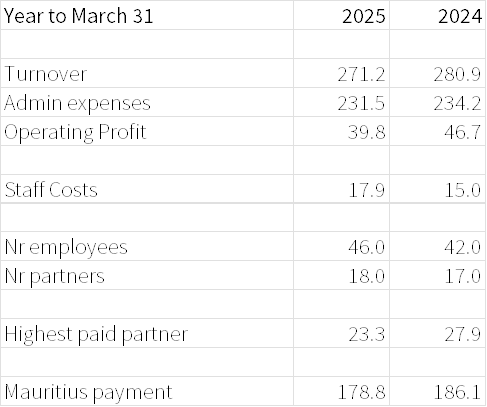
That prompted me to look again at the economics of the Fundsmith business. The numbers are extraordinary. Here are the key details from the last filed accounts:
Fundsmith Key Financials (£m)
Source: Company filings
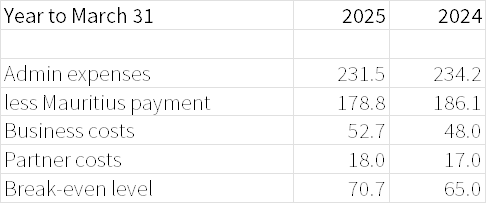
The business made £40-50m profit before paying partners, but after what I assume are Smith’s fees paid to a company in Mauritius of c.£180m. I guess that his number two Julian Robins is the highest paid partner. Assuming no change in salaries or headcount and that partners take just £1m pa each on average, here is the break-even cost base – I imagine that this could be reduced significantly, but it’s an illustration:
Fundsmith Cost Base (£m)
Source: Behind the Balance sheet from company filings
The underlying expenses are c.£50m and the total cost base would be £70m after paying partners a generous average £1m each. Presumably, they could get that down significantly, well below £50m. The cost base (before payments to the then 8 partners) was £23-24m in 2019 and 2020. Smith probably wants to do better than break-even but let’s take a worst case scenario for the business: taking £70m as the level, here is the AUM required at different fee levels:
AUM Required to Breakeven on a £70m Cost Base
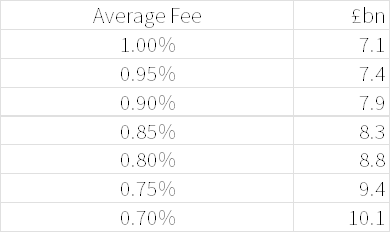
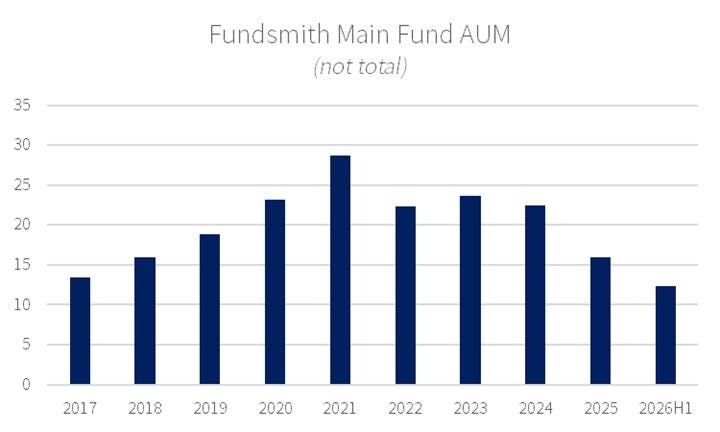
Fundsmith currently has £12bn in the main open-ended fund but there are likely other institutional assets and I don’t know the total. Fundsmith could probably lose another third of its assets before the economics of the business started to become uncomfortable. Assuming markets don’t fall, which is of course a business risk, but there should be scope to cut costs.
Fundsmith UK OIEC Assets £bn
Source: Various
Taken together, the letter and the economics of the business suggest that fund flows may now matter more than they once did. That in itself seems a significant change.
The Change in Strategy
Momentum
The H1 letter points out that in the UK, a Vanguard index tracker has delivered 66% in the last 5 years versus the average UK equity fund’s return of 32%. He notes that half of Vanguard’s FTSE 100 tracker is held in 10 stocks with bets on banks, oil producers and mining companies. In the US, the index delivered 83% over 5 years (to end-May) and the average open-ended equity fund (n=3107) returned 59%.
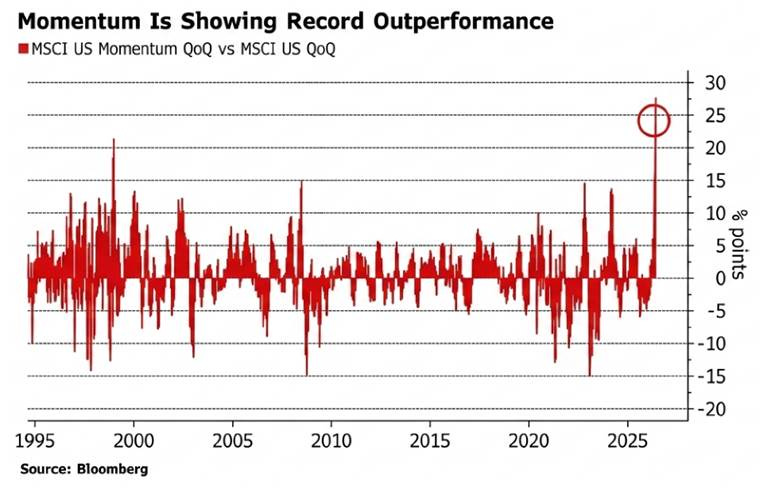
Momentum is at a high and has had an amazing run in 2026:
Momentum’s Record Outperformance
Source: Fundsmith
Smith writes:
“[Momentum] is at a 30 year high and more extreme than in late 1999 just before the Dotcom bubble burst. As active fund performance continues to worsen, more people abandon it, producing a pernicious feedback loop.”
He highlights in the letter overnight moves on consecutive days by Snowflake and Dell of $22bn (37%) and $68n (33%) respectively and attributes this to passive investing. While these are spectacular moves, they came after these companies produced earnings releases. Active fund managers are paid to identify just this.
Snowflake reported 30%+ revenue growth and a revenue retention rate of 126%. Dell blew past expectations in its server business, shipping a record $8.2bn in AI servers in the quarter and saw a recover in traditional servers and authorised a $10bn buyback and a 20% dividend hike.
Smith goes on to write:
“I am not aware of any fundamental methodology of investment which could help to predict or capture these moves.”
The moves are certainly extreme and create difficulties for active managers, but the trend is forecastable. He points out that the violence of these moves is a function of fewer active fund managers around to sell to dampen the move – that is clearly an issue in current markets. And he points out that stocks can fall even faster in a bear market:
“you can reasonably speculate about what’s going to happen if or when things reverse. It may make 2000–03 and 2007–08 look like a blip. In 2007–08, the S&P fell 57% in five months. Next time round, it would not surprise me if it accomplished this in five days.”
From 9 October 2007 to the bottom on March 9, 2009, the market was down 57%. And his point, although obviously exaggerated, is well made – bear market falls are usually faster than bull market rises.
The Strategy Change
Fundsmith has had a simple philosophy since inception which has made for genius marketing:
Buy good companies
Don’t overpay
Do nothing
Smith is now modifying the third leg of the strategy – I am looking forward to reading the fund’s next advert. Fundsmith always sold itself as process over outcomes. Now, the outcome has changed the process. He writes:
“We will take more account of momentum — both fundamental and share price — in our investment decisions. In particular, we will be much less willing to deploy the time-honoured technique of buying quality companies when they hit a glitch…. in the current momentum driven market buying shares in companies which have hit a glitch is like trying to catch the proverbial falling knife. All we are getting is cut fingers as their downward share price spiral is exacerbated by the index momentum enhancement effect.”
Yet his best performer in H1 was Fortinet which contributed 2.8% to the fund’s performance. On the podcast, he walked me through how Fundsmith buys quality on a glitch, using Fortinet as the worked example: COVID pulled growth forward to 40%, growth fell back to 10%, the market panicked…
“The share price halved, and we bought a load of it. But we bought it in three stages… these things come in threes.”
Source: Terry Smith, Behind the Balance Sheet Podcast
One stock doesn’t invalidate his thesis entirely, but Smith has demonstrated that this aspect of his strategy can work if his timing is right. It’s not just the strategy, it’s also a stock selection issue - I shall explain below what I think has gone wrong, but first let’s finish covering what he said in the letter.
Smith is obviously sensitive to the criticism he is likely to receive because he makes the point that he is selling some stocks at a loss and some stocks he has recently purchased. In my view, this is perfectly acceptable - it’s often better to take a loss; I could not count the number of times I realised I made a mistake and got out of something and was later glad to have got out early.
Terry Smith built Fundsmith around three simple principles and is now changing course. Whether that proves to be necessary adaption, or the moment an investor once hailed a genius blinked, will only become clear with hindsight.
Premium subscribers can read on for my full analysis of
what has gone wrong
what I make of the twelve new purchases and thirteen exits
what this means for Fundsmith’s future performance and
whether this could ultimately prove to be an important signal for the wider market.
Comments
Nothing yet. Say the first thing.
Sign in to join the conversation.