
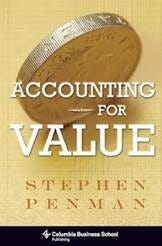
I spent six weeks in the British Library, researching my Forensic Accounting Course. I studied dozens of frauds and skimmed more than 20 textbooks, few of which were particularly useful, but Stephen Penman’s Accounting for Value was one of those.
I therefore bought his latest book, co-written with Peter Pope, both “leading authorities on accounting and its investment applications”. The book supposedly demonstrates “why attention to financial statements is the key to judicious valuation” and shows that accounting fundamentals can “teach us how to think about value in new ways”.
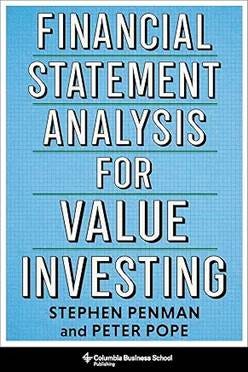
Initially, I didn’t get very far and it was painful going – it seems that every page has one of those complicated formulae which makes it feel more like a university textbook than something a practitioner might use.
Half way through, I was therefore surprised and relieved to find that an academic summary of the book had been produced which is a lot more palatable, much cheaper and much quicker to read. I thought I would share with you the findings, which are framed as 10 principles of valuation.
Good news: we are running our forensic analysis bootcamp again in the fall. It kicks off in early October, and will run for 8 weeks every Monday night, usually at 17.30 London, 12.30 EST, 9.30 PST. Classes run for 60-90 minutes and allow plenty of time for questions.
The curriculum is the full setup we offer to institutional investors but with some additional explanation and extra time allowed for a more considered deliberation. This year, we have tailored the content for AI application. And every session is recorded, so if you are travelling one week, no problem, simply watch the recording.
These courses are popular and we limit numbers so that everyone has the chance to ask questions and participate. Sign up for the waitlist and be sure to be notified when the discounted early bird tickets are released.

We know this of course and they quote Buffett as saying in his 2022 letter, “Charlie and I are not stock-pickers; we are business-pickers.”
The academic paper illustrates this by looking at the segmental analysis of revenue of a company which illustrates what’s happening in the business.
If you need a 10% return and you buy 100% of a business which makes $10m pa for $100m, then this is a fair price. Anything less is a benefit, anything more and you shouldn’t do the deal. Straightforward.
When you are buying a share in the stockmarket, that business which is generating a 20% RoE may be trading at 5x book – your effective return is only 4%. I was talking to my friend Sean Peche about this and he pointed out that few investors consider an investment from this perspective. That should be in the book!
Risk is permanent loss of capital not volatility.
The academic summary summarises this:
If you buy a ticker without knowing the business—you are ignoring information. If you refuse to read the financial statements—you are ignoring information. If you pay a price without asking whether it reflects the value of what you are buying—you are ignoring information. And if you ignore information, you are not an investor. You are a speculator.
The historical accounting data are fact. The consensus eps number is speculation. Investors don’t weight the facts enough because we are focused on the future.
This is the natural extension of the previous point. Valuation is value based on historical facts, the anchor, plus a speculative element based on our conjecture about the future. Clearly, investors cannot avoid the speculative element, that’s an integral part of the game.
But by extension, you can separate the valuation into the anchor based on historical fact and the speculative element relating to future growth. In the book, they use Netflix as an example – book value was 10%; 38% was what was justified based on the historical returns being generated; and 52% of the price related to future growth.
I don’t think this of itself is a sell signal, but it’s a useful illustration of the risk if growth disappoints. And what you are paying today for growth vs what you paid in the past might be an interesting exercise.
The authors caution against using ratios like P/E or Price:book to evaluate a stock – instead they prefer to calculate intrinsic value without reference to current price.
I used to pay close attention to price action as a gauge of market sentiment. Changes in valuation offer a similar signal and in my view it’s daft to ignore something so potentially useful.
The summary paper says “The role of this principle is to ensure that the investor does not abandon a sound valuation simply because the market has not yet adjusted”. This is fine in theory but in practice, there are two associated costs – the opportunity cost and the mental cost.
You never know how long an idea will take to work – I am dubious about catalysts as they are usually pretty obvious and should be in the price. But there is only so long you can wait before you would be better moving to a better opportunity.
When I sat down to write this article, I first picked up another stock from a recent UK conference – it had not moved in two years. The story had not really changed and meantime this cheap cash generative stock had bought back 13% of its share capital. But the share price had not moved. The business had not performed as well as hoped and there were some wider macro issues, but I wondered if I might be asking myself the same question in two years’ time – what will make this stock go up?
This is where academic valuation and real-world investing diverge. Valuation can tell you whether something appears cheap. It cannot tell you if/when the market will agree with you.
Opportunity cost matters. Catalysts matter. Sentiment matters.
A stock can be cheap for years while better opportunities pass you by.
That’s why my investment process has always combined valuation with an assessment of what might change the market’s perception.
Books like these don’t ask that fundamental question, what will make the stock price go up?. To be fair, the book doesn’t purport to do so, and the principles are valuable. But I wish I had seen the 17 page academic summary before spending time and money on the book itself.
Even better would have been a 1000 word summary.
Before you go, a word from my sponsor, AlphaSense.
A Tale of Two Economies: Divergences Shaping Financial Services in H2 2026
In an increasingly complex and evolving economy, having a sound research framework to navigate market volatility is essential. Discover how leading investment managers are leveraging AI-driven agentic workflows, deal workspaces, and robust screening capabilities to gain an edge in the market.
Next week, don’t worry if there isn’t an email - summer vacation.
Comments
Nothing yet. Say the first thing.
Sign in to join the conversation.