
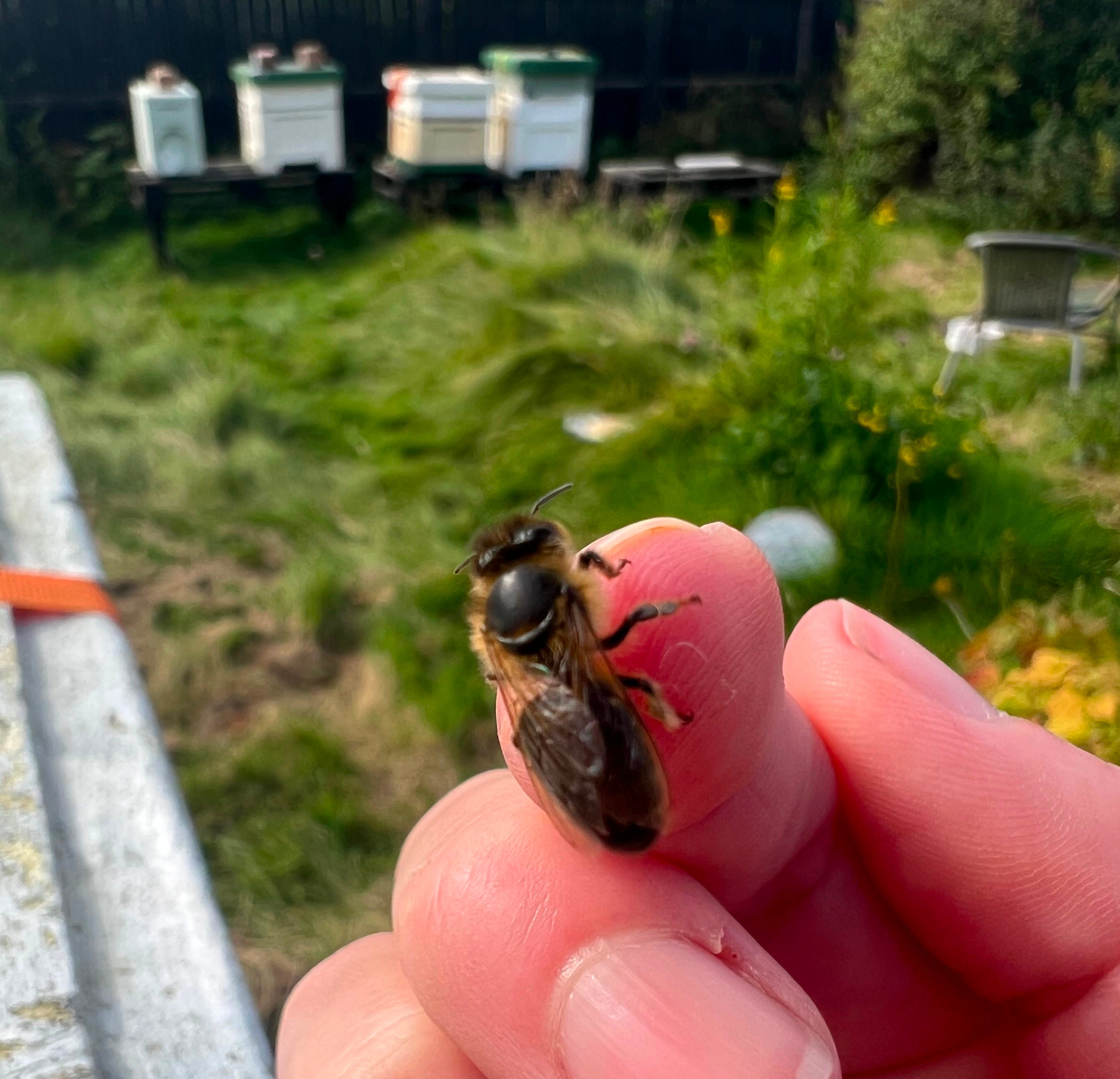
Every time I post something about honeybees, comments are full of love. Bees are wonderful. Bees are precious. Save the bees. Then, somewhere down in the comments, a slightly different comment appears. Something like: yes bees are fine, but not wasps. Or not ticks. Or please, anything but mosquitoes.
If you enjoy looking at bees and nature from a slightly different angle, you might enjoy Bees & Beyond. I write about the things we usually do not stop to question.
I understand this instinct. Wasps hunting for your picnic baskets. Ticks carry disease. Mosquitoes are an absolute menace.
There is another comment I see often too. Maybe even more often than the wasp one.
“Bees are the most important species on Earth.”
It sounds like a compliment. And I understand why people say it. Bees pollinate crops, they support ecosystems, they are connected with our food system. They are genuinely fascinating and important animals.
But important for who?
Because if we are honest, when people say bees are the most important species, they usually mean bees are the most important species for humans.
And that is a very different thing.
Nature doesnt have a ranking system. There is no official list where bees are number one and mosquitoes are somewhere at the bottom. Ecosystems are built through relationships, not like a pyramid with the ‘useful’ species at the top and the annoying ones underneath.
And its beyond rhetorics. It is an actual mechanism behind a lot of environmental harm. There is a term for this pattern of thinking: ecofascism. It describes an approach to nature that sorts species (and, historically, people too) into categories of worthy and not worthy, useful and disposable, based only on what serves us.
Save the charismatic ones. The pollinators with good PR. The fluffy ones. The ones who photograph nicely. Everything else can be written off.
Nature does not work like a guest list tho. It works like a web.
Wasps are ferocious pollinators in their own right and they are also the natural pest control that keeps caterpillar and aphid populations from striping your garden bare. Ticks, unpleasant as they are to us, are food for birds and part of the population control system for the small mammals they feed on.
Mosquitoes are pollinators too and their larvae are a foundational food source in freshwater ecosystems for fish, amphibians and birds. Remove them and many species will go hungry.
If we are being honest, most of us do not actually dislike wasps because they are ecologically useless. We dislike them because they inconvenience us.
But that is a preference. Dressed up like ecological argument.And I think we can all agree that preferences are a very shaky foundation for deciding the fate of entire species. Because preferences change depending on who is doing the disliking. Farmers have historically had strong preferences about wolves. Landowners have strong preferences about beavers.
Someone, somewhere, always has a very good reason why this particular animal is a probl;em.
This is the kind of topic I like exploring here. Not only what bees do, but what our relationship with other species says about us. If you want more of these conversations, you can subscribe:
Properly and often obsessively.
But I do not love bees more than I respect the fact they are one species among millions. They are not a chosen one.
Every organism, including ones that bite, sting or make your skin crawl, is holding up a small corner of a system that the rest of us depend on, whether we notice it or not.
So when someone tells me they are fine with bees but not wasps, I try to turn the question around.
Not fine with wasps because of what, exactly?
Because they sting? So do bees.
Because they seem aggressive? They are mostly just trying to survive, same like everything else out here.
The moment we start to decide which lives are inconvenient enough to eliminate, we step out of ecology and into something much older and much less scientific: the belief that the world exists to please us.
But it does not and it never did. And honestly, that is the whole point?!
A world that only contains species we find charming would be a theme park and a pretty short-lived one too. Right?
If this kind ofthinking is your kind of thinking, the sort of bee-obsessed, slightly contrarian, actually-reads-the-research kind of thinking, come join me proprly.
No posts
Comments
Nothing yet. Say the first thing.
Sign in to join the conversation.