
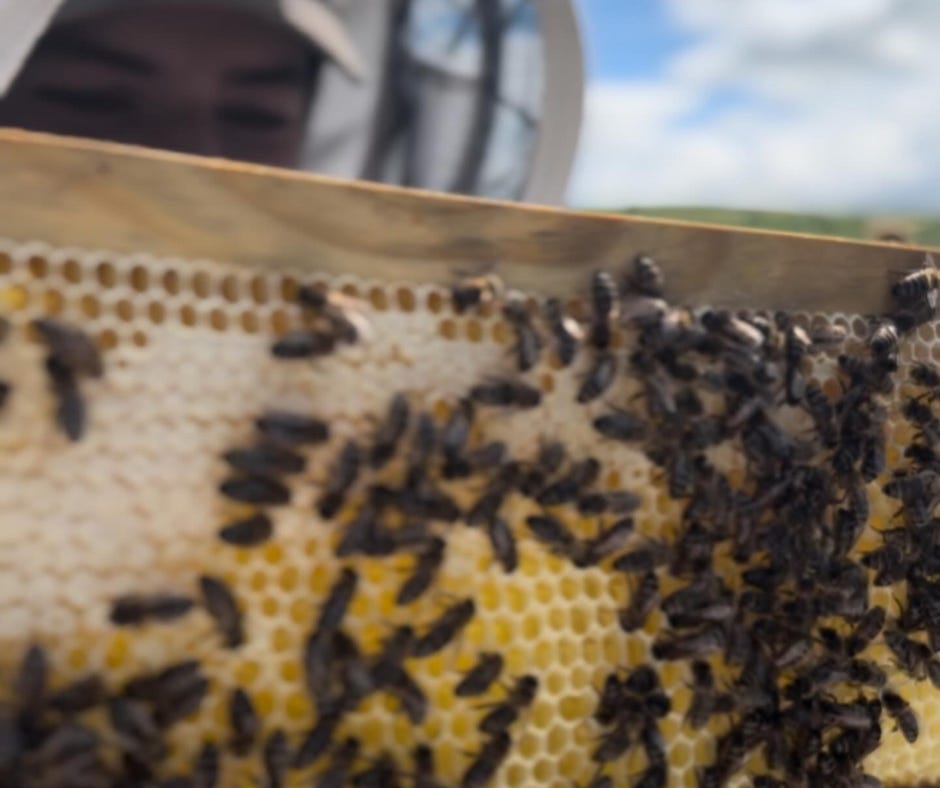
A small note before we begin: The Bee’s Mind is probably the most "nerdy" series on Bees & Beyond. We are moving beyond what bees do and into how they process information, make decisions and respond to the world around them. Some questions have clear answers. Others are still being debated by scientists. As always, peer-reviewed references are linked in the end of the article.
When beekeepers talk about a stressed hive they usually mean something they can see. Bees pouring out of the entrance. Defensive behaviour that does not match the season. A cluster that looks thin or restless. These are real signals and they matter. But they are late signals. They are what stress looks like after it has been building for weeks.
The biology of stress in bees runs ahead of everything you can observe from outside the box, and it starts earlier, is more systemic, and has more downstream effects than most beekeeping accounts acknowledge.
This article is about what stress actually is inside a bee, how it spreads through a beehive, what it does to the decisions you read about in the last article and what the science suggests you should be looking for before the obvious signs appear.
If this is your first time here, welcome to Bees & Beyond, where we speak bee. Expect nerdy articles about bees, pollinators and the environment, combining science, research and real-life observations from the bees. Subscribe for weekly articles.
Once a bee is stressed through any form of injury, pathogens, poor nutrition, heat or cold exposure, or physiological disruption by some pesticides, a chain reaction starts.
Stress changes the chemistry inside a bee. Octopamine and dopamine (chemicals involved in arousal, motivation, learning and stress responses) shift as the bee responds. Her immune system responds too by activating immune cells called ‘hemocytes’ and changing the production of antimicrobial proteins. At the same time, the fat body (one of the bee's main energy-storage tissues) begins mobilising stored resources to fuel the response.
This is what we call acute stress. It is an adaptive response. The problem is chronic stress, when the stressor does not resolve and the response cannot switch off.
Under chronic stress, a bee has to juggle competing demands on her physiological resources. Vitellogenin a major protein in her hemolymph, is one of the things that can change.
If you remember, we already talked about hemolymph in an earlier series, so I will leave the link here in case you need a little refresher:
Read article here»
Vitellogenin is involved in a surprisingly wide range of processes, including division of labour, reproduction, immune defence, protection against oxidative damage and longevity. Prolonged stress can also affect age-related physiology, along with behaviour, learning and memory.
And do you know what makes stress in a bee colony different from stress in a solitary animal? Let me explain it to you: in a solitary animal, stress is bounded by the individual. In a superorganism (such as the beehive), individual stress will have consequences beyond the individual.
A forager bee returning from a pesticide-contaminated forage site may be neurochemically and behaviourally altered. She may perform a less accurate waggle dance, as you read in The Bee’s World series. She may also return with pesticide residues acquired during foraging, depending on the compound and exposure route. And changes in her behaviour can affect the information, food and work available to the bees around her.
And through the social system of the hive, those effects can travel further. A change in foraging behaviour affects food coming in. A change in communication affects recruitment. A change in nursing behaviour affects brood. One altered bee does not have to chemically “infect” the rest of the colony with stress for her altered physiology to matter.
Stress pheromones exist in honeybees, but a single general “stress pheromone” system has not been clearly demonstrated. What we do know is that honeybees communicate through an extraordinarily complex combination of pheromones, behaviour, food exchange and physical contact.
The colony is not just a collection of stressed individuals. It is a system in which the effects of individual stress can feed back into the social system around them.
If you like your bees with a side of biology (or shall I say beeology :D) subscribe. There is plenty more where this came from.
Varroa destructor is one of the most important health threats facing managed honeybee colonies and it operates precisely at the intersection of many of the mechanisms described above.
Varroa reproduces inside capped brood cells, where the mites feed on the developing bee’s fat body tissue (horrible!) And once the bee emerges, the mites can continue feeding on their fat body tissue. This can leave a bee already compromised by the time she enters the world. Her nutritional physiology may be affected, her immune system can be impaired and she may not live as long as a bee that developed without Varroa.
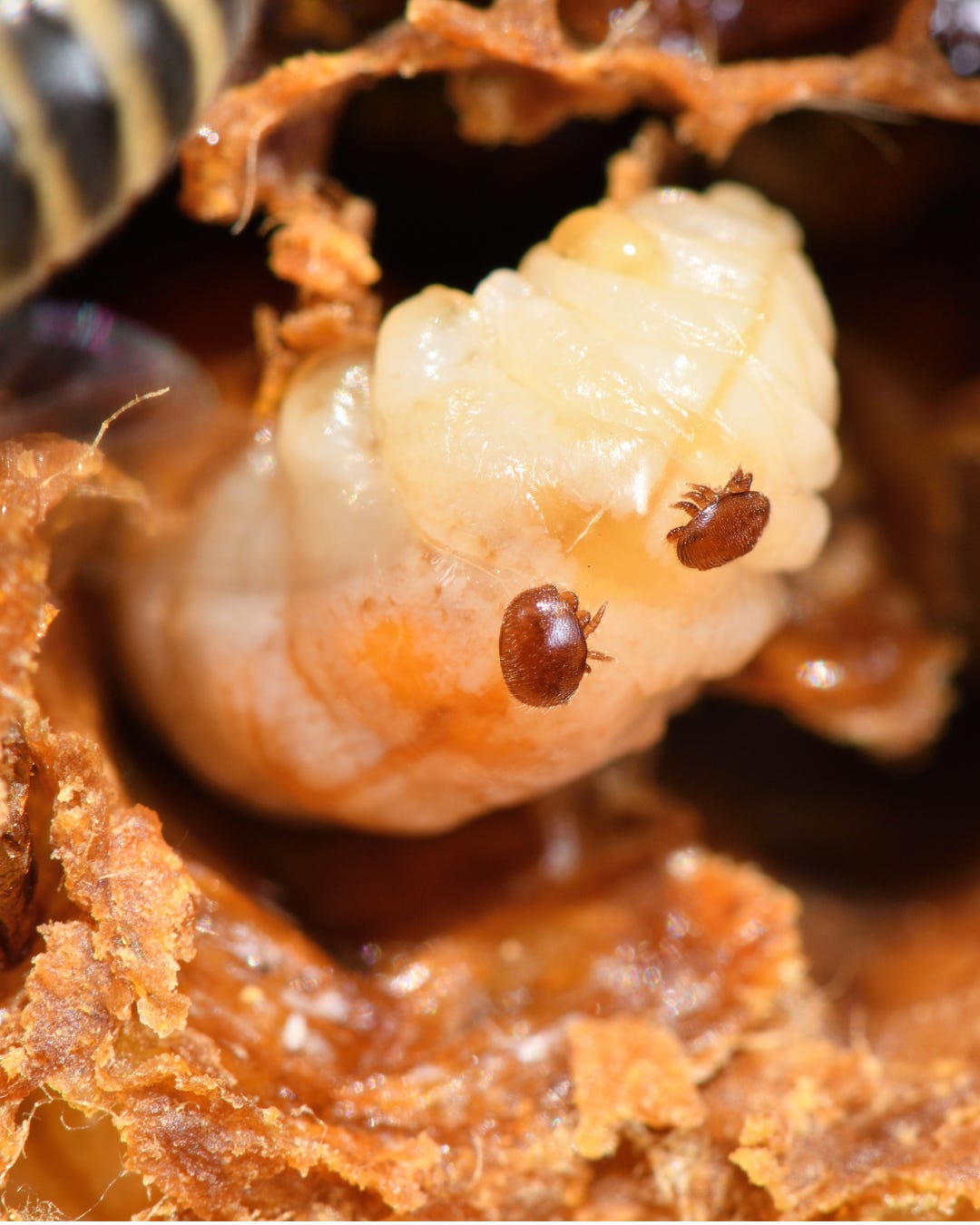
And they are being born into a hive that may already be under nutritional and immune pressure if the Varroa infestation is significant. This is where things get really interesting. One compromised bee is one thing. But when you have lots of bees developing with Varroa, their individual problems start adding up. And because a honey bee lives as part of a social system, those effects do not stay neatly contained within one bee.
But not every honey bee population responds to Varroa in the same way. Some populations have developed remarkable ways of surviving alongside the mite. Honey bees in places such as Cuba, the Dominican Republic and South Africa have shown forms of Varroa resistance that allow populations to survive without the routine mite treatments used elsewhere.
I see something similar in my own bees here in Scotland. I am a treatment-free beekeeper and over the last four years I have only lost four hives. Those losses were associated with queen failure rather than an obvious Varroa infestation. That does not mean my bees don’t have Varroa or that they immune to Varroa. It means that the relationship between honey bees and the mite can look very different depending on the way the bees are managed.
And that matters, because while some populations are managing to live with Varroa destructor, the mite remains responsible for enormous losses in managed honey bee populations elsewhere.
This is why Varroa management is not purely about mite numbers. It is about the physiological state of the bees those mites have already affected, the downstream effects of which may persist after mite numbers have been reduced.
Okay, so this is where we get properly into the interesting stuff.
I am going to show you what stress can actually do to a bee before you can see anything obviously wrong with the hive. We will get into pesticides, behaviour, early warning signs and then turn the question back on ourselves: how much stress are we creating when we work with bees?
Basically, we are going from “something seems off with this hive” to “what the hell is actually happening inside it?”
Comments
Nothing yet. Say the first thing.
Sign in to join the conversation.