

Most people, when they think about bee communication, think about the waggle dance. It is a reasonable starting point. The dance is remarkable. But it is one channel in a system that is considerably larger, more layered and more continuously active than a single elegant behaviour can suggest.
The primary communication medium in a honeybee colony is chemical. The air inside a hive, the surfaces of the comb, the bodies of the bees themselves are all saturated with information. Not one signal, but dozens, operating simultaneously, shifting in concentration and combination depending on the state of the colony at any given moment.
A hive is far from quiet. It is chemically loud in a way that is overwhelming if you are a bee.
Understanding this changes what beekeeping looks like. It also changes how we define a healthy hive, what we recognise as stress, and why certain interventions have specific effects.
This is part of an ongoing science series inside Bees & Beyond. Subscribe to read the next chapter of The Bee’s World when it drops.
Honeybees produce pheromones from more than a dozen specialised glands throughout the body. Each pheromone is typically not a single molecule but a blend of compounds carries information. The complexity of this system wasnot fully revealed until advances in analytical chemistry (particularly gas chromatography and mass spectrometry) allowed scientists to identify individual pheromone compounds and reveal just how complex the system really is. Before these techniques became widely available, much of the vocabulary of bee chemical communication remained invisible.
The functions range across almost every aspect of hive life.
Alarm and recruitment.
Orientation and navigation.
Queen signalling and worker suppression.
Larval negotiation.
Flower marking.
Each function involves different glands, different compounds and different receiver responses. The system has been running for tens of millions of years without a single bee being aware it exists.
The Bee’s World continues next week. Subscribe to stay with the series as we explore more.
Queen mandibular pheromone, or QMP, is the most studied and most widely understood bee pheromone. It is produced in the queen’s mandibular glands and consists of a blend of at least five main compounds, along with additional minor components that can vary between queens and between hives.
QMP does several things at once. It keeps workers (the queen’s daughters) reproductively inactive by suppressing ovary development, so they don’t start laying eggs when a healthy queen is present. It draws workers in and triggers retinue behaviour, that tight cluster of bees that surround and groom her. It also suppresses the raising of replacement queens under normal conditions. And it works at a distance too, acting as a signal that can guide drones towards her during mating flights.
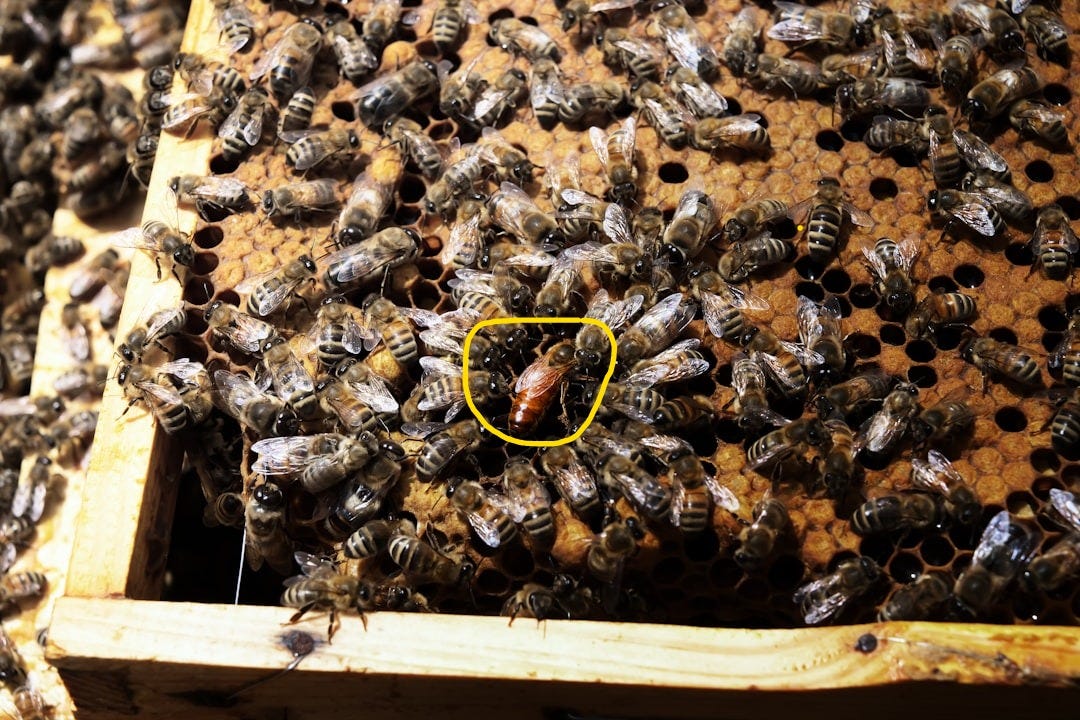
The hive does not orient around the queen because she is the queen. They orient around the chemical signal she produces. Remove or weaken that signal and the bees can begin preparing for a replacement surprisingly quickly, even if the queen is still physically present. The control is chemical. The queen is, in a very real sense, a walking broadcast.
When a bee stings, she releases alarm pheromone from the sting apparatus and the gland near the sting base. One of the main compounds is isoamyl acetate, which has that faint banana smell some beekeepers learn to recognise as a warning sign that things are about to escalate.
That signal spreads fast. It recruits other bees to the same target, marks the area and raises defensive behaviour in the surrounding bees. If it is not diluted or disrupted, a single sting can quickly turn into a full defensive response.
Smoke does not “calm” bees. It interferes with this communication. It masks the alarm pheromone so the signal cannot travel properly, which breaks the recruitment chain before it builds.
At the same time, smoke pushes a very different response: bees start preparing for possible fire. They take on honey. Focus shifts inward. A bee busy filling up her tummy is far less likely to sting.
So when smoke is used, nothing is being soothed. A communication system is being scrambled and attention is being pulled in another direction entirely. It is less “calming the bees” and more temporarily disrupting the language of alarm while triggering a survival routine.
The Bee's World is a four-part series on Bees & Beyond. Paid subscribers get every essay in full as it publishes.
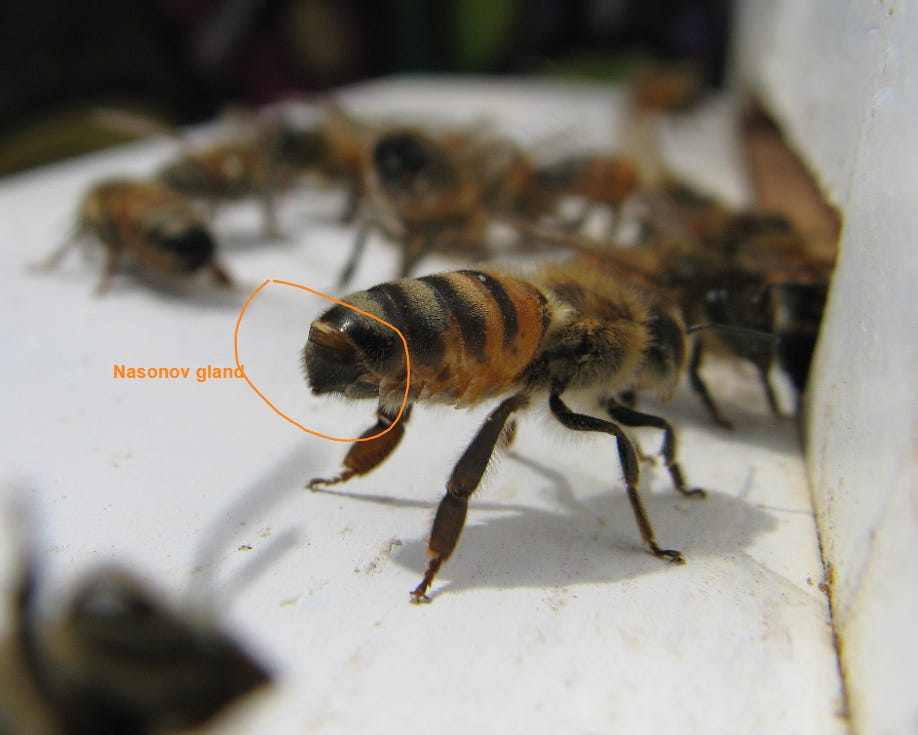
Female bees use the Nasonov gland, which sits on the upper side of the abdomen. They raise and fan it to push a specific pheromone blend into the air. This mix includes compounds like geraniol, citral and nerolic acid and it works as both an orientation and aggregation signal.
You will see this behaviour most clearly at hive entrances on warm evenings, at water sources and during swarming when a new nest site is being organised. It is essentially a chemical “come here” signal. Lost or drifting bees pick it up and reorient. When a swarm settles in a new place, bees fan it to pull the rest of the cluster together.
It is one of the clearest signals in the bee communication system. You can often recognise it before you even think about chemistry, just from the posture alone: abdomen raised, wings fanning steadily, broadcasting location into the air.
From here, we move into how chemical signals begin shaping what bees do, not just what they detect.
Comments
Nothing yet. Say the first thing.
Sign in to join the conversation.