
Of the four sensory worlds covered in this series, this one needs the most care about the difference between what is established and what is still being worked out.
The evidence that bees can detect and respond to magnetic fields is real, replicated across multiple research groups and broadly accepted in the scientific literature. The mechanism by which theyy do this is not agreed upon. The implications for how bees are affected by the electromagnetic environments that modern human infrastructure creates around them are significant, insufficiently studied and almost entirely absent from mainstream conversations about bee decline. This article will tell you what the science knows. It will also tell you, honestly, what it does not.
If you enjoy honest science writing like this, consider subscribing to Bees & Beyond for weekly articles.
Okay, so let’s start from the begining.
The first clear documentation of magnetic sensitivity in honeybees came in the 1970s. Researchers found that bees building comb in a new box tended to orient it consistently relative to the Earth’s magnetic field and that this orientation could be disrupted by applying an artificial magnetic field.
As a beekeeper, I find this so incredible and also beautiful.
Since then, multiple studies came out. Bees trained to associate magnetic stimuli with sweet rewards can reliably detect and discriminate between different magnetic field orientations. Some experimental work has shown that magnetic fields can influence orientation behaviour and waggle dance direction under certain controlled conditions. Bees navigating in conditions where other sensory reference points are removed still show non-random orientation behaviour that is consistent with magnetic sensing.
It does sound like science fuction. But magnetoreception in honeybees is a well-established finding. The question is not whether they have it but how it works.
If you are interested in how bees coordinate behaviour through signals we are only just beginning to measure, you can subscribe to follow Bees & Beyond.
Magnetite is a naturally magnetic iron oxide mineral. It has been found in the abdomens of honeybees, in concentrations and arrangements that suggest it is not incidentally present.Although its precise functional organisation is still under investigation.
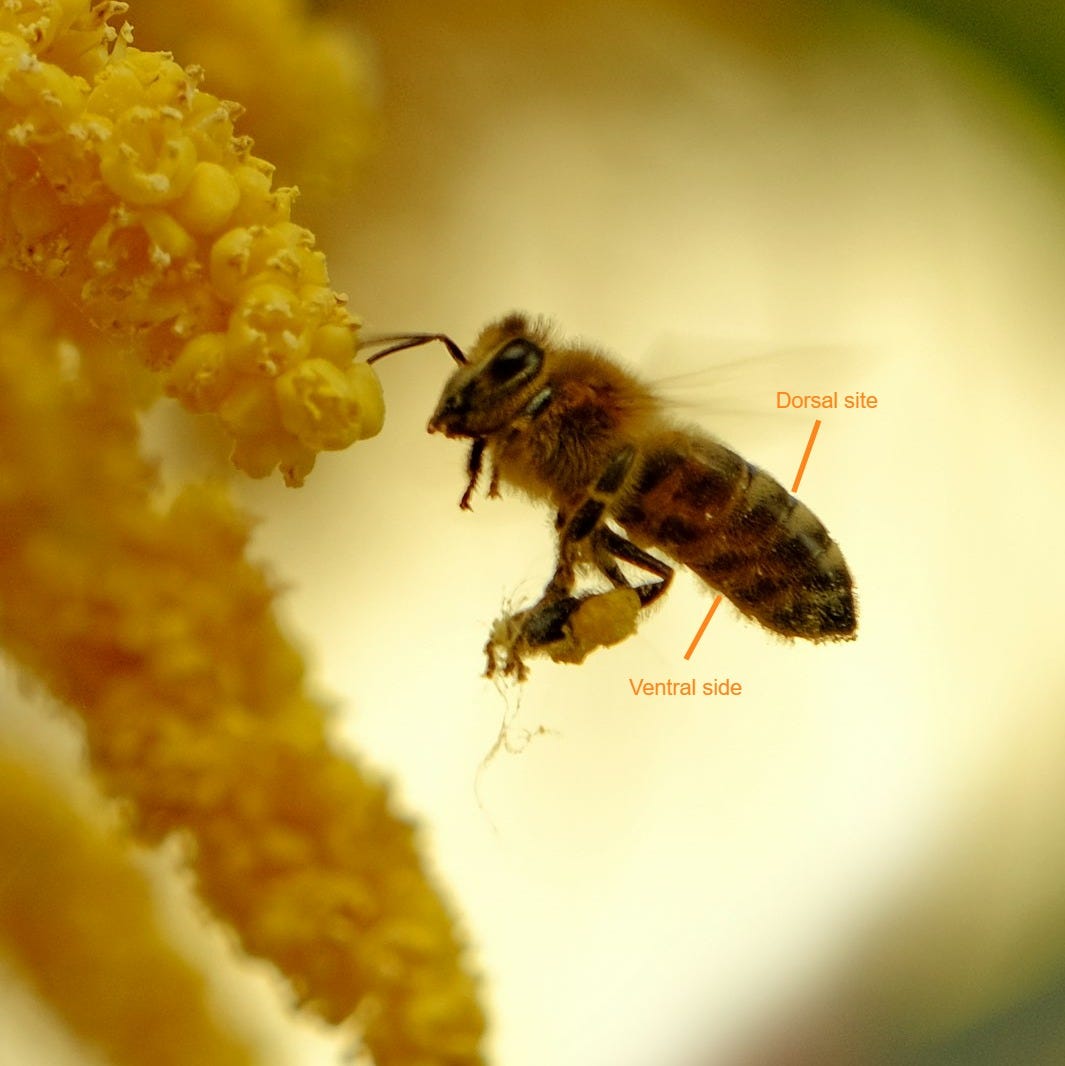
The hypothesis: microscopic crystals of magnetite in the bee’s body act as biological compass needlles, physically rotating in response to changes in the ambient magnetic field. This rotation is detected by mechanosensory neurons attached to the crystals, translating magnetic information into a physical signal the nervous system can process.
If this mechanism is correct, magnetoreception in bees would be a mechanical sense, more similar to touch or vibration detection than to vision or smell. The same kind of sensory logic that detects airflow through hairs and substrate vibration through leg joints might also be detecting the Earth’s magnetic field through the movement of iron crystals in soft tissues.
Bees are communicating in ways we are only beginning to understand. Subscribe if you would like to follow the latest discoveries, one articles at a time.
Cryptochromes are photosensitive proteins found in the eyes and brains of many animals. In migratory birds, they are involved in a light-dependent magnetoreception mechanism. When exposed to light, the protein undergoes a chemical reaction that is influenced by the Earth’s magnetic field. Allowing the bird’s visual system to see the magnetic field as a pattern layered on its visual field.
Honeybees have cryptochromes. Whether they function in magnetoreception the same way as in birds we don’t know. The mechanisms are sufficiently different between bee and bird biology that the analogy may not hold. ut the possibility that bees have two separate ways to sense magnetic fields at the same time is still possible. One system may use magnetite, and the other may use cryptochrome photochemistry.
It wouldn’t be unique to bees. Multiple mechanisms for the same sense have been found in other animals. The redundancy may reflect the evolutionary importance of the information.
I writeweekly science articles about bee behaviour, navigation and the sensory systems shaping how bees move through the world. Subscribe if you want more.
We still don’t know exactly how important magnetoreception is in bees’ everyday behaviour. But the scientists have suggested several possible functions:
Navigation: magnetic information may work together with the sun compass and landmark memory to help bees navigate accurately over long distances, especially when the sun cannot be used, such as during cloudy weather or over areas with few visual features.
Comb orientation: the consistent alignment of natural comb with the magnetic field suggests that bees may use magnetic information as a reference while they build, especially in new nest sites where no existing comb are there to provide directional cues.
Hive site assessment: scout bees that are evaluating possible nest sites may incorporate magnetic orientation in their assessment if the site is suitable, although the evidence for this are indirect.
The honest position is that we know this sense exist and have some behavioural evidence for when it is used. We don’t have a complete functional map of it.
Beyond this poin we explore how bees detect magnetic fields, what the research discovered about electromagnetic environments made by humans and why sensory disruption could become an important piece for the conservation puzzle.
Comments
Nothing yet. Say the first thing.
Sign in to join the conversation.