
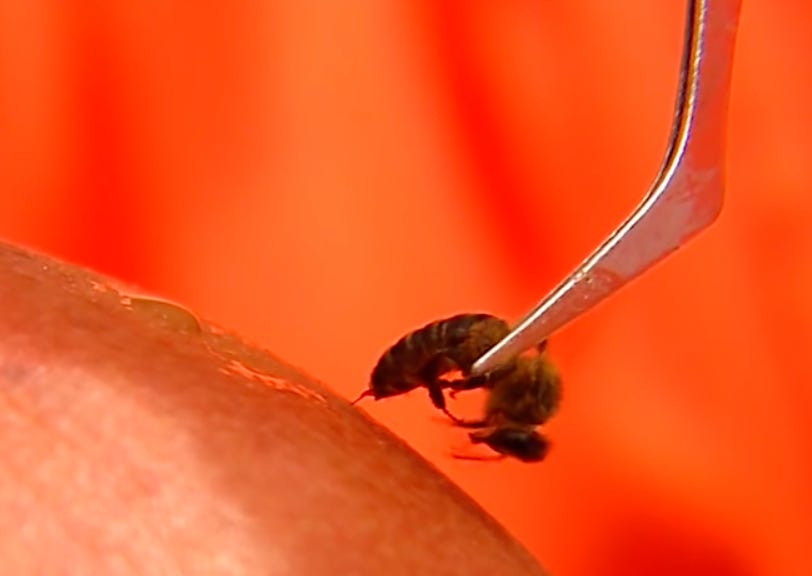
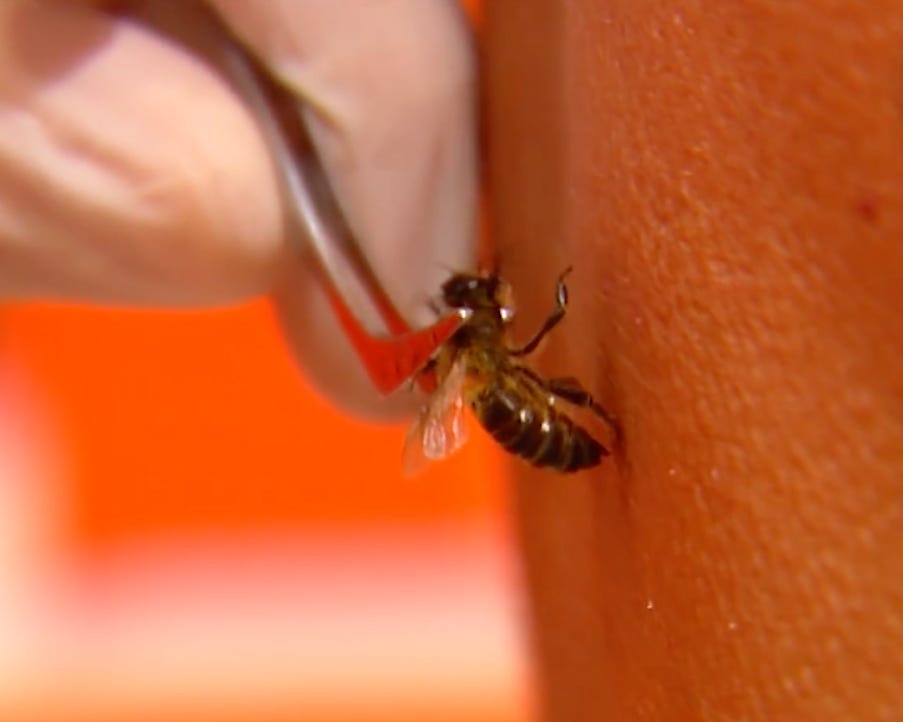
Okay. So this is going to be a long one. It includes images of deliberate bee stinging for apitherapy, which some people may find upsetting. This is your warning before you continue.
I need to get something off my chest and it is not going to be my usual calm-teacher voice, so bear with me, I am still your bee nerd, I have just also had a week.
I have been keeping bees for years. I spend a lot of my time teaching people to see the world from the bee’s point of view, instead of looking only at them through a jar of honey on a shelf.
Normally I am the patient person. The one who says, “wait, let us look at the evidence before we panic.” The one trying to bring everyone back to facts.
Not this week.
In the video that I watched this week, there was a lady holding a plastic sandwich bag at the entrance of a hive, catching bees as they flew out of the hive one by one, walking away with the bag of bees and pressing the bees with a tweezer to her dog intentionally so that they would sting the dog. In the name of ‘healing’…
…Yes, really…!
And then, a few days later, I read a post from another beekeeper. Someone who calls themselves a ‘natural’ beekeeper… which was the part that got me all riled up. This person stung their own mother to ‘treat their arthritic hands’ and by coincidence, one of the welt marks took on a shape resembling a heart. And they interpreted that (literally interpreted that) as a divine ‘message’ from the bees.
In their own words: it’s like the bees are saying that they are willing to ‘help’.
I have thoughts. None of them are calm. Let’s do this properly though. Science first, then risk, then the ethics and somewhere in there I am going to get annoyed again, so, fair warning.
And if you enjoy reading about bees, pollinators and the environment from an absolute bee nerd you can subscribe to Bees & Beyond for weekly articles.
Part one: what is actually in the little torture syringe
Bee venom or apitoxin if we want to get all scientific about it, is quite an intriguing mix. Melittin accounts for nearly half of the dry weight of this mixture and it does all the hard work during any laboratory tests that you might encounter. It comes along with phospholipase A2, apamin, hyaluronidase, histamine and a bunch of minor components.
Melittin is a truly mighty compound. It is amphipathic, meaning one end likes water and the other like fat. It is therefore able to break open a cell membrane, making a bee sting as painful as it is. And that is precisely why scientists find melittin interesting: a compound with the ability to punch holes into membranes is something that can be used to target cells that you would like to destroy, such as those with cancer.
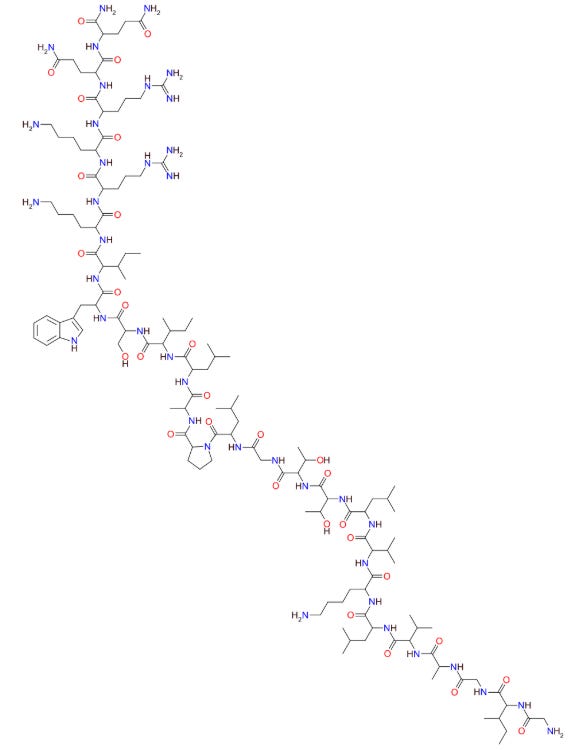
But you know what, I have said to myself that I would not throw away the research due to my annoyance over the sandwich bag and I won’t. It is legitimate research.It has been observed that melittin has pro-apoptotic activity and is capable of causing programmed cell death in various types of leukaemia cells and solid tumors.
There is an entire group of researchers that specialises in developing melittin conjugates and nanoparticles exactly due to the fact that the major downside of melittin is that it lacks specificity.
Thus, it destroys both healthy and cancerous cells. In addition, there is research done on bee venom acupuncture for the treatment of ankle pain that has demonstrated some effect in a limited sample of research, but even the authors of the reviews note the lack of adequate randomised trials with proper side effect reporting in half of the papers.
So the honest picture: interesting, promising, still mostly laboratory and small-trial stage and nowhere close to “proven treatment, do this at home with a bee you caught yourself.”
There is a massive gap between “melittin shows cytotoxic activity against cancer cell lines in a petri dish” and “my auntie’s arthritis needs a live bee pressed onto her knuckle this afternoon.” One of those is peer-reviewed cell biology, painstaking and slow. The other is a decision made mostly on vibes, that a defensive insect toxin is now, somehow, a wellness product the bees can be killed for.
Part two: the risk nobody’s plastic sandwich bag accounts for
But here comes the part that alone can put a halt to this practice without going into questions of ethics: allergy testing does not make intentional stings a safe practice. It only makes them marginally safer one time for the day.
I am not exaggerating here. This is what the literature tells us:
Systematic review which included 145 studies on the treatment using bee venom therapy showed a significant number of adverse events, ranging from local swelling to complete anaphylaxis.
Additionally, bee venom acupuncture has been found to carry a significantly higher relative risk of adverse events compared to regular saline injection. In one systematic review, for instance, the risk was more than doubled.
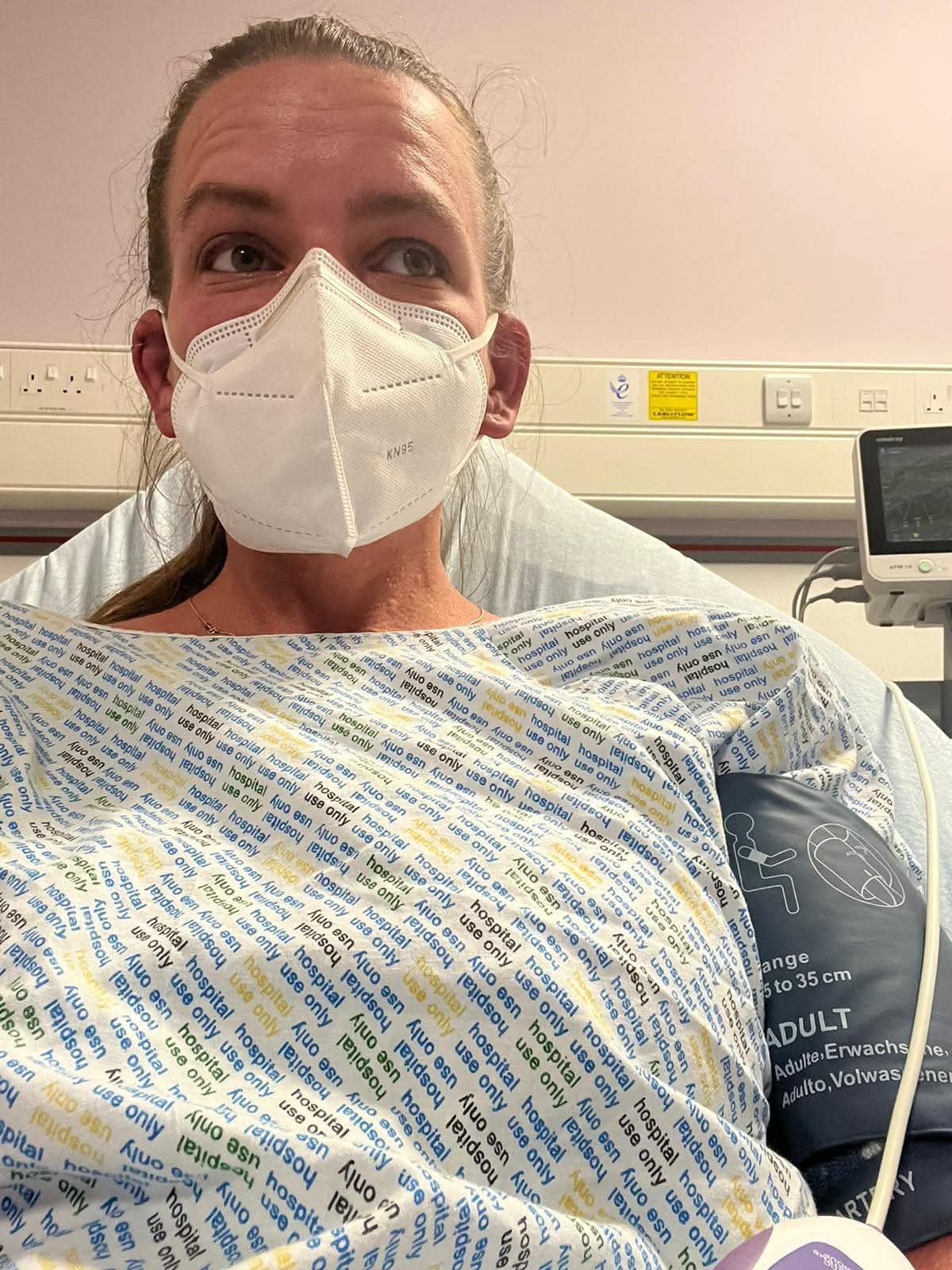
I know this risk personally. I am a beekeeper. I have been stung many times. And one day, out of nowhere, I had a systemic reaction and ended up in hospital. I don’t have allergy, yet I was discharged with an EpiPen. This is why I find the casual way some people talk about deliberately provoking bee stings so difficult to understand. The venom is not a harmless “natural remedy”. It is a biologically active substance that can have serious effects on the human body.
And here is the thing which, in my view, ought to be enough to bury forever the “but I always test first” argument: there is a recorded case of a 55-year-old woman in Spain who received apitherapy treatment every few weeks for two years and had no reaction at all throughout this period, but one day she got stung by a bee, suffered from anaphylactic shock and died.
Immunity may develop from exposure to a substance. A clear result from the past year or even the past month is not a ticket to safety. Your body is not static, your immunity system is not an Excel file.
And then there is the practical aspect of it. Wild venom from a bee you caught off your own hive has no standard dose, no standard of purity, no administration procedure, and, crucially, no backup team with an EpiPen ready to save your life should it all go wrong within the next 90 seconds. Contrast this with the real-life scenario of a proper scientific study, which involves careful dosing down to the milligram and the presence of a hospital close by. “I test for allergens first” is not the same as “it’s done under medical supervision.”
So, even setting the ethics aside: if you are experimenting on yourself, or your mum, or your dog, with wild-caught stings, you are running an uncontrolled medical experiment with something that has, on record, killed people. With no safety net underneath it.
If you are one of those people who needs to see the paper citations themselves rather than just believe me, that is pretty much what all of this Bees & Beyond is about. Come subscribe and I will just keep throwing citations out into the light for you. (Further reading and resources are always in the end of articles)
Part three: the bit where we actually talk about consent
Right.
A honey bee’s sting is not a tool. It’s not a byproduct, it’s not a gift she is handing over. It is the very last thing she has.
The sting of the worker honey bee is the modified version of an ovipositor, complete with barbs pointed backwards. This is designed in such a manner that it becomes firmly embedded in the thick skin of the mammals and when the bee tries to withdraw and leave, a part of the abdomen comes out with it… the entire digestive system, muscles and the venom sac. The bee does not survive this.
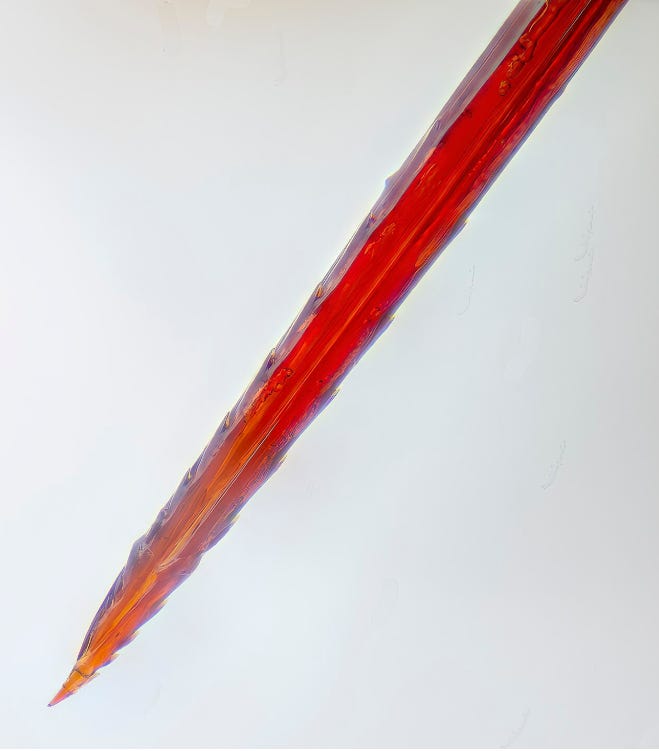
That is what a sting is. It is not communication. It is not affection. It is not a spa day. It is a dying animal’s last act of defence, because a human being caught her and pressed her against skin.
She isn’t choosing this interaction. She doesn’t have the ability to understand that the giant mammal she is being pressed against has decided this is a collaboration. She is responding to a threat because she has been placed into a situation she did not choose. She isn’t taking part in a ritual. She is dying, defensively, because you put her somewhere she never chose to be.
Now, the heart-shaped welt…
I want to be gentle here, because I really do think the person who wrote that post loves bees, sincerely.
But sincere isn’t the same thing as correct and love doesn’t automatically mean the thing you are doing is respectful of the thing you love.
A welt swelling into a rough heart shape is skin doing what human skin does. Localised histamine release causing tissue to swell in a roughly symmetrical pattern around a puncture point. That is the whole mechanism, start to finish. It is not a message. And it is definitely not consent.
Here is the comparison that I can’t quite let go of (and yes I know it is a blunt one): if a pig bite the farmer’s hand on the way to the slaughter and the bruise looks like a heart, would you take that as the pig is agreeing to become sausage just because the bruise has a heart shape? No. Obviously not. You would recognise it, correctly, as a frightened animal’s involuntary reaction and the only reason you would read it any other way is because the honest version (that the farmer took something from an animal who had no say) is uncomfortable to sit with.
Also: Calling something a ritual doesn’t make it consensual. It makes it a story we tell ourselves so the ‘taking’ feels like reverence instead of just... taking.
Part four: we are extremely good at lying to ourselves about animals
This isn’t new and it isn’t unique to bee people, we all do it, mostly because the honest version of events is harder to carry around.
“The bee wanted to help me” is easier to say than “I took a life for something with no proven medical benefit.”
“It’s a sign” is easier than “I genuinely don’t know if this worked, or if it’s a placebo, or if her arthritis just had a decent week regardless.”
“I revere bees, this is sacred to me” is easier than “I decided my wish for a treatment mattered more than the life of a bee.”
There is nothing wrong with anthropomorphising animals, actually. It is a beautiful, human quality and some of it does indeed help us empathise with beings that couldn’t be more different from us. I do this all the time. I will say things like “My hive is grumpy right now because there is a storm coming,” or “they seem so happy now that the nectar flow has started.”
The line gets crossed the second the anthropomorphising turns into a permission slip. The moment “she seemed calm” means “she agreed.” The moment “it looked like a heart” means “she wanted this.”
Honestly, this is the whole reason I started Bees & Beyond. Trying to look at bees as they actually are, not as whatever story is most flattering to us. If that is your kind of nerdy, come subscribe.
Part five: okay, but what is actually different here
I had mentioned in the beginning that I am not making any claims that all stings from bees on humans carry equal moral implications and I stick to my point.
There is actually a big difference between raising bees and understanding that there will be times when (even though you do everything right) you are going to get stung. Because that is what happens when you spend time around a tiny animal that can protect herself. And that doesn’t need anyone’s consent because no one was trapped in a plastic bag.
There is a difference again for something like standing on a bee by accident on a walk. An accident. Part of sharing a world with other creatures.
And then there is catching a bee, transporting her somewhere against her will and forcing her onto a body she’s never been near (a dog, a hand, whatever). That isn’t incidental. That is deliberate extraction. That is treating a living animal with complex behaviour, learning and stress responses as a delivery mechanism for a chemical you happen to want.
The first two are what coexisting with bees actually looks like. The third is what using them looks like.
And I think a huge amount of the “I revere bees” language floating around apitherapy is doing the emotional work of making the third thing feel like the first two.
It doesn’t work, though. A hive that stings you because you knocked it isn’t the same event as a person hunting bees down with a sandwich bag for a treatment that is, at best, promising-but-early in the lab.
Part six: the actual question I want you to sit with
We say that we love bees all the time. You find it on tote bags. You find it on jam jars. It’s kind of half the marketing in every farmer’s market you have ever been to.
But: are we in love with the bees themselves, as living beings, with all their evolutionary complexity, or do we merely love the end product that they create?
Honey. Wax. Propolis. Royal jelly. Pollen. And now, apparently, venom, repackaged as wellness.
Every single one of those is something we take.
And at some point, if the whole relationship is defined by what we can extract, “reverence” stops describing how we feel about bees and starts being a label we stick on the extraction to make it feel nicer. Calling it sacred doesn’t change what it structurally is.
The question I really want the beekeepers (natural or otherwise), to reflect on is not whether or not they “love bees”. Almost all people who do this will say that they love bees and I think that most of them are telling the truth. The real question is: would I still think this was fine if it gave me absolutely nothing back? If bee venom had zero therapeutic promise whatsoever, would catching one and pressing her against your mum’s ankle still feel okay? If my answer is no, than my reverence for the bee never had anything to do with the bee herself…
In my view, the whole discussion on how to treat bees requires transitioning from “What can bees do for us?” to “How can we live with them?” One of those treats an entire species as a vending machine that happens to have wings. The other treats them as what they actually are: a wildly sophisticated, ecologically essential, individually short-lived and collectively ancient superorganism that managed perfectly well for tens of millions of years before we decided their bodies were a wellness product.
If you want more of this kind of thing (proper science, no fluff, told from somewhere closer to the hive than the human ego) that is what I am building at Bees & Beyond. Come along.
So no. A heart-shaped welt isn’t a sign. A sandwich bag isn’t a ritual vessel. And “I revere bees” doesn’t survive contact with “I caught one against her will and let her die defending herself against my mum’s knuckle.”
I love bees enough to admit that sometimes loving something means leaving it alone.
Goodness me, this became a very long article… thank you for reading all the way! I would love to hear your thoughts on the topic. Share them in the comments or send me an email.
References & Further Reading:
Park, J.H. et al. (2015), Risk Associated with Bee Venom Therapy: A Systematic Review and Meta-Analysis, PLOS ONE, 145 studies, the big one on adverse events
https://pubmed.ncbi.nlm.nih.gov/25996493/
Vazquez-Revuelta, P. & Madrigal-Burgaleta, R. (2018), Death due to Live Bee Acupuncture Apitherapy, J Investig Allergol Clin Immunol
https://pubmed.ncbi.nlm.nih.gov/29461208/
MDPI (2024), Therapeutic Potential and Mechanisms of Bee Venom Therapy: A Comprehensive Review of Apitoxin Applications and Safety Enhancement Strategies, Toxins
https://www.mdpi.com/1424-8247/17/9/1211
PMC (2023), An Updated Review Summarising the Anticancer Efficacy of Melittin from Bee Venom in Several Models of Human Cancers
https://pmc.ncbi.nlm.nih.gov/articles/PMC10385528/
LymeScience.org, Stinging Yourself With Bees: Dangerous and Ineffective "Bee Venom Therapy"
https://lymescience.org/bee-venom-therapy-apitherapy/
Comments
Nothing yet. Say the first thing.
Sign in to join the conversation.