
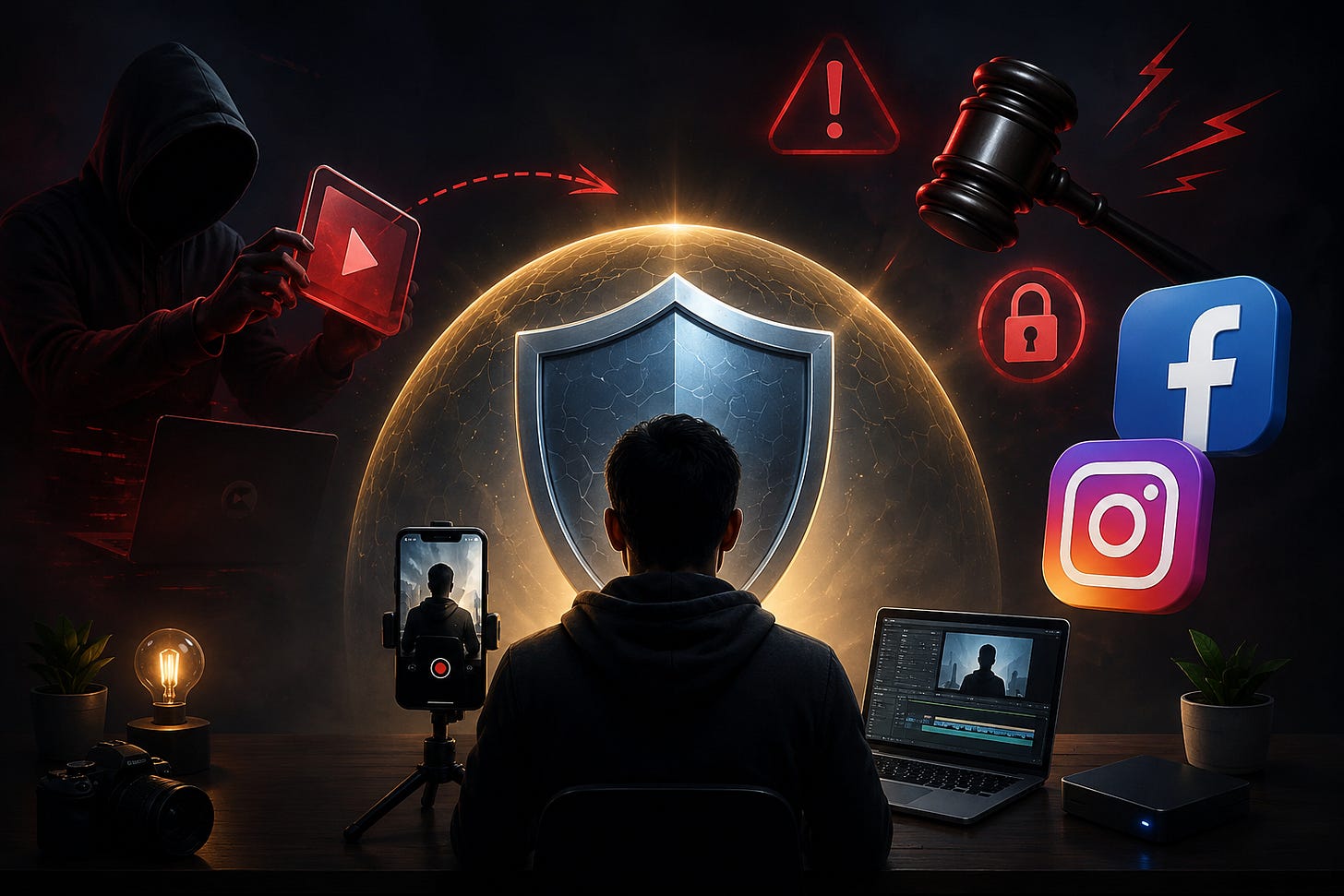
Dear Creators,
Your content can be original.
Your account can still be at risk.
Imagine this.
You spend three hours scripting a Reel.
You shoot it.
You edit it.
You publish it on Instagram.
It starts performing.
A few days later, you receive a copyright notification.
You think bro!!
Someone copied my video.
But then you discover something much stranger.
The person claiming copyright may not have created the video at all.
And in some reported cases, creators allege that bad actors have manipulated Meta’s copyright-enforcement system to make it look like they published the content first.
This is no longer just a hypothetical creator problem.
In July 2026, multiple Indian creators approached the Delhi High Court alleging that Meta’s copyright tools were being misused to file fraudulent copyright claims against their original content.
And if you’re a creator, there is one important takeaway:
Your content library is an asset. Start protecting the proof that you created it.
First: What exactly is happening?
Let’s simplify the alleged mechanism.
Step 1 - You create original content
You shoot a Reel.
You publish it on Instagram.
You have the original footage sitting on your phone, camera, hard drive or cloud storage.
Everything is normal.
Step 2 - Someone downloads your Reel
A bad actor downloads the video.
They now have a perfect copy of your content.
Step 3 - They allegedly manipulate an older Facebook post
According to allegations made in cases before the Delhi High Court, bad actors may first upload unrelated content to Facebook.
Later, after the genuine creator publishes their Reel, they allegedly use Facebook’s Edit Post functionality to replace the old media with the creator’s video.
The important part:
The post can continue displaying its original publication date after the media is changed.
That can potentially create the appearance that the copied video existed on that account before the genuine creator published it.
Step 4 - The alleged attacker uses copyright tools
Meta’s Rights Manager is legitimately designed to help rights holders identify matching video, audio and image content and manage how their intellectual property is used on Facebook and Instagram.
The problem alleged in these cases is that the system may be manipulated into treating the bad actor as the original rights holder.
Step 5 - The original creator receives a copyright strike
And suddenly...
You are defending your own content.
Why this is particularly dangerous
A copyright complaint against one Reel is annoying.
But multiple copyright strikes can become an account-level problem.
That changes everything.
Your Instagram account may contain:
Years of content
Millions of followers
Brand partnerships
Sponsorship contracts
Affiliate revenue
Course sales
Community members
Leads
DMs
Business contacts
Your personal brand
So your Instagram account isn’t merely a social profile.
It is a business asset.
And when the enforcement system is automated, a false claim can potentially create a disproportionate amount of damage before the underlying ownership dispute is resolved.
This isn’t just one creator
The recent Delhi High Court litigation involves multiple creators making allegations about fraudulent copyright strikes.
Pushkar Raj Thakur
According to reporting on his case, Thakur alleged that dozens of his original videos were targeted by fraudulent copyright strikes.
He has sought court intervention, including stronger safeguards around copyright enforcement and measures such as KYC, timestamp integrity and metadata verification.
Neeraj Joshi
Joshi alleged that his verified Instagram account was disabled after a series of copyright complaints involving his original content.
The Delhi High Court recorded Meta’s assurance that it would investigate the allegations and preserve his verified account, subject to the circumstances of the case.
Mohammed Nawaz Shaikh
The Indian Express reported allegations from AI educator Mohammed Nawaz Shaikh of numerous copyright strikes and subsequent demands for money to remove strikes.
Sidharth Bhardwaj
Separately, actor and creator Sidharth Bhardwaj has publicly alleged that his verified Instagram account was suspended after three copyright strikes and that fake email IDs were involved. He has said legal action has been taken.
And then comes the scariest part:
Extortion.
According to allegations reported in the Delhi High Court cases, some creators were allegedly contacted after receiving copyright strikes.
The message was essentially:
Pay us → we remove the claims.
One reported case involved an alleged payment of ₹55,000 followed by withdrawal of copyright complaints only for another round of strikes and another alleged payment demand to follow.
This is why creators need to understand something:
A copyright strike isn’t always the end of the story. It can potentially be the beginning of a scam.
If someone contacts you saying:
Pay me and I’ll remove the copyright strike.
Do not treat that as a normal business negotiation.
Preserve the evidence.
Screenshot everything.
Save the emails.
Save the usernames.
Save UPI/payment details if any payment was requested.
Save the URLs.
And escalate through the appropriate platform/legal channels.
BUT - let’s be precise.
There is an important distinction here.
Not every copyright strike is fake.
Copyright law exists for a reason.
If you use:
Someone else’s music
Someone else’s footage
Movie clips
Sports footage
News footage
Stock footage without the appropriate licence
Commercial music without permission
Another creator’s video
Copyrighted images
you can legitimately face copyright action.
Meta also has legitimate copyright-protection systems, including Rights Manager and reporting mechanisms designed to help rights holders protect their work.
The issue currently being challenged in India is different:
What happens when someone weaponises the copyright-enforcement system against the actual creator?
That is the problem creators need to understand.
THE CREATOR SAFETY SYSTEM
Here’s what we want every creator in the SkillHouse community to start doing.
Don’t just create content.
Build proof of creation.
Think of every major piece of content as an intellectual-property asset.
And maintain an evidence trail.
01 KEEP YOUR ORIGINAL FILES
This sounds obvious.
But many creators don’t do it.
You publish a Reel and then delete the raw footage because:
It’s already on Instagram.
Keep
RAW → EDIT PROJECT → FINAL EXPORT → PUBLISHED VERSION
If possible, maintain a dedicated folder for your content.
2026 → August → Reels → Reel_042
Inside:
Raw footage
Audio
Project file
Final export
Thumbnail
Script
Caption
Published URL
02 DON’T RELY ONLY ON YOUR INSTAGRAM TIMESTAMP
This is one of the biggest lessons from the current controversy.
Your Instagram post date is useful.
But it’s not necessarily the strongest possible evidence of authorship.
A stronger evidence trail could include:
Camera footage
↓
Editing project
↓
Exported video
↓
Cloud backup
↓
First publication
↓
Original project metadata
The more independently verifiable evidence you have, the easier it becomes to establish the chronology of your work.
03 BACK UP YOUR RAW FOOTAGE
Use at least:
1 local copy
Your computer / SSD.
2 cloud copy
Google Drive, Dropbox, iCloud, etc.
3 secondary physical backup
Another hard drive/SSD for important projects.
For creators producing serious commercial content:
3-2-1 backup is a good operating principle.
3 copies.
2 different types of storage.
1 copy stored separately.
Your content shouldn’t disappear because your laptop died.
04 KEEP YOUR EDITING PROJECTS
Don’t only save the final MP4.
Keep:
Premiere Pro project
DaVinci Resolve project
Final Cut project
CapCut project
Photoshop files
Illustrator files
After Effects projects
Original audio
Original graphics
Why?
Because an editable project can provide substantially more context about how the content was actually created than a final exported video alone.
05 SAVE YOUR PUBLISHED URLS
For important content, maintain a simple spreadsheet with following columns:
Content ID | Content Title | Content Type | Created On | Published On | Platform | Published URL | Original File | Project File | Rights / Licence | Notes
This takes 10-30 seconds per post.
It can save you hours or potentially much more later.
06 DON’T IGNORE COPYRIGHT NOTIFICATIONS
This is where creators often make a mistake.
They receive:
Your content has been reported for copyright infringement.
And think:
It’s obviously fake.
Then they ignore it.
Don’t.
Even if you know you’re right, treat the notification seriously.
Immediately document:
The affected Reel
The claimant
Claim/reference number
Date
Screenshot
Original URL
Your original files
Any communication from the claimant
Any account involved
Create a case folder.
07 IF YOU RECEIVE A STRIKE, BUILD YOUR CASE
Your response should not simply be:
This is my video.
Build an evidence package.
Example:
CONTENT: Reel - How AI Is Changing Jobs
Created: 4 August 2026
Original footage: Available
Editing project: Available
Final export: Available
First published: 5 August 2026
Original Instagram URL: ______
Original Facebook URL: ______
Raw footage timestamp: ______
Cloud backup: ______
Other publication records: ______
This turns an emotional argument into an evidence-backed ownership dispute.
08 NEVER PAY RANDOM PEOPLE TO REMOVE A STRIKE
This deserves its own rule.
DON’T.
If someone contacts you privately and says:
Pay ₹25,000 and I will remove the strike.
or
Pay me or your account will be deleted.
Do not immediately pay.
First:
Screenshot → Preserve → Verify → Report → Escalate
If there is an active legal or commercial dispute, speak to a qualified lawyer.
And if money has already been transferred, preserve:
UPI IDs
Bank details
Transaction IDs
Phone numbers
Emails
WhatsApp chats
Instagram usernames
Facebook URLs
Screenshots
Voice notes
Do not delete the evidence.
09 BUILD AN AUDIENCE OUTSIDE INSTAGRAM
This is the bigger creator-business lesson.
If Instagram is your:
Audience + Distribution + Revenue + Community + Identity
then you have a concentration-risk problem.
You should be building at least one additional owned or controllable channel.
For example:
Instagram - Discovery
YouTube - Long-form + search
Email newsletter - Owned audience
Website - Owned platform
WhatsApp/community - Direct communication
Database/CRM - Customer relationship
The objective isn’t:
Leave Instagram.
The objective is:
Don’t let one platform become your entire business.
10 BUILD YOUR EMAIL LIST
This may be the most underrated creator asset.
Followers are rented.
Email subscribers are much closer to an owned relationship.
Imagine having:
1,000 Instagram followers
vs.
1,000 email subscribers who actively opted into your newsletter.
The second group is significantly more portable.
If Instagram disappears tomorrow, you can still email them.
That is creator resilience.
11 VERIFY WHO ACTUALLY OWNS YOUR CONTENT
This becomes especially important when working with:
Agencies
Editors
Freelancers
Production houses
Brands
Music producers
Videographers
Ghostwriters
Co-creators
Before publishing commercial content, know:
Who owns the copyright?
Creator?
Agency?
Brand?
Production company?
Freelancer?
Jointly owned?
Licensed?
Get this clear in writing.
Because the creator who uploads the content isn’t always automatically the only person who owns every underlying asset.
12 MUSIC IS A DIFFERENT PROBLEM
Creators often say:
But I created the Reel.
That doesn’t automatically mean you own every element inside the Reel.
For example:
You shoot 100% original footage.
But add a copyrighted song.
Your footage may be yours.
The music may not be.
Think in layers:
Layer 1 - Your footage
Layer 2 - Your voice
Layer 3 - Your graphics
Layer 4 - Music
Layer 5 - Stock footage
Layer 6 - Third-party images
Layer 7 - Brand assets
Layer 8 - AI-generated assets
Your content can be original and still contain third-party rights.
Know what you’re publishing.
13 CREATE A CONTENT PASSPORT
For every important piece of content, create a record containing:
CONTENT PASSPORT
Title:
How AI Will Change Your Career
Creator:
Your Name
Created:
04/08/2026
Published:
05/08/2026
Raw footage:
Drive Link
Editing project:
Drive Link
Final export:
Drive Link
Script:
Drive Link
Music licence:
Drive Link
Stock licence:
Drive Link
Original publication:
URL
Brand/client agreement:
URL
Copyright owner:
Your Name / Company
This can live in:
Google Sheets + Google Drive
You don’t need expensive software.
You need a system.
14 PROTECT YOUR ACCOUNT, NOT JUST YOUR CONTENT
Your account itself is an asset.
So activate every security layer available to you.
✅ Two-factor authentication
✅ Strong unique password
✅ Backup codes
✅ Recovery email
✅ Recovery phone
✅ Meta account security features
✅ Verified business/contact information where appropriate
And make sure your team knows:
Who has admin access?
Who can publish?
Who can change account settings?
Who can access Business Manager?
Who can respond to copyright issues?
15 DON’T KEEP YOUR BUSINESS INSIDE ONE LOGIN
If your entire business depends on:
one Instagram account + one email + one password
you have created a single point of failure.
Build redundancy.
Your team should have documented access to:
Content library
Brand assets
Contracts
Analytics
Customer database
Email platform
Website
Social accounts
Recovery information
Not everyone’s password.
But a proper business continuity system.
THE 30-MINUTE CREATOR SAFETY CHECK
If you’re reading this and thinking:
I haven’t done any of this.
Don’t panic.
Do this today.
First 10 minutes
Turn on:
2FA + backup codes + account recovery
Next 10 minutes
Create:
CONTENT MASTER DRIVE
And start uploading your important raw files.
Final 10 minutes
Create a spreadsheet with:
Content → Date Created → Date Published → URL → Raw File
That’s it.
Start there.
Then improve the system over time.
THE BIGGER CREATOR-ECONOMY LESSON
This story isn’t really about Instagram.
It’s about digital ownership.
For years, creators were taught:
Build followers.
Then:
Build engagement.
Then:
Build your personal brand.
But the next phase of the creator economy requires something else:
Build your infrastructure.
Your:
Content
Audience
Data
Distribution
Intellectual Property
Revenue
Community
should not all depend on a single platform.
Because platforms can change.
Algorithms can change.
Policies can change.
Accounts can be hacked.
And, as the current Meta copyright disputes show, enforcement systems can themselves become a source of risk when they are allegedly abused.
THE SKILLHOUSE CREATOR RULE
Here’s the rule we want you to remember:
CREATE ON PLATFORMS.
BUILD ASSETS OFF PLATFORMS.
OWN YOUR AUDIENCE.
DOCUMENT YOUR WORK.
Instagram can give you distribution.
YouTube can give you discovery.
LinkedIn can give you authority.
WhatsApp can give you direct communication.
But your:
content library,
email list,
customer database,
contracts,
IP,
raw footage
and business relationships
are what make your creator business durable.
Before you publish your next important piece of content - do this checks
☐ Do I have the original footage?
☐ Do I have the editing project?
☐ Do I have the final export?
☐ Do I know who owns every third-party asset?
☐ Do I have licences where required?
☐ Have I saved the original publication URL?
☐ Is my account protected with 2FA?
☐ Do I have backup/recovery access?
☐ Is my content backed up?
☐ Is my audience accessible outside Instagram?
☐ Would my business survive if Instagram disappeared tomorrow?
If the answer to the last question is no, that’s your next creator-business project.
The creator economy taught us how to go viral.
Now we need to learn how to stay resilient.
Because your follower count may be public.
Your views may be public.
Your engagement may be public.
But the most valuable thing you can build is something nobody can take away with a single platform decision:
A real creator business.
— Team BeerBiceps SkillHouse
Creator Reality Check: Protect the work. Protect the audience. Build beyond the platform.
Important Reads / References
The current Indian cases involving alleged misuse of Meta’s copyright system are before the Delhi High Court. The allegations described above are claims made in litigation and reporting, not final judicial findings. The court has recorded interim assurances from Meta in some of the matters while the disputes continue.
Meta itself says Rights Manager is designed to help rights holders identify matching video, audio and image content and manage intellectual-property protection across its platforms.
Copyright protection is legitimate. Copyright-system abuse is the risk creators need to understand and prepare for.
Meta: Helping creators and publishers manage intellectual property
Business Standard: Delhi HC hears creators’ plea over Meta copyright tools
LiveLaw: Delhi HC orders Meta to share user details & IP logs
Times of India: Sidharth Bhardwaj on Instagram account suspension
Indian Kanoon: Delhi High Court order in Neeraj Joshi matter
Comments
Nothing yet. Say the first thing.
Sign in to join the conversation.