
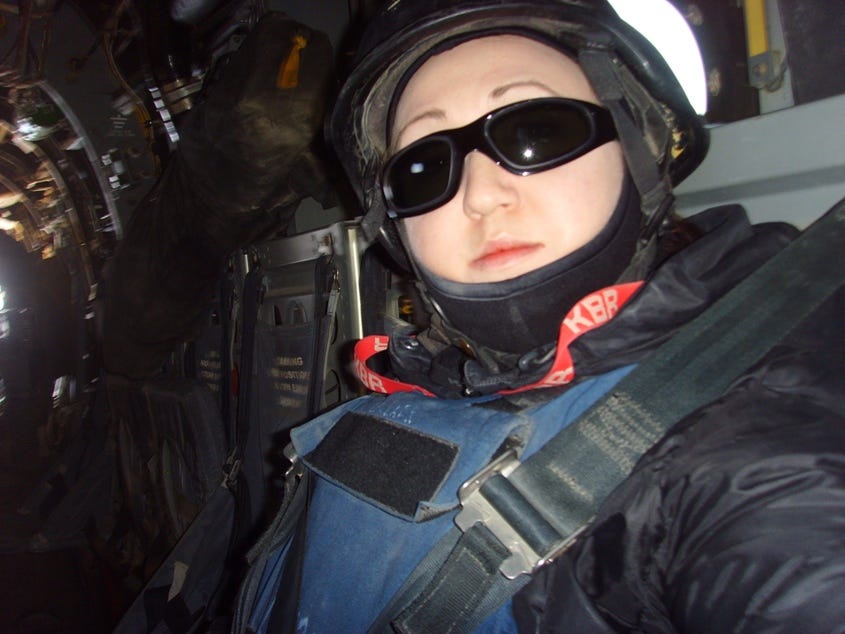
Twenty years ago today, right about the time I am writing this actually, I was frantically running around my hotel room in Dubai repacking my oversized suitcase and that standard-issue black duffel bag they handed each of us in Houston.
I’d barely slept on the flight over, but I was too wired to sleep when we landed. I’d never been to the Middle East before, and Dubai was vibrating.
After a quick shower and a change of clothes, a few of us took off on a whirlwind tour of the city and made it back just in time for an 8pm briefing to find out when we were flying out.
My name was in the first group of seven. We had to be packed, checked out, and down in the lobby by 2am.
So at 1:40, still half-dressed, I rapidly took inventory: Clothes, check. Sunscreen, check. Mosquito spray, check. Flashlight, check. Malaria medication they weirdly made us take pre-emptively, check.
Hazmat suit, 1 roll of duct tape, 3M-full-face respirator with extra cartridges...check check check.
Kevlar vest...that thing weighed a ton...and a helmet that felt like wearing a bowling ball...check and check.
I was as ready as I’d ever be, I guess.
Of the seven of us traveling that day, only one had ever deployed. He was a retired Marine officer and combat veteran headed to one of the big bases to be the HR manager.
The rest of us...an HVAC guy, a fitness instructor, a mechanic, an administrative assistant (me), some other odd jobs I don’t recall...we were all pure civilian. But of the 200+ contractors who boarded that flight in Houston a couple days earlier, we seven were the first bound for Baghdad.
The last three weeks had been a blur. I let myself be carried along by the endless sequence of tasks, tests, trainings, and briefings. It wasn’t until I was sitting in the terminal, waiting to board a small charter plane, that a wave of panic set in.
Holy shit, I’m about to go to Baghdad.
We boarded that flight and flew straight to Baghdad International Airport. Shortly before we landed we were told to put on our Kevlar because “They’ve shot at some of the planes before.”
The pilot did a steep, sharp descent and we touched down. The airport back in those days was a bombed out, broken down shell. There was no power. No plumbing. Maybe 10 people in the whole building...waiting for us seven.
Moments after being told to put on Kevlar for landing, we now had to walk across an open tarmac into the airport building.
We weren’t staying long, but they did have procedures to follow. We had to get our passports stamped. We had to have the drug dog sniff our bags. We had to sit around in 120 degree heat in a building with no air conditioning and no lights and no plumbing waiting for our next plane to show up.
And we couldn’t take the Kevlar off. Just in case.
About 3.5 months earlier, a civilian supply convoy run by my company was ambushed right outside this very airport. I’d seen the news stories about the truck driver who was taken hostage and escaped a few weeks later.
It wasn’t until after I’d been in country for a few months that I learned more about that incident...how many of the drivers had been killed, that others and a soldier were still missing. And it would be YEARS before I learned the full story of that April 9 convoy...if it’s even possible to know the full story.
I didn’t know any of that yet, but our handlers sure did. You would’ve needed a blowtorch to cut the tension in that building while we waited - a knife wouldn’t do it.
All I knew was that I was supposed to be paying attention - they drilled that into us for three straight weeks in Houston.
OPSEC - don’t talk about things you don’t need to talk about, you never know who might be listening.
Situational awareness - trust me, I was very aware of my situation.
I was sitting in a dark, sweltering, bombed out airport terminal wearing body armor and a bright red lanyard, waiting to be told what to do.
I still hadn’t slept. One boot in front of the other. Hurry up and wait. Head up, eyes open, be alert. Look for anything out of the ordinary.
All of this was out of the ordinary.
Eventually our bird arrived, and we lugged all of our gear (still wearing Kevlar) back out across the tarmac. The next 24 hours were REALLY a blur.
We landed at Camp Anaconda, then the logistical super-hub of the entire Iraq war. Some of my traveling companions were staying there. Four of us were flying on to other bases. We were shuffled into tents and pointed vaguely in the direction of the DFAC (dining facility). They told us when to show back up to find out about our next flight. Lucky me, my name came up in the first group again. I’d be flying out the next night, which meant I would finally have one entire night to sleep.
And boy did I. After three straight days of travel and no sleep, I crashed so hard I slept right through the explosions. One of my tentmates shook me awake from what felt like a coma, told me to grab my Kevlar...again...and head for the bunker.
Calling it a bunker was generous, but okay. We sat on wooden benches inside a concrete hutch open on both ends. After 20 minutes or so the mortars stopped, all clear sounded, and we went back to bed.
This happened four more times that night. By the fourth volley I decided I wasn’t leaving the tent. I just slept in my Kevlar.
Welcome to Iraq.
It took another two days of travel, including a stopover in Kuwait where the wet-bulb temperatures were climbing north of 140 degrees, but I finally made it to my assigned work location, Al Asad Airbase.
Of the seven who left Dubai with me, only one remained...the HVAC guy. His name was Mike.
We flew to Al Asad in a raggedy little puddle-jumper – a twin-prop plane that looked like it was held together with duct tape. Good thing I had a spare roll in my bag.
A Pajero zoomed towards the plane as we rolled to a stop. Two guys with bright red lanyards just like ours jumped out. Thom, head of security, and Nate, our ops coordinator. They introduced themselves and handed us each an ice cold bottle of water. I had no idea how thirsty I was. In fact, I’d be discovering new dimensions of thirst in the weeks to come.
We left Kuwait at 140 degrees. In Al Asad it was pushing 150. At least this time I didn’t have to wear my Kevlar.
I got checked in, found my tent, dropped my bags, met my boss and about a hundred other people. At some point they gave me food. At some point I showered. At some point I attempted to unpack. Mostly I walked around in a heat-induced daze.
Get some rest, they told me. I’d start work the next day right at 7am. It was a 12 hour shift, so brace yourself and get used to it.
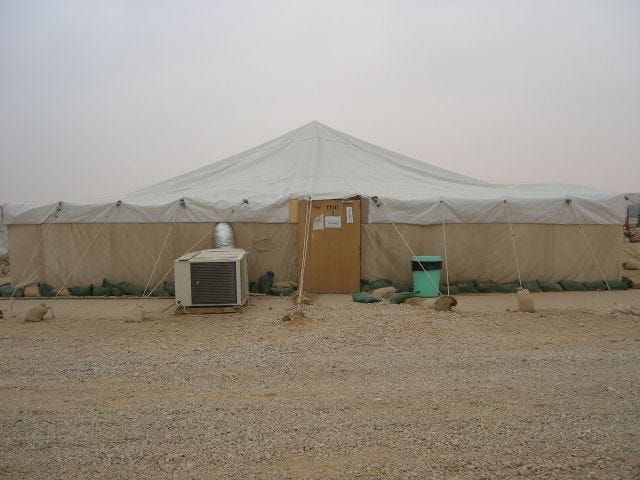
I went back to my tent and laid down on my cot. All the other women were still at work, so I had the place to myself. After the blur of the last few weeks, the planes and the bombs and the heat, this tent felt like a cocoon, and my thoughts were suddenly very loud.
Am I doing the right thing?
At the time I felt sure that I was.
20 years later, I still wrestle with that question...and these days I don’t like the answer as much.
I went to war. Not as a Soldier, a Sailor, an Airman or a Marine.
I was a war zone contractor. It wasn’t the same. We were “just there to support the troops.”
My plan was to work for six months. Get some interesting new experience, save a bit of money up, pay off some debt, and maybe come back and pay my way through film school.
About a month into it I thought, I can probably do a year.
About a year into it I no longer thought about leaving...though I finally did on October 4, 2009. (A couple years later I’d be back in another war zone, but that’s another story for another day, and this one is long enough.)
I landed in Iraq on July 26, 2004 and started a journey that changed the total trajectory of my life. It made me the person I am now, and for that I have no regrets.
I met a lot of people along the way, and I lost some of them, too.
Some to bombs. Some to cancer, heart attacks, and mystery illnesses. Some to suicide.
I’m still losing them.
Being a war zone contractor is a strange little club. We don’t talk about it with outsiders. Hell, we barely talk about it with each other.
But I think it’s about time we change that.
That’s part of what I’m doing here.
I recently reconnected with some of my old coworkers to launch the Association of War Zone Contractors.
It’s a new nonprofit – the first, as far as we know – specifically addressing the needs of the millions (yes millions) of contractors who serve alongside our troops all around the world.
For the last 30 years contractors have been this vast invisible army the public knows almost nothing about. That’s not your fault, that’s by design.
But as I said, we’re going to change that.
If you’re interested in following along for that journey, go ahead and subscribe to this Substack. Throw us a few bucks if you can. It’ll help us get things off the ground.
And if you really want to be part of what we’re building next, you can start us off with a donation here.
If you were a contractor, too, I’d love to talk to you. I’ve been bottling up these stories for 20 years, and I know you have, too.
It’s time the rest of the world heard them.
Thanks for reading.
- Cory
Comments
Nothing yet. Say the first thing.
Sign in to join the conversation.