
Written at B2. Vocabulary to C1. | ~15 min read
This is an opinion piece. I’m not telling you what to think. I’m asking you to think.
One article, one level of English, two levels of vocabulary. The sentences are written at B2 so they stay readable. The vocabulary box in each section is tagged: [B2] items are the core, [C1] items are the stretch. Take whichever you need, ignore the rest. If you would rather do this than read it, there is a self-study version you can run on your own with any AI, and a free three-level lesson if you teach.
Two piles. Everything in your working week that can be finished goes in one. Everything that cannot goes in the other.
That was the whole instruction. I put it to seven rooms of German professionals last week, ninety minutes each, phones face-down on the table.
Malte got there fast. He runs finance and operations, and he could document the entire job, he said. Write it all down, hand it over, and any competent colleague could pick it up. What he could not write down was how he knows when a key account has started to go cold, months before anybody says anything, while everyone in the meeting is still smiling.
One of those piles has a finish line. The other one is the job.
Later that week I sat down to watch Christopher Nolan’s Odyssey, and I could not switch any of it off.
I’ll get to the film. It won’t mean much until you have the two piles, which is the order the week actually happened in.
Key Vocabulary: Two Piles
[B2] complicated | made of many parts, hard, but solvable, with a finish line at the end | kompliziert
[B2] complex | made of meaning, judgement and people; you can understand it completely and never finish it | komplex
[B2] to atrophy | to grow weak and shrink from not being used | verkümmern, schwinden
[B2] scarce | not enough of it to go round; in short supply | knapp, rar
[C1] the attention economy | a market in which the thing being bought and sold is your minutes | Aufmerksamkeitsökonomie
[C1] cognitive offloading | handing a mental job to a device until you no longer do it yourself | kognitive Auslagerung
[C1] load-bearing | carrying the weight of everything above it; take it away and the rest falls down | tragend
[C1] a simulation | a convincing copy of the real thing, missing one part | Simulation
[C1] a wager | a bet; something you believe without being able to prove it | Wette
The whole idea is based on two piles that are not mine. Systems thinkers have been drawing this line since the nineties, and Arthur Brooks, the Harvard professor who studies happiness, is the one who carried it into ordinary life.
A complicated problem is made of information and things. The how and the what. Your tax return. A transmission. The system architecture you maintain. Some of these take a career to master. But they all share one thing. There is a state of the world in which they are finished.
A complex problem is made of love, meaning, judgement and mystery. The why. Whether to tell a colleague something they will not enjoy hearing. What you owe an ageing parent. Whether the work is worth doing. Brooks likes to point at his own thirty-five-year marriage and note that it is, by his own account, still not solved.
In other words: complicated = solvable; complex = unsolvable.
Brooks splits happiness into three parts: enjoying your life, feeling satisfied with what you build, and knowing why you exist at all. The third one is load-bearing. Take it away and the other two fall down. It also lives entirely in the second pile.
Both piles matter. The complicated pile is where competence lives, where craft lives, where the rent comes from. Nobody in this piece is going to tell you it’s the enemy.
But in today’s modern world, only one of the two piles gets fed.
An entire industry now bids for something nobody used to think of as scarce. That’s the attention economy: a market where the product being sold is the number of minutes you can be talked into giving away. The bidding runs all day, it’s automated, and it’s very good at its job.
There’s only one statistic in this article; and it’s here because it matters:
In 2019 the average American adult checked their phone 96 times a day. Three years later the same survey said 352.
Nearly every one of those checks lands on the solvable side. A notification, a price, a score, a message that wants an answer rather than a thought. There’s a phrase for a day built out of those, and it’s the one this week’s lesson was named after. It is a simulation of a real life. Everything present except the part that carries the meaning.
Two things atrophy under that arrangement. The first is attention in the old sense, the ability to hold one thing steadily for long enough that a judgement can form. The second has a name: cognitive offloading. We hand a mental job to a device, stop doing it ourselves, and after a while stop being able to do it. The phone number you no longer learn. The route you no longer hold in your head. The paragraph you no longer struggle to write. Skills you stop practising go soft, and that part is neither new nor controversial.
Now the part I can’t prove.
Teenage mental health starts falling around 2011 and 2012. That is the same moment the phone stopped being a gadget and became the surface that our lives exist on. Both of those are measured. The link between them is where the arguing starts.
And this is where I leave the evidence behind altogether and make my wager.
I think what those numbers are recording is a loss of meaning.
Nobody can prove it either way. There is no graph that tracks people slowly losing their sense of why they exist, because nobody has worked out how to count that. What we have instead is a great deal of unhappiness arriving at the same time as a machine that eats the hours you would once have spent working out what you love.
I could be wrong about this. I don’t think I am.
What I do have is the rooms I taught.
Key Vocabulary: Seven Rooms
[B2] to drift | to move slowly away without anyone noticing | abdriften
[B2] a signal | a small thing that tells you what is really going on underneath | Signal
[B2] judgement | the ability to decide well when the situation is unclear | Urteilsvermögen
[B2] a status symbol | something you have that shows other people your position | Statussymbol
[C1] discernment | the slow capacity to see what actually matters here | Unterscheidungsvermögen
[C1] to read a room | to sense the real mood of a group without being told it | die Stimmung erfassen
[C1] dormant | not dead, only sleeping, and able to wake | ruhend, schlummernd
Malte’s was one of seven that week. Same question in every one: German professionals, ninety minutes each, phones down, sort your own working week into the two piles.
Not one of them needed a warm-up. They went straight for the complex.
These are not philosophers. They are busy people with full calendars and phones in their pockets, thinking all of this through in their second language.
Bernd works in legal tech. He took about nine seconds. “A complex problem can make you competent and rich, but also that’s the one you actually love. And sometimes you hate it. Just like a marriage, a good marriage.”
He held a thing he loves and sometimes hates in a single breath, and he never once asked anybody to resolve it for him. Hand that man the unedited Odysseus and he would have been absolutely fine.
Rüdiger manages forty contracts, every one with its own terms, its own supplier, its own clock. “This is the complexity of my work every day,” he said, and he was not exaggerating. Katrin, back in Bernd’s room, put her whole job in nine words: “It’s not the message itself, but it’s the interaction with people.”
That is discernment: the slow business of seeing what actually matters here, and noticing when something has started drifting long before anybody can point at a signal. There is no dashboard for it. You read a room or you miss it. It was the phrase the whole week kept coming back to, the half that stays yours.
Now the part I did not expect, and the reason I have put all this in front of you.
Across seven rooms, every single person put what makes their work worth doing in the same pile. The complex one, the one that runs on judgement. Not once in seven sessions did anybody tell me the meaningful part of their job was the documentation, or the contracts, or the forecast.
And that is exactly the pile nothing in their day is built to feed. No app opens it. No notification points at it. It has no dashboard and no finish line, which is why the phone cannot help you with it, and why it loses every single time something buzzes.
One of them took it out of the office altogether. Miriam works in exhibitions. We had drifted back onto the previous week’s subject, status symbols, the watches and the gravel bikes and the sourdough, and she had been talking about the pension age and the political noise about working until seventy. Then she said it flatly, as though it were the most obvious thing available.
“I would actually argue that happiness is the greatest status symbol of all.”
Nobody in two previous weeks of running that question had put it that way. And look at what she does to the word. A status symbol only means anything when other people can see it. She takes it and attaches it to the one thing they can’t.
She is also right about the supply. There is less happiness in the world today than there was 20 years ago.
But here is what I keep noticing, for whatever my observation is worth. The people I meet who do seem genuinely happy have something in common, and it surprises me. They are at peace with the big questions. They have spent real time on the why, and they still don’t have the answers.
The thinking carries on. That is the whole point of it. They turn an idea over for the pleasure of turning it. They give an afternoon to something that will not resolve. They go at a belief they have held for twenty years just to see whether it still stands up. And they enjoy it, which is the part I keep coming back to. The pleasure is in the going, and the going does not stop. Even when it gets tough.
There is my wager, said out loud by people who were not trying to prove anything and did not know they had.
Ninety minutes without a screen and every one of them went to the complex like water going downhill.
The muscle is dormant, and dormant is a completely different diagnosis from dead.
Key Vocabulary: Tell Me About a Complicated Man
[B2] to flatten | to press something into a simpler, smoother shape | plattmachen, glätten
[B2] a spectacle | a large, visually overwhelming event | Spektakel
[B2] a suitor | a man who is trying to persuade a woman to marry him | Freier, Verehrer
[B2] to admire | to look at someone with respect and approval | bewundern
[B2] cunning (noun) | cleverness of the kind that works by tricking people | List, Gerissenheit
[C1] legible | easy to read and understand at a single glance | lesbar, entzifferbar
[C1] moral ambiguity | a situation where right and wrong cannot be cleanly separated | moralische Ambivalenz
[C1] to sand something down | to rub away the rough edges until the surface is smooth | abschleifen
[C1] hubris | dangerous pride; overconfidence that invites disaster | Hybris
[C1] therapised | reshaped so that a problem becomes something you can talk through and close | therapeutisiert
So that was the teaching week. On the Thursday night I went to the cinema.
I watched the film with my longest-standing client. Twenty years of Friday-morning coffee. At some point it stopped being an appointment and quietly became a friendship, though we both still pretend it’s a booking.
We talked about it on the way out but decided it still needed time to be processed, so we agreed to sleep on it and pick it up at our next session.
The next morning we sat down with the coffee, read a review, and started talking.
And before I could get my own word out, he used it.
The film had been flattened, he said. Flattened for a modern audience, and Nolan probably had no choice, because roughly nine people in ten will never read the book, and people don’t read now, and if you don’t read then you don’t build the equipment to sit with a story like that afterwards.
Two people. Same word. Nobody had prompted anybody.
And then the part that made the whole week fold in on itself.
Emily Wilson’s 2017 translation, the first English Odyssey by a woman, opens with a line Nolan has said out loud was his guide to the character.
“Tell me about a complicated man.”
Her word for polytropos, the second word of the poem, the one that means something like “of many turns.”
I had spent five days in seven rooms teaching that exact word against its neighbour. And the biggest film of the year opens on it, aims at it, and hits it.
Nolan aimed at a complicated man. He got one, beautifully, for three hours, in a film I genuinely loved.
The complexity is what went missing. And that problem isn’t his.
Let me put the praise where it belongs first, because I am not writing a complaint.
The film is a spectacle in the honest sense of the word. The images stay in your head for days afterwards. The reviews have been among the best of his career and he has earned them. (Nolan is one of my favourite directors and, I think, the most important one working today. I read Stephen Fry’s Troy and Odyssey before release because I wanted to know what he was starting from.) My friend and I both walked out impressed. I would watch it again this weekend.
And Homer’s Odysseus is gone.
The poem gives you a man who blinds a Cyclops and tells him his name is Nobody. Brilliant.
(In Greek the joke is on his own nickname. Homer hardly ever calls him plain Odysseus; he calls him polymētis, the man of many mētis, which is the Greek for cunning. The way a man becomes Big Jim and stops being James. So when he gives the Cyclops the name mē tis, nobody, he is hiding one breath away from the word he is famous for. Good luck getting that on screen.)
He gets clean away with it, and then cannot stop himself shouting his real name back across the water like a teenager. Poseidon hears him. The curse that follows costs him ten years and, in the end, every man he sailed with.
That is the hubris the poem keeps pressing on. He tells the whole episode himself, years later, and you can hear him wince as he does it: he went into that cave against his own men’s advice, because he wanted to see what the Cyclops might have to offer. Nothing in Homer costs him what his own mouth costs him.
It gives you gods who behave like unsupervised children, taking sides out of spite and vanity. Petty, ridiculous, and load-bearing: pull them out and the story has no engine.
It gives you a man who spends a year in Circe’s bed and another seven with Calypso, on his way home to the wife he apparently misses so much.
And it gives you a homecoming in which the hero kills a hundred and eight suitors, the men who spent ten years eating his food and courting his wife, and then has twelve household maids hanged. The poem does not punish him for it. Does not redeem him. Does not even seem especially bothered.
You are asked to admire a man you would not want living on your street.
That is a complex problem in the shape of a person. There is no version of the Odyssey in which Odysseus is solved.
Nolan’s version keeps the journey and sands down the man. The gods are largely gone, with Athena left as an occasional adviser and Olympus never shown, which moves the cause of everything from divine chaos into human psychology. Circe stops being an erotic danger and becomes a moralist, turning men into pigs because they behaved like pigs. Calypso is more mystical than physical. And the ending sends him into exile, handing the kingdom to his son to pay for the Trojan Horse, which the film treats as a war crime against the sacred law of hospitality.
Look at what that last change actually does. In the poem the Horse is his masterpiece. A bard sings it at a feast as glory, and nobody in the poem ever asks him to answer for it. Nolan takes the one thing Homer lets him be proud of and turns it into the thing he must pay for.
Which gives him something to feel guilty about.
My friend put his finger on it over the second coffee, and it is the cleanest piece of literary criticism I heard all week. In the film, Odysseus regrets the violence. A specific act, in the past, with a beginning and an end. Something a man can carry to a therapist, name, work through and eventually set down. In the poem he regrets what he is: the vanity, the appetite for glory, the mouth that could not stay shut, the fact that men who trusted him died of his personality.
One of those is a wound. The other is a character. The film swapped a complex problem for a complicated one, and out went the moral ambiguity that has kept people arguing about this man for three thousand years. What’s left is legible, therapised, and considerably easier to sit with for three hours.
And then there is the hall at the end, where the film lets some of the suitors live.
In the poem one of them tries. A man called Leodes goes down and takes hold of Odysseus by the knees, which is how you begged for your life in that world, and Odysseus kills him anyway. That refusal is the hardest half-page in the story. On screen, the men who kneel are allowed to stand back up.
Emily Wilson, whose line about the complicated man Nolan built the script on, has been publicly unimpressed. She told reporters in July that she would be “ashamed to have written any part of this script,” and that the film lacks “psychological, emotional, political and ethical depth.”
She has every right to say it. He built on her work, she doesn’t want her name near the result, fair enough.
I’d add one thing to her, though. It is still very good art. Nolan gave us a hero we could stomach, and enjoy, and take home without anything of ours being disturbed. Which tells you more about us than about him.
Key Vocabulary: We Asked For This
[B2] an audience | the people watching, reading or listening | Publikum
[B2] a contradiction | two beliefs that cannot both be true at once | Widerspruch
[B2] to demand | to ask for something firmly, as though it is owed to you | fordern, verlangen
[C1] a sensibility | a shared sense of what is acceptable and what is not | Empfindsamkeit, Haltung
[C1] squeamish | easily made uncomfortable by unpleasant things | zimperlich
[C1] to indict | to accuse formally; here, to expose someone as guilty | anklagen, belasten
[C1] to condemn | to state publicly that something is very wrong | verurteilen
Now the sentence I’ve been circling, and I’m going to say it plainly because hedging it would be dishonest.
A faithful Odyssey would not survive contact with a 2026 audience.
Not the sex. Not the twelve maids on the rope. Not a hero who does monstrous things and whom the poem never bothers to condemn.
Release that film and the reaction would be loud, immediate and organised. The loudest part of it would come from a broadly progressive sensibility that has decided a story owes us morally clean heroes and outcomes we can approve of.
Homer never condemns him. And the rule now is simple: show a thing without condemning it and you are recommending it. So the contradiction disappears. What is left is a murderer held up as a model.
That sensibility is only the sharpest current edge of something all of us now do, and it belongs to every tribe, mine included.
It also comes from exactly where the rest of this article has been pointing. The muscle that went soft was the one for complex problems. It is the same muscle a complex person asks for. Odysseus is an unsolvable problem with a face on it, and we are badly out of practice at those.
And when there is no time to sit with a thing, you react to it instead. Offence is the quickest reading available, and quick is what we are built for now.
The shape it takes is very ordinary. We want the complex delivered to us legible. We want the film with the moral clearly labelled. We want the colleague sorted into good or difficult by Thursday. We want the historical figure fully approved or fully cancelled, and we get squeamish when someone insists on being both at once.
Above all we want the version that doesn’t indict us. A genuinely unresolved hero is a mirror, and most of us are quietly doing the same sums he is. Everybody wants to live an ethical life. Almost nobody wants to look straight at the compromises holding theirs together.
So the audience demanded a hero it could hold. Nolan delivered one, at the top of his powers.
That is a reading of the room, and his reading was correct, which is the depressing bit.
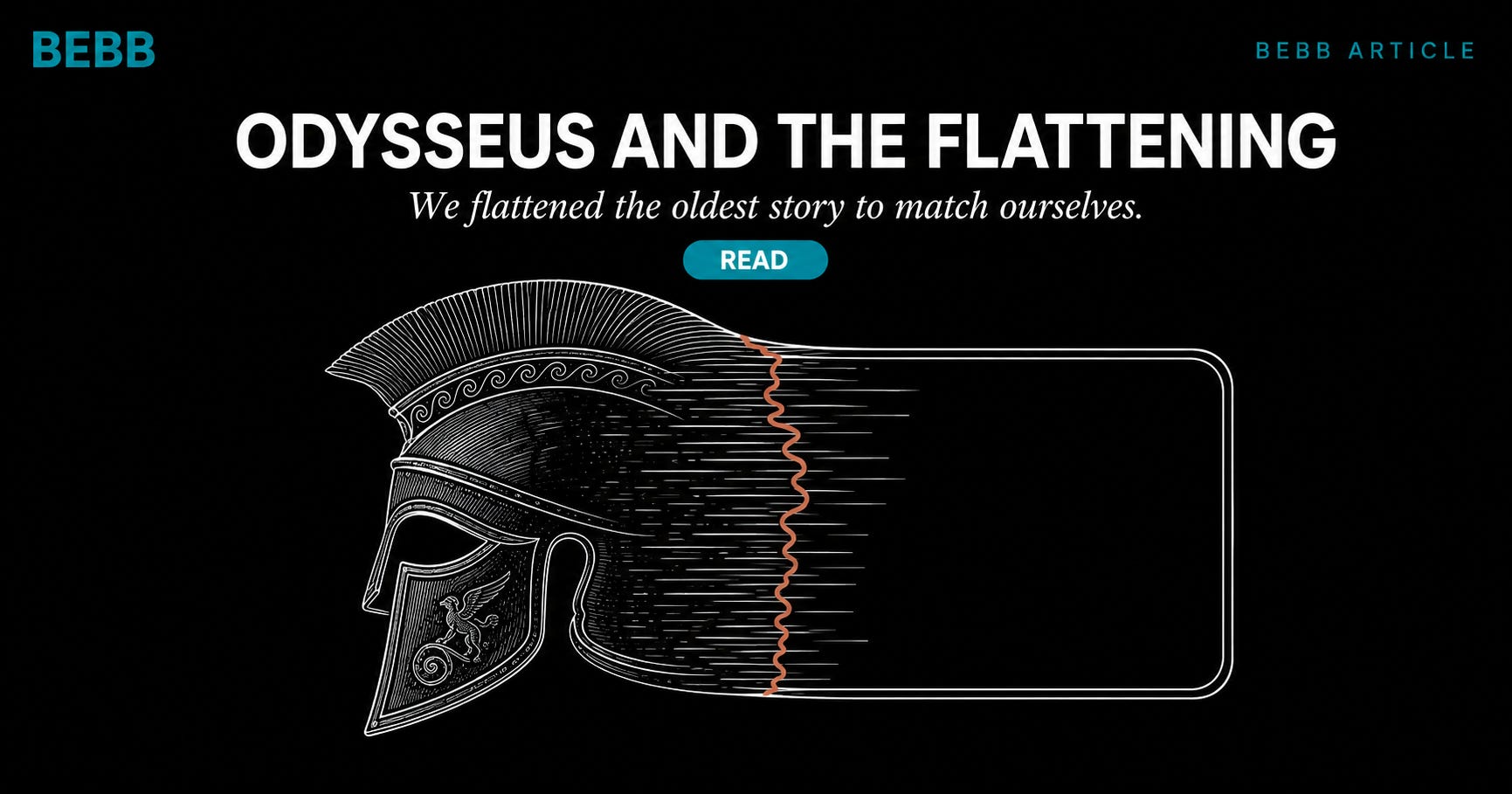
We flattened the oldest story we have, because we flattened ourselves first.
Key Vocabulary: There Is No Test
[B2] deliberate | done on purpose, with thought behind it | bewusst, absichtlich
[B2] to reinforce | to make something stronger | verstärken
[C1] ambiguity | not being able to be certain which reading is the right one | Mehrdeutigkeit, Unschärfe
[C1] to sit with a question | to keep a question open instead of rushing to close it | eine Frage aushalten
[C1] a reflex | an automatic reaction you did not choose | Reflex
[C1] unnoticed | happening without anyone seeing it, including you | unbemerkt
[C1] to silence the monkey | to quiet the restless chatter running in your head | den inneren Lärm abstellen
The complex tells you what is worth doing; the complicated is how it gets done. Once you have answered “what do I love, and why,” the complicated work you pour into it is that answer being expressed. It’s deliberate, and it reinforces the why. The restored motorbike, the twelve-hour build, the loaf of bread that took three days: these are people who know something true about themselves and are going further into it.
The danger is complicated activity with no why behind it. Motion without a question underneath. Something done to you rather than chosen by you, and above all something that goes unnoticed.
Which raises the objection I put to myself hardest. The same thing can be self-knowledge on Monday and a wall against something on Tuesday. So what’s the test? How do you tell the difference?
I was asking for a test. A rule, a checklist, a diagnostic. Something you could apply on a Sunday evening and get an answer. That is the complicated brain reaching for a complex problem. It’s my oldest reflex and I’ve had it my whole life.
It is also, incidentally, how I have gone at German for twenty years. Give me the rule. Give me the table. Let me solve it.
Which brings us to you, because you are reading this in a language you are still working on. English has rules. Thousands of them, and you should learn them, because that is the complicated pile and it is honest work. But there is no Tuesday on which English is completed and handed over. Nobody finishes it, and the natives cannot do it properly either.
So why keep going at something with no end? Completion was never what you were after. You are after the meeting where you said the difficult thing and it landed, and the moment you reach for a word, miss it, come down somewhere near it, and get understood anyway.
That is the complex pile, and it is the whole reason any of this is worth an evening of your life. Getting comfortable in that ambiguity is most of what I am actually paid to teach. If what you want is rules, buy a grammar book: it will be excellent, and it will be finished, and it will not be the reason you are still at this.
There is no test. Asking for one is the disease presenting itself as the cure.
The muscle that has atrophied is not the ability to answer. It’s the willingness to keep asking, and to sit with a question you cannot Google, and to let it stay open for a week and be slightly worse company because of it.
None of which I am above. I am writing this with the phone face-down next to me, buzzing. And here’s what I’ve got, which isn’t a solution.
Put the phone in another room. Then spend some time alone in your own thoughts. No music, no podcast, no input at all. Just you, and whatever pops into your head.
Walking is my way in; my best thinking in twenty years has happened on footpaths with nothing in my pockets. Yours might be a kitchen at six in the morning, or a swimming pool, or the car for ten minutes after you have already arrived.
Miriam, who works in exhibitions, had the phrase for it. What she wanted was to silence the monkey. One moment in the day quiet enough to be alone with herself.
And there is a version of the story where none of this is necessary.
Calypso offers Odysseus immortality on the island. No more questions, no more sea, the whole thing finished and safe and solved. He turns it down. He takes the risk of ten more years of open water to get back to a wife who has aged and a house full of men eating his food.
We could not sit with that man for three hours. So we were given one we could.
Build the muscle back and we get a different film.
When did you last let a question stay open long enough that it changed you?
One thing this week. Not five.
Choose a question you cannot look up. Why does this job matter to me. What do I owe my father. What am I actually avoiding. Write it on paper, because paper doesn’t offer to answer it for you.
Then leave the phone in another room and take that question somewhere for twenty minutes. Walk with it, sit with it, wash up with it. No music. No podcast. Nothing coming in.
You will not solve it. That’s the point, and it’s the hardest part for anyone raised to finish things. Success here looks like still holding the question at the end of the twenty minutes.
If your mind wanders off it fourteen times, that’s fine. Mine does. Bring it back and carry on. Progress over perfection, in this as in everything else.
And if you want to do it in English, even better. Think the question through in your second language and you’ll find out very quickly which parts of your thinking you have words for and which parts you don’t. That gap is where the good stuff is.
This came out of a week of teaching the same question across seven sessions. Two things are published alongside it. If you want to practise the language in this piece on your own, the self-study version is a set of prompts you paste into any AI, free and with no sign-up. If you teach, the companion three-level lesson, “A Simulation of a Real Life”, has the reading, the vocabulary and the full discussion task at B1, B2 and C1, and the notes on how to run it are at the bottom.
The task cycles in that lesson run on what I call The BEBB Method — The Agency Loop, a five-step framework for using AI in language learning without letting it replace your own thinking. It is my own configuration of established best practices in human-AI collaboration, built in direct response to Gerlich (2025) on cognitive offloading, and informed by the “AI Sandwich” tradition (Ippolito, 2023) and “AI as Critic” scaffolding (Mollick, 2024). All names and companies in this piece have been changed.
If you found this useful, share it with a colleague who’s working on their English.
No posts
Comments
Nothing yet. Say the first thing.
Sign in to join the conversation.