
There is a moment in the Howard Napper conversation that I keep coming back to.
We are talking about margins. About a more sustainable mat versus PVC, about the price difference, about why a product that is better for the environment costs more to make and returns less when it sells. Howard is direct about all of it. And then he says something that is not really about yoga mats at all:
“Compromising one’s values is really something I take very seriously. I try not to compromise my values. That gets tested a lot.”
Not as a founder manifesto or a positioning statement. Just a fact, stated plainly, by someone who has spent 25 years finding out what it costs to mean it.
Howard started Agoy in 1999 after a thought he couldn’t shake during a yoga class: why do yoga mats have to be made of PVC? The yoga market was just starting to explode. Madonna was doing yoga. Sting was doing yoga. Companies were springing up everywhere, mostly racing to the same factories in China to produce the same mat in a different colour.
Howard went the other way.
What followed was not a short story of a founder with a vision who built a company that proved the doubters wrong. It was decades of tight margins, minimum order constraints, a manufacturing environment that was not interested in sustainability for most of that time, and competitors who could always produce the same product faster and cheaper.
Howard chose the harder path not once, at the beginning, continuously. Every time there was a shortcut available, he decided not to take it. That is a different kind of commitment to the one most business stories celebrate.
There is a detail that gets to the heart of Agoy’s commercial position.
Howard describes his more sustainable mat as the better environmental choice. And then he explains that a PVC mat can last five to ten times longer, which means you replace the sustainable one five to ten times more often. So which one is actually better for the planet? He does not have a clean answer. It depends. And that complexity is the kind of thing that gets flattened in most business conversations about purpose.
He has been living inside it from the start. Tighter margins, harder manufacturing constraints, cash flow always a consideration. None of this is dressed up. It is just what the harder path looks like when you measure it in actual money over actual years.
And he keeps choosing it.
Before I get to the rest, I want to say something about how Howard and I met.
We were each in the middle of the Sahara desert, just after Christmas, with our families. Our guide, a Berber nomad who had traded his camel for a Toyota Land Cruiser and was somehow cooler for it, took us to an oasis. Howard and his family were the only other tourists there. A man from the nomadic tribe made tea and cooked bread on an open fire, squatting in the sand. We all ate it together. Howard took a photograph of the man making the bread, an action shot, completely still in its own way, the kind of photograph that could have been taken a thousand years ago and would look exactly the same.
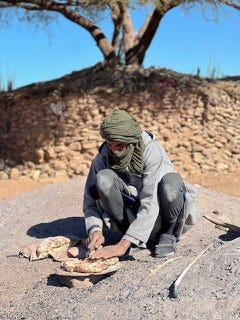
We exchanged details and called it Breaking Bread. I am still in his phone that way.
Howard is someone who notices things. The man cooking bread. The visual cue on a yoga mat that draws you into the present moment. The gap in information for people living with Parkinson’s. He pays attention in a way that eventually becomes a business, or a photograph, or a Substack series.
The conversation moves somewhere I did not expect.
Howard was diagnosed with Parkinson’s in the early stages of the pandemic, following a severe case of COVID. The diagnosis brought something he describes with quiet directness: a collapse of motivation. Dopamine, which Parkinson’s depletes, is not only responsible for movement. It is also responsible for the will to do anything at all. He could barely get out of bed.
Then he started medication and something unexpected happened. A surge of creative energy. A desire to design, to write, to build more than ever. He started a Substack series called How to Fix a Broken Brain, partly because he could not find the clear, practical, honest information he needed when he was first diagnosed. He writes it for the people in the same position who come after him.
In 1999, Howard noticed a problem and thought: if anybody is going to do something about it, I can do it. With Parkinson’s, he noticed a gap and thought the same thing.
Towards the end of the conversation, I asked Howard what he would do if capital was no longer a constraint.
Buy more product, expand the catalogue, scale. Not pivot. Not reinvent. Just do more of what Agoy already does, with fewer constraints. It is the answer of someone who knows exactly what the business needs and has simply not had the financial headroom to do it at the scale it deserves.
The business is not waiting for a new idea. It is waiting for the conditions to match the conviction.
Howard’s company slogan is Live to Inspire. He has been using it since the beginning.
Listening back to the conversation, it works in both directions. And his favourite quote is John Lennon: Life is what happens to you when you’re busy making other plans. He said it in the context of Parkinson’s. It could just as easily describe 25 years of building a sustainable yoga company in a market that mostly didn’t want one yet.
Share this episode with someone who would find it useful
If Howard’s story moved you, act on it.
Buy a mat at agoy.co.uk. Read Healing a Broken Brain on Substack if you or someone you know is navigating Parkinson’s.
And if this story reminded you of a founder, a team, a company doing something the harder way without making too much noise about it, tell us. That is how Beaver Tales finds its next tale.
Comments
Nothing yet. Say the first thing.
Sign in to join the conversation.