
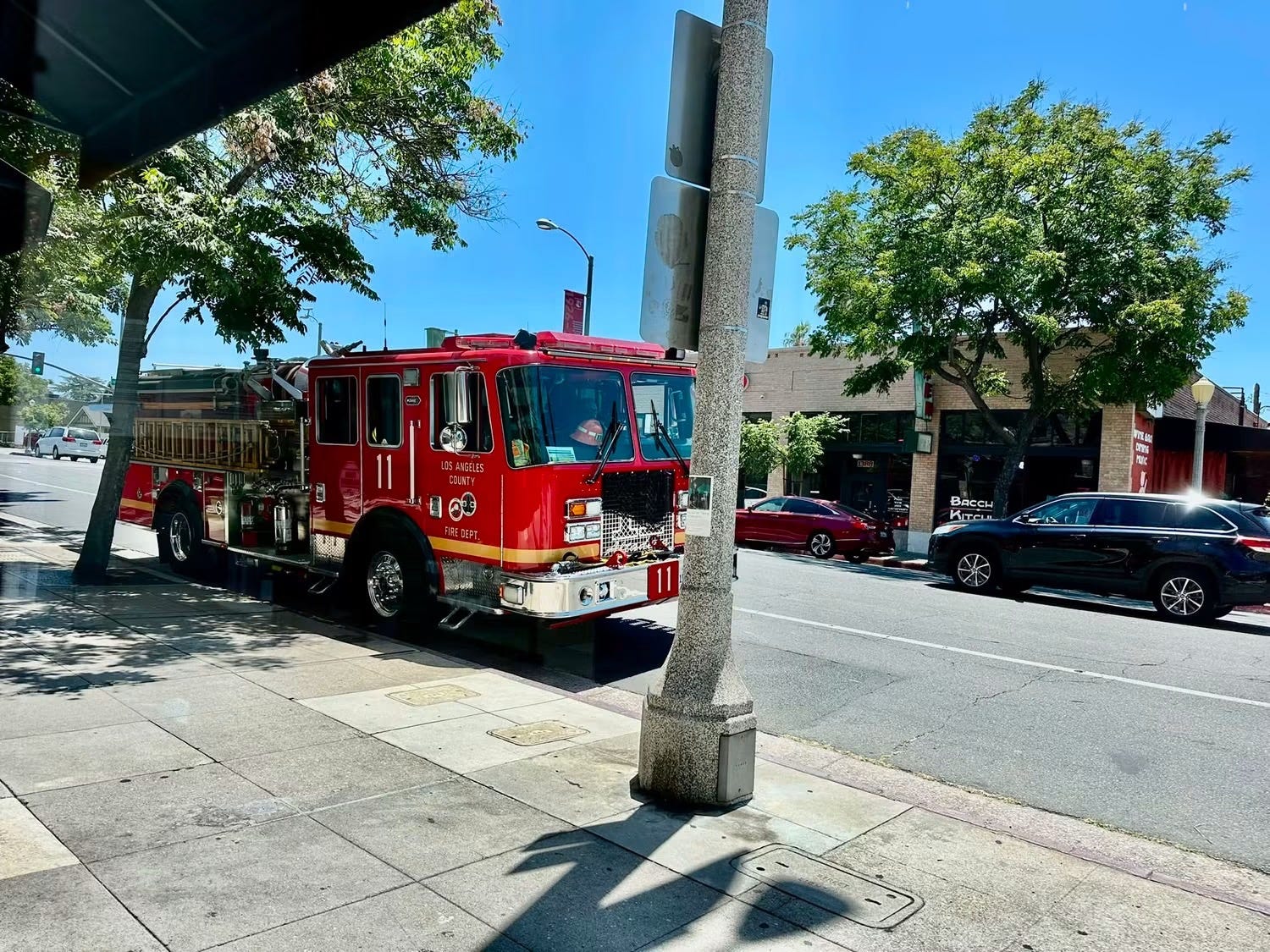
I’ve been sitting with a conversation that sparked off in our private group this weekend because I think it exposed something much bigger than a disagreement over whether or not people should feel some sort of way about seeing a fire engine sitting idle in front of a local coffee shop while the firefighters enjoy coffee and pastries.
It revealed the vastly different places people in our community are occupying more than eighteen months after the Eaton Fire.
Some people looked at that photo and saw a fire truck parked outside a coffee shop.
Others saw the institution that, in their experience, failed them, failed their neighbors, and failed everyone who died that night.
Those are two very different realities. And if we can’t make room for both, especially the second, we’re going to have a very hard time healing as a community.
What disappointed me most about that thread wasn’t the disagreement. It was how quickly some people rushed to dismiss a neighbor’s pain.
Someone saw a fire engine parked outside a coffee shop (incidentally owned by an Altadena fire survivor) and shared that it was triggering. Whether that particular crew responded on January 7 is beside the point. It doesn’t erase the trauma. It also doesn’t erase what happened.
There is a difference between blaming individual firefighters and demanding accountability from the systems and leadership that failed an entire community.
The data we have is significant enough that the California Attorney General opened a civil rights investigation into the emergency response. That wasn’t because people were “too emotional.” It wasn’t because of opinions. It was because there was sufficient evidence to investigate whether an entire community experienced a disparate response. We don’t yet know what the final findings will be, but we do know there was enough evidence to justify that investigation and that that investigation would've never happened if not for the determined work of people in this community led by Black women from our community.
So no, telling people to “move on,” “get over it,” or suggesting they live sad, angry lives because they still carry trauma isn’t compassion. It’s another way of asking survivors to make everyone else more comfortable.
Anger is not the opposite of healing. Sometimes anger is the beginning of healing.
Righteous anger is what has driven nearly every meaningful civil rights movement in history. It is what demands accountability when institutions fail. It is what insists that what happened must be acknowledged, must never happen again, and that some form of justice must be served.
What concerns me is not that some people are angry. It’s that so many aren’t.
That wasn’t really a disagreement over how to feel about a fire engine. It was people instinctively defending institutions before extending empathy to the people those institutions have harmed.
That impulse to preserve existing power structures before confronting whether they failed isn’t unique to Altadena. It’s a pattern that repeats itself throughout history. And it’s one we should all be paying attention to, especially considering where we find ourselves in this country right now.
Comfort and complacency are how democracies erode. They are how authoritarianism gains a foothold. Not overnight. Not all at once. But through the normalization of injustice, the instinct to defend institutions before examining whether they deserve defending, and the pressure placed on those who speak uncomfortable truths to quiet down for everyone else’s convenience.
Around the world, an extraordinary amount of political and economic power remains concentrated in the hands of a relatively small group of overwhelmingly corrupt white male leaders and elites.
Authoritarian and fascist systems are never maintained by a handful of powerful men alone. They survive because others—often people who believe themselves to be decent, reasonable, and even progressive—choose comfort over confrontation, proximity to power over solidarity, and institutional loyalty over accountability. Patriarchy requires collaborators as much as it requires patriarchs.
That conditioning runs deep. Especially for white people. Especially for white women. And yes, especially for white liberal women.
Many of us have been socialized to mistake politeness for justice, proximity to power for influence, and maintaining harmony for progress.
Patriarchal systems teach us to protect institutions, smooth over conflict, and reassure ourselves that those in authority generally mean well, even when those same institutions repeatedly fail us and most especially marginalized communities.
Those are learned behaviors. They are forms of internalized patriarchy. They reinforce existing power structures. Left unexamined, they can become fertile ground for the very authoritarian and fascist tendencies we tell ourselves we oppose.
That work is uncomfortable. It's messy. It requires looking inward before pointing outward. But if we refuse to do that work, then we become participants in sustaining the very systems that continue to fail and oppress us.
And yes, I see that happening here. Including among some of our own community leaders.
Some continue to uphold power structures that have repeatedly failed Altadena. Maybe they believe there is something to be gained in posing for a photo. Maybe they believe that proximity to power gives them influence. Maybe they think cooperation will earn favor. Or maybe these systems have been so deeply internalized that they genuinely don’t know how to move differently.
Whatever the reason, the result is the same. The institutions remain protected. The people remain unheard.
We cannot "love and light" our way out of systemic failure.
We cannot heal by pretending accountability is divisive.
And we should stop pretending that questioning first responders or government leadership is somehow disrespectful. Respect and accountability are not mutually exclusive. In fact, institutions worthy of respect should welcome scrutiny.
I have immense respect for many firefighters. I know a few personally. None of that changes the fact that leadership decisions deserve scrutiny. None of that changes the fact that families begged for help, that neighbors were left to evacuate one another, that people banged on the sides of fire engines begging and pleading for help while being ignored, that an entire side of town received no evacuation warnings, or that eighteen of the nineteen civilian deaths occurred west of Lake Avenue.
Those aren’t feelings or opinions. Those are facts that deserve accountability.
Respecting individuals and demanding accountability from institutions are not contradictory positions. In a healthy democracy, they are complementary ones. So let’s stop minimizing the experiences of our neighbors.
Let’s stop telling survivors how they should process trauma. Let’s stop demanding emotional comfort when what this moment actually requires is moral courage.
If someone tells you a fire engine is triggering, your first instinct shouldn’t be to defend the truck. It should be to wonder what happened to your neighbor that made them feel that way.
Because right now, in case you haven’t noticed, it’s us against the world.
No one is coming.
Not to save Altadena.
Not to save this country.
Not to save the world.
Not from the next disaster.
Not from any of this.
And not from the climate crisis that is fueling increasingly destructive fires and calamity across California, across this country, and across the world. And not from the climate gentrification and climate fueled refugee crisis that is looming on the horizon as our democracy hangs in the balance.
No one is coming.
What we have is each other.
Let’s start acting like it.
Let’s treat one another with the care, respect, and empathy we keep asking everyone else to show us.
Healing without accountability isn’t healing at all.
It’s just silence.
Comments
Nothing yet. Say the first thing.
Sign in to join the conversation.