
Bisous, Zoo Bisous! Welcome to Tuesday Zoosday! This is the fifth installment in the feature’s first series, Animal Alphabet Soup! Each week we’ll cover an animal starting with each letter of the (English) Alphabet! Enjoy!
You can keep tabs on the Alphabet Soup series here.
—Ranger Beau
As a lad, Sonic the Hedgehog was a little mythical to me because the only person I knew who owned a Sega Genesis system was my uncle. The only time I got to experience the blue speedster was when I visited him; otherwise, I spent my video game time in the worlds of Mario and Kirby. But in 1994, Sonic got a new frenemy: Knuckles. He looked a little like sonic, but otherwise had red skin and a funky dreadlocks hairstyle. I’m not exactly sure how I found out that he wasn’t a hedgehog himself, but a different creature with a made-up sounding name: the echidna. I guess you can see the hedgehog parallels:
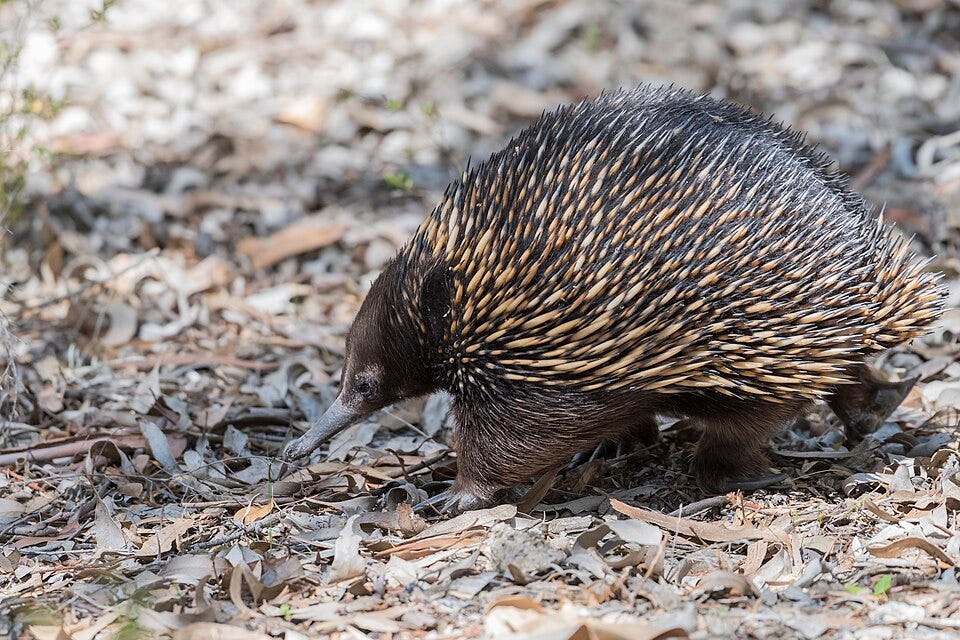
It has quills like a hedgehog, but a snout like a…mole? When Europeans encountered echidnas for the first time, they called them sloths! Biologists noticed that these critters have a sticky tongue and prefer to eat ants and termites, and thusly named them spiny anteaters. But further study showed they were neither hedgehogs, nor moles, nor anteaters, and certainly not sloths.
They were animals in another order entirely: they’re monotremes!
Monotreme comes from Greek roots: mono- meaning one, and -trema meaning hole. Like reptiles and birds, monotremes have an opening called a cloaca, through which both reproduction and waste excretion occur. Most mammals have specialized structures for birthing, urination, and defecation so this was a rather shocking discovery. Even more shockingly, monotremes lay eggs to birth their young instead of giving live birth! Monotremes also do not have teats and biologists (mistakenly) believed that they do not produce milk, and so European researchers believed monotremes were some new kind of reptile/mammal hybrid. This is how they came up with the name “echidna”—in Greek mythology, Echidna is a monster that is half serpent, half woman.
For a quarter century, the debate raged: are echidnas and their (arguably more famous) monotreme relatives, platypuses, mammals or some weird reptilian offshoot? The question was finally answered in 1824 when a German biologist discovered that these animals do in fact produce milk. Monotremes have “milk patches” on their skin where mothers will secrete milk through pores from which their puggles (the adorable name for a baby monotreme) can receive their sustenance. Milk production indeed cements the echidna and platypus in the mammalian class.
I’m guessing you’re a little familiar with the platypus from its place in popular culture (I’d wager at least three of the people who read this know of Perry the Platypus at the very least). Platypuses are known for being strange beaver-like creatures with a signature ducklike bill. Research suggests echidnas and the modern platypus share a common mostly-aquatic ancestor, and the echidna evolved to be more terrestrial about 13 million years ago.
Echidnas have an electrosensitive beak that they can use to find ants, termites and worms hidden in logs or in the soil—the platypus has similar detecting capabilities. Inside the proboscis snout, echidnas have sticky tongues they use to capture prey, which they then grind up in their toothless beaks before swallowing. In fact, the scientific name for the echidna’s family Tachyglossidae meaning “quick tongue.”
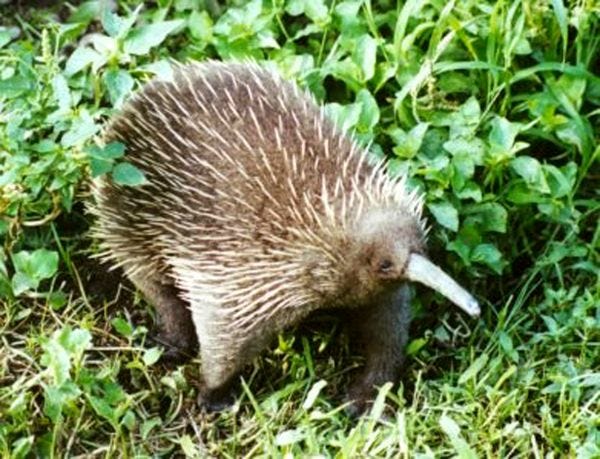
Despite living on land and tending to burrow when it senses danger, echidnas are very adept swimmers. They may lack the webbed feet of their platypus-like forebears, but have a similar bone and limb structure that makes them efficient in the water. They’ll use their long beaks like a snorkel as they paddle.
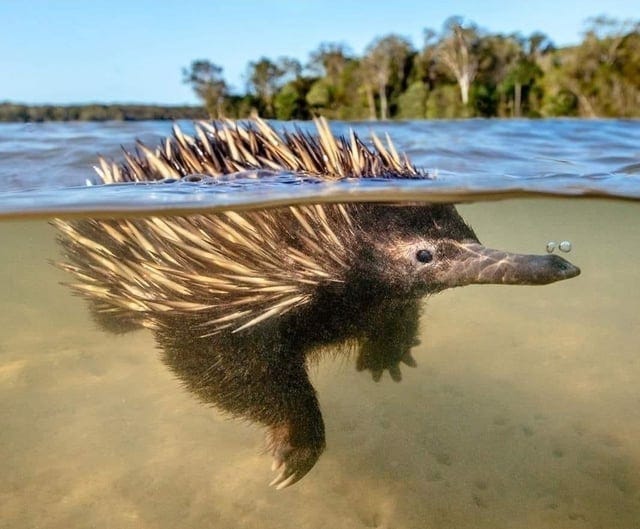
There are four primary species of echidna, with the short-beaked variety being the most common and widespread and is found all over Australia, Tasmania, and parts of New Guinea. The eastern and western long-beaked echidnas live on New Guinea, and the exceedingly rare Attenborough’s echidna (named after everyone’s favorite naturalist, Sir David) was thought to be extinct but was recently found in the northern mountains of New Guinea.
Echidnas prefer, wooded temperate areas, and do not tolerate extreme temperatures well. In colder months or other periods of climate stress or natural disasters, echidnas will hibernate or enter torpor— a period of reduced metabolic activity a little like hibernation.
Echidna reproduction has been difficult to observe because the animals don’t show any interest in breeding when kept in captivity, and their shy nature makes them tricky to observe in the wild. About three weeks after breeding, though, the echidna mother will lay an egg. Unlike birds and like some reptiles, this egg has a soft, leathery shell, and this egg is deposited directly in the mother’s pouch. After about 10 days, the puggle will use an egg tooth—another reptile-like strategy—to rip out of its shell. It’ll spend about two months in mom’s pouch before it starts to grow spines.
As it grows spines, mama echidna moves the puggle into a burrow, where it will spend the next seven months weaning off milk, and will then live in the burrow for a year or so before striking off on its own. They’ll continue growing for another three to six years, reaching the size of a small dog and weighing in at about 22lbs. This is also about the time they’ll be ready to start families of their own.
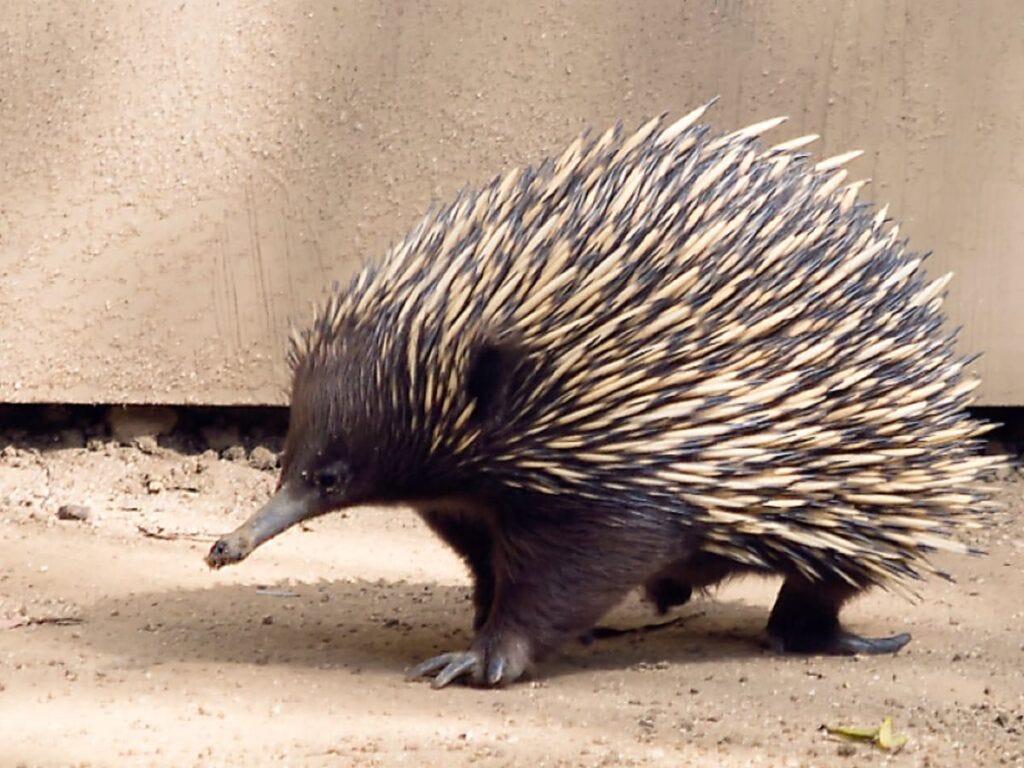
The Australian short-beaked echidna is thriving and not endangered, but its relatives to the north on New Guinea face a different prognosis. The Western long-beaked echidna and Sir David’s echidna are both critically endangered, in part because of over-hunting: echidna meat is considered a delicacy by many folks, but commercial hunting is now banned. Deforestation and climate change prove to have the most devastating impact on these finnicky little guys…I feel like I type that every week.
That’s it for this week, Zoo Bisous! Who do you think we’ll meet next week, for F?
Catch up on previous editions of the soup here:
Tuesday Zoosday
Tuesday Zoosday: Animal Alphabet Soup
·
May 26
I think if you know me well, you know that I am an animal enthusiast. In fact, the very first time I had to answer the question “What do you want to be when you grow up?” in Kindergarten, I responded with “Zookeeper!” (by the first grade, my answer had changed, dubiously, to “t-shirt designer”)
Comments
Nothing yet. Say the first thing.
Sign in to join the conversation.