
Bisous, Zoo Bisous! Welcome to Tuesday Zoosday! This is the first installment in the feature’s first series, Animal Alphabet Soup! Each week we’ll cover an animal starting with each letter of the (English) Alphabet! Enjoy!
—Ranger Beau
They’re pretty well beloved on the internet these days, with their pink skin, wild hair, and sly smiles, but I think I encountered axolotls for the first time when playing Animal Crossing: Wild World on the Nintendo DS. In it, you play as the only human resident in a town populated by anthropomorphized animals. Most of ‘em are easy to identify: racoon, pelican, rabbit, and so on. But I ran into a touchy-feely comedian character named Dr. Shrunk.

I immediately put down the system and googled “what is dr shrunk” and learned that he wasn’t some bizarro creation by the game developers, he was a creature called an axolotl. Looked like a salamander with seaweed for hair. Pretty cute, actually!
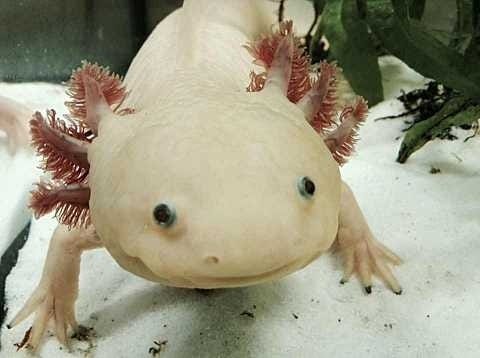
The next thing I did was Google “how do you pronounce axolotl” and found it’s pretty much like it’s written: ak-so-lot-ull. That x kept throwing me off (you don’t see the 24th letter of the alphabet much in animal names) and I’ve since learned a little bit about the etymology of our friend.
Axolotls are native to the Mexican highlands where the Aztecs built Tenochtitlan, and what is now present-day Mexico City. While Europeans didn’t document the creatures until the mid 19th century, the Mexicans and the Aztec that preceded them had been familiar with the axolotl for hundreds of years. The researchers used taxonomy1 to classify the axolotl as Ambystoma mexicanum, an amphibian in the salamander group. All well and good to science, but to the Aztecs the name in their native language (Nahuatl) had a different origin.
Axolotl is pronounced like “ah-show-lote” in Nahuatl. Why is that tl in there, you (like me) might wonder? Well, these characters represent what linguists refer to as a “voiceless alveolar lateral fricative” which is basically a fancier, slightly more succinct way to say “you press your tongue to your palate like you’re going to make an ‘L’ sound but instead blow air around it.” Yeah…it’s not a sound that exists in English, but you will find it in Welsh and Icelandic. If you’ve ever made a breathy scoff as a teenager, you’ve come close to the sound, but it’s not something we use as part of our day to day pronunciations, so we often just treat it like an “L.”
The axolotl takes its name from Xolotl (you got the pronunciation now! show-lote), who is the god of fire and thunder in the Aztec religion. He’s also like Egypt’s Anubis as he guides spirits to the afterlife, and, just like Anubis, Xolotl has a dog-like head. Xolotl also represents twins2, monsters/grotesqueness, and games, so when you try to directly translate the Nahuatl term axolotl you might get “water monster,” “water twin,” or “water player” but my personal favorite translation is “water dog.”
Even if I hadn’t already mentioned the axolotl was an amphibian above, you could probably suss it out from the way they look.
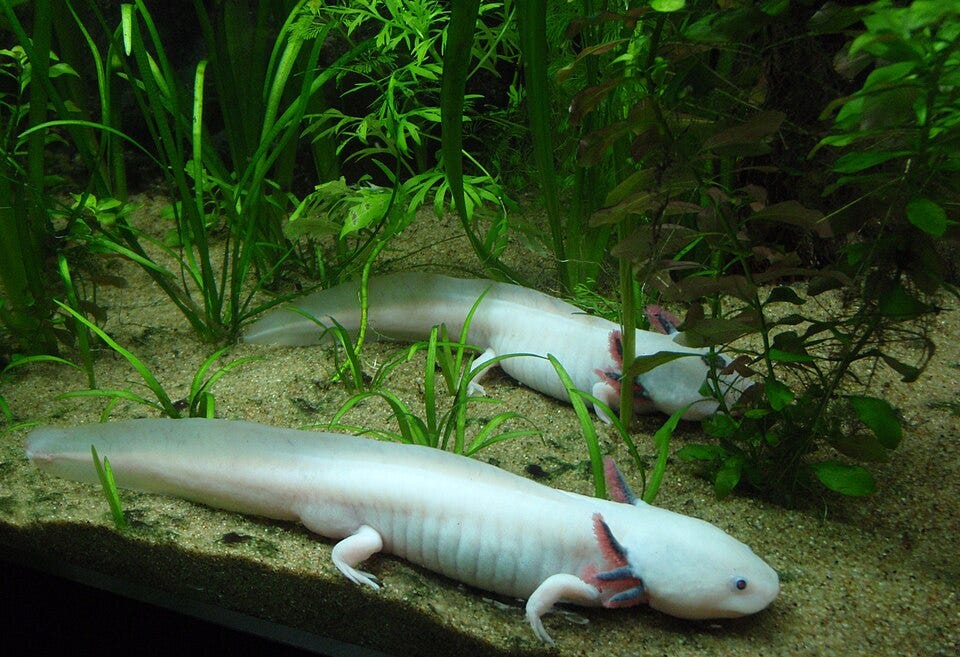
They look vaguely reptilian, like a lizard, except for a distinctive caudal (i.e. tail) fin. Their most prominent feature are the gills that sprout around the base of their skulls like a mane of strange seaweed. A mix of fishy features and reptile features is almost always a good sign you’re dealing with an amphibian!
You probably also know that most amphibians undergo metamorphosis. Frogs, being the the amphibia’s poster children, are a perfect example: they hatch from eggs in water and begin life as totally aquatic tadpoles. Over several days, they begin to grow legs and lungs (replacing gills), and before long they’re hopping out of their puddles and croaking out songs.
Axolotls are a little different: they practice “neoteny,” which means they can actually reach sexual maturity without undergoing metamorphosis. Imagine a frog that remains as a tadpole for its entire life! Fascinatingly, Axolotls can undergo metamorphosis like other salamanders; researchers have been able to induce the process by exposing axolotls to various thyroid-stimulating hormones. They look like most other salamanders:
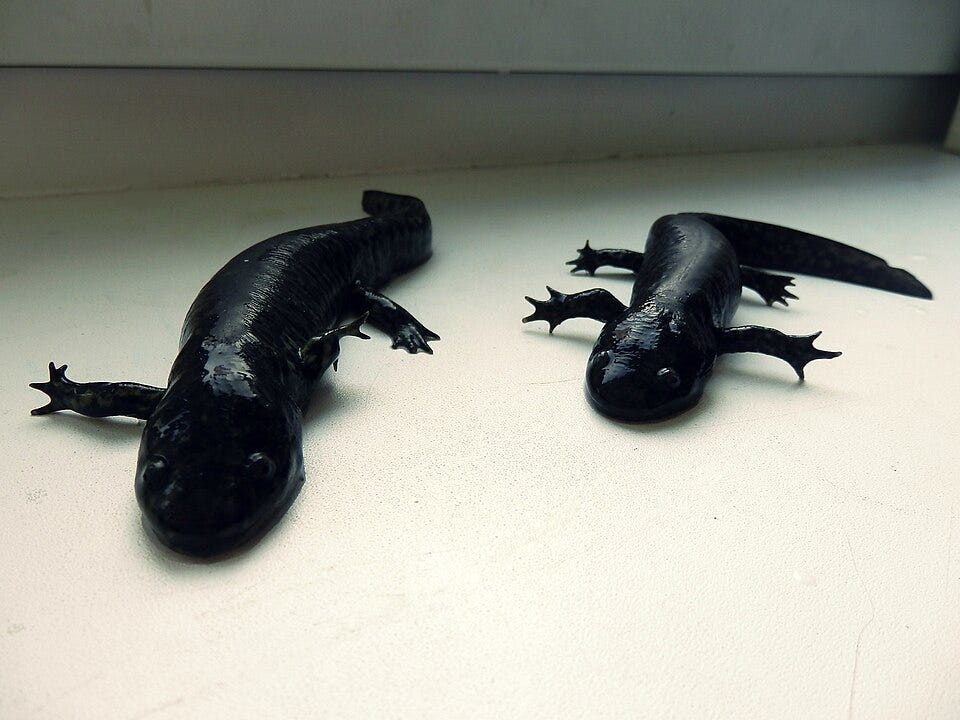
So why don’t axolotls metamorphose in the wild? For one thing, the axolotl (from a genetic perspective) does not produce the thyroid hormones other amphibians use to trigger the transformation process. Luckily, they live in a pretty stable environment that lets them get away with it.
Most amphibians, like frogs, enjoy success as species because their tadpoles can develop in relative safety. A tadpole can grow up in a springtime puddle without large fish threatening its survival and work on growing its legs and lungs. By the time the puddles begin to dry in the summer, the young frog is able to hop away from the shrinking puddle in search of bigger water; its powerful legs and jumping ability will give it a better chance against predators. Conversely, axolotls developed in highland Mexican lakes where such predators were few and far between; they’re basically the top (water) dog in their habitats and simply didn’t need to undergo all that trouble metamorphosing.
I personally think there’s another benefit to the axolotl’s neoteny: remarkable regeneration capabilities.
I remember learning about regeneration in 7th grade biology class. My teacher gave us a little petri dish with a planarian (flatworm) in it and asked us to slice in in half. Every day after that, we measured each half of our worm. In about a week or so, we had two planarians in our petri dish. Wouldn’t it be grand if we could lose an arm or a leg and grow it back? It’s much easier for a relatively simple organism like a flatworm; not so much for us.
But the axolotl can do it, and is one of the best, most complex regenerators in the animal kingdom. Axolotls are able to completely regrow limbs and tails, and have also been observed regrowing parts of their hearts and brains. Naturally, this has lead to a lot of research in the last decade or so on the biological mechanisms at play. An interesting study about a year ago shows that a molecule called Retinoic Acid (RA) is a primary feature of this behavior. RA helps the axolotl’s cells “know” which body part is missing and which part to grow. Genes build a “gradient” of RA where higher concentrations promote “proximal growth” (like a trunk of a tree) where lower concentrations promote “distal growth” (like the branches of a tree). The hope is that by understanding these processes, we may develop a way to naturally grow human body parts.
What does this have to do with neoteny? Well, axolotls have a much easier time regenerating in their juvenile/larval state; they can still regenerate after metamorphosis, but their capacity is severely reduced. Though it’s not a conscious decision, trading the ability to survive on land for the ability to regenerate might indeed be worth it if it were!
Unfortunately, the axolotl is critically endangered. It really only exists in a single water system outside Mexico City, the Lake Xochomilco in particular, and since the turn of the millennium, the population of the rare amphibian has severely declined. Estimates put less than 1000 axolotls in the wild, with the lowest estimates at a mere 50 individuals. Paradoxically, there are an estimated million or so axolotls in captivity as research subjects and pets. Of course, captive animals raise concerns about genetic diversity, but studies on reintroduction efforts by Mexican universities are underway.
Axolotls: Meet the amphibians that never grow up by the UK’s natural history museum.
Paper on the reduced regenerative capacity of metamorphosed axolotls
Paper on axolotl limb growth as it relates to nerve activity
What animal do you think we’ll meet next week on Animal Alphabet Soup?
A branch of science that creates standards for classification so we have a system for identifying species of organisms. Maybe we should write an intro to taxonomy!
Xolotl is the twin of Quetzalcoatl, the Aztec god of life, the sun, and wind
Comments
Nothing yet. Say the first thing.
Sign in to join the conversation.