
I recently received two books that will be reviewed below, alongside news about forthcoming books about the Beat Generation. I am combining these below rather than sending them as individual updates to avoid spamming your inboxes.
Oliver Harris needs no introduction in the Beat world. He is and for a long time has been the foremost expert on all things Burroughsian. Recently, he’s done several books for Moloko Print, which publishes high-quality books on a range of subjects, including the Beats. It is based in Germany and many of these publications are bilingual. In fact, Moloko has put out two of my favourite Beat books: Thomas Antonic’s Amongst Nazis and Harris’ One Shot. (My reviews are here and here, respectively.)
This current book in fact should perhaps not be credited to Oliver Harris as it is technically Roosevelt After Inauguration Redux by William Burroughs. It is “Edited and with an introduction by Oliver Harris,” but Burroughs’ text is only 1,200 words and Harris’ introduction (which comes after the text it introduces) is more than 30,000 words. The Burroughs story/skit/routine takes up only a few pages at the start of the book and what follows feels to me more like a book by Harris.
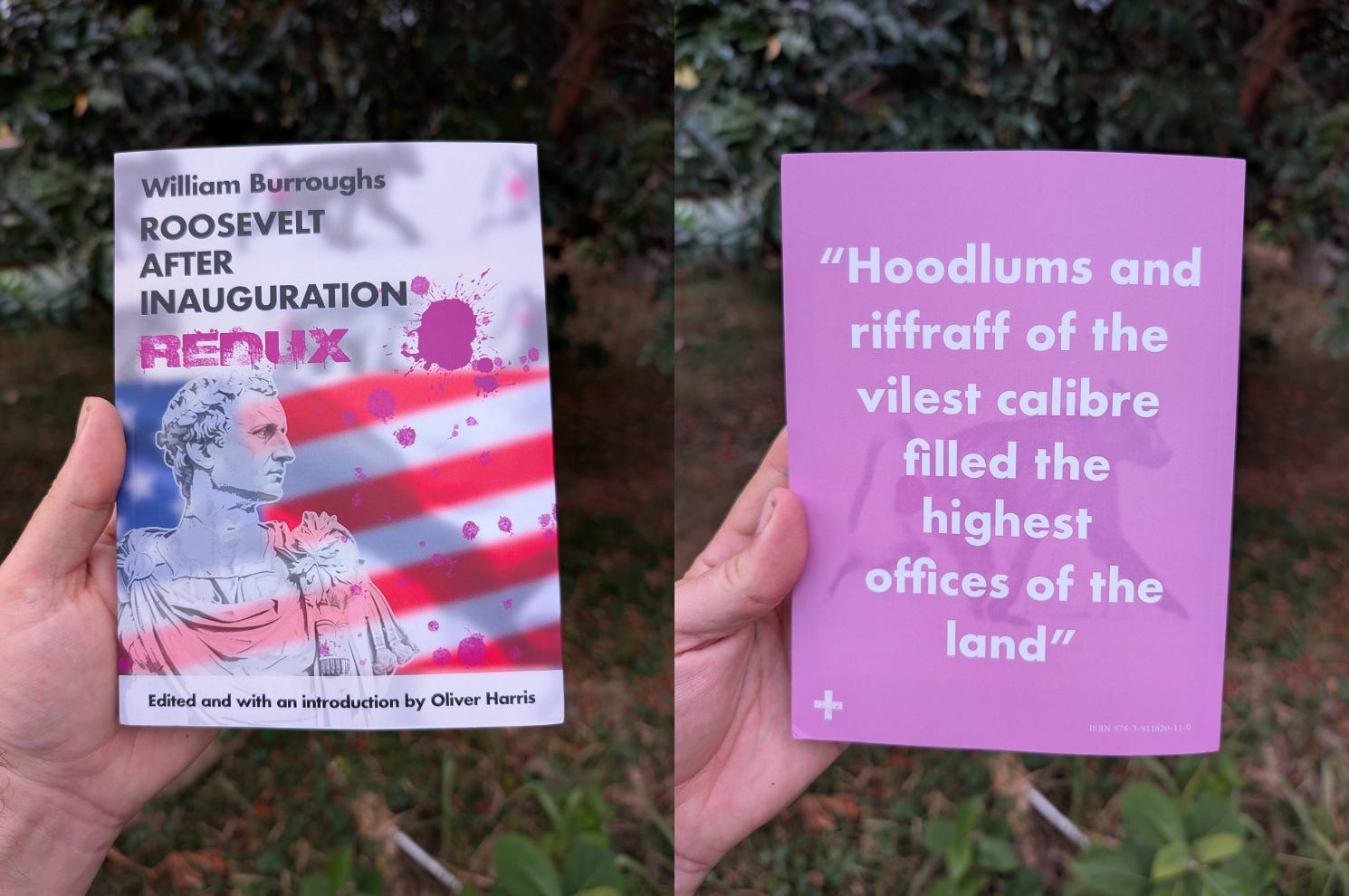
The introduction is a long discussion of “Roosevelt After Inauguration” that you might call a textual history. To the average person, I’m sure “textual history” sounds about as dull as it gets but for me—and I suspect for most readers of Beatdom—this book is quite the opposite. It is a fascinating examination of a weird and important literary artifact. If you are familiar with, for example, Harris’ writing on The Yage Letters, then you will know what I mean. With Burroughs, the story behind the story is often much more interesting than the story itself.
As I mentioned in my review of One Shot (which concerns a mysterious photo), Harris approaches these artifacts sort of like Hercule Poirot explaining how someone came to be killed. He weaves a story deftly and unpacks it slowly but in a very entertaining way, guiding you to a number of false assumptions and then dismissing them before eventually reaching his surprising conclusion. And as we Beat buffs know, there is usually no shortage of myth obscuring the reality behind novels, poems, photos, and other Beat documents.
I wouldn’t want to give away the end of a murder mystery and so I will be careful what I say here, too, except that Harris takes us through the published editions and attempts to explain what Burroughs’ purpose was in writing it. This was not a short story Burroughs wrote for some magazine or with the intention of giving to a publisher or editor. It emerged—I think most will know—in a letter to his good friend, Allen Ginsberg. But why did Burroughs attack Roosevelt of all people? Like any good detective story, the more you dig, the more mysteries arise…
Harris starts his part of the book (which comprises, as I’ve said, the overwhelming bulk of the book) by saying, “If you didn’t know better, you would swear ‘Roosevelt After Inauguration’ had been posted online this morning. […] If you assume the names were changed to dodge a libel bullet, it reads like a wild, gallows-humour satire of our present-day political apocalypse, a dirty bomb of obscene words primed to go off in the ugly orange face of the 47th President of the United States.” Indeed. And he circles back to this point often, even suggesting that this text was an example of trolling.
We’ve always needed Burroughs to wake us from our suspension of disbelief, our retreat into private resignation or business as usual politics, to shock us out of Capitalist Realism and liberal guilt. That “Roosevelt After Inauguration” provokes in me a nervous laughter is as it should be for a text that trolls the humanism of my inner Ginsberg—idealistic, naïve, hypocritical. We need Burroughs to not just tell us the house is on fire but to make us feel the heat. Were his words of warning all for nothing—or was it always too late?
You can order a copy from Sea Urchin Editions.
Although I was aware of Harris’ book well in advance of its publication, and waited impatiently as it worked its way from Germany to Cambodia, this next book caught me rather off guard. Its author sent me a PDF copy out of the blue just last week.

Running Through Heaven: Visions of Jack Kerouac by Jacob Loewentheil is a book released in conjunction with an exhibition of items related to Kerouac, to be held at the Grolier Club from March 5 to May 16, 2026. It includes a number of essays as well as photos, scans, and descriptions of some of the items from Loewentheil’s “exhibition of Kerouaciana” (to borrow a phrase from Ann Charters’ foreword).
The book’s title comes from an annotation Kerouac made when reading The Possessed by Dostoevsky: “As if they were all running through heaven.” This is one of the items in the collection and I will quote one paragraph from that entry in the book so that the reader can get a sense of Loewentheil’s descriptions:
This copy of Dostoyevsky’s The Possessed is annotated by Kerouac throughout, with approximately seventy of his handwritten words on twenty-one pages. […] Next to Dostoyevsky’s famous line, “Man is unhappy because he does not know he is happy,” Kerouac wrote, “Neal’s idea,” referring to his companion and constant muse Neal Cassady. He mentions William Burroughs in relation to a passage on God and the Devil. Based on the content of some of the notes, Kerouac may have been in a frenzied state when he was reading and annotating.
There are, in addition to such descriptions, many photos and scanned copies of the items he has collected. This includes unpublished letters from key points in Kerouac’s life.
Loewentheil has included alongside these items five essays he has written and has gathered essays as well from Holly George-Warren, Tim Hunt, Richard Kopley, and Rob Sean Wilson. These essays describe the contents of the collection and are arranged thematically. For example, George-Warren writes about the letters Kerouac wrote to George Apostolos, mostly in the early 1940s, and then Tim Hunt covers the ones sent to Ed White from the early 1950s. There are descriptions of said letters, a few excerpts, and occasionally a colour scan.
Tim Hunt’s essay stresses the fact that Ed White is often overlooked as a minor side-character in Kerouac’s life story. He writes:
In a Kerouac biopic, the actors playing Allen Ginsberg and Neal Cassady would be vying for best supporting actor role, but if the biopic were to be true to life – if it included the story that Kerouac’s letters to White in this collection allow us to see – several of the most crucial scenes would need to be Jack and Ed writing letters to each other or in a bar talking so intently that the pitcher of beer between them grows warm and stale as they talk on. Despite their decades-long correspondence, the 600-page Selected Letters of Jack Kerouac (covering the years 1940–1966) has only one letter to Ed White, documenting Kerouac’s delight at having The Town and the City accepted for publication. In On the Road, White, fictionalized as Tim Gray, can sometimes seem little more than an extra. These surface level facts have lent themselves to the historical misperception that White was simply a bit player in the Kerouac story with little to teach us about either Kerouac the person or Kerouac the writer.
Sometimes collections like these feature very minor artifacts that are of interest only to the extremely obsessive scholar or fan but, as the above quote suggests, these letters often contain very important details. That includes information related to the creation of Kerouac’s most famous work, On the Road, as well as more broadly his writing techniques. We come about halfway through the book to this claim, which expands upon a very interesting line from a 1958 letter:
Kerouac’s “spontaneous prose” had its beginnings in some of his earliest writing, including in his unpublished letters to George Apostolos in this collection. The germ of his process was always latent in his writing style. Scholars have proposed many possibilities for the exact catalyst, including inspiration from jazz, Neal Cassady, or nights spent “rapping” on marijuana. The truth is that it was cumulative; many of these factors played a role, but in terms of an original contribution, Kerouac, surely the preeminent authority on the matter, believed that White’s suggestion was the progenitor.
Later letters include ones to Allen Ginsberg, Gary Snyder, Will Peterson, Neal Cassady, Sterling Lord, and others. A lot of it deals with his early interest in Buddhism. One interesting postcard was sent to Carolyn Cassady probably about one month prior to Neal’s death. Kerouac writes, “Where’s Neal (Mexico?)” (Incidentally, and relating to an interview I dug up and shared here recently, there is a letter elsewhere in the book that seemingly shows Kerouac really did believe Cassady had faked his death and was not just making a dark joke when he told a Boston Globe reporter of his doubts.)
The book also features photos of Kerouac, many of which are quite rare and some seemingly unpublished before now. There are photos of items in the collection, such as Kerouac’s pocket-sized photo of his brother, religious artifacts, and Neal Cassady’s chess set. We also see rare copies of his books, including first editions and copies signed for friends and famous people. Of note is a copy of The Town and the City that Kerouac gave to Al and Helen Hinkle in 1952, calling his own novel “lousy.” Another is the 1960 edition of Visions of Cody with a hand-drawn cover by the author. The book was only published more widely after Kerouac’s death. There are also copies of very early published works dating back as far as 1939. There are typescripts (including an early version of Visions of Gerard) and copies of books Kerouac owned that include his annotations (including Alan Watts’ The Way of Zen). A lot of these include explanatory notes that provide valuable context.
The book is available for pre-order on Amazon with the release date listed as March 22. It is also available from the University of Chicago Press here. No specific date is given. There is a little information about the Grolier event here.
Again, rather than spam you with multiple emails/posts, I will mention some things here of interest to Beatdom readers.
June 6 will mark the 100th anniversary of the birth of Allen Ginsberg, and we will release Beatdom #26 on that date. We are open to submissions until March 31. Details here.)
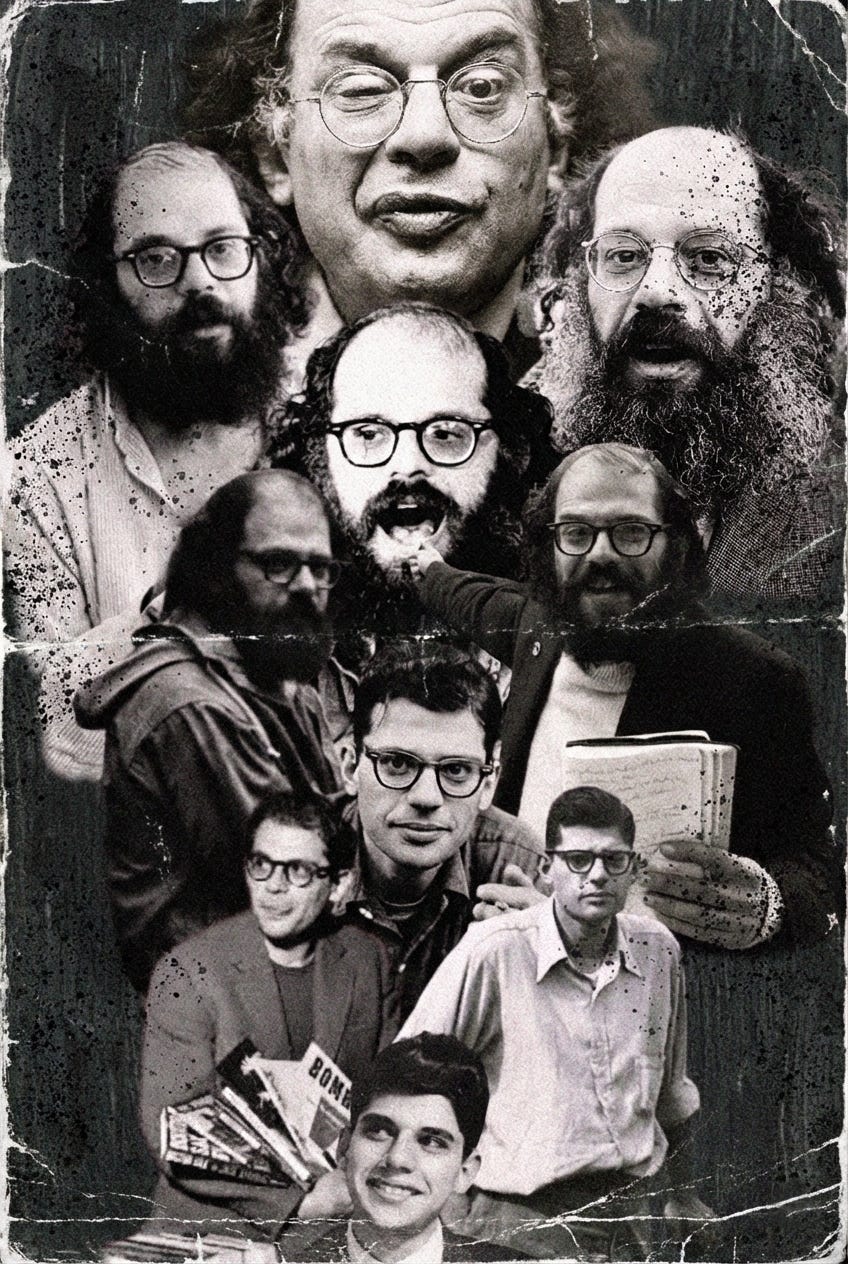
Around that time, we will also release a book by Marc Olmsted titled Beat Dharma. It is about the Beat writers and Buddhism.
Thomas Antonic’s book, The Three Wives of Queer William S. Burroughs, is coming soon as well. We have not given a definite release date because it is not a book we want to rush. It contains many very important details about Burroughs’ life, not the least of which is the fact that he had a wife no one knew about until 2025. There is also a huge amount of information about Burroughs’ first wife, about whom misinformation abounds. This book substantially rewrites Burroughs’ biography. We said last year that it would “be released in early 2026” and we still aim to get it published in the first half of the year. Thank you to those who pre-ordered it and I do aim to get your copies sent out relatively soon. (It’s still available for pre-order…)
Next year, we will publish a novel about Edie Parker. This is a rare change for us as we have only dealt with non-fiction books over the past decade. However, it is based on a great deal of research and is a very detailed portrait of a Beat character, told from her perspective. The author is Michael Zadoorian, a best-selling novelist.
Also forthcoming is Dark Angel: The Theology of William S. Burroughs by Joseph Darlington. It is a long and detailed book that digs into many areas of Burroughs’ work. I was extremely impressed when I first read this because it makes many observations I had never seen mentioned before and will be an extremely important book. We aim to publish this in early 2027.
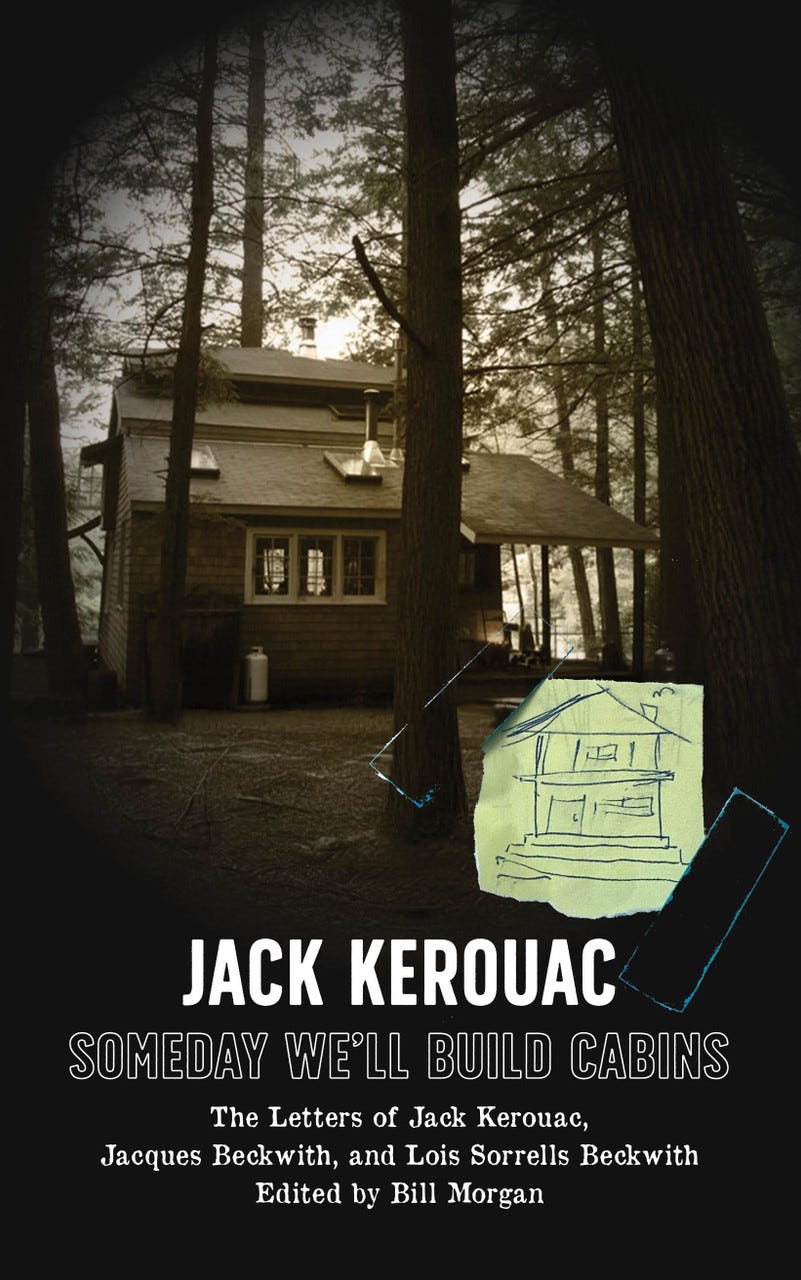
Sal Paradise Press and Rare Bird Books have another book coming soon. It’s called Some Day We’ll Build Cabins: The Letters of Jack Kerouac, Jacques Beckwith, and Lois Sorrells Beckwith, and it’s edited by Bill Morgan. The synopsis says:
In 1960, Jack Kerouac began a correspondence with New York artist Jacques Beckwith. Their shared vision: to build cabins in the woods, retreats from a world of war, dishonesty, and literary pressure. Kerouac wrote, “I want to live in the woods where I don’t even have to think about this evil world of wars and dishonesties.”
But while Beckwith realized his dream, Kerouac was thwarted by alcoholism, lawsuits, constant travel, marital strife, and the burden of caring for his mother. These letters reveal the deeply human side of the Beat legend—his frustrations, distractions, and restless longing for peace.
Pre-order the book here.
There is a new book out called City Lights: Lawrence Ferlinghetti and the Biography of a Bookstore that I very much look forward to reading. Jonah Raskin has reviewed it here. It is on Amazon as a Kindle edition and can be ordered directly from the publisher.
These are just some of the books that have been recently released or will be released soon. At the end of 2025, I listed many of the Beat books published that year. It is hard to keep track of all the publications from the rapidly expanding world of Beat Studies but I do my best and I hope that this newsletter helps. If you know any others worthy of mentioning, please add them as comments below and/or send me an email. I do not have time to review all the books that are published but reach out and I’ll try to at least mention them here so that our readers have a chance to fill their bookshelves.
In other Beat news:
Neal Cassady’s centennial was earlier this month and Simon Warner’s Substack had several posts about it. The Allen Ginsberg Project also has some posts that feature Ginsberg’s photos of Cassady. Here’s a Substack note here with some discussion, too.
Following the death of Jim Irsay, Kerouac’s On the Road scroll is up for auction. Does anyone have a spare few million dollars?
For those who missed it, we posted an essay connecting Kerouac’s On the Road with Alain Fournier’s Le Grand Meaulnes.
Jack Spicer’s 101st and Richard Brautigan’s 91st birthdays just passed as well, so I wrote an essay connecting them with the Beat Generation.
There is a short conversation here about creating a Kerouac cultural centre in his hometown of Lowell.
Consider subscribing to get more Beat news, reviews, and essays. It’s free (and always will be) but if you want you can become a paid subscriber to help cover the costs incurred in accessing research materials.
Comments
Nothing yet. Say the first thing.
Sign in to join the conversation.