
Beatdom #26: The Allen Ginsberg Centennial Special comes out in 3 weeks. You can pre-order it here. More information about it (including a list of contents) can be found here.
With most artists, it would be a little strange that on their hundredth birthday, and almost thirty years after their death, there was so much new work being released. Every year, we see not only essays discussing Allen Ginsberg in new ways but newly uncovered poems, interviews, songs, and photographs. This is largely because he was such a prolific artist and also very generous with his time, always willing to sit down with interviewers and students.
Tomorrow (May 15) sees the release of a new album. This is America, Give a Shit!, which was recorded in Austria in 1980. Ginsberg was touring Europe at the time with Peter Orlovsky and musician Steven Taylor. This performance, given in Graz on November 10, was recorded by Österreichischer Rundfunk, Austria’s national broadcasting corporation, and originally intended to be aired but—likely due to the provocative language used—it was instead archived and forgotten.
Thomas Antonic (author of the forthcoming book, The Three Wives of Queer William S. Burroughs) uncovered it during a research project and was amazed by the quality of the recording and the fact that it had sat unheard for all these decades. It is now being released through Tate Swindell’s label Unrequited Records as a limited run of 200 LPs. Each set is comprised of 4 LPs and an eight-page booklet, in which you will find 24 previously unpublished photos. It will not be available on CD or via streaming, so this is very much a collector’s item.
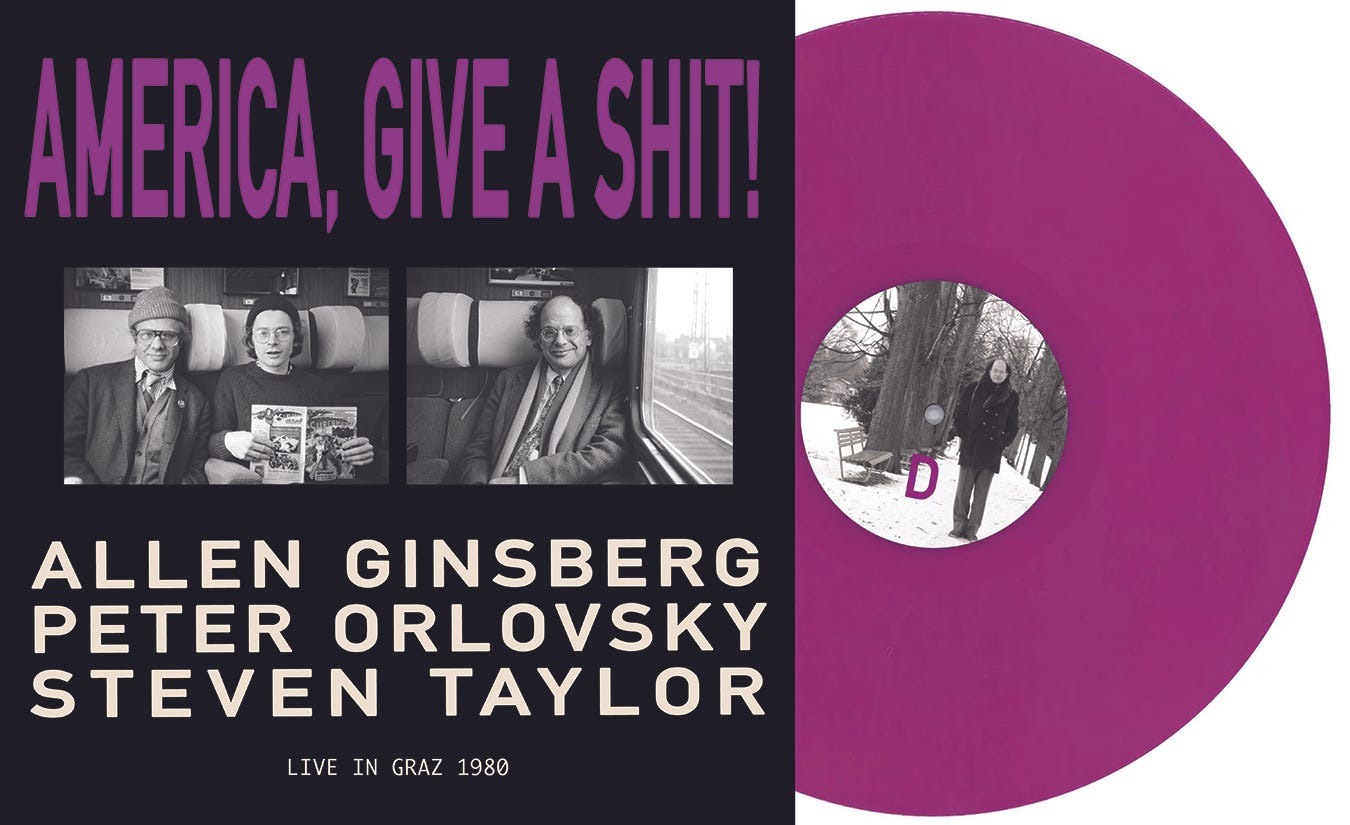
The album begins with Ginsberg singing “Four Noble Truths.” Steven Taylor plays guitar and someone sings alongside Ginsberg with a German translation. This is followed by a musical interpretation of William Blake’s “The Tyger” and then Ginsberg’s “Dope Fiend Blues.”
The recording quality is, as Antonic notes in his accompanying essay, astoundingly good. I have listened to hundreds of recordings of Ginsberg from his digitised archives at Stanford and of course some of the more widely available ones and this ranks very highly. Of course, that is because it was not simply recorded for future reference but was intended for national broadcast.
After these introductory songs, Ginsberg explains that he will “begin with recent poems and then work backward in time,” which he does albeit with a section in the middle where Orlovsky reads. It is a very energetic reading. In fact, it is amusing how much Ginsberg changes from a sedate explanation of what he will do into the animated first lines of “Punk Rock Your (sic) My Big Crybaby.” Several of these poems are also set to music, with Taylor playing the guitar to accompany Ginsberg’s reading or singing.
Peter Orlovsky gives a wild and amusing reading next, getting much laughter from the audience. He is even more animated than Ginsberg—often shouting and screaming lines, including the titular “America, Give a Shit!”—and from the audio recording it sounds as though he is acting out his performance, doing certain lines in a falsetto voice. He reads mostly very short, pornographic poems that go over extremely well with the crowd. Some are sung, again with Taylor providing the music.
Ginsberg returns with his older poems at the end of the reading. Notably, the only poem with “Song” in the title is not sung. That’s “Song of the Shrouded Stranger.” He then reads “America” and Parts IV and V of “Kaddish,” ending the reading with “Guru Blues.”
For me, the highlight of the recording is “America,” which he reads not only with a very different style to what I have previously heard, but he changes the content, updating it for the year 1980. It seems clear from the recording that he has the original in his hand but decides to spontaneously alter the lines and perhaps this was due to an accident. At the very start, when he begins to read the first word, someone drops a glass bottle and Ginsberg immediately extemporises and incorporates it into the poem:
America, I’ve given you all… but now I’m a bottle rolling around on the concrete floor of the back of the room.
He then launches into a manic, fast-paced performance with strange but effective emphasis on certain words. He seems to be racing through the poem as quickly as possible but the stressing on different lines seems to suggest the mental instability of the writer. It is almost as though he reads it imagining there are two speakers or two versions of the speaker.
Before long, he is adding words and phrases to make his poem more contemporary. There are slight verbal clues that show these were not planned. He clearly comes up with these ideas as he reads and is uncertain how exactly they will fit into the poem or how the audience will react. Ronald Reagan had won the presidential election about a week before the reading and Ginsberg inserts this fact:
America the plum blossoms are falling.
I haven’t read the newspapers for months, everyday somebody like Ronald Reagan gets elected president or the Rosenbergs go on trial for atom bomb secrets.
Later, he repeats Reagan’s name and adds Henry Kissinger and other political figures who were in the news in 1980. He also adds a line about having been a young beatnik long ago, even though that word had not been coined when the poem was originally written:
America I used to be a beatnik when I was a kid I’m not sorry.
He also expands old lines so that “You should have seen me reading Marx. […] I won’t say the Lord’s Prayer / I have mystical visions and cosmic vibrations” becomes “You should have seen me reading Karl Marx. […] I won’t say the Catholic Lord’s Prayer / I still have Blakean mystical visions and cosmic vibrations.” Each line gets one new word. Then, instead of letting his emotional life be run by Time Magazine, it is Der Spiegel. Many more changes and additions occur, including a line about Wilhelm Reich. Particularly relevant in 2026 is a series of lines about stealing Iranian oil and threatening “our Cuba.”
Altogether, this is a fantastic recording. It is Ginsberg on top form, performing new work and old work, throwing all his energy into each piece and, most interestingly, updating “America” 25 years after its composition and adding references for the benefit of the Austrian audience. Kudos to Thomas Antonic for finding this recording and going to the effort of getting it released.
The album can be ordered at www.unrequitedrecords.com/ or via Bandcamp.
An abridged version of the liner notes appears as an essay in Beatdom #26, which can be pre-ordered here. That appears alongside a previously unpublished Ginsberg interview from 1990, which was also found by Antonic.
Comments
Nothing yet. Say the first thing.
Sign in to join the conversation.