
I took my young son, Guy, and joined the beatnik brigade.
--Maya Angelou
One does not typically think of Maya Angelou as having any particular connections to the Beat Generation, but during the research for my recent book, A Remarkable Collection of Angels: A History of the 6 Gallery Reading, I had to look through many archival documents and was surprised to see her name alongside Allen Ginsberg’s in newspapers from 1955. They do not appear to have known each other and she was not exactly part of the Beat poetry or San Francisco Renaissance scenes but certainly there were connections. The purpose of this essay is to explore those and to show how close their lives were at one point and what Angelou and the Beat writers thought of each other.
Allen Ginsberg was born in New Jersey in 1926 and Maya Angelou was born in St. Louis in 1928, so they were of the same generation. St. Louis, of course, was the hometown of William S. Burroughs, born more than a decade earlier. In terms of their early lives, that’s pretty much where the connections between Angelou and the Beats end. The life of a young Black woman was always going to be very different to those of young White men. This will be apparent to anyone who has read Angelou’s most famous work, I Know Why The Caged Bird Sings, which makes the complaints of the young Beat writers seem rather trivial.
Although the Beat movement started on the East Coast, it really gained momentum in San Francisco about a decade after its principal members first met. However, Angelou beat them by more than a decade. It is unclear when exactly she moved there because her autobiographies and the various biographies written about her are extremely vague and even contradictory, but she was in George Washington High School in 1945 and had a child just a month after graduating. She was still in high school when she became the city’s first Black female streetcar conductor.
Whilst the Beat writers mostly moved to San Francisco due to its reputation as an alternative centre of arts, with progressive schools such as the California School of Fine Arts, Angelou and her family moved in large part to escape the racism of the Deep South. San Francisco was obviously not completely devoid of racism but it had long been a diverse city and had a reputation for tolerant attitudes that set it apart from the rest of the United States at that time. A great many Black people moved from the South to San Francisco in the early and mid-forties and a huge number settled in the Fillmore District, where they took over the businesses and homes of interned Japanese citizens following Pearl Harbor. “The Japanese area became San Francisco’s Harlem in a matter of months,” Angelou recalled.[i] The fact that she reports this as an eyewitness suggests she was there at least as early as 1942 and some accounts say she moved in 1940. The Fillmore District became famous for Black music and most of the era’s great jazz musicians performed there. Jack Kerouac was amazed by it. “I never saw such crazy musicians,” he wrote in On the Road. “Everybody in Frisco blew. It was the end of the continent, they didn’t give a damn.”[ii]
We tend to look at the footloose Beat writers and their lives of almost voluntary poverty in a certain romantic sense, and many of them moved to San Francisco because it was a cheap, bohemian place where they could pursue their art and live a basic but exciting life in spite of a lack of funds. This was very different from the position Maya Angelou was in. In her autobiographies and—perhaps more explicitly—her later interviews, she describes the grim reality of having to work to support herself and her son (whom she had given birth to in her mid-teens). She cooked and cleaned and scraped paint from cars. It was not an easy life and, unlike the Beats, she had no option to pack it in and go home. Poverty was not temporary or optional.
She took dance lessons in the mid-forties and eventually realised she could make money singing and dancing, and by early fifties that was how she made her living. It is also how she came to be called “Maya Angelou.” Previously, she had been Marguerite (or just “Rita”) Johnson but when she started her career as a Calypso singer she was told she needed something more “exotic” and “glamorous” than her birth name.[iii] She was reluctant to change her name but did so. What she does not mention in her autobiographies is that there was a moderately well-known movie actress called Rita Johnson active at the time and changing her name was probably done in part to avoid legal problems.
Although she lived in the predominantly Black Fillmore District, Angelou eventually ended up performing at the Purple Onion in North Beach, which was the city’s hipster centre long before the beatnik craze of the late fifties. In the early fifties, the writer George Hitchcock came to see her perform and they became close friends, and through Hitchcock she met the painter Jean Varda. Varda had taught at Black Mountain College in North Carolina, had taught the 6 Gallery founders at the California School of Fine Arts, and was friends with Henry Miller and Anaïs Nin, the former having written of Varda in Circle, an important forties literary magazine for the Bay Area. He was friends with Kenneth Rexroth and he later met Neal Cassady when teaching a painting class in San Quentin Prison. He felt Cassady had a “halo” around him and referred to him as a saint.[iv] Varda’s paintings hung in the Iron Pot and the Tin Angel, among many other hip locations, and his importance to the SF arts scene is briefly explained in Evergreen #2.[v]
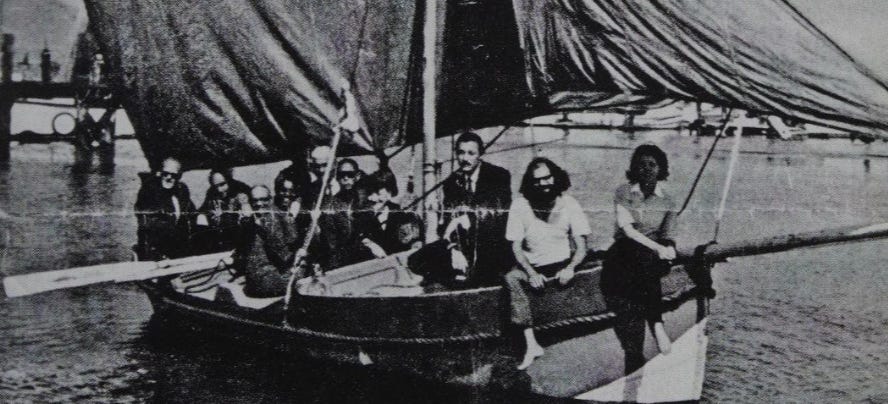
Angelou recalls in Singin’ and Swingin’ and Gettin’ Merry like Christmas that Varda called her and invited her to his Sausalito houseboat, the Vallejo, a name which should be familiar to those familiar with Beat history. Varda did not own it for he was perpetually and proudly impoverished. The owner was Gordon Onslow Ford, who later sold the boat to Alan Watts, and it was later the location for the famed “Houseboat Summit” involving Timothy Leary, Allen Ginsberg, Gary Snyder, and also Watts. Watts and Ginsberg seem to have been invited to earlier parties with Varda, too. This photo shows Varda and a great many people on his boat on his sailboat Sakri and a caption mentions Ginsberg, but I don’t believe it is him with his legs over the bow, though the hair and beard certainly fit.
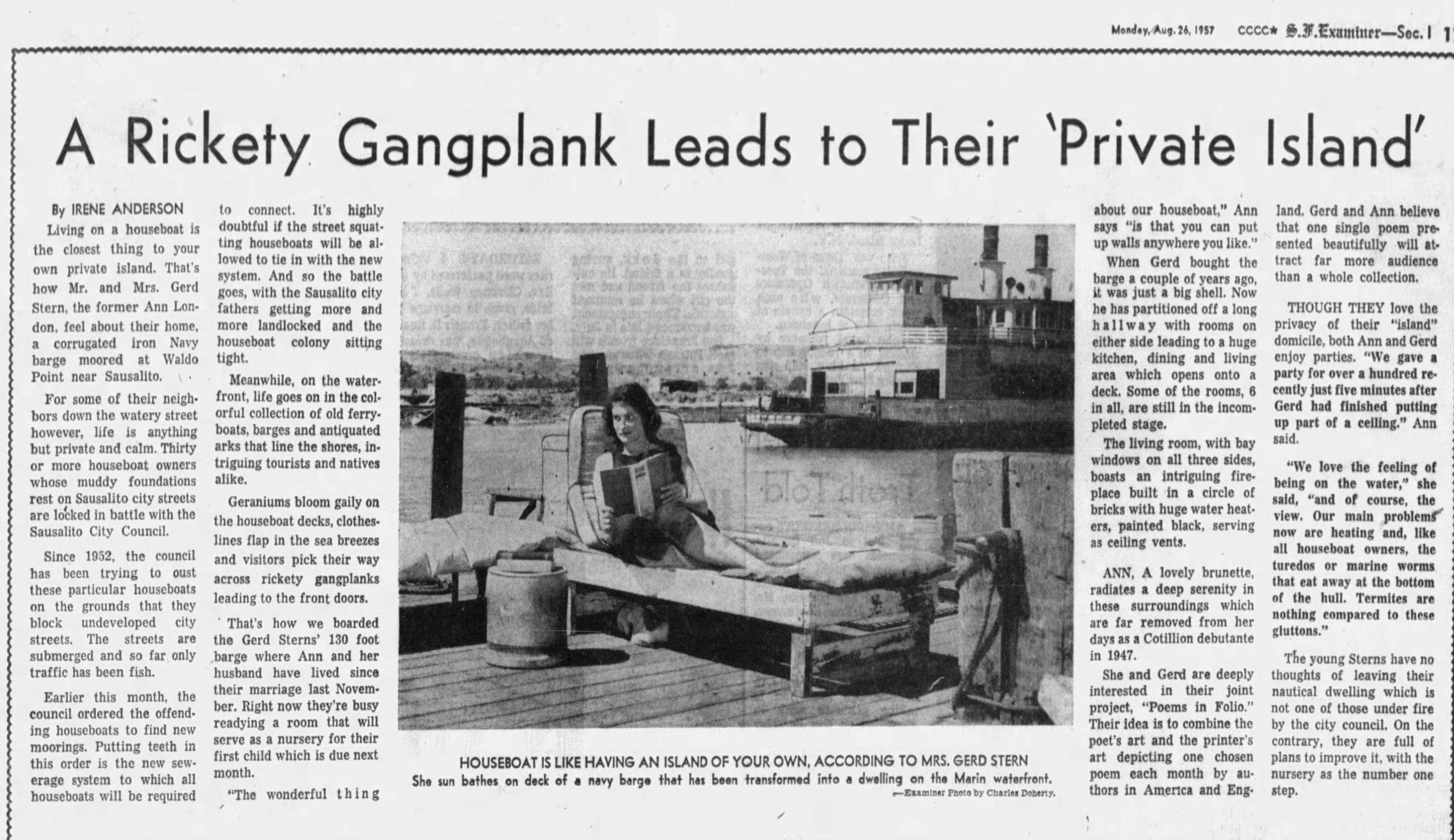
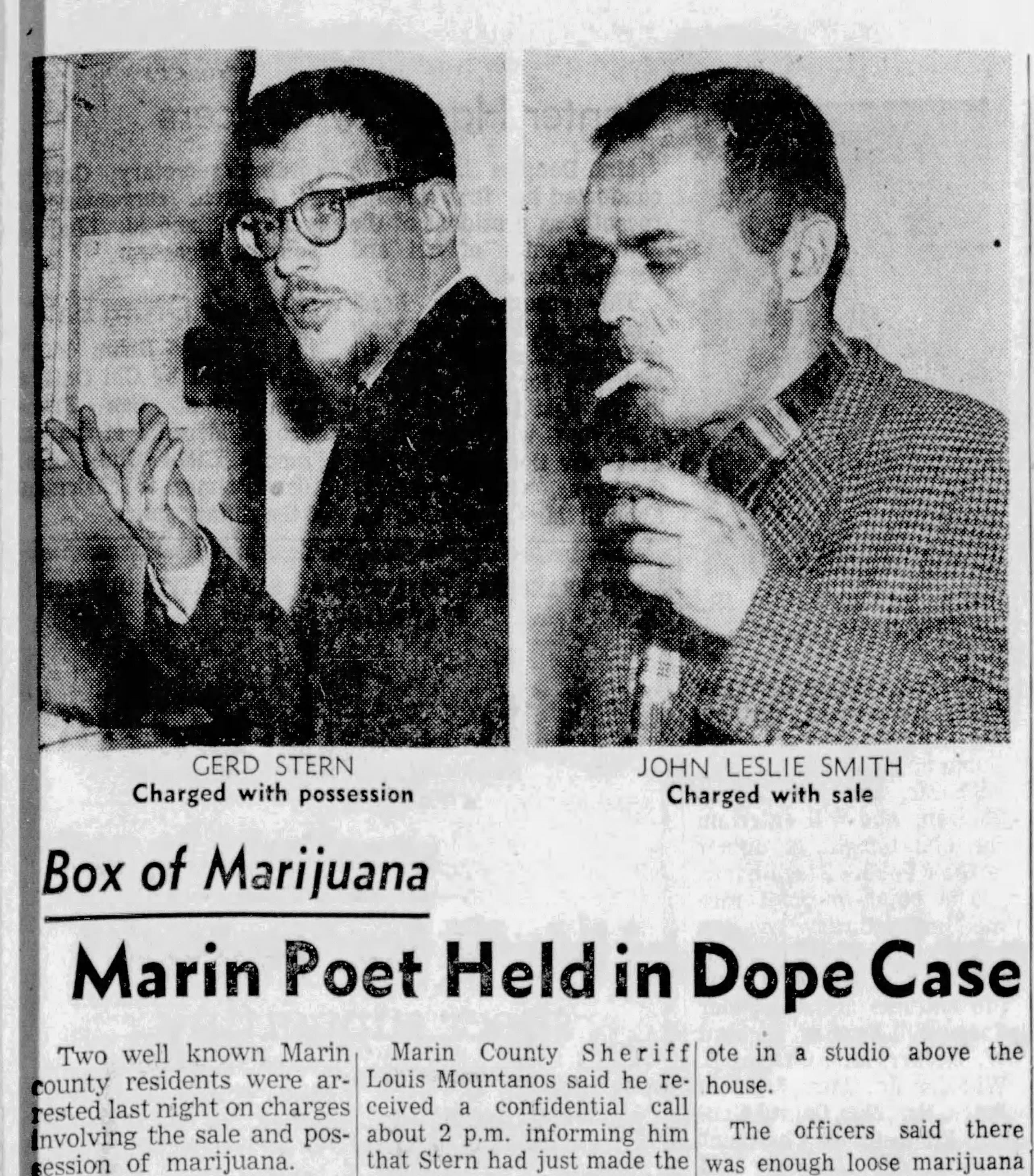
It seems that Gerd Stern was introduced to Gordon Onslow Ford via Philip Lamantia and that the two became quite close. Ford invited him to the Vallejo one day and Stern later bought his own boat in Sausalito—a sunken barge that he patched up and refloated, then parked next to Ford’s vessel. This was where the Joan Anderson letter was supposedly lost.[1] Stern—who passed away just last year—is often treated as a footnote in Beat history but he was a fascinating character and artist deserving of more attention. He started a publishing company and ran it from his barge in 1956 and ’57. Unlike other local publishing ventures, he had a number of quite well-known poets on his roster (including WH Auden, Robert Frost, and William Carlos Williams) and he released a small run of poetry broadsides, printed monthly. He was also very active in trying to protect the Sausalito waterfront from development. This gained much positive media attention until he was arrested for marijuana possession in 1959, his appearance helping to confirm beatnik fears…
According to the oral history, Gerd Stern: From Beat Scene Poet to Psychedelic Multimedia Artist in San Francisco and Beyond, Stern had been locked up with Allen Ginsberg and Carl Solomon at Columbia Presbyterian Psychiatric Institute. “Now there we were,” he says, “three weirdos out of the literary world.”[vi] He places this in the 1950s but it would’ve been 1949, which is when Ginsberg and Solomon were at PI.[2] Stern also knew a great many people related to Beat history, including John Hoffman, whose poems Philip Lamantia read at the 6 Gallery, and Kenneth Rexroth. He also had a poetry show on KPFA, the Bay Area radio station that provided literary and artistic content in the fifties, and worked as its publicity manager.
Maya Angelou never mentioned Stern by name in her writings (at least not in any text I have seen) and his memories are often a little vague and sometimes fanciful. Frankly, in this context they don’t even make that much sense. He claims he met Angelou before she worked at the Purple Onion but after she returned from a tour of Europe; however, the tour of Europe came after her first stint at the Purple Onion. He seems to suggest that he managed and dated her between his marriages to his wives Jane and Ann, but there was—astonishingly—only a gap of 14 months between those marriages and that was again after her Purple Onion career. Evidence strongly suggests that they lived together in 1955-56, meaning that he did not help her get the Purple Onion gig unless he managed her first and then dated her later, which is not impossible. Stern claims to have been in the crowd for the 6 Gallery reading, begging the question of whether she was his date, but it seems unlikely as she would most likely have been working that night.
About meeting Angelou, Stern said:
One of my neighbors was John Drew. He lived on the waterfront, and he was a real queen. Wonderful guy--from the Barrymore family.[3] He was the manager and impresario of the Purple Onion. I became Maya s manager, and we got her into the Onion. She was an instant star there.[vii]
If this claim is accurate, then Stern met Angelou in 1953 or ’54 but as I’ve said they almost certainly didn’t date until 1955 and his memory seems inaccurate here. It is, however, true that she “was an instant star” at the Purple Onion. Angelou was a massive hit in the San Francisco press, the subject of many glowing reviews. Writers seemed shocked that such a talent worked in such a small venue and were not surprised when she went off to tour Europe later that year.
As best I can tell, Angelou never wrote about her relationship (professional or personal) with Gerd Stern, but there is a subtle reference in The Heart of a Woman. Here she writes that she “joined the beatnik brigade” when she “moved across the Golden Gate Bridge and into a houseboat commune in Sausalito where I went barefoot, wore jeans, and both of us [she and her son] wore rough-dried clothes.”[viii] Although she puts this after her European tour, it fits with Stern’s claim that “we lived together [on his barge], and we had a great time.” It should also be noted that Stern claimed to have been an amateur ichthyologist in his oral history and Angelou wrote that one of her “commune mates” was an “icthyologist” (sic).[ix]
This seems to confirm that Angelou lived with Stern but casts major doubt over his claim that he got her started at the Purple Onion and does not necessarily prove that they were lovers. However, for the purposes of this essay it is enough to note that she lived with this man who was thoroughly enmeshed in the fifties and sixties Beat scenes and considered herself—for a short time at least—part of “the beatnik brigade” (even if that was before the word or concept existed[4]). It is also worth noting that Stern was a friend and collaborator of composer Harry Partch and it seems that Angelou worked with him on some kind of production. An uncited article claims, “She also participated in Sausalito’s art scene, developing choreography and dancing in a production by composer Harry Partch.”[x] However, Harry Partch: A Biography mentions only that it was planned but did not come to pass: “He had been enthusiastic at the prospect of casting the poet Maya Angelou, a neighbor in Sausalito, as the Witch, but finally decided she lacked sufficient theatrical experience.”[xi]
The Beats, beatniks, and other hipsters of San Francisco do not appear as characters in her books nor did anyone from the Beat world write about having known Maya Angelou but there is at least one reference she made to that scene. This was when she introduced the Purple Onion in Singin’ and Swingin’ and Gettin’ Merry like Christmas. I’ve mentioned this place a few times now but held back on saying exactly what it was. This is because when she first mentions it she emphasises its close proximity to the North Beach scene and to the Beat poets who were active there. She calls it “a basement cabaret” and writes:
One block away on Columbus Avenue, Vesuvio’s bar was an international center for intellectuals, artists and young beats who were busily inventing themselves. Next door, Allen Ginsberg and Lawrence Ferlinghetti read their new poetry at the City Lights Bookstore.[xii]
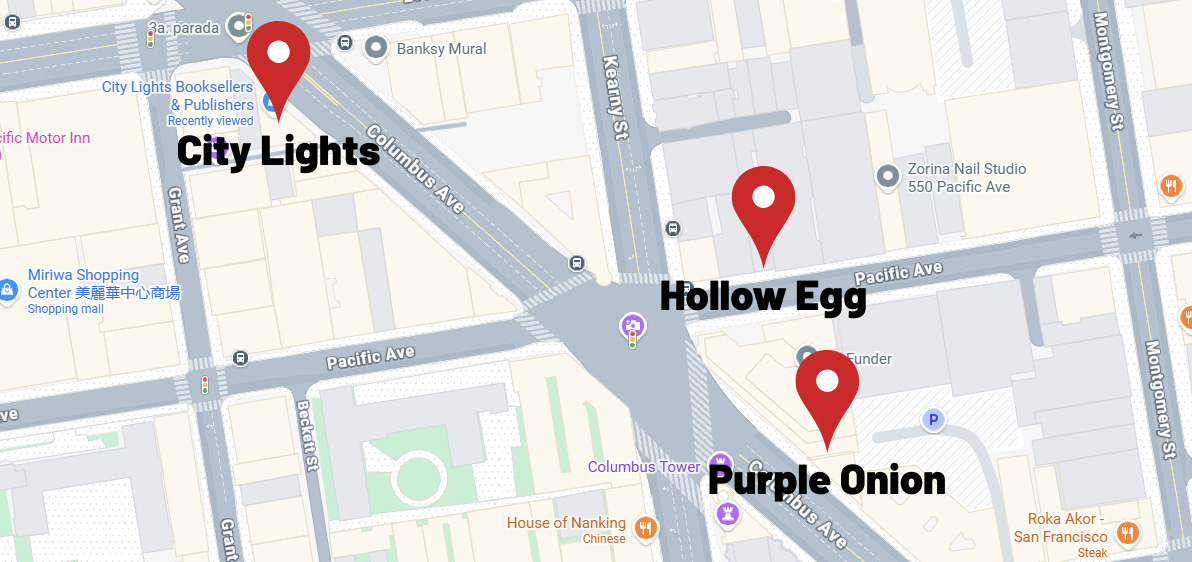
Stern said it was one of “two hip clubs in North Beach,” the other being the hungry i. (Both were owned or part-owned by the same man, Enrico Banducci.) Interestingly, one local journalist called it a “subterranean” bar, a phrase that naturally brings to mind yet more Beat connections… The Purple Onion also opened the same year as City Lights (1953).
Most would call it a nightclub, which at the time meant a place that put on a variety of entertainment forms, with singing, dancing, and comedy chief among them. One of the main attractions was comedienne Phyllis Diller, who also performed weekly at the hungry i. You may wonder why I mention her in conjunction with this essay but she performed alongside Lawrence Ferlinghetti and Weldon Kees at a pivotal event in 1955 that quite possibly influenced the 6 Gallery reading later that year.
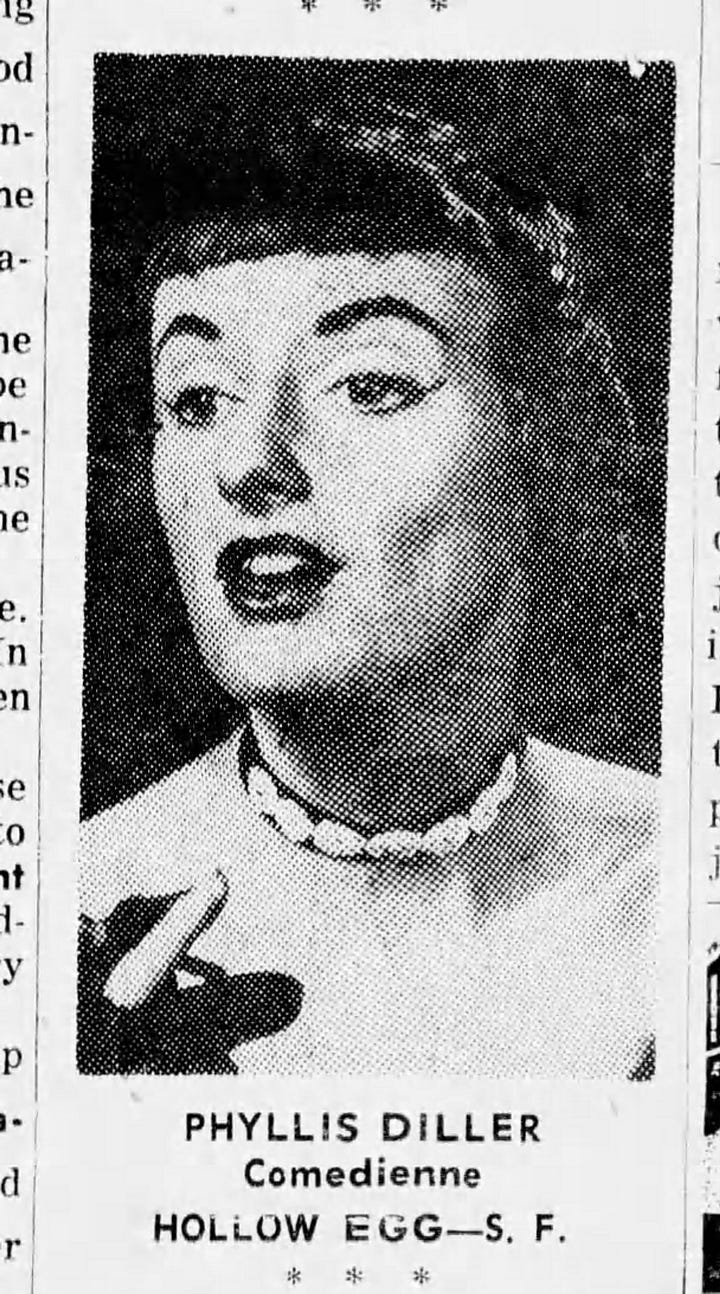

Although Angelou had started out at the Purple Onion in 1954 and then left the city, by late 1955 she was at the Hollow Egg, a venue even closer to City Lights. She started there on September 2, the venue’s opening night. The ownership was complex but it was at least partly owned by people involved in the Purple Onion and hungry i. It did not last long, though, closing less than four months later, with its owners saying the street had “too many strippers.”[xiii] During its brief existence, it featured singing and comedy and seems to have been an attempt to repeat the success of the Purple Onion.
I cannot help but wonder whether any of the San Francisco poets saw her perform at the Onion or the Egg… Both were right at the heart of the hipster centre of the city, just a few minutes from City Lights and a few more minutes from Allen Ginsberg’s Montgomery Street apartment. She was in Europe during Ginsberg’s first months in the city but by the time of the 6 Gallery reading and the weeks before it, during which Ginsberg befriended Snyder and Whalen and met up again with Kerouac, she was performing four nights a week in North Beach. If it really was such a hip venue, it’s quite possible they stopped in, but perhaps it was too upscale for them. It wasn’t a dive bar or jazz club. They preferred The Place, a few blocks north.
It is possible that Ginsberg and Angelou crossed paths at the San Francisco Arts Festival in mid-September, though. Those of you who’ve read my book or this essay will know that the Arts Festival was Ginsberg’s first public poetry reading. The event lasted two days. On September 15, Angelou sang and danced whilst Stern played with the BooBam Bamboo Drum Ensemble,[5] and 22 hours later, at the same venue, Ginsberg read a poem to a packed house, an event that gave him the confidence to read “Howl” a few weeks later.
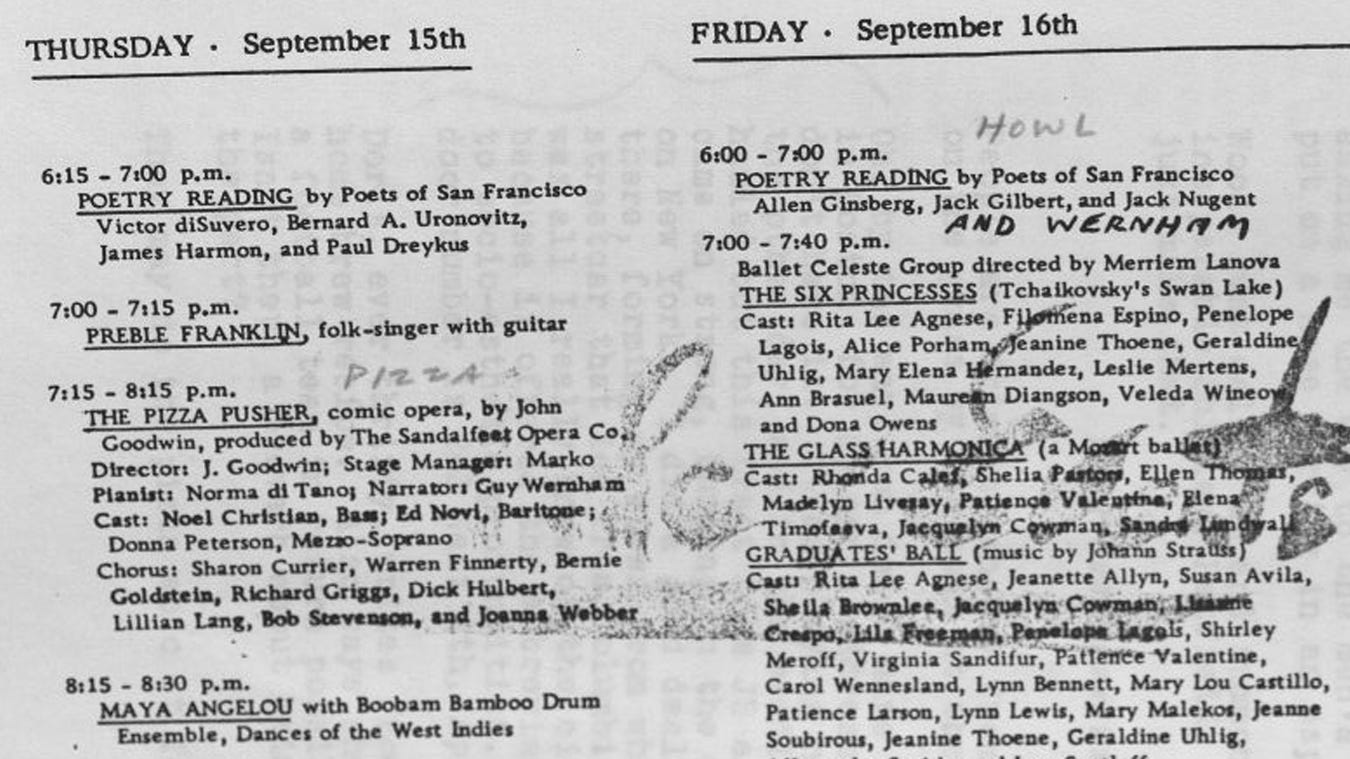
There is no evidence that Ginsberg was there on the 15th and none to say that Angelou attended on the 16th, but it’s a tantalising prospect. As Stern knew Ginsberg by then, would he have come along both nights? Would he have invited Ginsberg on the first night? It is possible but hard to prove. In addition, Ginsberg knew two of the poets performing on that first night and may have wanted to hear them read. Certainly some people attended both nights, including composer Jack Goodwin and director of the Poetry Center Ruth Witt-Diamant. There were dances on the second night, too, and given how many dancers Angelou knew in the city, it’s possible she would have wanted to attend in order to watch her friends perform… but it looks like she was working at the Hollow Egg that night.
Ginsberg left San Francisco in late 1956 but returned often, and whilst Angelou left for Europe again, she was back at the Purple Onion in 1958, lauded not only in the local press but—of all places—in Playboy. Given the interlinked circles of friends and artists, it is again tempting to wonder whether they bumped into each other. However, Stern and Angelou did not last long as a couple. There were difficulties due to his not being accepted in the Black community and also with her violent temperament (at least as Stern tells it). He said they had a big fight and soon broke up but as with so much it’s hard to know when exactly this happened. In her book, Angelou gives very little information but says her time on the houseboat lasted “less than a year.” She liked that these White people were not racist like so many others she had known but she “began to yearn for privacy, wall-to-wall carpets and manicures”[xiv] and was worried about her son, who was beginning to resemble what later became known as the beatnik stereotype: unclean, undisciplined, lazy. All she says about the end of her time on the boat was: “I packed our bags, said goodbye and got on the road.” (My italics.)
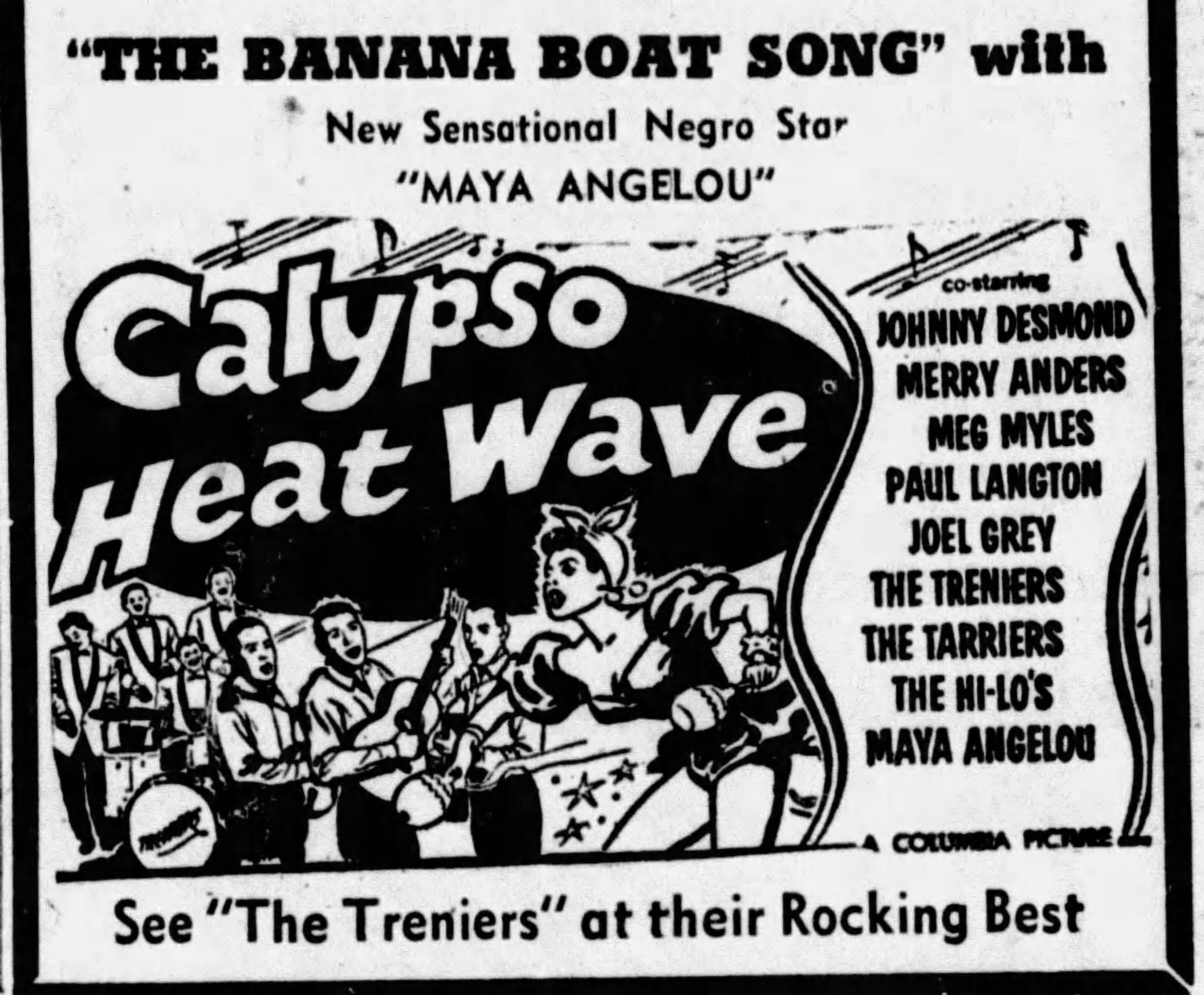
In 1957, Angelou’s career moved in a different direction, taking her away from the subterranean nightclubs of North Beach. She appeared in Calypso Heat Wave, a stage show, and released the album Calypso. Like the Beat writers, she did not simply stay with the form or discipline in which she first excelled. She was a woman of many talents. Looking back, she wrote, “The year’s popular book was Jack Kerouac’s On the Road, and its title was an apt description of our national psyche. We were indeed traveling, but no one knew our destination nor our arrival date.” It’s not clear that she read that book at the time, but mentioning it is yet another connection.
Of course, Angelou later became famous as a poet. Her autobiographies are generally more highly regarded but as a poet she was extraordinarily popular, and alongside Ginsberg she was probably the last celebrity poet. In fact, the few times they were ever mentioned together in news articles, it was to note that there were the only ones of their stature. They were about as different as it gets poetically, but they earned millions of fans and became iconic in a way that few poets have been in the last half-century or so. Their difference was perhaps illustrated in the one quote I could find from Ginsberg concerning Angelou. Before reading to an audience of 30,000 baseball fans, he was asked to choose something “with universal appeal,” but he responded:
I’ve read to a stadium with 40,000 people in Prague. No one wanted to tame me. I don’t want to be polite to national television. I ain’t going to be no Maya Angelou for you.[xv]
Perhaps it is unfair. It does sound a little dismissive, but Angelou was widely considered an accessible, even commercial poet. “Her poetry has a large public,” wrote Harold Bloom, “but very little critical esteem. It is, in every sense, ‘popular poetry,’ and makes no formal or cognitive demands upon the reader.”[xvi] A year before Ginsberg’s remark, she had read a poem at Bill Clinton’s inauguration and later she created a line of greeting cards for Hallmark. She was sometimes called “the people’s poet” and occasionally embraced the term.[6]
Perhaps this all makes it sound as though Angelou wanted to be a singer and dancer, then later got into writing as an afterthought. Her writing career began long after Ginsberg’s, but she was writing poetry in the fifties. The problem was that she had more responsibilities than the Beat writers (or perhaps took more responsibility than they did). She wrote poems and occasionally showed them to people, but later reflected, “I hadn’t time to be a poet, I had to find a job.”[xvii] The fact was that singing and dancing was a reliable way to pay her rent and raise her child and there was no chance of poetry doing the same. At least not then.
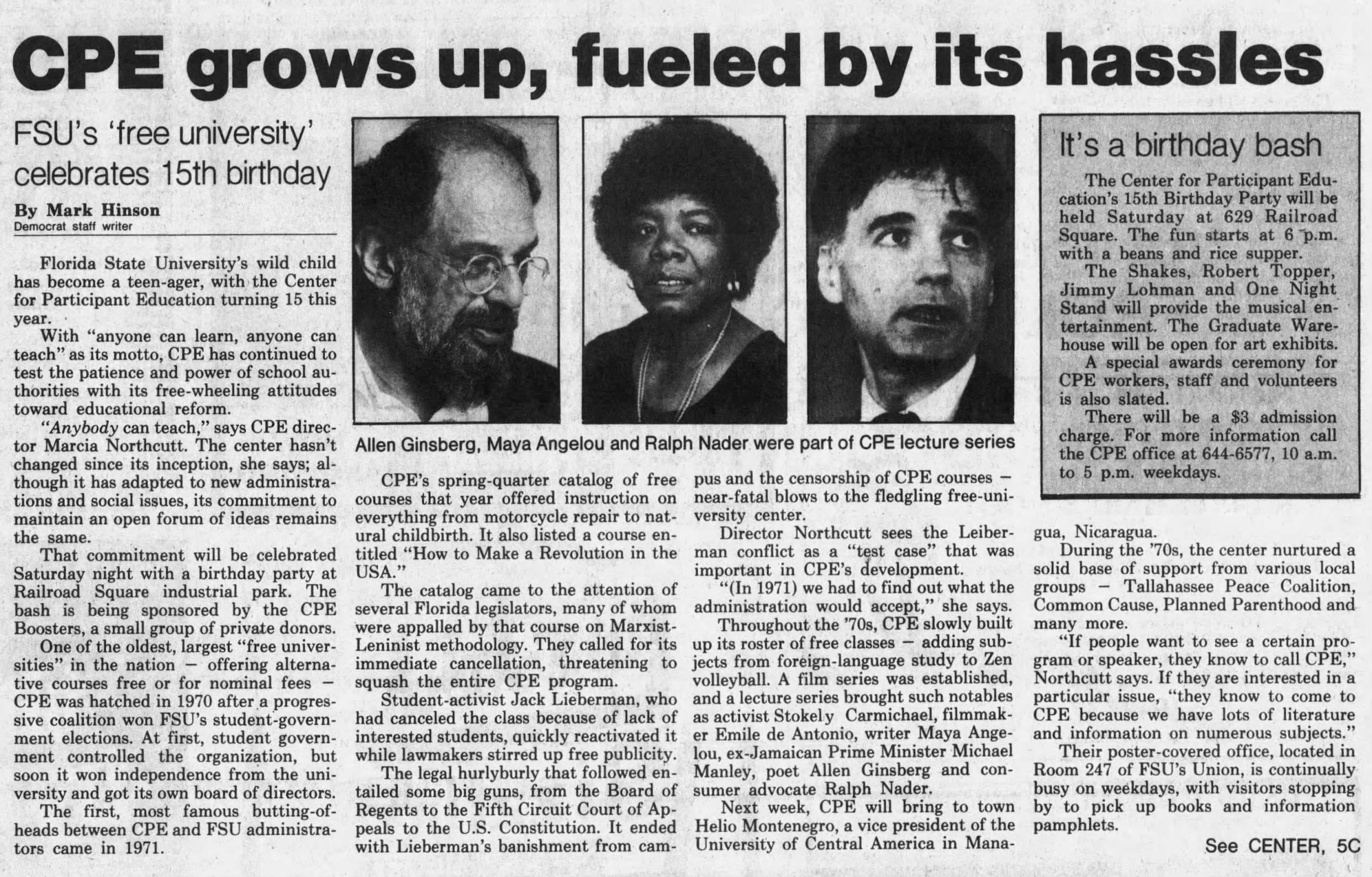
In later years, I see fewer connections. There is not much to connect Angelou and Ginsberg except that often they were mentioned on the same page of a newspaper due to having a book published or a lecture scheduled at approximately the same time. Angelou sometimes performed alongside others associated with the Beat writers. She read together with Gary Snyder, Philip Lamantia, Ted Joans, Richard Brautigan, and Kenneth Rexroth in 1980, for example. In 1984, she and Ferlinghetti stood together against South African apartheid and both were members of the Bay Area Writers Group in the 1970s. In 2000, Angelou recalled “going to jail” with Ferlinghetti as a protest against apartheid.[xviii] She is deliberately vague but it seems they were not arrested but rather marched to a jail with certain other writers. She calls him “Larry,” a name mostly used by close friends.
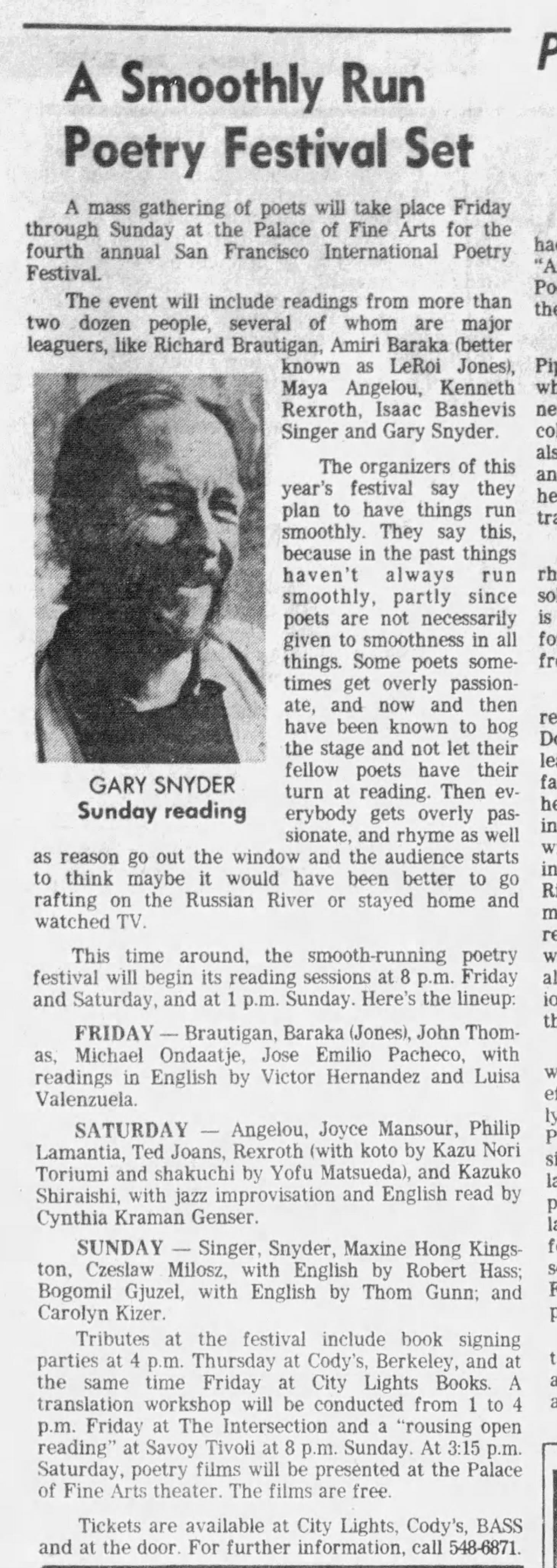
In the above clipping, you will see the name Amiri Baraka. I have thus far avoided mentioning him for he is perhaps the most obvious connection and yet it does not seem they crossed paths during the 1950s or early ‘60s Beat period. Instead, I’ve focused on the San Francisco scene and specifically Allen Ginsberg, but of course most of these people were White and as Angelou’s writings made so apparent, race was always a factor, even in a place like San Francisco, which was far more progressive than the rest of the country. People of different ethnicities mixed socially here more than in other parts of the countries but still this was not always extensive and later, with the Civil Rights movement on the sixties, people like Angelou were viewed as Black artists and the post-Beat hippie movement was viewed as being very White. With different poetics and politics and social circles, Angelou and the Beats grew so far apart that it is hard to imagine they had ever crossed paths.
This was also the case with a Beat-associated writer, LeRoi Jones, who later became Amiri Baraka. Angelou befriended and worked with Malcolm X and although Baraka did not know him he was very much inspired by him and left shocked and angered by his assassination. It was following this tragic event that Baraka changed his name (given his new name by the man who buried Malcolm X) and only a few years later Angelou started publishing her writing, though that was more in response to the assassination of Martin Luther King.
In 1993, Angelou interviewed Amiri Baraka, who had long since ceased to be part of the Beat movement, for a TV show. She called him the greatest living poet and they went on to talk about the power of plays, about politics, and about what they believe were the failings of the Academy. There was no discussion of the Beat Generation but they talked about why they believed American society had regressed since the sixties but that there was hope in (some) rap music.[xix] Baraka read a poem that talked about Malcolm X, which apparently cut short the interview by answering the question Angelou was going to ask.
[1] It was found about a decade ago and is now published.
[2] There are more details here: https://doubleblindmag.com/gerd-stern-allen-ginsberg-carl-solomon/
[3] He seems to be referring to “Barry Drew,” whom Angelou describes in Singin’ and Swingin’… She would certainly disagree with Stern’s assessment of Drew as a “wonderful guy.” He is depicted as being quite cruel.
[4] A proto-Beat scene of the Bay Area was well underway by this point and Sausalito had been filled with artsy hipsters since the forties. Bern Porter, W. Edwin Ver Becke, and other important names from my history of the 6 Gallery lived and worked there before the SF Renaissance kicked off, and arguably the SF scene grew out of the movement of artists from Sausalito and Berkeley. This is also discussed in Beatdom 25. Likely she was looking back years later and saw little difference between the early Beat-like and later beatnik scenes.
[5] An interesting note is that this part of the show was nearly cancelled due to complaints about the noisiness of the drums.
[6] In 1987, in Ginsberg’s home state of New Jersey, both poets performed as part of the Whitman Center’s poetry series. No doubt Ginsberg would’ve been upset to learn that Angelou’s reading had to be moved to a much larger venue due to her greater popularity.
[i] I Know Why The Caged Bird Sings, p.204
[ii] On the Road: Original Scroll, p.277
[iii] Singin’ and Swingin’…, p.84
[iv] Off the Road, p.333
[v] Evergreen #2, p.154
[vi] From Beat Scene Poet to Psychedelic Multimedia…, p.19
[vii] From Beat Scene Poet to Psychedelic Multimedia…, p.44
[viii] The Heart of a Woman, p.3-4
[ix] The Heart of a Woman, p.4
[x] https://www.sausalitohistoricalsociety.com/2022-columns/2022/5/25/when-maya-angelou-danced-in-sausalito
[xi] Harry Partch: A Biography, p.230
[xii] Singin’ and Swingin’…, p.79
[xiii] The San Francisco Examiner, Dec 11, 1955
[xiv] The Heart of a Woman, p.4
[xv] https://lithub.com/when-lawrence-ferlinghetti-defended-a-tribute-to-allen-ginsberg/
[xvi] Bloom’s Major Poets, p.9
[xvii] Gather Together in My Name, p.117
[xviii] The Cincinnati Enquirer, May 4, 2000
[xix] Conversations with Amiri Baraka, p.260-266
Comments
Nothing yet. Say the first thing.
Sign in to join the conversation.