
I was reading Malcolm Lowry’s Under the Volcano recently and came across the line “among the Indians,”[1] which reminded me of William S. Burroughs’ amusing start to The Yage Letters: “Wouldn’t do to go back among the Indians with piles.” I laughed at the stupid connection and quickly dismissed it. A few pages later, though, Lowry mentions the Mayan Calendar. Hmm. Okay… and then a few more pages and there’s a reference to Oswald Spengler’s Decline of the West. Later, it references Céline’s Journey to the End of Night. Well, that doesn’t necessarily mean anything, does it? Burroughs was living in and writing about Mexico in the late forties and early fifties, only a decade after Lowry. They were literary men of loosely the same era, both upper-class addicts who ended up in Mexico, so it’s not surprising that they would mention some of the same ideas. But then I thought about the whole concept of Lowry’s novel: a man in the grips of a terrible addiction knows he is destroying himself but cannot escape it. Is that not a fair summary of Junky? The more I read, the more I saw in this book that connected with Burroughs’ three interlinked books from this period: Junky, Queer, and The Yage Letters.
None of these books is by itself entirely inspired by Under the Volcano to the extent that we might call it a template but remember that these were at one time thought of as a single work. (Confusingly, this was called Naked Lunch.) If we look at these books together, and compare them with Lowry’s novel, there are many connections. In addition to the aforementioned cultural references, and the thematic overlap with Junky, there is the critique of the Ugly American and his colonial-like attitude, bizarre routines as a means of coping in painful circumstances, yet more linguistic connections, and similar imagery. Both Queer and Volcano speak of “unbridgeable distances/voids” and are filled with vultures and volcanoes, for example. There is even a reference to a degenerate consul in Queer.
Are these coincidences? Am I looking too closely and finding what I wish to see? Quite possibly. For a long time, I searched for evidence that Burroughs had read Lowry’s book but could find none. When a search of his letters and other writings led to no proof of Burroughs having read Volcano, I turned to books related to his Beat peers and here I had more success. In Kerouac’s Selected Letters, we see him recommending the book to Neal Cassady in 1951. Kerouac writes:
Incidentally, apropos of everything, get high on good shit and open the pages of Malcolm Lowry’s “Under the Volcano” for the end of the line or at least the best (for you) since Proust & Joyce—try same thing with Wm. Faulkner’s ‘‘Pylon’”—but certain parts of “Volcano” are our personal meat.[i]
Interesting. What do those last three words mean? Joyce Johnson writes that
Jack had been reading Melville’s Pierre and Malcolm Lowry’s Under the Volcano, works he considered flawed but very illuminating. He admired Lowry’s stream- of- consciousness prose and probably also Lowry’s portrayal of Mexico and his alcoholic protagonist[ii]
The evidence is thus clearer of an influence on Kerouac than Burroughs but I feel there are more examples in the text of Burroughs taking ideas from Lowry than Kerouac.
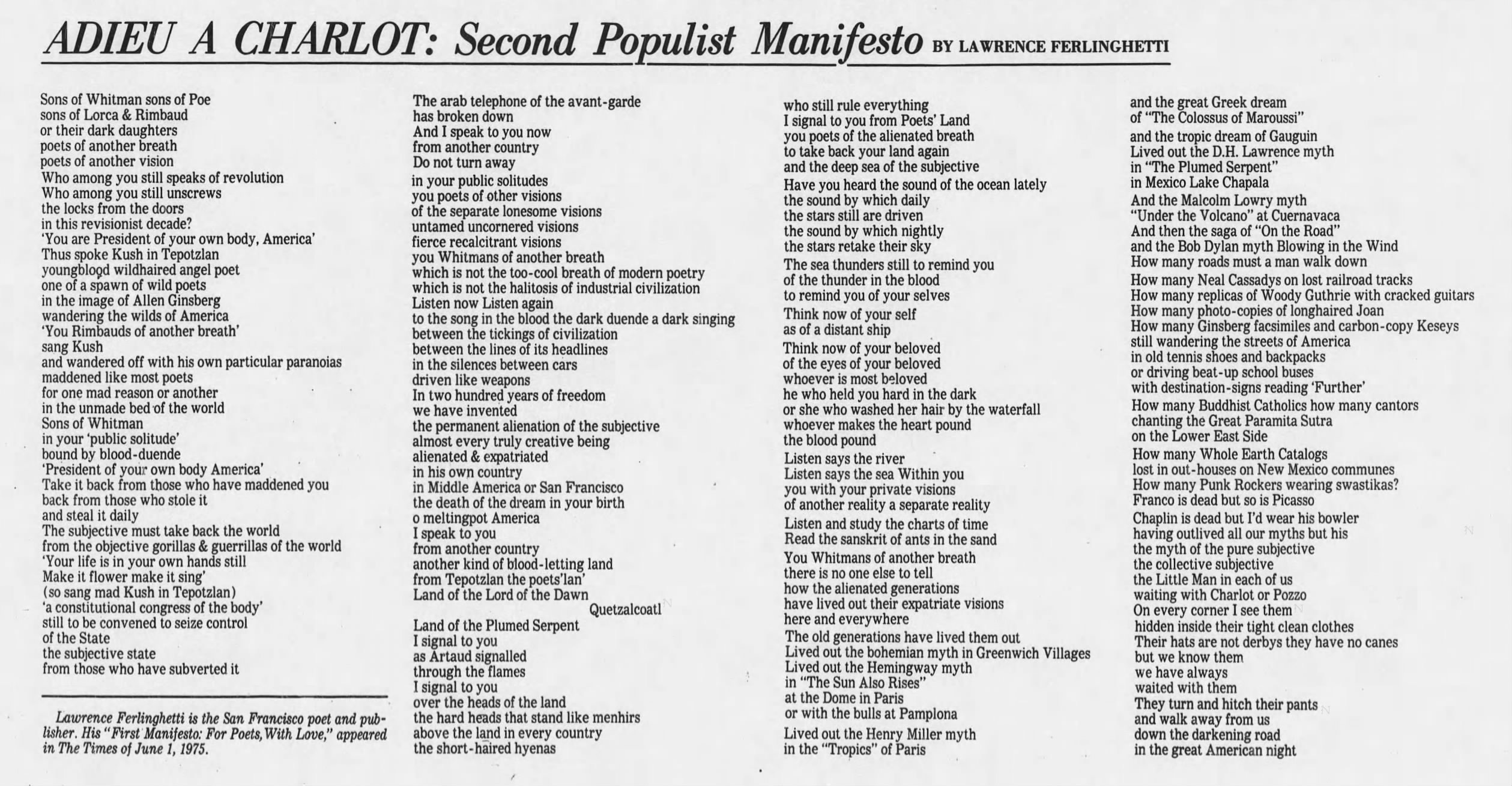
A further search of the Beat books in my collection yields more evidence of Lawrence Ferlinghetti’s interest in Lowry than any of the Beat poets. (Ferlinghetti, of course, said many times he was not a Beat poet but it is hard to deny he was closely associated.) He published Lowry posthumously through City Lights as part of the Pocket Poets Series. This was, in fact, the first collection of Lowry’s poetry to be published. Ferlinghetti referred to him often in travel journals, letters, and poems. The book Starting from San Francisco begins with a Lowry quote and The Mexican Night makes allusions to Under the Volcano.[2] On a trip to Nicaragua, he felt the environment was similar to that of Lowry’s book and made reference to the grisly end of the protagonist.[iii] On that same trip, he “binged” on books by Kerouac, F. Scott Fitzgerald, and Lowry.[iv] On a trip to Mexico, he sought out a café that Lowry had frequented, and in “Adieu a Charlot: Second Populist Manifesto,” he links Kerouac and Lowry as part of a long American mythology:
And the Malcolm Lowry myth
Under the Volcano at Cuernavaca
And then the sage of On the Road[v]
In 2003, for the 50th anniversary of the founding of City Lights Bookstore, the San Francisco Chronicle ran a feature called “City Lights and the Counterculture 1961-1974,” in which many people (including Gary Snyder, Diane di Prima, Michael McClure, Joanne Kyger, David Meltzer, and Lenore Kandel) shared their memories. Oddly, and apparently with no provocation, Ferlinghetti chose to talk about Lowry:
Malcolm Lowry’s “Under the Volcano” had a reputation of being a psychedelic book in the ’60s. […] In “Under the Volcano,” the hero was an alcoholic—Lowry himself—who was the vice consul [sic] in Cuernavaca, and he drank a lot of mescal. He hallucinates on mescal in the famous scene at the end of the book. That was a top best-seller for many years.[vi]
I wonder if Ferlinghetti ever discussed this book with Allen Ginsberg, who alluded to it in “Howl” in the line:
who disappeared into the volcanoes of Mexico leaving behind nothing but the shadow of dungarees and the lava and ash of poetry scattered in fireplace Chicago
Personally, I always assumed this was merely a reference to John Hoffman, a poet friend who had died in Mexico in 1952, coupled perhaps with Ginsberg’s own visits to Mexican volcanoes, but evidently there is more to it than that, for Ginsberg notes in Howl: Original Draft Facsimile… that this is “[a] Ref[erence to] Malcolm Lowry, Under the Volcano.”[vii] Perhaps as a heroin addict who died in Mexico, Hoffman seemed to Ginsberg like a version of Lowry’s alcoholic Consul.
Did Ginsberg perhaps take something else from Lowry’s book? The following lines certainly bring “Howl” to mind…
Quauhnahuac was like the times in this respect, wherever you turned the abyss was waiting for you round the corner. Dormitory for vultures and city Moloch!
I have written before that Ginsberg likely took the “Moloch” idea from Kenneth Rexroth—and it goes without saying that Rexroth and Lowry were not the only writers to invoke Moloch before Ginsberg—but the grammar and punctuation in the bold sentence above are quite familiar. From the very first draft, Ginsberg relied on the exclamation mark for references to this figure. The idea of “city Moloch” also brings to mind the obviously urban nature of Moloch in Ginsberg’s poem. The “Dormitory for vultures” phrase of course suggests Ginsberg’s “hydrogen jukebox” concept of combining apparently unrelated words for surrealistic effect. He explained this once as:
the inspired line, my favorite phrase in “Howl.” So hydrogen jukebox is murderous innocence. It’s the same thing, taking two opposite words or two words that would be theoretically unrelated and putting them together to make a connection which comes surrealistically from the unconscious but really makes sense.[viii]
In 1985, the same year Ginsberg was annotating “Howl,” Burroughs finally published Queer, a novel written about 30 years earlier, and he added an introduction. It began:
When I lived in Mexico City at the end of the 1940s, it was a city of one million people, with clear sparkling air and the sky that special shade of blue that goes so well with circling vultures, blood, and sand—the raw, menacing, pitiless Mexican blue.[ix]
The book indeed refers to vultures though not nearly as often as Lowry’s, where they appear a dozen times. The colour blue comes up again and again—almost 60 times—in Lowry’s book, and the word “menacing” is very common. Burroughs goes on to describe life in Mexico circa 1949 and it certainly echoes Lowry’s book. The following line also seems very much to repeat an incident about a third of the way through Volcano, when the Consul awakens face down in the street, having happily slept there in a drunken stupor. Burroughs writes:
Drunks slept right on the sidewalks of the main drag, and no cops bothered them.[x]
He goes on to say:
It was sinister and gloomy and chaotic, with the special chaos of a dream.[xi]
This pretty much captures the Mexico of Lowry’s novel. Burroughs then goes on to recount several stories of excessive violence he supposedly read in newspapers. The last one:
More murderous were the politicians and off-duty cops, each with his .45 automatic. One learned to hit the deck. Here is another actual story: A gun-toting político hears his girl is cheating, meeting someone in this cocktail lounge. Some American kid just happens in and sits next to her, when the macho bursts in: “¡CHINGAO!”[3] Hauls out his .45 and blasts the kid right off his bar stool. They drag the body outside and down the street a ways.[xii]
I wonder if perhaps this is a rewriting of the end of Under the Volcano, where the Consul’s killer is the Chief of Rostrums, who says “Chingao” several times before shooting him. He is seemingly dragged to a ravine and tossed in, with a dead dog thrown after him. What went through his mind when he was shot? “At first the Consul felt a queer relief.”
Of course, Burroughs did not choose the title for his book based on this line (or for that matter the other 18 uses of “queer” in Lowry’s book) but again it is an interesting coincidence. As I noted above, though, it is possible these are all coincidences… The two writers were not far apart in age (born 1909 and 1914); both from affluent families with servants; both well educated (Cambridge and Harvard); both haunted by deaths (Paul Fitte and Joan Vollmer); both well-travelled and well-read; both more interested in outsider, criminal elements than academia; both addicts; both spent time in mental institutions, with Lowry spending time in Bellevue, where Burroughs once picked up Joan Vollmer; both having fled to Mexico to evade the law only to eventually find new legal problems and flee once again; and of their time in Mexico, both wrote books that examined the idea of the Ugly American, which were studies of addiction… So perhaps it was inevitable that there were connections of a coincidental sort and that Burroughs had never read Lowry’s book at all.
But in fact he did.
Finally, after much searching, I found it in a text I had wanted to initially check: Burroughs Live: The Collected Interviews of William S. Burroughs, 1960-1997. Alas, I lost my copy a good few years ago and it’s out of print and not easy to acquire here in rural Cambodia. Lowry is mentioned twice in that book, with Under the Volcano explicitly noted as a book Burroughs admired. But most importantly, on page 135, Burroughs calls Lowry an influence on his work:
I have also been influenced by a number of writers that I’ve read to one degree or another: Joseph Conrad, Joyce, Celine, Cocteau, Beckett, Malcolm Lowry…
Had I found that when I first began, perhaps this essay would’ve been a long comparison of Under the Volcano and Burroughs’ early books, but somewhat fortuitously the struggle to find that acknowledgement of influence led me to the realisation that Lowry’s great novel not only came to inspire Burroughs but also Kerouac, Ginsberg, and—most of all—Ferlinghetti. Though we do not find Lowry’s name in many books about the Beats, except to occasionally note that they entered a literary tradition of visiting and writing about Mexico, it seems that he perhaps ought to be considered another of the many writers categorised as an influence on the Beat Generation.
I should note here that this essay was probably triggered in an unconscious way by reading the manuscript of a forthcoming book about Burroughs. It does not mention Lowry at all, but in the introduction it talks of Burroughs’ “unacknowledged borrowings” from books he read. This is Joseph Darlington’s Dark Angel: The Theology of William S. Burroughs, to be published by Beatdom Books in 2027. In it, Darlington writes that Burroughs had an incredible (although not perfectly eidetic) memory and frequently took phrases and ideas from books he had read, inserting them into his own work in a way that often involved “misdirection.” Darlington explains:
I have found many instances of Burroughs […] highly praising an author’s work in the form of a book he hasn’t borrowed from, while making no mention of another book by the same author which he cribs for his own purposes.
I don’t think this exactly applies here because Burroughs didn’t praise other Lowry books and did admit the influence of Under the Volcano. But of course there weren’t many other Lowry books to praise. Although Volcano is widely considered one of the great novels of the century, its author only published two books in his lifetime and even considering his posthumous works Lowry’s bibliography is not extensive. Still, it appears that Burroughs took much from this novel that we might call “unacknowledged borrowings.” I read Darlington’s manuscript about a month before re-reading Under the Volcano and possibly it pushed me to notice those little bits of language so familiar to the Burroughs reader: “among the Indians,” etc. Certainly, it made me think more about them and led to the writing of this essay, which I do hope in turn leads to others conducting more research into the links between Lowry and the Beat writers. For now, though, I am too busy editing the next issue of Beatdom and a book about Burroughs’ three wives. I’ll post an update about those soon. Subscribe for updates…
[1] Lowry repeats this phrase 7 times in his novel, which is quite possibly why it stuck out so much for Burroughs.
[2] See David Stephen Calonne’s book The Beats in Mexico p.22-26 for more on this text and its relation to Lowry.
[3] My 1987 edition has this incorrectly rendered “CHINGOA” but other versions get it right as “CHINGAO.” I have corrected the above quote as clearly Burroughs meant “CHINGAO,” whether or not he was borrowing from Lowry.
[i] Charters, Ann (ed.), Jack Kerouac: Selected Letters 1940-1956 (New York: Penguin, 1996) p.235
[ii] Johnson, Joyce, The Voice is All: The Lonely Victory of Jack Kerouac (New York: Viking, 2012) p.406
[iii] Ferlinghetti, Lawrence, Seven Days in Nicaragua Libre (San Francisco: City Lights, 1984) no page numbers
[iv] Seven Days in Nicaragua Libre, no page numbers
[v] Ferlinghetti, Lawrence, Landscapes of Living & Dying (New York: New Directions, 1979) p.44
[vi] SF Chronicle, June 9, 2003, D6
[vii] Miles, Barry (ed.) Original Draft Facsimile, Transcript, and Variant Versions, Fully Annotated by Author, with Contemporaneous Correspondence, Account of First Public Reading, Legal Skirmishes, Precursor Texts, and Bibliography (New York: HarperPerennial, 2006) p.129
[viii] Morgan Bill (ed.), Best Minds of My Generation: A Literary History of the Beat Generation (New York: Grove Press, 2017) p.395
[ix] Burroughs, William S., Queer, (New York: Penguin, 1987) p.v
[x] Queer, p.vi
[xi] Queer, p.vii
[xii] Queer, p.ix
Comments
Nothing yet. Say the first thing.
Sign in to join the conversation.