
Before I get going here’s something completely different. My amazing wife Bambaji has written a book, which has inspired me too; a story for another day. Its called Remember Your True Self and is the first book about Human Design written in Conscious Life Language. It may all mean nothing to you but you can read about the “whys and wherefores” in the free download of the introduction before you buy a copy at Mr Amazon’s bookstore it’s only £2.19! 😎
Meanwhile on with the show
Three weeks ago, SK Hynix, Samsung and Micron, the three firms actually making the “shovels” that makes the gold rush possible, had their forecast earnings marked up by $150 billion in six weeks, and their combined market cap fell by about a trillion and a half dollars over the same stretch. Do the maths, as Gerard Minack of Minack Advisors did on Grant Williams’ podcast this week: a month ago these three traded on a forward PE just under 10. Now it’s 4.
Four. Tesco trades higher than that. The market’s verdict is that these earnings don’t survive the decade and valuation was never the argument. Minack calls it, an earnings bubble, and earnings bubbles pop on a different time scale, slower and without the single crash everyone’s bracing for. In the language I trade by, that’s a quad shift: growth decelerating inside the AI thematic while the story everyone’s still trading stays stuck on acceleration.
Why does this matter? Because if the pop comes from earnings rolling over rather than multiples collapsing, the people who get hurt are the ones with no valuation cushion at all: the Hyperscalers and the pure-play AI names burning cash while the chipmakers make hay. Goldman Sachs counts $1.5 trillion of Hyperscaler lease commitments, and a trillion of that isn’t on any balance sheet yet, because the leases haven’t started. Morgan Stanley flags close to another trillion of commitments sitting elsewhere, uncounted. Call it $2.5 trillion of promises, most of it invisible, held together by the assumption that today’s chips still earn their keep in five years. They won’t, they never do.
Here’s the bit the consensus keeps missing while it stares at Nvidia’s chart: this cycle’s CapEx isn’t landing in the American economy the way 1999’s did. Minack’s number: AI-related spending added about a quarter of a percentage point to US GDP over the past four quarters. In the dot-com cycle it added up to 0.8 points. A lot of the chips get bought from Korea and Taiwan, and US tech equipment imports are running $320 billion a year above where they sat twelve months ago. Korea and Taiwan are booking the actual GDP print. When this earnings bubble does let the air out, it probably won’t drag the US into recession the way the Nasdaq bust did, though not necessarily for anyone holding the wrong stock. It will still be painful.
There’s a second problem for the American AI thematic that has nothing to do with valuation: China isn’t behind anymore. A recent Chinese model closed the gap on the frontier labs, and buyers of AI services, like buyers of anything, go for the cheap, serviceable option once it exists. Minack’s analogy is the right one: this may end up looking less like a winner-take-all platform business and more like the auto industry, where nobody captures oligopoly returns because there’s always a BYD undercutting the Bentley. As Louis Gave puts it: as soon as the Chinese walk into an industry, profits walk out.
So, an earnings bubble, badly hidden leverage, spending that leaks abroad, and a competitor closing fast. None of that means sell everything and hide in the bunker. What it means is that the flows, when they turn, have somewhere specific to go. Follow the money, and it leads to Japan.
Four reasons, and they compound. Corporate Japan spent the better part of 15 years being dragged out of its bubble-era habit of chasing market share over margin, and the restructuring is real and finally showing in the numbers. The banks, which spent the better part of 20 years in a genuine credit contraction, are now lending into rising nominal growth and a steep curve. The next global cycle looks set to be led by CapEx rather than consumption: reshoring, supply-chain duplication, the whole deglobalisation checklist. That’s a goods-making cycle, and goods-making is Japan’s forte. And then there’s the yen, sitting close to 2 standard deviations below its long-run trade-weighted value on the BIS numbers, while the dollar sits 1.5 above its own: about as wide as this measure ever gets.
The cheap yen is the mechanism behind all four reasons above. Japanese investors have spent years buying foreign bonds unhedged. Hedge a US Treasury back into yen and you’re giving up 3 points of JGB yield for less than 2. The carry only works while the yen keeps falling, and the moment it stops falling, those unhedged holders start taking losses on the currency leg. Japan has roughly 130% of GDP in portfolio assets parked overseas with which to start bringing money home, and repatriation strengthens the yen, which triggers more repatriation. Once that kind of reinforcing loop starts, it tends to run for years, not weeks.
Nobody, Minack included, will tell you exactly when it starts. He keeps a chart for clients of the Nasdaq’s final 15 months into the dot-com top: a rally of roughly 150%, and five separate corrections of 10% or worse along the way, before the real top arrived in March 2000 and opened onto a 78% drawdown. He still can’t tell you why that particular pullback was the one that stuck when the other five weren’t, and he’s honest enough to say so. See chart below
There’s a mirror to all this, and it’s China: “turning Japanese” in the vernacular, with none of the currency mechanism that might fix it. Same disease: savings running ahead of investment, a GDP deflator that’s gone negative, index earnings flat for a decade, bonds the only thing working. Japan’s open capital account and floating currency let its excess saving go looking for yield abroad. China’s capital account stays closed, so it has no comparable channel out, and the excess saving just sits there compounding the overcapacity while Beijing holds tools it won’t use.
My View from the Bridge
Start shifting incrementally away from the AI thematic and toward the parts of the world that already did the restructuring while everyone was watching Nvidia’s chart. Call it a probability, weighted toward Japanese assets outperforming over a multi-year horizon once the AI thematic finishes cooling.
The gold rush isn’t over (Minack won’t call the top, and neither will I), but the shovel sellers are already telling you, at a PE of 4, exactly how much they trust their own story.
Got yen?
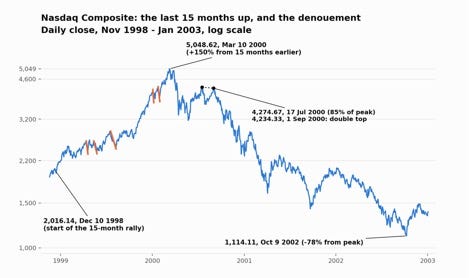
Nasdaq Composite, daily close, Nov 1998 to Jan 2003, log scale. The orange segments mark the five corrections of 10% or worse on the way to the March 2000 top, each one bought back while the rally was still intact. The dotted line marks the failed rally back to 4,274.67 on 17 July and the lower high at 4,234.33 on 1 September, the double top that gave way to the big leg down.
Comments
Nothing yet. Say the first thing.
Sign in to join the conversation.