
My best wishes to you for the holidays, loyal readers, and my gratitude to you for sticking with me on this, the day of thanks. I’ve been on a long break from this newsletter while my regular co-author Jan and I researched, wrote, and readied for publication a trade press book. The good news is that the book, Feed the People!: Why Industrial Food is Good and How to Make it Even Better, is entirely done and will be officially published in February with Basic Books, so if you’ve been hungering for new writing from me, you’ve got 288 pages worth coming your way in just a few short months (more on this in a moment).
In the meantime, I’d like to give you an update on some of the writing I’ve been doing that you may have missed, including a real barn burner that just dropped today over at The New Republic.
“The Internet Loves These ‘Gay Sheep.’ The Real Story Is Much Darker,” The New Republic, 28 November 2025.
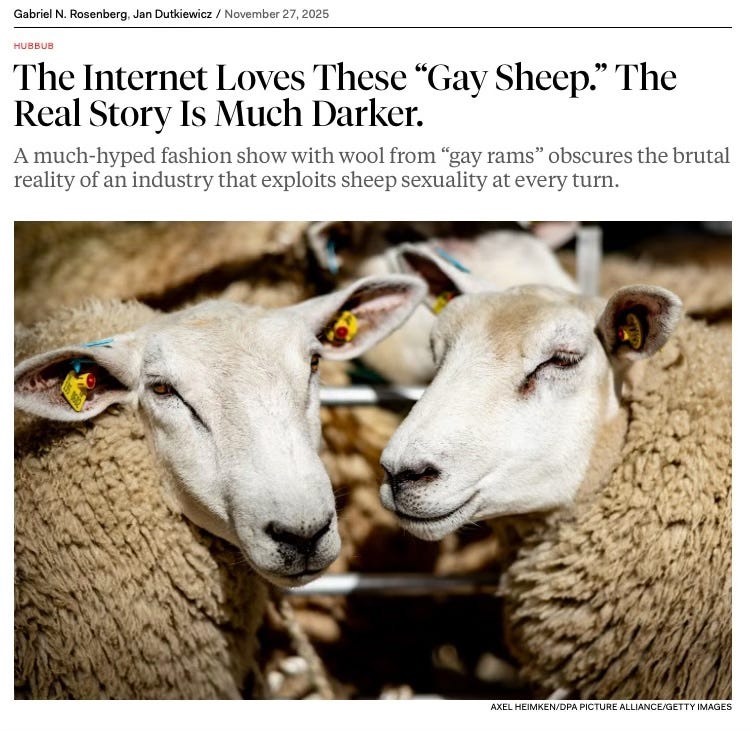
Jan and I take on the recent viral internet story about “gay” rams. Fashion designer to the stars, Michael Schmidt, in collaboration with a German sheep farm and gay sex app Grindr, put on a fashion show featuring clothing made from the wool of ostensibly “gay” rams that had been saved from slaughter. Proceeds from the show went to support the rams and German LGBTQ organisations. Sounds nice, huh? Jan and I disagree:
But the tale of the rescued gay rams is not actually a feel-good story. It only looks that way because the public is largely unaware of how the sheep industry operates. Gay rams, who refuse to breed with ewes, aren’t the only animals the industry deems unprofitable to keep alive. It passes that same judgment on breeding ewes worn out from too many pregnancies and older sheep who don’t produce enough high-quality wool. Eventually, they all get sent for slaughter, just like most male sheep, the overwhelming majority of whom are castrated as lambs and slaughtered before their first birthday. If anything, the gay wool fashion show should make us think not about the good fortune of the few rescued rams but about how animal farming systematically, routinely, and often violently exploits the reproduction of all the animals it encounters.
Oh, and the rams probably aren’t even “gay” in the way you and I mean it: the studies purporting to document “gayness” in rams are shoddy pieces of work as inquiries into the sex lives of rams. (Among other things, they’re predicated on systemic “bottom-erasure”):
In the most influential study of the subject, “stimulus animals” (what they call the bottoms and a phrase that admittedly would look great on a cropped tee) were either those previously observed to be engaged in receptive sex with other rams, and therefore deemed suitable mounts, orthose “test rams” that had already exhibited a preference to top other rams. The study designers assumed that once a ram had topped another ram it was suitable as a “stimulus animal.”
But this is a big logical leap. Defining sexual preference exclusively in terms of “topping,” and not necessarily on willing partners, is taking phallocentrism to the extreme. That’s how farmers think about sheep sex, since they need to exploit it, but is that how researchers should think about it? What if no rams like being topped? Perhaps some rams who like to top ewes also like to be topped by other rams. Perhaps some rams would simply prefer not to top or be topped by anyone. We cannot know from the cited studies. If these rams are gay in the way most people mean it, we would need evidence of both topping and bottoming, and other things besides, options the studies fail to anticipate because they’re not actually designed to study sheep sexuality. They’re designed to exploit it. This is what the Rainbow Wool sweater hype ignores: Most of what we know about the sexual behavior and preferences of farmed animals comes from research distorted by questions about how to more efficiently extract profit from the loins and labors of livestock.
Read the whole thing over at The New Republic.
“The Myth of the Carnivore Caveman,” Vox.com, 31 October 2025.
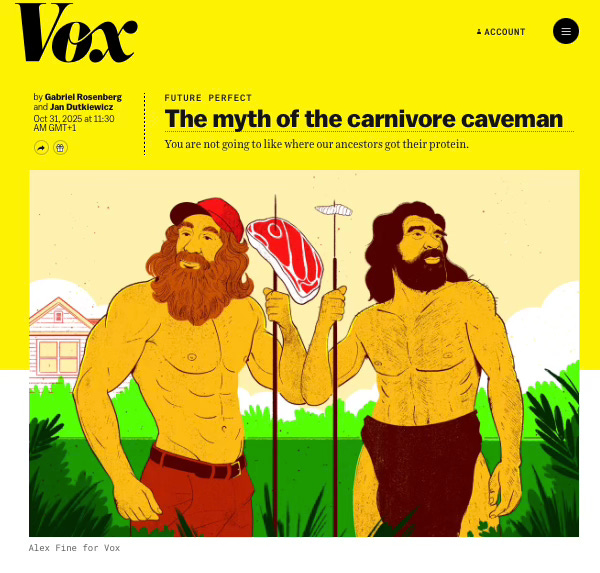
Jan and I take a deep dive into, among other things, zooarchaeological rat taphonomy to assess how much meat our prehistoric ancestors likely consumed. Did we evolve, as carnivore diet enthusiasts often suggest, to eat a diet of mostly meat? We doubt it! Humans are highly adaptive eaters, seeking calories, protein, and other nutrients where landscapes make them available. In other words, we evolved to eat many different diets, some relatively high in calories from meat, others relatively low. If that’s true, searching for diet tips from the long dead, whether prehistoric hunter-gatherers or Michael Pollan’s apocryphal “great-great grandmother,” is likely to distract us from the most consequential questions about food today:
For both left and right, myths about a romanticized past bolster present-day identities, politics, and eating habits while shielding them from debate about the food future we ought to create. Of the many problems with the modern food system, a paucity of meat is not one; research on food’s environmental impacts points us toward the need to massively reduce meat consumption. But tackling that problem, and many others, means we first need to abandon myths rooted in bad history.
Read the whole thing over at Vox.com.
Feed the People!: Why Industrial Food is Good and How We Can Make It Even Better (Basic Books, February 2026).
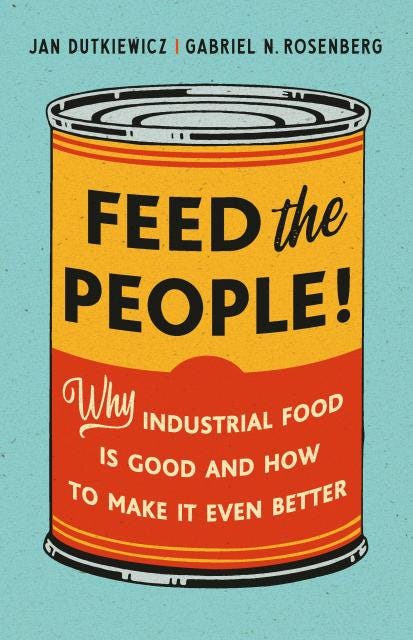
I’ll do separate posts in support of the book in the coming months, including some lengthier selections from it. For now, this is what the back of the book says:
Why Wendell Berry, Michael Pollan, and other slow-food-loving locavores are wrong about food in America—and why Waffle House can save us all.
The food industry is a major driver of climate change, pollution, obesity, animal suffering, and workplace exploitation. Many food writers blame the industrial food system and tell individual eaters to fix these problems by buying local, artisanal food from small farmers—a solution most Americans can’t afford.
But, as food policy experts Jan Dutkiewicz and Gabriel Rosenberg remind us, modern technology has made food more affordable, abundant, varied, and tastier than at any other time in history. In Feed the People!, they argue that modern food pleasures like Waffle House waffles, and the industrial systems that make them possible, are actually good. With smart technology and commonsense policies, we can make them even better.
Dutkiewicz and Rosenberg have traveled around the United States to find the people changing the way we make and eat food, from the innovators behind plant-based burgers to the cooks serving free school lunches to the labor organizers unionizing fast food joints. They show that building a food system that works for everyone will take more than just eating your vegetables.
Feed the People! invites you to sit at the table and join this delicious movement.
I’m enormously proud of the book, but in case you are skeptical of my (admittedly biased) judgment, please consider these endorsements:
“Are you tired of half-baked platitudes about the problems with our food system and hungry for real solutions? Then this book is for you. Dutkiewicz and Rosenberg refuse simplistic formulations and offer a complex, incisive, and, yes, provocative analysis, coupled with a rousing call to remake powerful industries to serve humane and sustainable ends. This book is sustenance for your mind as it imagines more democratic and delightful ways we can all fill our stomachs.” ―Astra Taylor, author of Democracy May Not Exist, But We’ll Miss It When It’s Gone
“The wild ride through politics-on-the-plate that Rosenberg and Dutkiewicz offer here invites readers to meet this moment in contemporary American foodie culture with equal parts skepticism and realism. Blending analysis of many 21st-century food fads with agricultural history and politics, their vision of the future of the food system shifts attention away from the romanticized virtues of small family farmers producing local food and toward an embrace of how industrialization can address major problems at scale. The best part is that it tackles conventional wisdom, especially the assumed value of the locavore life, with a rare combination in food lit of wit, humor, and data. Speaking to anxiety about the contemporary American food system in a fresh way, this book brings readers face-to-face with hostile noodles, long nights at the Waffle House, and a chance to reconsider their assumptions about what’s best to eat and why.” ―Kelly Alexander, James Beard award–winning former editor of Food & Wine and Saveur, coauthor of Hometown Appetites
“Feed the People! is an enjoyable and incisive corrective to some of the most misunderstood facets of the American food system. In an age of rampant misinformation around the foods we eat, this delightful and well-researched book acknowledges the wonderful and challenging complexity of food, and moves us closer to the painstaking and harmful aspects of its production and regulation. A brilliant and important way of understanding that we are most powerful when we are most educated and empathetic.” ―Marcia Chatelain, Pulitzer Prize and James Beard award–winning author of Franchise: The Golden Arches in Black America
“A powerful and essential riposte to the reactionary nostalgia that blights the public discussion of food.” ―George Monbiot, author of Regenesis: Feeding the World Without Devouring the Planet
“Dutkiewicz and Rosenberg have a knack for writing against food orthodoxies in a way that is surprising, refreshing, and informative. Polemical but reasoned and based in the idea that everyone deserves access to food pleasures, this exciting book informs about the food systems we have inherited and imagines the food worlds that could be. A rethinking of common ideas about food that is sure to radically upend how we think about what we do eat, what we should eat, and what we could eat, if only we could redistribute access to the everyday hedonism that we all deserve.” ―Kyla Tompkins, James Beard award–winning author of Racial Indigestion
“Feed the People! takes an entirely fresh approach to our ‘broken’ food system. The two authors are academic experts unafraid to point out the elitist flaws in a number of proposed food system remedies. Their coast-to-coast tour of our nation’s foodscape is egalitarian and humane. They earn our trust by providing useful information in a conversational tone, rather than partisan lectures. Open-minded readers will be rewarded and learn.” ―Robert Paarlberg, author of Food Politics: What Everyone Needs to Know
“Feed the People! cuts through both foodie nostalgia and corporate greenwash to reveal the real politics of what’s on our plates. Dutkiewicz and Rosenberg show that the industrial food system is both a triumph of abundance and a site of profound exploitation—and that the answer isn’t retreating into elitist fantasies of artisanal purity or storybook narratives of a past that never existed. Instead, they demonstrate how we can demand justice, sustainability, and pleasure—for everyone. This is a bold, necessary book that refuses despair and gives us a vision worth fighting for.” ―Will Potter, author of Green Is the New Red: An Insider’s Account of a Social Movement Under Siege
“Feed the People! overturns foodie clichés while taking the politics of food seriously. Dutkiewicz and Rosenberg show how industrial food has made abundance possible and how its strengths can be harnessed for justice, sustainability, and pleasure. With wit, clarity, and urgency, they argue for ‘democratic hedonism’ as a compelling alternative to both industrial excess and locavore elitism, advocating for policies that enhance worker rights, expand food access, and reduce environmental harm while preserving the pleasures that make eating joyful. Feed the People! is essential reading for anyone who cares about what we eat and why it matters.” ―Bruce Friedrich, founder and president, the Good Food Institute
Pre-order at the link.
Animal Mobilities: Osiris Volume 40 (University of Chicago Press, 2025), 1-309.
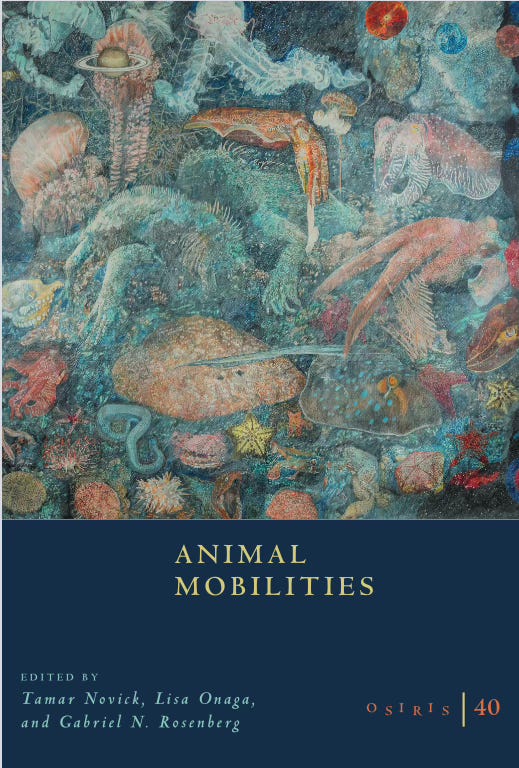
With my collaborators at the Max Planck Institute for the History of Science, I edited a volume on the role that the regulation of animal movements has played in the history of science and knowledge production. It has unusually lovely cover art, twelve brilliant essays, and an introduction by yours truly along with Lisa Onaga and Tamar Novick, my co-editors.
A side note likely of interest only to other academics and my Deans: For institutional bean counting purposes, it’s hard to say whether this is a journal “special issue” or a “book.” The series it is in (Osiris) self-describes as a journal published by the History of Science Society (HSS), but HSS also publishes another journal, Isis, that has regular quarterly issues, while the only thing Osiris ever publishes is competitively selected special issues, which, from the perspective of peer review, are edited like books and are, well, book-length. Meanwhile, it has an ISBN number and Goodreads, Google Books, and Amazon all seem to think it’s a book. So I says it’s a book, which is, incidentally, also what the Osiris editors told me to say. Case closed!
Without making any big promises—that hasn’t worked out too well in the past—my goal is to update this newsletter somewhat more frequently in the coming year, especially as we get closer to the publication date for Feed the People! and as I will (hopefully) have big news to share about <drumroll> the book after Feed the People!. I’ll also be doing public events in support of the book all over the country. On that front, if you’d like Jan and/or I to come talk about the book, we’re available and enthusiastic with presentations suitable for public audiences, academic crowds, corporate retreats, and Bar Mitzvahs. I also DJ!
Have a lovely holiday!
Comments
Nothing yet. Say the first thing.
Sign in to join the conversation.