
I like moving fast. Anyone who has spent five minutes with me knows it. In the wild, speed often is safety. Get off the ridge before the lightning arrives, cross the river before dark, make the shelter before the temperature drops. Out there, slow is how people get hurt.
So it sits strangely, even now, to admit that the most significant deal of my working life moved at a pace that nearly drove me round the bend. And that the slowness turned out to be the whole point.
One day in Cannes
In October 2019, at a television market in Cannes, we announced that my long-time producing partner Delbert Shoopman and I were joining forces with Banijay, one of the biggest production groups in the world, to build The Natural Studios, a home for adventure programming and for the next generation of adventurers coming through behind us.
The announcement took a day. There was a press release, a photo of Delbert and me grinning like schoolboys, and a headline that made it sound like something that had simply happened. That is what headlines do. They compress. A decade of graft arrives in the world looking like a morning’s news.
I want to tell you what was underneath that morning, because it holds something for every one of us, whatever we happen to be building.
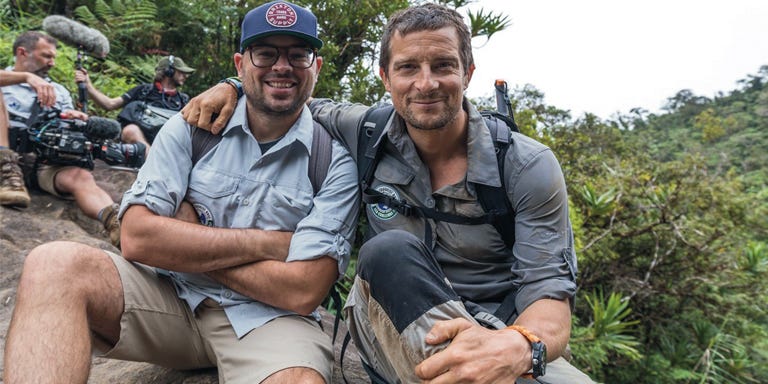
Above: Me and Delbert when filming The Worlds Toughest Race
What the deal actually changed
To understand why it mattered so much, you have to understand what the years before it looked like. For well over a decade, whatever the posters said, I was a hired gun. The networks owned the shows I fronted, and ownership means control. They controlled the narrative of every episode, what was said and what got cut, how the story was shaped in an edit suite I was rarely in. They controlled when I filmed, where I flew to and how long I was away from my family. I could give everything I had for weeks on a mountain, and then the story of those weeks belonged to somebody else to tell.
In one sense that is just a job, and most of us know the feeling. We pour ourselves into work where someone above us holds the final say, and I will always be grateful to those networks for taking chances on me when nobody knew my name. But there is a particular cost when the thing being controlled carries your face. A show can be steered towards angles and agendas its presenter never chose, and the world watching at home assumes every frame of it is you. My name went out the front of programmes I had no real say in. That gap, between what carries your name and what you actually control, wears on you more with every year it runs.
The Natural Studios turned all of that on its head. For the first time, Delbert and I owned the studio making the shows. We decide the stories we tell and how they are told. We hold the edit, the rights and the strategic control, and I decide when I leave my family and for how long. Banijay brought the backing and the global reach, but the keys stayed with us. After thirteen years of carrying other people’s programmes, we finally had a home where what we built was ours, and where we could hand opportunities to the next wave of adventurers rather than wait for a network to hand them out.
That is what made it the most significant deal of my working career. It set us free. And freedom like that is never given out. It gets bought, slowly, and mostly in instalments nobody sees.
The slow middle
Before anything was signed, there was a full strategic review of everything that carried our name. Every show, every contract, every partnership, laid out on the table and examined by people whose job it was to find the cracks. Then came the deal itself. There were drafts and redrafts, lawyers on calls across time zones, points I was sure had been settled coming back around for another round. It went on for what felt like an eternity to someone wired like me.
Every instinct I own wanted to sprint. I have spent my whole life treating hesitation as the enemy, and at this table I was learning that the opposite was true. Rush a river crossing and you get wet. Rush a deal like this and you spend the next twenty years living inside the mistake.
There were days I wanted to walk away just to feel the relief of a decision, any decision. I am not proud of that, but it is true. Staying in the process, letting the thing take the time it genuinely needed, asked more patience of me than most mountains ever have. And slowly it dawned on me that the pace itself was a form of respect, the seriousness the thing deserved.
The deal before the deal
The truth is that the paperwork was never really the negotiation. The negotiation started back in 2006, when Man vs. Wild first went out, and it ran quietly for thirteen years before anyone at Banijay picked up a pen.
It looked like episodes delivered when we said they would be delivered, budgets honoured, and broadcasters, from Discovery to Channel 4 to Netflix to National Geographic, treated the same way whether a show was flying or fighting for its life. The Island, Running Wild, You vs. Wild, Hostile Planet. Behind every one of those titles sat years of crews looked after, promises kept and hard yards done when nobody was watching.
Nobody pays properly for an idea, however good. What Banijay backed was a track record, and a track record is simply trust with receipts. It gets built in drops, one kept word at a time, and there is no way on earth to hurry it. That is the part a headline can never show. The deal was agreed in 2019. It was earned over the thirteen years before that.
The other slow deal
There is a second negotiation buried inside that story, and it matters just as much. Delbert and I had been making shows together for well over a decade before we ever put our names side by side on a studio. You do not sign up to run a company with someone because they interview well. You do it because you have watched them for years in the moments that reveal people: when a shoot falls apart, when money gets tight, when the credit is being handed out and it would be easy to take more than your share.
Trust between two people is built exactly the way trust with an audience is built, slowly, and mostly in the unglamorous moments. By the time we stood in Cannes, the partnership had already been stress-tested a hundred times over. That is why it held.
The time I nearly lost it all
And I should be honest about something else, because it belongs in this story. Early on in the Man vs. Wild years, the show took a public battering over how some scenes had been put together. It was a painful and humiliating stretch, and plenty of the criticism was fair. Standards had slipped in places, and it cost us.
What that period taught me has shaped everything since. Trust that takes years to build can wobble in a week. We changed how we worked, became far more open about how the shows were made, and then set about the long business of rebuilding it, episode by episode, season by season. Nobody hands it back to you. You earn it again in the same slow drops you earned it the first time.
I sometimes wonder whether the 2019 deal would ever have happened without that hammering. It taught us, early and in public, that reputation is the asset. Everything else is rented.
The headline and the iceberg
We all know the old line about overnight success taking ten years. It is worn out because it is true. What we forget is to apply it to ourselves.
Because every one of us has a version of this deal running in our own lives. The reputation at work that gets built one kept promise at a time. The marriage that is really ten thousand small acts of turning up. The friendship that survives because somebody kept choosing it. The business that looks lucky from the outside and is actually years of unrecorded Tuesdays.
Nobody claps for those Tuesdays. There is no press release for answering the email properly, doing the job right when cutting the corner was free, or telling the truth when a small lie would have been easier. But every one of those moments is a payment into an account that somebody, someday, is going to check. And people always check. Banks, bosses, partners, kids. Everyone reads the track record in the end.
A good name
There is a line in Proverbs that has followed me around for years: a good name is more desirable than great riches. I used to read it as a nice sentiment. These days I read it as hard fact, commercially and spiritually. The name is the riches. There was no deal in 2019 without the name, and there was no name without a thousand slow, boring, invisible deposits that nobody ever saw being made.
And I take real comfort that this is how God works on us too. He is never in a hurry. We judge ourselves on the daily chart, the good day, the rough week, the month we would rather forget. God reads the decade one. He watches the direction, and He builds people the same way trust gets built, slowly, in drops, over years we barely notice.
Keep making the deposits
So this week, one deposit. Keep the small promise nobody would notice you breaking. Do the job properly when nothing is checking except your own conscience. It will not feel like much on the day. It never does. But somewhere down the line, the slowest and most important deal of your life is quietly being negotiated by the person you are on an ordinary Tuesday.
Make sure they are someone worth signing with.
Next Sunday I’m starting the new series, Anchor Points. Part one is about the only question that matters when the weather turns: what is the rope actually tied to?
Never Give Up.
Bear
No posts
Comments
Nothing yet. Say the first thing.
Sign in to join the conversation.