
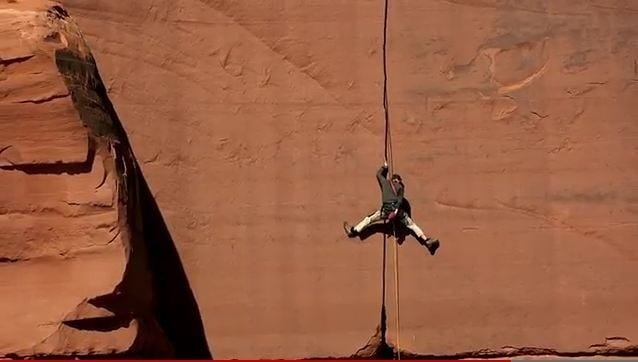
In climbing, the system only works in pairs. One person climbs, the other belays. When you come off the wall, your partner holds the rope with your whole weight on it, and on the next pitch you do the same for them. The military is built exactly the same way. Whatever the films suggest, there are no lone heroes. Everything is pairs, patrols and teams, because everyone breaks eventually, and the plan for that day is each other.
Somehow, away from the mountain, we absorb the opposite idea. That needing people is a weakness to grow out of. That the strongest version of us is the one who can do it all solo. Independence as the badge of honour, asking for nothing as the proof of strength. The wild has no patience with that idea. Lone wolves don’t look strong for long out there. They look hungry. And then, sooner or later, you stop seeing them at all.
Weight on the rope
A rope is just theory until you fall on it.
You can inspect it, coil it, trust it, talk about it. But the day it becomes real is the day your feet cut loose and everything you are hangs off it. I’ve had that day. On Everest I went through a snow bridge into a crevasse, and the world turned black and cold in about a second. What stopped me falling to the bottom had nothing to do with my own ability. It was a rope, pulled tight, held by a man on the other end who did his job.
You never forget the feeling of being held like that. All your weight, all your fear, carried by someone who simply refused to let go.
And life asks the same of us. The rope in a friendship or a marriage stays theory until we put weight on it. Until we say out loud the thing we’ve been carrying quietly for months. Until we ring a mate and admit we’re not coping. That fall can feel more frightening than any crevasse, especially for men, because we’ve been trained to believe the fall itself is the failure. It isn’t. The fall is how we find out the system works.
When I broke my back at twenty-one, I didn’t walk out of that year on grit alone. I was carried through it by family and friends and faith, by people who sat with me when I had nothing to give back. If we’ve never let anyone take our weight, we don’t actually know who’s holding our rope. We just hope.
Checking the knot
Every climber checks their partner’s knot before a climb. Every single time, no matter how experienced either of you is, no exceptions. It takes five seconds, it costs nothing, and it catches the small mistakes that kill people.
The sobering part is that the check matters most on the climbs that feel routine. Nobody forgets their knot on the terrifying day. We forget it on the ordinary one, when we’re relaxed and chatting and sure of ourselves.
I wonder what the equivalent is in a friendship or a marriage, and whether we do it anywhere near as often. The call out of nowhere. The message that says nothing except thinking of you, mate. The “how are you actually doing” asked twice, because the first answer is always fine and the second answer is the truth.
We’ve all been carried by mates through seasons we couldn’t have walked alone. And most of us, if we’re honest, have also let a good friendship quietly fray from nothing worse than neglect. Told ourselves we were busy, that they knew where we were, that we’d pick it up again when life calmed down. Life never calms down. And good relationships rarely end with a bang. They fail like an unchecked knot. Everything looks normal right up until the moment weight comes on the rope.
The strongest partnerships I’ve ever seen aren’t the ones with no strain on them. They’re the ones where somebody keeps checking.
Holding the rope
Belaying isn’t glamorous. You stand at the bottom of the climb, paying attention, feeding rope out, taking rope in, watching your partner move. For an hour, sometimes more. Nobody films the belayer. But lose concentration for three seconds and your partner hits the ground.
Most of loving people well looks exactly like that. Unspectacular attention, held for a long time.
We tend to think supporting someone means having the right words, the wisdom, the fix. On the wall it means something far simpler: stay alert and don’t let go. Think about the moments that have genuinely steadied us in a hard season. It’s rarely the clever advice we remember. It’s a mate sitting with us, phone away, fully there, not fixing anything, just keeping hold of the rope.
And I know how often I’ve been the sloppy belayer. Half listening while my mind is on work. Nodding along to my kids with one eye on the screen in my hand. Present in the room and absent on the rope. It’s a hard thought, that someone we love might be falling quietly, in slow motion, while the person holding their rope is scrolling.
So the rope runs both ways. It’s not only about who’s on the other end of ours, it’s about whose rope is in our hands right now, and how well we’re holding it.
A cord of three strands
There’s a line in Ecclesiastes that reads like it was written by a climber: though one may be overpowered, two can defend themselves. A cord of three strands is not quickly broken.
Two is stronger than one. Every climber, every soldier, every marriage knows it. But the picture in that verse is three. For Shara and me, the third strand has always been faith, woven through everything, and I’m convinced it’s the strand that has held us through the seasons when the other two were worn thin.
Because every long marriage and every old friendship has those seasons. Times when one person carries far more of the load than the other. Illness, grief, failure, plain exhaustion. A single strand under that sort of strain will snap. A cord is built for exactly that. It holds while a strand recovers, and it can only do that because the strands were woven together long before the load came on.
That’s the part we get wrong when times are good. We tell ourselves we’ll go deeper with God later, that we’ll invest properly in the friendship once things settle down. But you can’t weave a cord mid-fall. The third strand goes in early, quietly, on the ordinary days, so that it’s already there on the day everything pulls tight.
God has been that strand for me more times than I can count, and I don’t mean as some vague comfort in the background. I mean a rope that held when everything else had been stripped away.
This week
No grand challenge this week, just the knot check.
Think of one person on the other end of your rope. Someone who has held your weight before, or someone whose weight you’re meant to be holding now. One message or one call this week that says, in whatever words you’d actually use, I’m still holding it.
Five seconds. That’s all the check ever takes. And it’s the five seconds that keeps the whole system alive.
The next part in this series is: training in the rain, and why the reps nobody sees are the ones that hold.
Never Give Up.
Bear
No posts
Comments
Nothing yet. Say the first thing.
Sign in to join the conversation.