
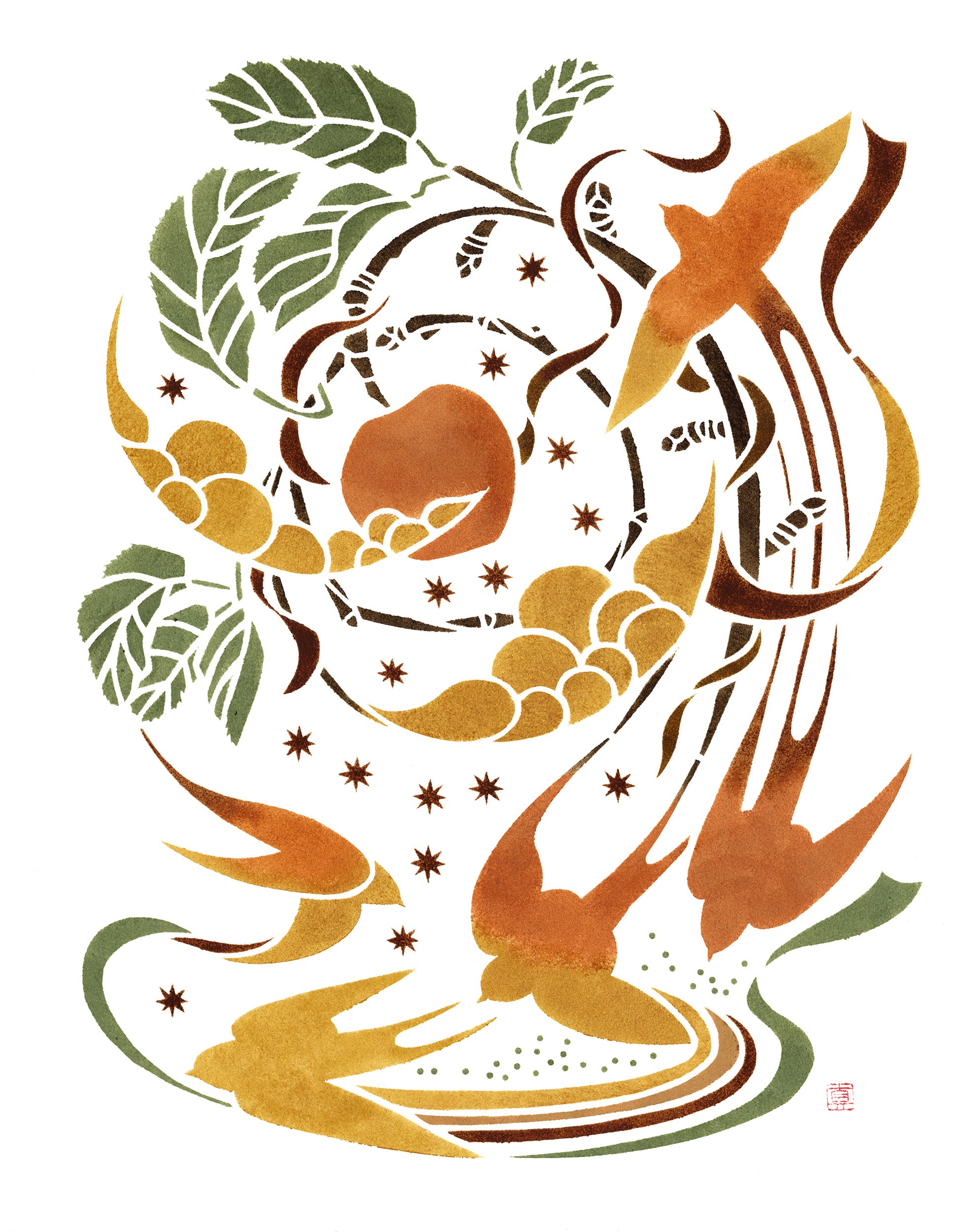
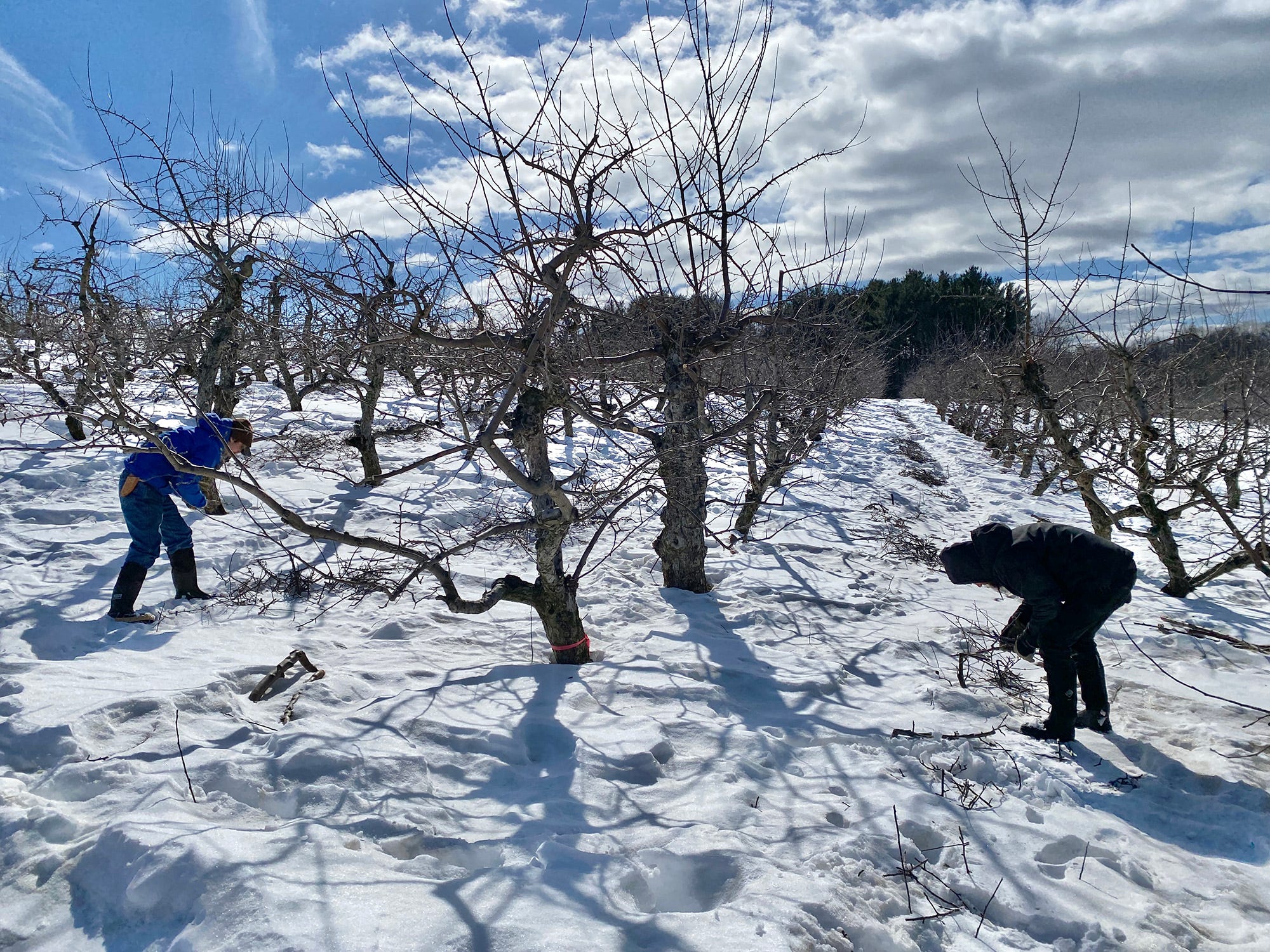
When I visited Rose Hill Farm in February to interview Kevin and Dallas, pruning was underway in the orchard. After the interview, they took me outside to see the site and collected some of the pruned branches for me to take home and experiment with. The piece above was made using pigments extracted from those materials, except for green which is from Common Buckthorn. The apple branches produced colors similar to those of the Toringo crab apple (yellow, orange, reddish brown and dark brown) which I suppose is not surprising, since they are related. Both are very rich in pigment.
The more I learn about plants that are invasive in the US, the more I feel that moral qualities such as “good” or “bad” may not be inherent traits. Invasive plants are only “bad” in relation to a specific ecosystem rather than being inherently evil. And I suppose the concept of morality is a purely human invention to begin with.
The interview with Kevin and Dallas, and their perspective on the surrounding world with a focus on balance, offered great insight into this way of thinking. Talking about weeds, Kevin said, “Weeds, in quotation marks. I have the belief that all plants that come up out of the ground are there for a reason,” and I have been thinking about it ever since. Complete elimination of invasive species is very unlikely. It may be that we need to think about changing the dynamics, our relationship with them. I will be thinking about what Dallas said as I move forward with this invasive plant project: “It’s actually a lot harder to work with it when you view them as your enemies, even though it can feel like that’s the only way to view them sometimes.” I have deep respect for farmers, biologists and gardeners for whom this is not an abstract question. They must come up with a specific solution for each situation. Artists, unlike them, are not accountable to immediate, concrete outcomes. As an artist, what I can do is be a supporter for those who do real work and celebrate their achievements through creativity.
This leads me to think that human actions may also need to be judged by their dynamics with the surrounding environment rather than through a simple “good guys and bad guys” perspective, no matter how much we want to believe there is such a clear line. Similarly, strength and ability may not be entirely individual achievements. Ethics may be less about individual grit and more about the strength of one’s network. I seem to remember news from a few years ago about Western researchers looking at resilience not simply as a trait belonging to a single person, but as something that resides in relationships with others. Everything may be more fluid than it seems. In ancient times, heroes’ powers were often credited to external forces, such as gods or stars, rather than their own achievements. Maybe ancient people were onto something.
I think the risk of fluid thinking like this is setting boundaries. When someone, or something, is clearly causing harm to others, can this fluid thinking be morphed into making excuses for them? Would that make me complicit in enabling them? What may be even more challenging is that this way of thinking asks us to see the problem as our own, rather than something belonging to 'them.'
But rather than going in with a predetermined conclusion, the assessment has to be made every step of the way, for each situation, and setting boundaries accordingly is the realistic path. You cannot decide what team you are on and settle firmly and comfortably, never re-examining the way you operate. I will be following the way of farmers, their ongoing learning, adapting, and changing, as they do at Rose Hill Farm.
Beakuency: Meet Bird People in the Hudson Valley! is a reader-supported publication. To receive new posts and support my work, consider becoming a free or paid subscriber.
Comments
Nothing yet. Say the first thing.
Sign in to join the conversation.