
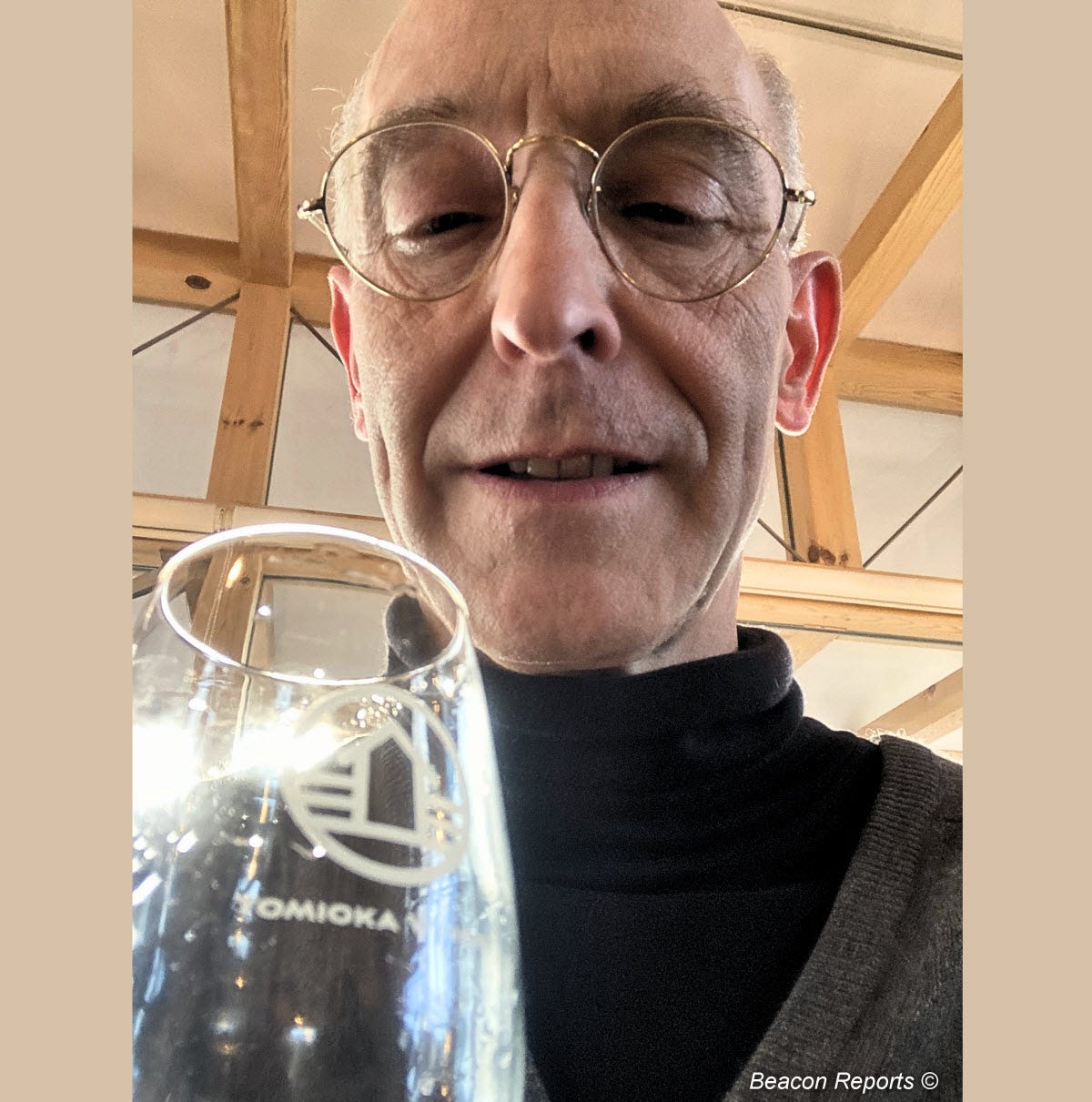
I stared into the wine before taking a first sip. It was not to let it breathe. I was catching my own breath—making a last-minute decision whether to drink produce grown on a vineyard located less than ten kilometers south of the Fukushima Daiichi Nuclear Power Plant. Radioactive material continues to escape from the damaged reactors into the atmosphere and surrounding ocean. Did the grape vines not draw on a shared water table? How could I be certain the wine wasn’t contaminated, even with low-level traces?
The visit to the Tomioka Winery was the final stop on a government-organized press tour of the disaster-affected towns of Namie, Futaba, Ōkuma and Tomioka, marking the fifteenth anniversary of the Great East Japan Earthquake.
Two fellow journalists on the tour consoled me: Japan’s water supply is among the world’s cleanest, they said. Food safety standards are also among the world’s strictest, limiting radioactivity in food to 100 becquerels per kilogram. In lay terms, a becquerel measures the “bullet count” of atomic particles fired per second. Another widely used unit, the sievert, measures the “hits” that can damage human tissue. By any measure, Fukushima produce is rigorously tested before sale. The wine was certainly safe to consume, I told myself.
Still, the regularly spaced Geiger counters placed along highways, at intersections and even in front of the Michi-no-Eki Namie (the roadside rest station in Namie Town, Futaba District, which opened on August 1, 2020), served as unsettling reminders of the radioactive dangers that had once engulfed this coastline.
* * *
At 2:46 p.m. on March 11, 2011, an earthquake of magnitude 9.0 struck off the Pacific coast of northeastern Japan — the most powerful ever recorded in the country. The tsunami it unleashed, reaching heights of up to 40 meters in the hardest-hit areas, destroyed more than 123,000 homes and damaged nearly a million more across the coastal region. In Namie Town alone, the wave exceeded 15 meters, washing away or damaging 604 houses.
We visited Ukedo Elementary School in Namie, a snapshot frozen in time. Eighty-two of the school’s 93 elementary students were still at their desks when the earthquake struck. Teachers and students fled on foot to Mt. Ohira, 1.5 kilometers away, running without coats into freezing wind. All survived, as the tsunami swallowed the building they had just abandoned up to the second floor.
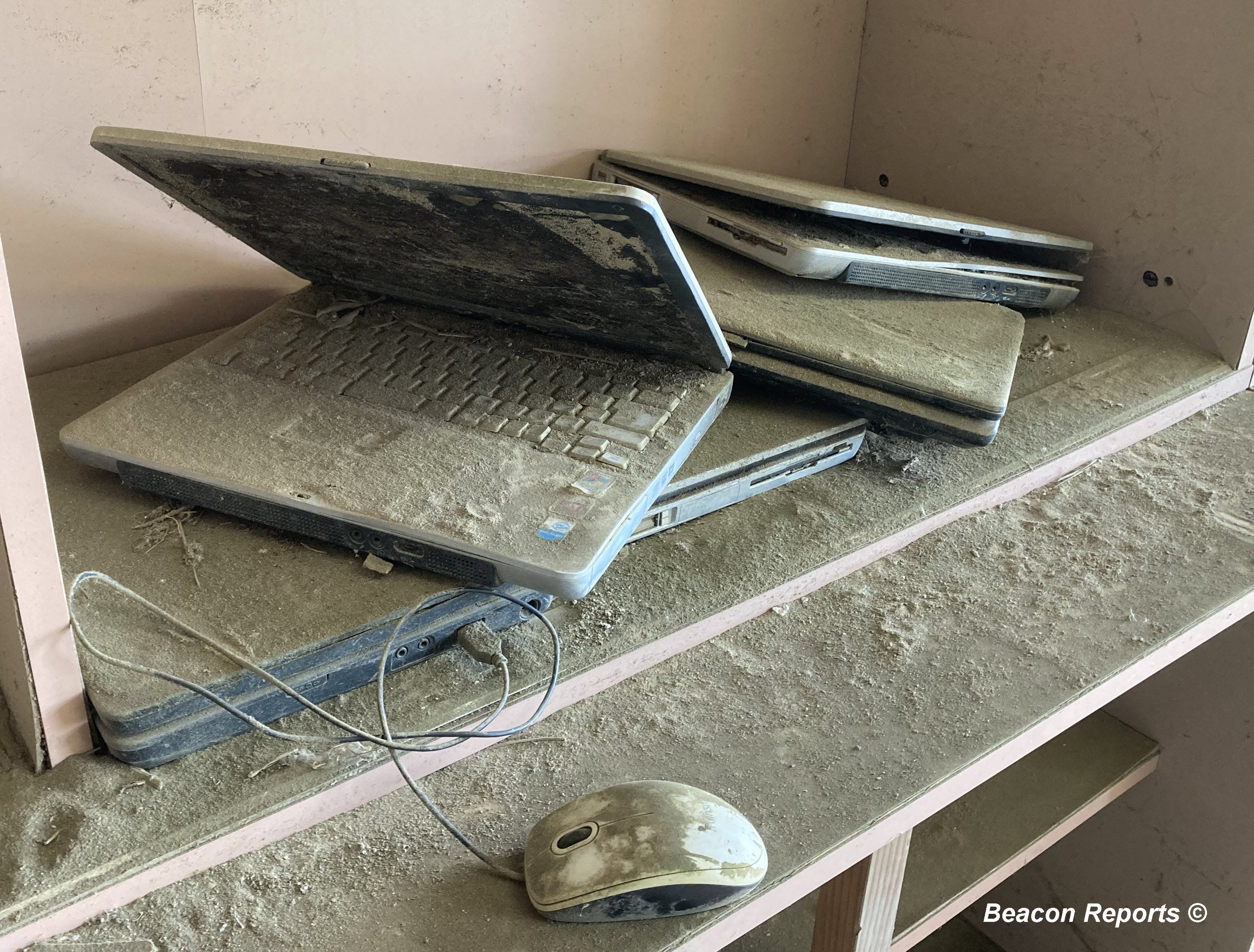
Others in the coastal districts were not so fortunate. Residents who stayed at home, family members who went to collect them, police and firefighters guiding evacuation—all perished in the wave. Across the broader disaster region, more than 18,000 people lost their lives to the earthquake and tsunami.
Then came the nuclear crisis. The earthquake and tsunami triggered reactor meltdowns at the Fukushima Daiichi Nuclear Power Station, discharging radioactivity equal to between 15 and 18 percent of what escaped at Chernobyl. Approximately 164,000 people were forced from their homes. More than 2,300 people, mostly elderly, died from the trauma of forced evacuation alone.
* * *
From 2013, national and municipal governments started decontaminating Fukushima’s evacuation zones. No nation had ever attempted such an ambitious decontamination program. The program included pressure-washing roads, cleaning roof gutters and sandblasting hard surfaces, in addition to topsoil removal—the main decontamination method.
Workers scraped up approximately five centimeters of contaminated topsoil and vegetation, packed it into one-cubic-meter container bags, and trucked it to 1,370 temporary storage sites dotted throughout the prefecture. Workers completed this task by March 2018 across all but the most restricted zones.
From March 2015, truck convoys began hauling the bags from the temporary sites to the Fukushima Interim Storage Facility, a centrally located 16-square-kilometer site straddling Ōkuma and Futaba towns and encircling the Daiichi plant itself. At peak operations, 3,000 trucks a day made the run, amounting to some two million trips in total. By March 2022, the convoys had cleared almost all temporary sites.
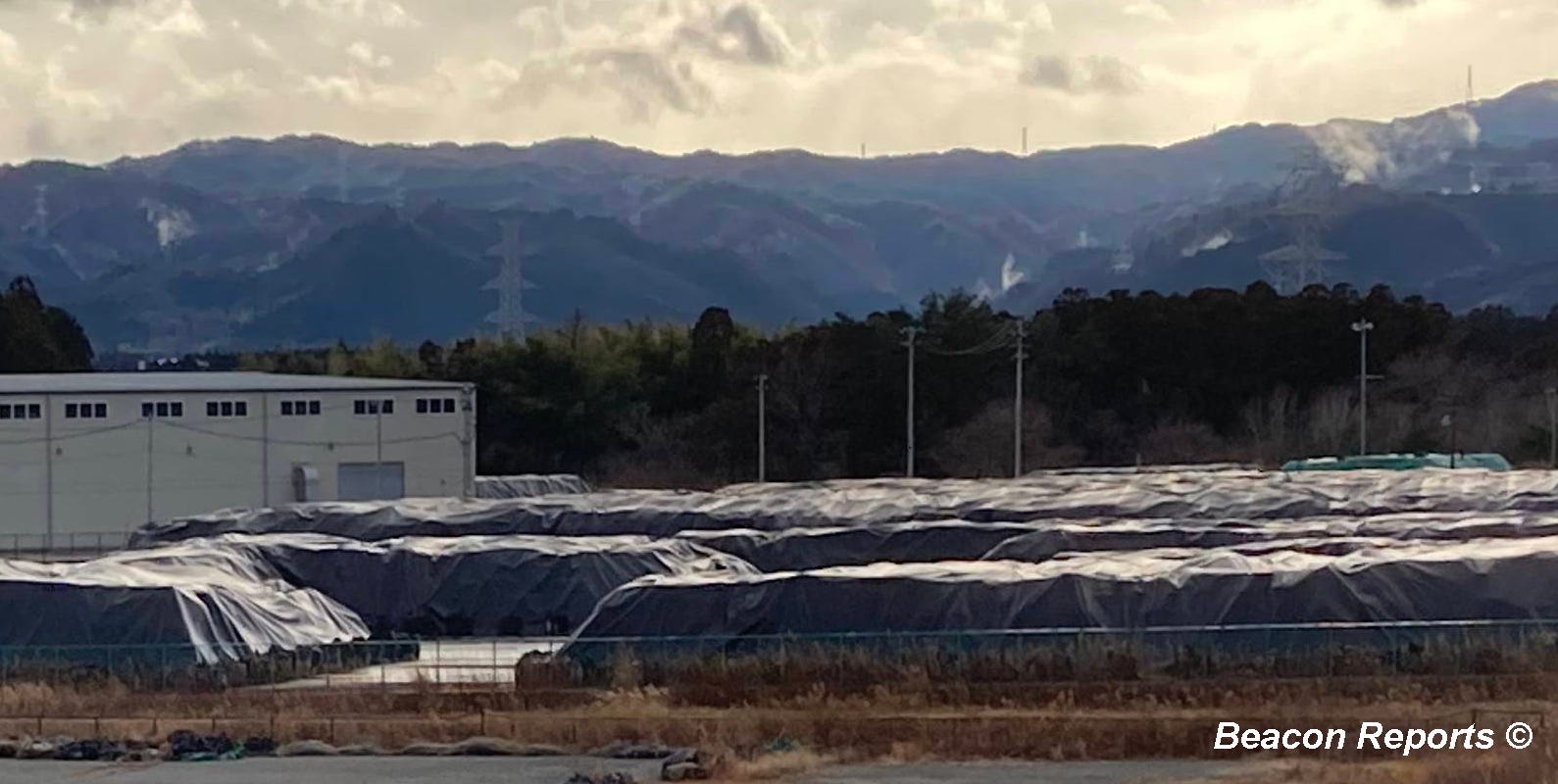
On the drive through Futaba and Ōkuma to the interim storage facility, we passed some of the last remaining temporary storage sites, witnessing the black-bagged contaminated soil still littering the landscape.
At the interim facility, workers separated contaminated soil from combustible waste — vegetation and felled trees — before incinerating the latter. The resulting highly radioactive ash is sealed in steel containers inside reinforced concrete buildings. Outside, we stood before the managed storage mounds: vast earthworks burying the less contaminated soil beneath clean earth — enough material to fill Yankee Stadium approximately 37 times over.
According to the Ministry of Environment, radiation levels at the soil storage facilities measure 0.1 to 0.3 microsieverts per hour, well within the range of natural background radiation levels found around the world.
* * *
By law, Japan’s government pledged to remove all stored soil from Fukushima Prefecture by March 2045 — 30 years from the start of interim storage. In return, the people of Ōkuma and Futaba extracted a promise: accept the facility on their ancestral land today, and the soil leaves within a generation. The redistribution strategy rests on what the government calls “managed recycling” — the reuse of lower-contamination soil in public works projects rather than burying it all as waste.
The plan is to reuse the roughly 75 percent of the soil registering 8,000 Bq/kg or below, the threshold the government considers safe, for use in road embankments, coastal defenses and similar infrastructure, though no other prefecture has yet agreed to take it. The remaining 25 percent, which exceeds the threshold, needs permanent burial at a location still to be chosen by around 2030.
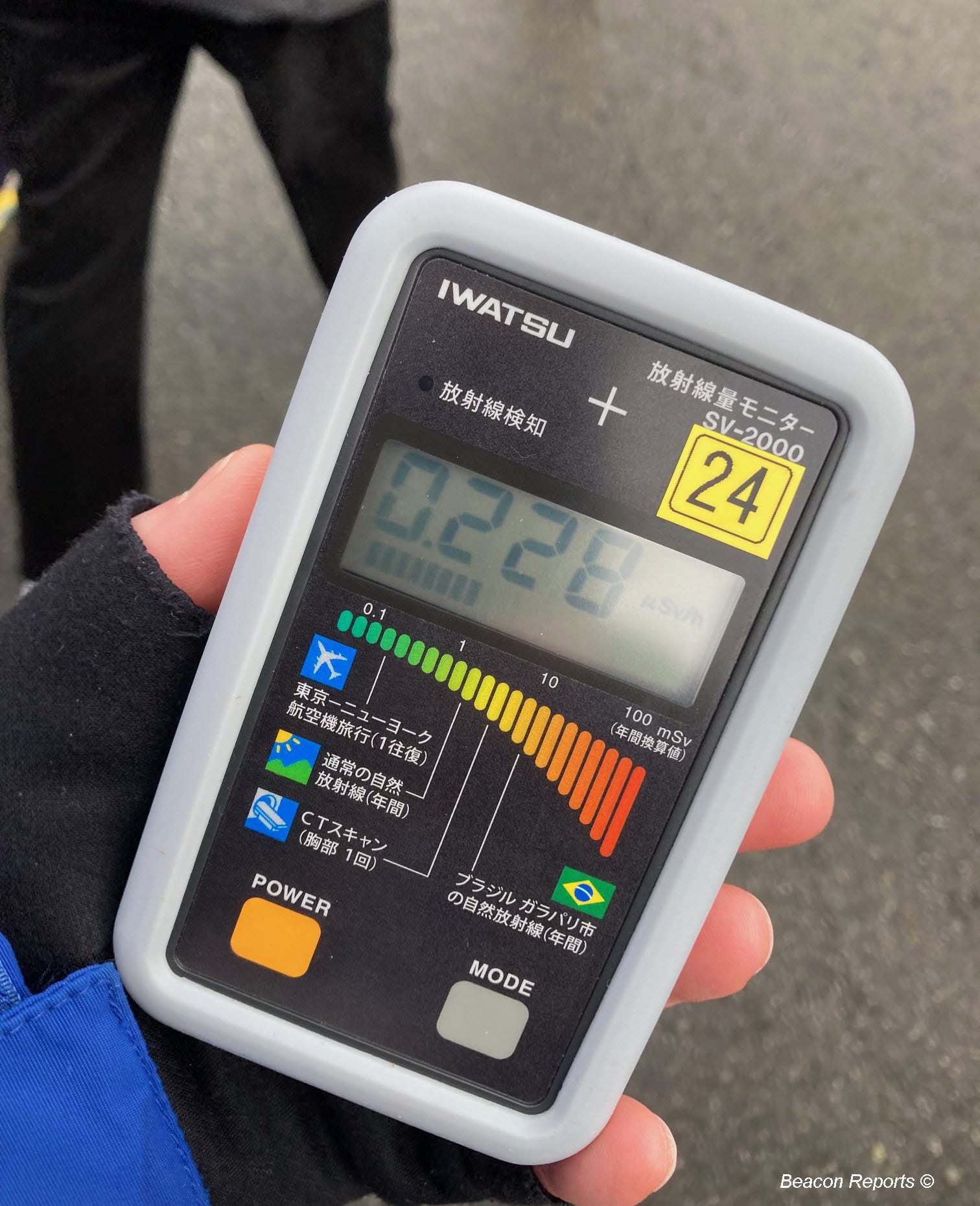
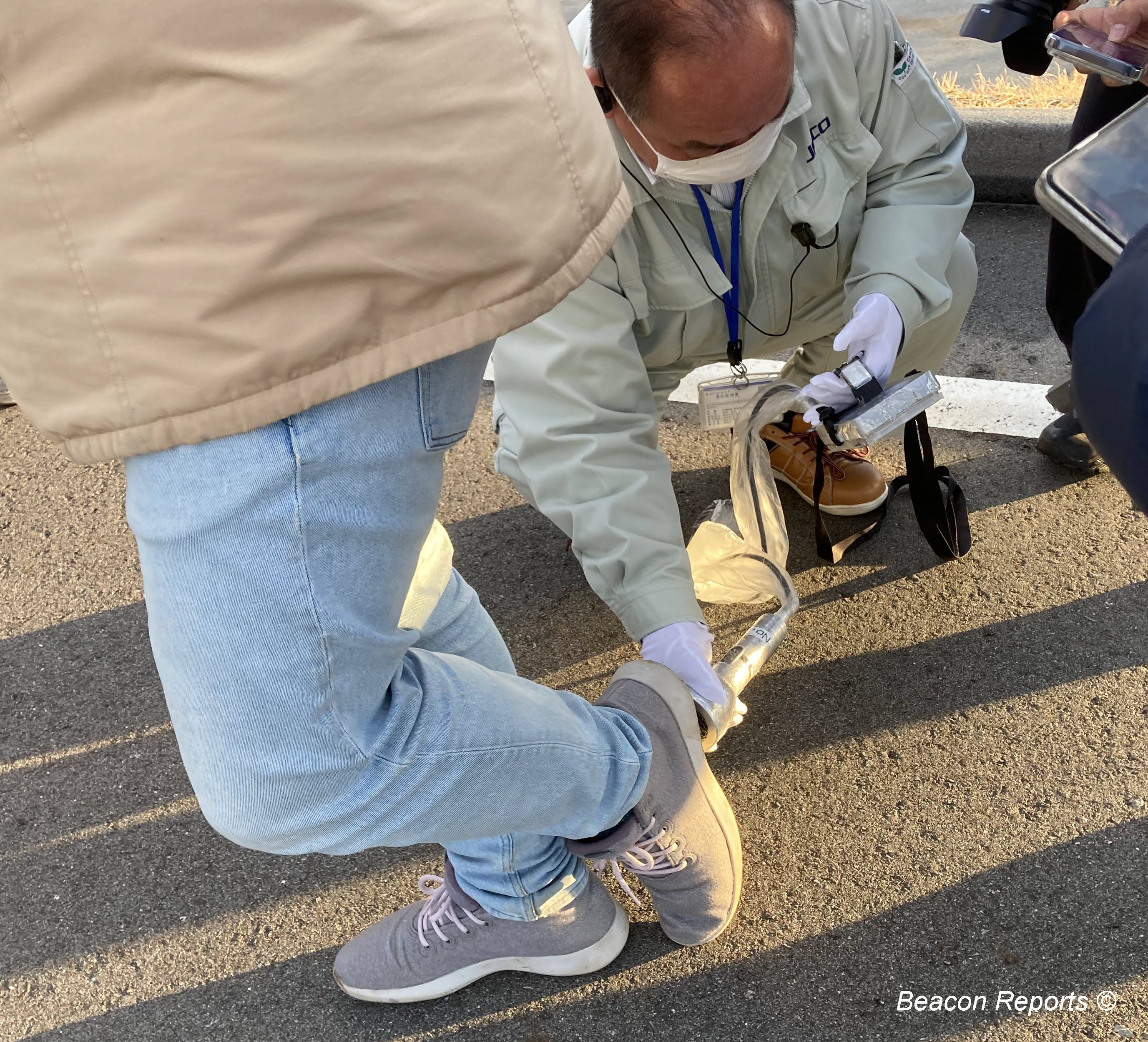
We toured the Road Embankment Demonstration Site within the interim storage facility, where the reuse methodology is being tested. The demonstration embankment sandwiches contaminated soil between waterproof liners and a cap of clean earth. A handheld Geiger counter I carried registered 0.228 microsieverts per hour at the surface (a reading comparable to natural background radiation in London, Hong Kong or Seoul, and well within the range measured across the facility). A white-gloved official checked our shoes with a professional-grade Geiger counter as we departed, a precaution that felt both reassuring and sobering.
The primary barrier to the reuse plan is not technical but political. Nationally, roughly 60 percent of Japanese say they do not want the contaminated soil relocated near where they live — and a 2021 survey of prefectural governors across Japan found universal opposition to accepting it. The government is hoping the Japanese public will ultimately accept Fukushima’s displaced soil in an act of shared national responsibility, honoring the pledge made to the Fukushima people. Whether that hope proves realistic remains an open question.
Only now are people returning to areas that were once within the exclusion zone. Between June 2022 and November 2023, authorities finally lifted evacuation orders in the six most contaminated municipalities — Katsurao, Ōkuma, Futaba, Namie, Tomioka and Iitate. Futaba, the last town to remain entirely off-limits, allowed residents to return to parts of the town for the first time in August 2022.
We toured new businesses in the zone. In Namie, Rice Resin Inc. converts discarded rice, comprising old government stockpiles, broken grains and damaged harvests, into bioplastic. They aim to grow inedible rice on abandoned farmland as a way of rehabilitating soil for eventual food production. In Futaba, Super Zero Mill operates a huge yarn-twisting factory which now employs 20 people in a town whose population fell from 7,000 to zero following the disaster.
At the Tomioka Winery, where annual production runs to about 10,000 bottles sold entirely on-site, the winery’s representative offered a measured assessment of the recovery: “This place may look like it has recovered on the surface,” he said, “but the substance of recovery — people haven’t come back. No matter how many facilities are built, if people don’t gather there, it’s just empty boxes.”
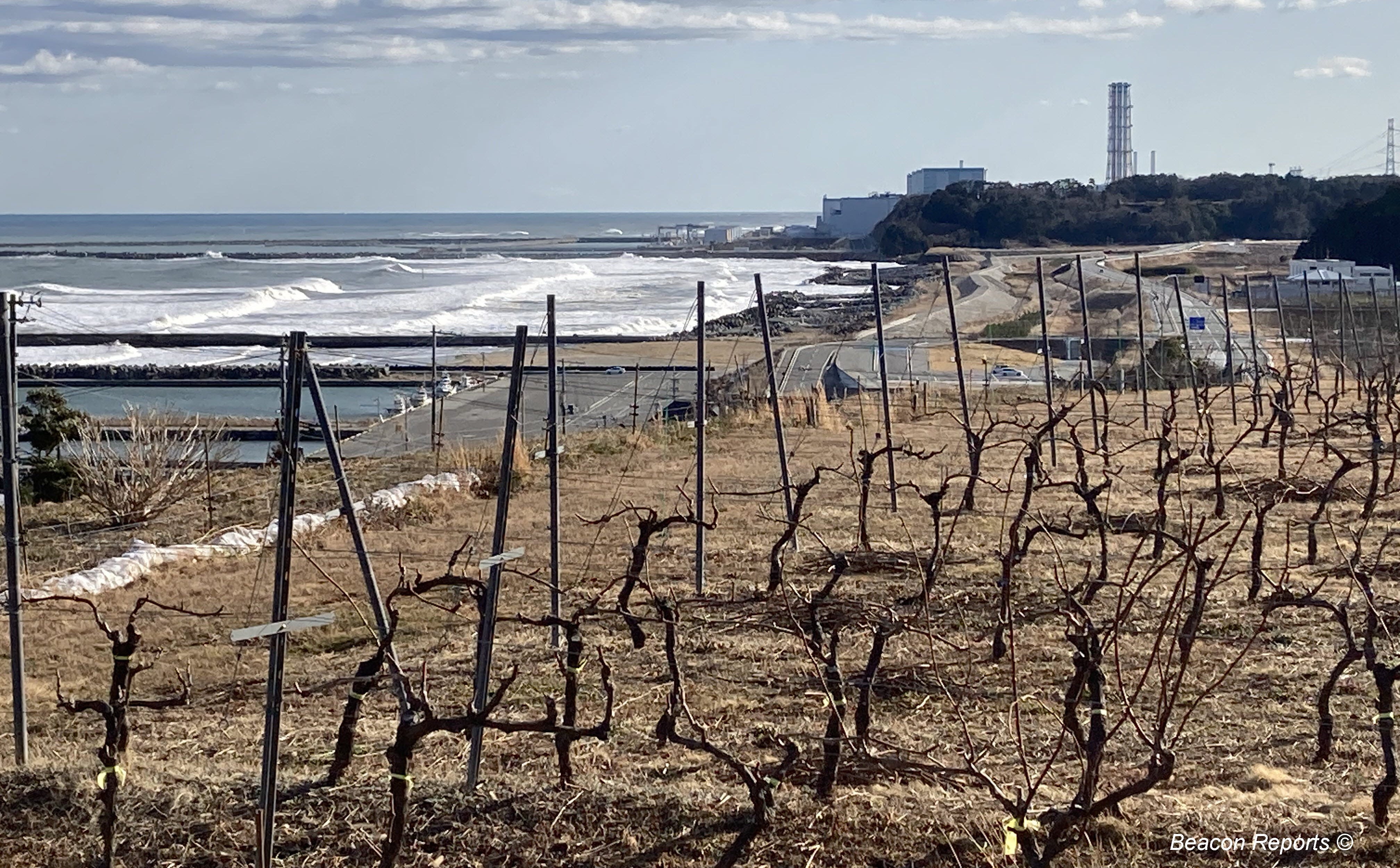
With some 27,000 people across Fukushima Prefecture still displaced more than a decade and a half after the disaster, full recovery will take many years to come.
* * *
Not everyone agrees the government’s plans are safe.
Tetsunari Iida, a nuclear engineer turned energy policy critic, founded the Institute for Sustainable Energy Policies and now chairs it. He cites what he calls the three foundational principles of radiation safety, established from the pioneering days of Marie Curie: concentrate radioactive material, isolate it from human life, and keep it contained.
The government’s plan to distribute Fukushima’s soil in public works projects across Japan, he argues, does the opposite on all three counts. He points to what he regards as a fundamental double standard: before the nuclear disaster Japan’s regulatory limit for radioactive waste discharged from nuclear power plants was 100 Bq/kg. The threshold now applied to Fukushima soil is 80 times higher. Iida says the health risk is greater still, because radioactivity can be swallowed or inhaled to attack living tissue from within.
“The individual exposures may be small,” Iida said, “but spread across 120 million people, even a small per-person risk adds up — the expected number of additional cancers is not zero.” He believes the soil should remain in Fukushima under permanent containment, for “at least several centuries.”
Iida’s concerns are shared by others in the scientific community. They reflect a genuine tension between the International Atomic Energy Agency’s endorsed approach, which treats the risk as manageable under engineered controls, and a more precautionary interpretation of radiation safety principles. As 2045 approaches, that tension will intensify.
The people of Fukushima have borne an extraordinary burden. Whether the rest of Japan will share it, by accepting contaminated soil in their own communities, may be the most difficult question of the next two decades.
* * *
Wisely or unwisely, I drank the wine.
No posts
Comments
Nothing yet. Say the first thing.
Sign in to join the conversation.