
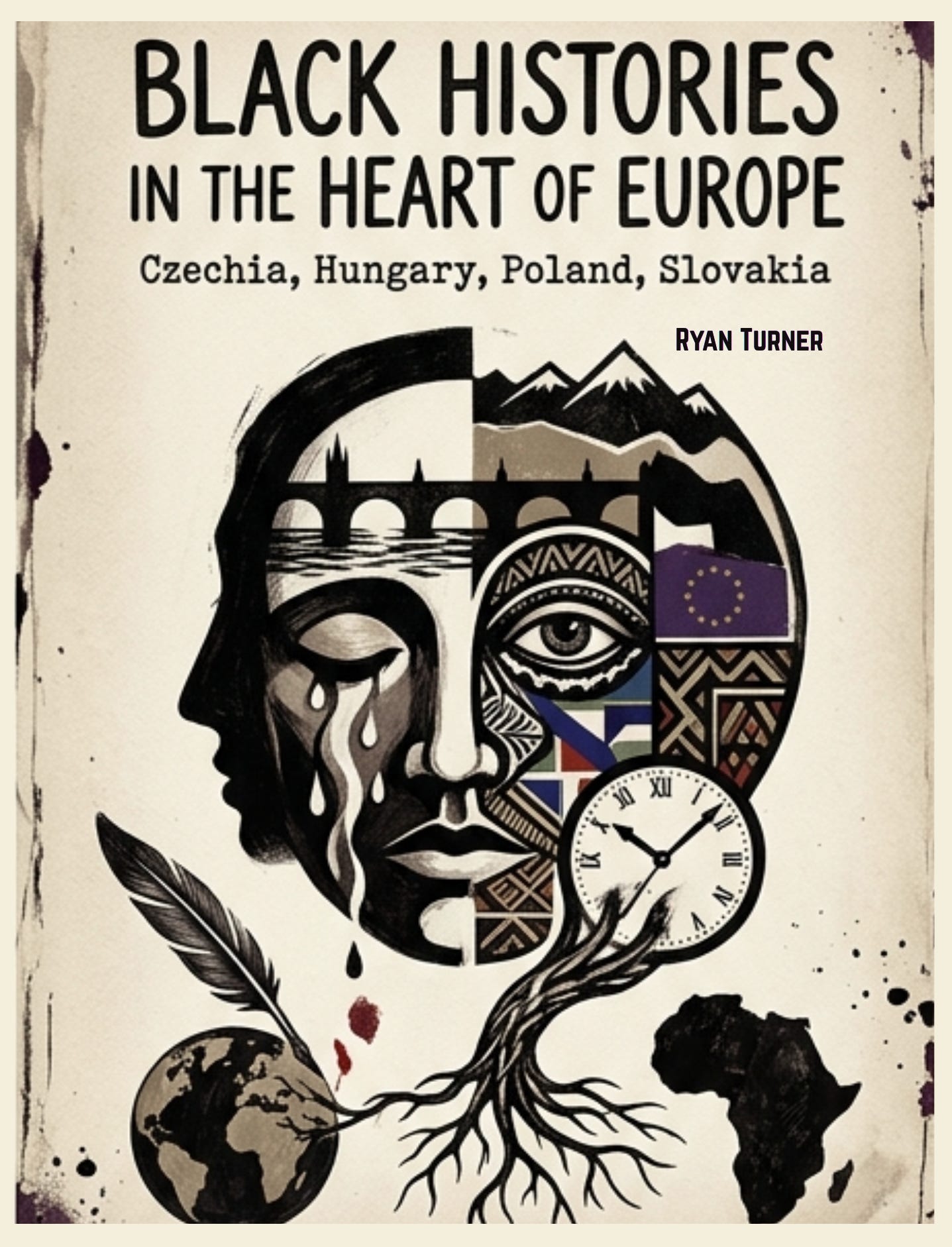
During the research and writing for my first book Black Histories in the Heart of Europe , a curious side story regarding advocacy, charity, fundraising, philanthropy, civil society and politics started to form involving young America and old Europe during the 1800s-1900s.
Between roughly 1800 and 1920, Black Americans developed one of the richest traditions of self-help and philanthropic organizing in U.S. history. Figure that before 1920 there were probably dozens of nationally significant Black-led fundraising campaigns and hundreds of regional ones. These pioneering and innovative mutual aid societies, churches, women’s clubs, schools, and local fundraising efforts left incomplete records— but the models and activities have been adapted and adjusted over time.
But…every so often, whenever some anecdotal nugget would emerge from piles or stacks of notes, there was also some prominent European political or revolutionary leader who just happened to come to the United States. Not merely as a diplomat or visiting dignitary, but to raise money.
This got my fundraiser’s curiosity stirring.
Sometimes the European appeals were openly political and sometimes purely humanitarian. Many times, there were lecture tours or advertised requests to the public. Community events were not uncommon, with concerts, live performances, oratory or book readings. But some seriously savvy outreach and marketing, raising money through the sale of bonds or public collections. For causes abroad.
After encountering a few, I made note of the ones that struck me most. I now curious to know whether these were isolated episodes or part of a broader historical pattern. The ones that are stuck in my thinking for now include:
(1) Daniel O’Connell (1830s–1840s) He and his team persuaded Americans to establish local chapters of the Loyal National Repeal Association. So rather than a centralized national apparatus, there was a built-in financial remittance stream through which small donations from Irish-American immigrants were collected and sent directly to O’Connell’s headquarters in Dublin. So I’m pegging this, for now, as the the precedent and blueprint for using overseas ethnic communities to fund domestic European political agitation.
O’Connell also fiercely denounced American slavery and urged Irish Americans to align with abolitionists. His vocal anti-slavery positions strained relations with many Irish Americans tied to the pro-slavery Democratic Party, cooling financial support by 1843.
(2) Lajos Kossuth (1851–1852) toured Great Britain and the United States to raise funds, print “Kossuth-dollars”, and rally public backing for Hungarian independence. Though greeted by massive crowds and prominent leaders, he secured immense sympathy but no official government intervention. We hinted at a few reasons why this failed in the book.
(3) Gottfried Kinkel (1851–1852), traveled to the United States between as a spokesperson for European Forty-Eighters to raise money through a “German National Loan”. His goal was to finance a future democratic German republic. Despite a positive public reception in the U.S. and a meeting with one of the 10 worst presidents in all of U.S. history the campaign brought in very little actual money and caused political rifts among exiles.
(4) Amand Goegg (1851–1852), Another of the “Forty-Eighters” who did an American lecture and fundraising campaign to raise funds and rally support for European republican revolutions. This did not go well, mainly I think because his German skills faced some language and cultural barriers. But also he just didnt have the “it” factor that his contemporaries did when it came to public speaking. Kind of important when you’re raising money.
(5) Alberto and Jessie White Mario (1858-1859), came to the U.S to promote the Italian Risorgimento, deliver public lectures, and raise vital funds for Giuseppe Mazzini’s republican movement. Jessie spoke in English to American audiences; Alberto spoke in Italian to the local immigrant community. This tour actually got what passed for a rave review from the New York Times back then. But I think this one was a bust. Not for trying. But it’s kind of hard to raise funds and support when your base can’t decide if they want a monarchy or a republic. No money raised, and actually they had to borrow money from Mazzini himself as the war for unification escalated
(6) Charles Stewart Parnell did a mega-American tour in 1880 blending famine relief and radical Irish nationalism. Crop failures in 1879 created real starvation risks, which allowed Parnell to appeal broadly to American empathy and non-Irish donors who might otherwise resist radical separatist politics. That economic crisis provided an emotional and financial gateway to advance structural political reform. And his messaging was blunt: starvation was not an act of God, but the direct structural result of an oppressive land tenure system. No sugar coating, he made a plea for food into an indictment of imperial rule.
He became the first foreign political representative to address a formal gathering of the U.S. House of Representatives, elevating the Irish land question to an international diplomatic issue. By addressing the U.S. Congress and touring over 60 cities, Parnell used immediate humanitarian needs to mobilize the diaspora for a permanent political war against British landlordism.
(7) Ignacy Jan Paderewski (1915–1918) raised millions of dollars for Polish war relief by uniting the wealthy and working-class Polish diaspora (Polonia) through a blend of high-profile piano recitals, passionate public oratory, and organized charity networks. There were four elements I’ve been able to suss out.
The Vevey Committee: co-founded in Switzerland in January 1915 with Nobel-prize-winning writer Henryk Sienkiewicz to collect international donations for war victims.
The Polish National Department (Wydział Narodowy Polski) which evolved from his charity campaigns to unify American Polonia under a centralized political and financial apparatus.
The Polish White Cross, founded in 1918 by Ignacy and his wife, Helena Paderewska, to support Polish soldiers. This last one is striking because it raised funds through clever tactics like selling regional “Paderewska’s Dolls” for up to $300 each.
Combo events featuring concerts and lectures:. Shortened musical repertoires—heavily featuring Chopin—immediately followed by lengthy, compelling political and humanitarian speeches. All delivered in English.
The grassroots mobilization component was essential and quite compelling. Lots of travelling extensively across North America to meet émigrés face-to-face, successfully bridging divides within the diaspora to fund both humanitarian aid and the recruitment of a “Kosciuszko Army” of volunteers to fight in France.
(8) Tomáš Garrigue Masaryk (1918), mobilizing Czech and Slovak communities while seeking political recognition and financial backing for an independent Czechoslovakia. What’s fascinating for me is the elements at play. Communities like the Slovak League of America and the Czech National Association organized massive financial campaigns, collecting hundreds of thousands of dollars to fund the Czechoslovak National Council.
The funds raised paid for exile operations, propaganda, travel across the globe, and the upkeep of foreign offices in Paris, London, and Washington, D.C. I’m seeing the name of wealthy American industrialists popping up, especially Charles Richard Crane. So the notion of patrons and benefactors helping foreign causes seems to be more than a casual thing. But it’s also the leverage and influence these wealthy patrons and donors brought— financial and political— to help Masaryk gain access to high-ranking Allied leaders.
(9) Éamon de Valera (1919–1920) did an American tour that raised some $5 million for the Irish Republic through a mix of large public rallies, political lobbying, and the sale of bond certificates
(10) Jonas Vileišis (1919/1920) served as a key Lithuanian representative in the United States, securing vital financial and political backing. If my notes are right, he secured nearly $1.9 million from roughly 28,000 subscribers in the United States. His approach, I think, was modeled on the American Liberty Loans model used during World War I. So fundraising by issuing bonds that promised financial repayment only after formal international recognition of the Republic of Lithuania was his strategy.
The examples may or may not point to something from me further. But this blurring of distinctions that we often take for granted today is hard to dismiss. Political advocacy, charitable giving, humanitarian relief, philanthropy, and public fundraising operating together rather than as separate activities. And all of this at a time when democracies abroad were looking to the America as a model and a source of funds.
Meanwhile… Black philanthropy in this era wasn’t peripheral—it was an entire parallel philanthropic ecosystem. Because mainstream foundations, governments, and white charities largely excluded Black Americans, Black communities created their own fundraising infrastructure decades before the emergence of modern philanthropy.
By the early twentieth century, this ecosystem included thousands of churches, hundreds of mutual aid societies, numerous newspapers, dozens of colleges, fraternal orders with hundreds of thousands of members, and national fundraising networks spanning the United States.
Whether this ultimately proves to be historically significant or merely an interesting coincidence, it still seemed worth following the trail to see where it leads.
Black Histories in the Heart of Europe now available at
Amazon (paperback, hardcover, eBook)
Barnes & Noble (eBook)
Kobo (eBook)
Apple Books (eBook)
Google Play (eBook)
Bookmundo (eBook)
On BE4SI, we’re talking nonprofits/NGOs, social enterprise, philanthropy, civil society, and social impact— filtered through U.S. and Central/Eastern European lenses. We’d be honored to have you as a subscriber! ⚡
Enjoyed our read? Drop a tip to help us stay 100% independent and ad-free! 🫶🏾
Word of mouth is essential to our growth. Please share us with others. 💫
Comments
Nothing yet. Say the first thing.
Sign in to join the conversation.