
In mid-June, I covered Leopold Aschenbrenner’s call to action for the US government to make AI a critical national mission, like it did with the development of atomic weapons. This week, Sam Altman, CEO of OpenAI, wrote an op-ed for the Washington Post where he called for a similar solution to Aschenbrenner.
Altman stated that “the U.S. needs to maintain its lead in developing in AI, rather than leave a vacuum for authoritarian governments,” and, with a slight difference of emphasis than his US-focused former OpenAI colleague, that a “U.S.-led global coalition can best ensure that AI stays democratic, and that it benefits as many people as possible.” [Emphasis added].
Mark Zuckerberg, Founder and CEO of Meta, however, set out a very different argument this week. Here’s the TL;DR:
· Zuckerberg believes open-source AI is better for developers, companies and the world.
· Better for developers because it gives them more control.
· Better for companies because they won’t get ‘locked in’ a closed-source system.
· And better for the world because it’s better if everyone has access to powerful AI, rather than just a select few who could use it maliciously.
· The subtext: use Llama 3.1, Meta’s new AI model.
Last week, Andrej Karpathy, former head of AI at Tesla and researcher at OpenAI, launched Eureka Labs, an “AI native” education platform. It aims to create AI teaching assistants that will help teachers explain their material to students.
A few thoughts:
· Given Karpathy’s pedigree, this is definitely a start-up to watch.
· It’s interesting that they don’t see immediate potential for AI teachers, but rather software which helps teachers teach.
· My concern with this kind of technology when it imagines automating teaching entirely (which admittedly Eureka Labs doesn’t claim to be its ambition) is that a huge part of teaching young children is getting them to engage. I’m yet to see an example of a child using education software unattended, which you’d need to do to ‘replace’ teachers entirely.
A key paper was published in Nature showing that AI models collapse when trained on AI-generated data repeatedly. The below is a good graphic to understand what happens.
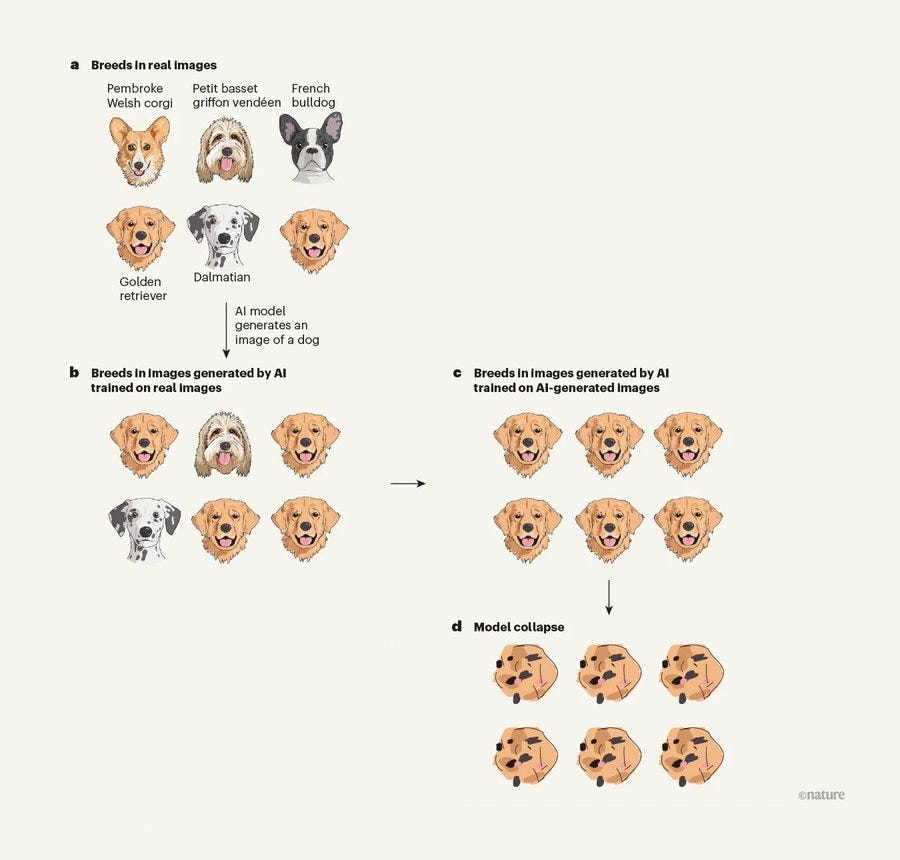
Now, this isn’t a dunk on synthetic data, which has clear use cases (see: Researchers train AI on ‘synthetic data’ to uncover Syrian war crimes, Financial Times). But it does suggest that LLMs’ intelligence ceiling may be dictated by simply how much data we can feed them. Once AI models are trained on every data set available, how much smarter will they get?
A Danish study found that men are 20 percentage points more likely to have used ChatGPT than women. The study also found that those who earn more are more likely to use it, and that they believe they are more productive when they do.
Technologies are tools which can help us do things we wouldn’t have otherwise been able to. If some choose not to use it, then, by default, inequality will grow.
The world’s largest ever real-world experiment of Universal Basic Income delivered its first results this week, which essentially showed that if you give people some money ($1,000/month) no strings attached, they work a bit less and leisure more. Duh. There was also some evidence of increased entrepreneurship and young people spending longer in education. The second results, which will focus more on people’s quality of life, is due to be published soon.
The reason for including this experiment in a section about AI is that several industry figures, including Altman, advocate for the policy in what they imagine will be a post-work world following AI-gifted resource abundance.
It’s an interesting idea, but we’re clearly so far away from mass abundance that it’s difficult to think about, or believe that real-world data can really be collected when we’re in such a different situation. Perhaps it feels less like a philosophical utopia in San Francisco.
With it now seeming inevitable that the news cycle will be dominated by the US election for the 101 days (even in the UK), I want to make a prediction: as soon as the election is over and the dust settles, there will be a flurry of AI announcements that appear almost as if companies have been sitting on updates in recent months.
There are two reasons for this:
1) OpenAI hasn’t released anything genuinely awe inspiring this year, despite making rapid progress in recent years.
2) AI companies have learnt from Facebook’s and YouTube’s experience in 2016 that you can get blamed for how your technology is used by bad actors during elections. They may think it’s sensible to simply wait until what is likely Trump’s last election is over.
The UK’s Department for Science, Innovation and Technology has hired Matthew Clifford to deliver the Government’s AI Opportunities Action Plan, which aims to identify how to boost uptake of AI across the public and private sectors to increase productivity. One to watch.
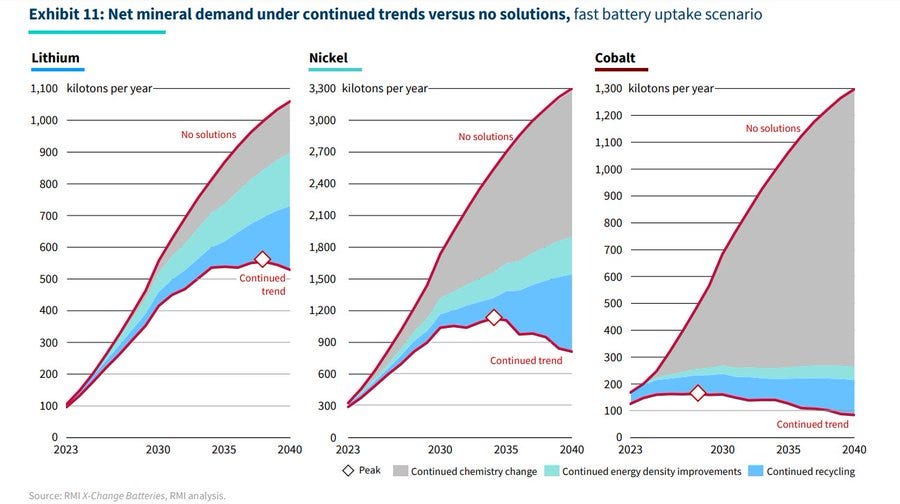
One of the key challenges in the green energy transition is that we might run out of certain critical resources, such as rare early metals, necessary to build enough batteries to fulfil the demand for renewable energy (or that we use so many that the additional cost of mining hard to reach minerals increases the cost of energy dramatically).
A new report by the Rocky Mountain Institute (a leading climate focused think tank), indicates that we’re making strides to avoid that happening. How? Chemistry (more efficient ways of making batteries), and battery density (getting more out of the same minerals).
And here are the results…
Last week, I cautiously commended JD Vance, Donald Trump’s running mate, in his longstanding belief that falling birth rates are a critical issue facing the West.
This week, I want to tell the other side of the story about how he’s shown why natalist ideology and talking points are associated with either religious antediluvians, autistic technologists or the far right: because so many of its most vocal spokespeople come from those quarters (or in Vance’s case, debatably, all three).
What happened? Before he was announced as Trump’s potential VP, Vance said on Fox News that women who haven’t given birth like Kamala Harris are “childless cat ladies who are miserable at their own lives,” and have “no direct stake” in America. In additional leaked audio, he called for a federal response to stop women from traveling from red states to blue states to receive reproductive healthcare.
The second fact is insane and straight out of Gilead, but the first deserves a proper refutation. Like Vance, I agree that, on average, having children would give citizens a greater stake in society. Well known UK Substacker Sam Freedmen may disagree (when talking about UK politician Miriam Cates), but I think it’s uncontroversial that people’s life perspectives change when they have children, and that this would likely affect their political priorities. This sentiment isn’t a million miles away from Japanese philosopher Tatsuji Miyoshi’s statement following the dropping of atomic bombs on his country:
"If there were another world war, I think only expectant mothers should be allowed to vote."
A quote which I think would enjoy broad societal support.
The reason why Vance’s comments are distasteful is because he made them personal. You don’t know why someone doesn’t have children and you cannot assume how that has shaped their politics. When then Conservative leadership hopeful Andrea Leadsom made similar (but less crass) comments about her rival Theresa May, it rightly ended her campaign.
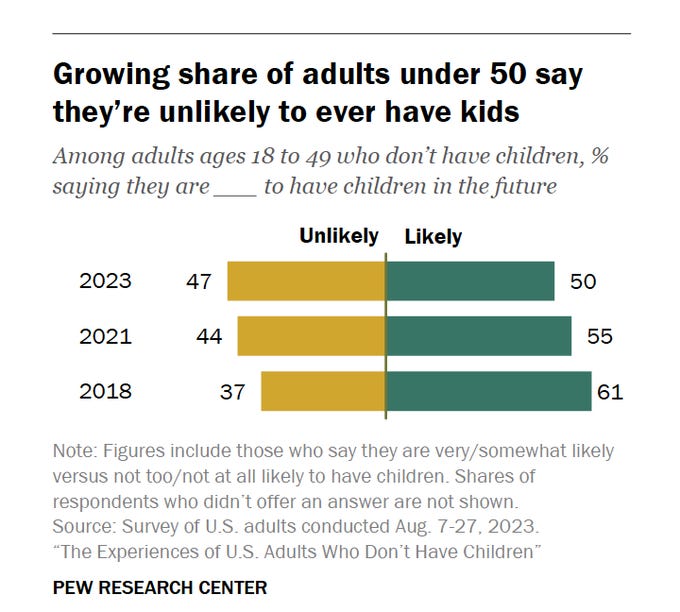
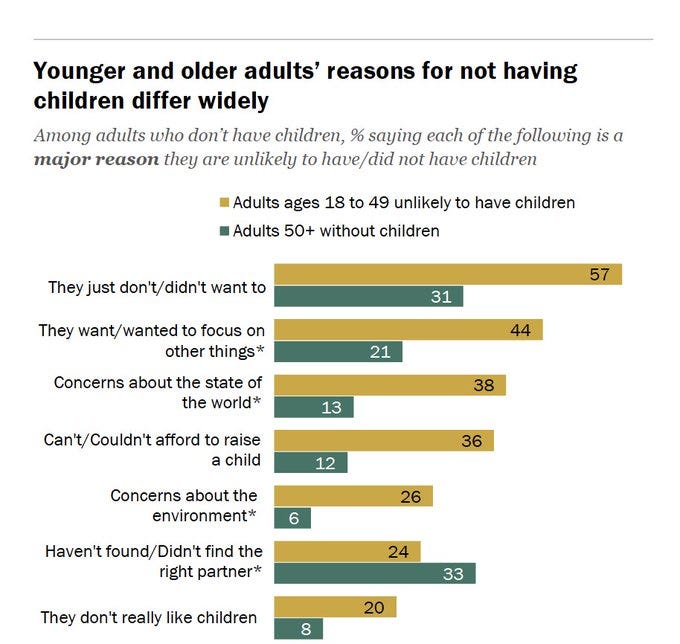
New polling from Pew Research shows that the share of young adults, especially young women, who say they are "unlikely" to have kids is surging. The biggest reason: "Just don't want to".
Here’s the data set:
The emergence of trad culture as ‘counterculture’ against perceived liberal/progressive, technological and capitalistic excesses has been a strange phenomenon since the pandemic.
This article in The Times about one of the poster women of the movement, Hannah Neeleman, and how her supposedly idyllic, nostalgic, buxom famer’s wife lifestyle is actually both tragic and sinister, with her billionaire husband controlling her life, should (but won’t) give the movement pause for thought.
If you have a subscription, it’s worth the long read. If not, take this one anecdote away:
She also gave birth to them without pain relief. None at all? She shakes her head. Why? “I don’t know, I just have never loved taking it.” She stops herself. “Except with Martha — I was two weeks overdue and she was 10lb and Daniel wasn’t with me …” She lowers her voice. Daniel is currently out of the room taking a phone call. “So I got an epidural. And it was an amazing experience.” Where was Daniel that day? “It was shipping day [for the meat boxes] and he was manning the crew.” But the epidural was kind of great? She pauses — and smiles. “It was kinda great.”
No posts
Comments
Nothing yet. Say the first thing.
Sign in to join the conversation.