
Artificial intelligence
We like slop
Last month, blogger Scott Alexander Siskind created an experiment to test if his readers could detect AI art when compared with obscure paintings by classic artists. 11,000 answered the call, and the results are now in.
Since there were two choices (human or AI), blind chance would produce a score of 50%, and perfect skill a score of 100%. The median score on the test was 60%, only a little above chance. The mean was 60.6%.
Thanks for reading Chronicles of the Future! Subscribe for free to receive new posts and support my work.
Alan Turing recommended that if 30% of humans couldn’t tell an AI from a human, the AI could be considered to have “passed” the Turing Test. By these standards, AI artists pass the test with room to spare; on average, 40% of humans mistook each AI picture for human.
Siskind also asked participants to pick their favourite picture. The two best-liked pictures were both by AIs, as were 60% of the top ten. Even those who claimed to “hate” AI art (scored it a 1 out of 5 on a scale of how much they like it) still preferred AI paintings to humans when they didn’t know which were which. This AI image received the most votes.

As Siskind admits, it wasn’t a completely fair test. He consciously chose AI art that he thought looked most realistic, discounting those that were obviously AI-generated. As such, there were no six fingered figurines, illiterate scrawling, or the strange maximalist style that characterises so much of DALL-E’s output.
Even when faced with this unfair test, a small proportion of respondents performed very well. For example, 5 achieved a score of 49/50. If there was no skill involved, the chances that 5 out of 11,000 people would achieve this would be 0.00000000000000000000000000000000000000000000002316%. I think it’s safe to say that it wasn’t complete luck!
The Manhattan Project begins
United States–China Economic and Security Review Commission (a US quango) has published its annual report. Its top recommendation is for Congress to “establish and fund a Manhattan Project-like program dedicated to racing to and acquiring an Artificial General Intelligence (AGI) capability.”
This is straight out of Leopold Oppenheimer’s playbook, who published a series of essays in June recommending the US government take control of AI development and scale it quickly, so China doesn’t build it first. His ideas have gradually taken hold in the AI security world, being adopted by Sam Altman and, to an extent, Elon Musk.
This represents a total failure for the AI safety community. Max Tegmark, President of the Future of Life Institute, called the proposal a “scientific fraud” and a “suicide race,” because AGI would be “inherently uncontrollable.” But no one’s listening. Back in February, I warned that Tegmark’s comms was “dangerously dull”, and in August, I pointed to inconsistencies in his policy recommendations.
Now, the chickens are coming home to roost. Accelerationist AGI initiatives in the name of national security are increasingly baked in and will take a sea change to shift. This wasn’t inevitable.
Looking Back at the Future of Humanity Institute
In April, I covered the demise of Oxford’s Future of Humanity Institute, which led early research into existential AI risk. Tom Ough, an existential risk writer, has now published a long-read on the history, which I’d recommend.
Climate change
Historic debt
Last week, I dug into the big climate finance deal that could be agreed at COP. One of the key questions is ‘who pays’, with countries like China not currently required to contribute. Generally, the argument against including countries like China in climate finance deals is due to their low living standards and historically low emissions.
As China has developed, the first reason become harder to justify. Why should Bulgaria (with a median wage of $1.6k per month) be obligated to pay climate finance through its membership of the EU, while China (with a median wage of $3.9k) is exempt? And to anyone who says, ‘but Bulgaria pays a very small portion of the EU’s total contribution’, then why does Greece have to pay an additional sum on top of its EU membership, as one of the 23 countries who pay climate finance directly, when its median monthly income comparable to Bulgaria’s?
As of this week, the second reason is less tenable as well. Carbon Brief have shown that China has now emitted more carbon dioxide than the EU historically.
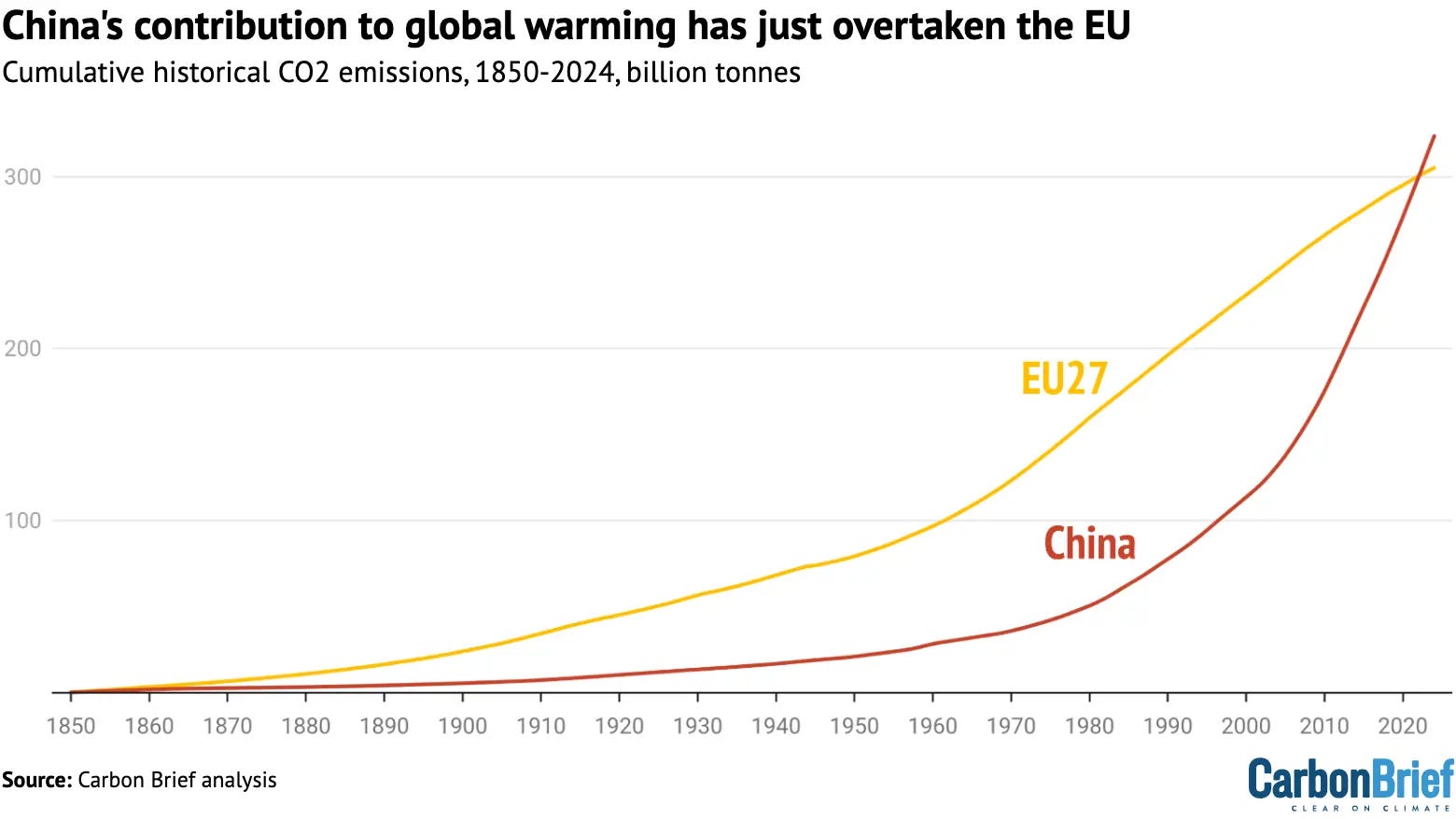
Granted, China has a population around 2.5X larger than the EU’s. But the difference wasn’t always so stark. In 1960, China’s population was approximately 2X larger, and even less so in the decades before.
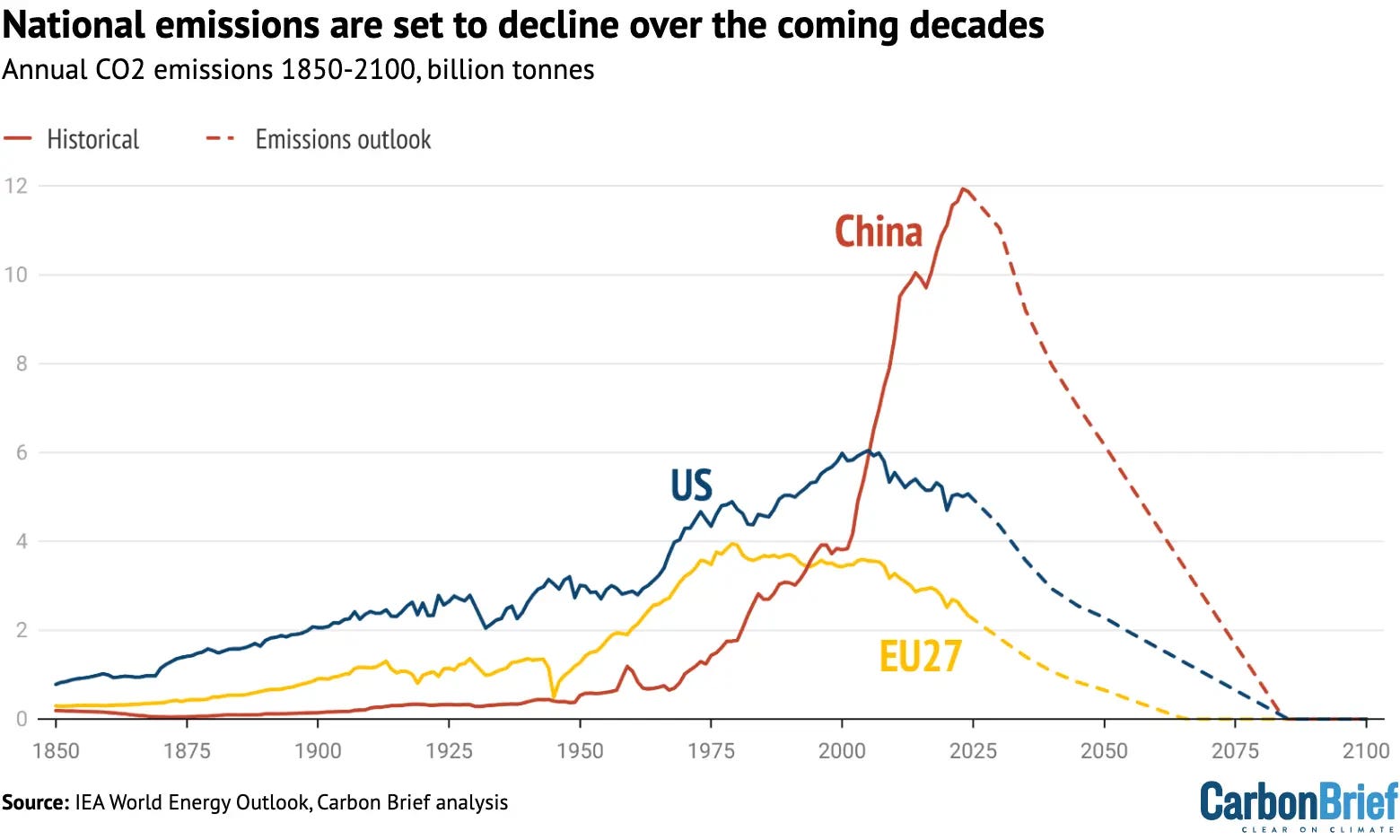
Carbon Brief claim that China’s cumulative emissions may never surpass the US’, but that relies on China sticking to its pledges to reduce its emissions at an astonishing rate. Despite China’s efforts, I think this is unlikely. If nothing changes, in a decade or two, we could have a situation where the country with the highest historic emissions is still paying zero climate finance.
Demographics
Maladaptive modernism
British journalist Louise Perry has written an excellent long-read for First Things on “modernity’s self-destruct button.” After a long intro describing how Britain is getting the worst of all possible worlds with low growth, high tax, and uncontrolled immigration, Perry identifies the cause:
“The people on whom modernity depends are failing to reproduce themselves, which means that modernity itself is failing to reproduce itself. Most voters have no idea that this is happening. Nor do most politicians. But it is happening nonetheless, and we are experiencing its early stages in the form of diverse political crises across the modern world.”
Britain’s political crises this year are early tremors of the greater shock to come. Just wait until climate change ravages Sub Saharan Africa and millions move North towards Europe.
Techno-optimists’ hope is misplaced, Perry argues, “Elon Musk will not colonize Mars. We will not live in Mark Zuckerberg’s virtual reality. Such breakthroughs depend on the rich world’s producing a sufficient number of young, hyper-intelligent people and putting them to those tasks … [instead] children are unlikely to be given the resources and freedom necessary to innovate in adulthood, since their talents will be put in service of keeping an enormous elderly population as comfortable as possible for as long as possible, not least by means of the tax system.”
Eventually (despite a gerontocratic voter base clinging to it for as long as possible), Perry believes that the “Ponzi scheme” of state welfare to pensioners will collapse. “The elderly will be cared for privately, mostly within the extended family, and mostly by women. Healthcare for the old will be mostly palliative, and the only safety net for the poor and lonely will be provided by charities. Lifespans will shorten.” The only solution Perry sees as acceptable within Overton Window is assisted suicide. As Matthew Parris argued in March, “euthanasia is coming – like it or not.”
As to what happens beyond the next 50 years, Perry is not sure, toying with the idea that hyper-fertile sects like the Armish will inherit the Earth. Whatever happens, it spells the end of modernity. In April, I covered Robin Hanson’s article which made the same point.
You need workers to grow
Robert Armstrong made an astute point in his Unhedged FT column this week, linking the overperformance of the US economy with the growth of America’s working age population over the last 25 years. The correlation between the growth of workers and real GDP is notable.
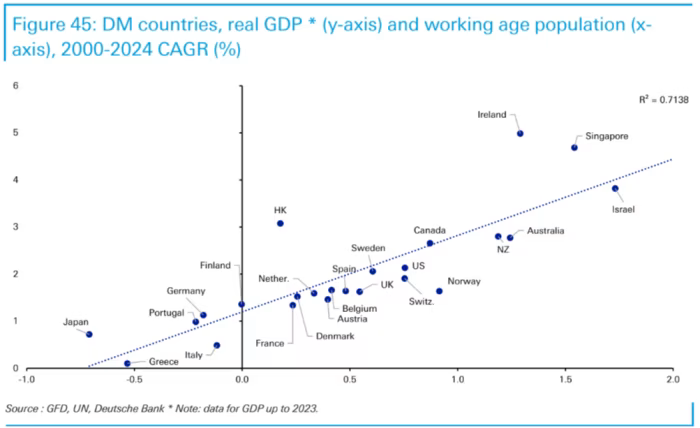
Armstrong then argued that the era of American exceptionalism may be about to end, as the growth of the country’s working age population is forecast to slow from 0.8% per year (2000-2024 average to around 0.1-0.2% (forecast 2025-2049 average). That being said, most of Europe and China is expected to fare even worse.
Thanks for reading Chronicles of the Future! Subscribe for free to receive new posts and support my work.
Comments
Nothing yet. Say the first thing.
Sign in to join the conversation.